

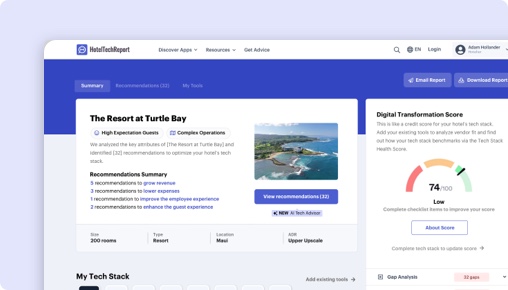
抱歉,此功能仅向已认证的酒店从业者开放
项目面板是一款免费工具,仅向已认证的酒店从业者开放。它通过简化调研流程和沟通环节,让采用新技术变得更轻松。

Amadeus 对比 Dataria:按酒店细分市场排名
各产品在不同酒店规模、类型和区域的 价格监测 供应商中的排名——基于各细分市场中酒店经营者的经验证评价。
按酒店规模
| 细分市场 |
 Amadeus |
 Dataria |
|---|---|---|
| 小型(10-24 间客房) ▾ | #15 3 条评价 | #12 5 条评价 |
| 中型(25-74 间客房) ▾ | #7 14 条评价 | #17 2 条评价 |
| 大型(75-199 间客房) ▾ | #4 26 条评价 | #16 1 条评价 |
| 超大型(200+ 间客房) ▾ | #5 6 条评价 | — |
按酒店类型
| 细分市场 |
Amadeus
|
Dataria
|
|---|---|---|
| 精品酒店 ▾ | #6 20 条评价 | #17 4 条评价 |
| 豪华酒店 ▾ | #4 30 条评价 | — |
| 品牌/连锁酒店 ▾ | #4 29 条评价 | #15 2 条评价 |
| 长住酒店 ▾ | #4 10 条评价 | #16 1 条评价 |
按区域
| 细分市场 |
Amadeus
|
Dataria
|
|---|---|---|
| 北美 ▾ | #3 27 条评价 | #13 1 条评价 |
| 欧洲 ▾ | #10 7 条评价 | #9 8 条评价 |
| 亚太 ▾ | #7 8 条评价 | — |
| 中东 | #6 4 条评价 | — |
Is Amadeus – Demand360® or Rate Shopper (by Dataria) Better for Hotels?
Amadeus – Demand360® and Rate Shopper by Dataria both address rate shopping but diverge sharply in scope and operational focus. Demand360 excels in delivering comprehensive forward-looking occupancy and competitor benchmarking data, best suited for hotels prioritizing strategic demand generation and RevPAR rank insights. Dataria, meanwhile, offers precise real-time competitor rate monitoring with advanced parity and reputation management, ideal for hotels needing granular price control and channel parity.
Both platforms solve the core problem of market intelligence for pricing decisions. Demand360 provides historical and forecast occupancy data to inform demand capture strategies, while Dataria focuses on competitor pricing dynamics and channel parity enforcement to protect rate integrity and optimize revenue.
Amadeus – Demand360® vs Rate Shopper (by Dataria): Which Should Your Hotel Choose?
If you operate a medium to large hotel chain or branded hotel seeking to benchmark future occupancy and RevPAR rank, Amadeus’s 57 reviews and broad market presence across 20 countries make it a reliable choice for strategic revenue management. Its data depth supports complex pricing strategies, evidenced by user praise for its deep analytics and demand insights. However, it has no recent reviews in the last six months, which may limit certainty on current user experience.
If your hotel is a boutique, city center, or resort property prioritizing real-time competitor rate monitoring, parity tracking, and reputation management, Dataria’s 9 reviews with 4 recent ones and perfect 5/5 ratings indicate strong satisfaction. Its unique features like OTA price monitoring and local event databases allow agile pricing adjustments. The smaller integration ecosystem and narrower market footprint reduce suitability for large, multi-property groups.
For properties with fewer than 50 rooms in Europe or Latin America, Dataria’s flexible pricing logic and automatic pricing system are advantageous. For larger independent or branded hotels requiring extensive benchmarking and demand forecasting, Amadeus offers a more comprehensive dataset and integration network.
Is Amadeus – Demand360® or Rate Shopper (by Dataria) Easier to Use?
Amadeus scores 4.2/5 for ease of use and 4.0/5 for onboarding across 57 reviews, with users noting an intuitive interface that integrates well into decision-making workflows. However, some reviews mention a need for improved user experience on certain platform sections.
Dataria leads with 4.8/5 ease of use and a perfect 5.0/5 onboarding rating, though based on only 9 reviews. Users emphasize the platform’s clarity, intuitive dashboards, and flexible pricing adjustments that reduce the learning curve for revenue teams.
Given the comparable feedback and Amadeus’s broader user sample, the difference is not statistically significant with current data. Both platforms deliver usable interfaces, but Dataria’s slightly higher scores reflect notable user satisfaction with onboarding speed and system navigation.
Edge: Even.
Which Has Better Features: Amadeus – Demand360® or Rate Shopper (by Dataria)?
Amadeus offers 6 unique features including an analytics dashboard, real-time data collection, automated prioritization, distribution partner management, workflow automation, and in-app support. These capabilities enable hotels to integrate demand forecasting with operational workflows and maintain channel management efficiency. For example, automated prioritization helps revenue managers focus on high-impact segments, improving RevPAR.
Dataria provides 10 exclusive features such as vacation rental rate intelligence, metasearch connectivity, OTA price monitoring, real-time updates, discrepancy alerts, 12-month parity monitoring, parity reports, device type tracking, local event monitoring with a database, and an open API. These features enhance granular rate comparison and parity enforcement, critical for hotels managing multiple online channels. Discrepancy alerts notify revenue teams of rate violations, reducing revenue leakage.
While Demand360 emphasizes demand forecasting and operational integration, Dataria focuses on detailed price monitoring and parity control. The additional 4 unique features in Dataria support hotels with extensive channel distribution challenges.
Edge: Dataria.
Which Has Better Customer Support: Amadeus – Demand360® or Rate Shopper (by Dataria)?
Amadeus has a customer support rating of 3.9/5 and onboarding of 4.0/5 from 57 reviews, with some users praising responsiveness but others citing difficulties reaching account managers and delayed issue resolution.
Dataria holds a perfect 5.0/5 in both support and onboarding, although from only 9 reviews. Reviewers highlight the Dataria team’s hotel business understanding, rapid query resolution, and personalized assistance.
Despite Dataria’s smaller review base, the consistency of praise indicates a higher support quality experience. Amadeus’s broader user base shows mixed feedback, suggesting support may vary by account or region.
Edge: Even.
Which Has More Integrations: Amadeus – Demand360® or Rate Shopper (by Dataria)?
Amadeus supports 107 verified integrations, including industry staples like Mews, Priority Software, Amadeus’s own systems, and various marketing and revenue management partners. This extensive ecosystem enables seamless connectivity with PMS, CRS, and distribution platforms, critical for hotels managing complex technology stacks.
Dataria has 3 verified integrations, sharing Mews with Amadeus but otherwise limited to its proprietary systems. This restricts its plug-and-play capabilities for properties relying on diverse third-party software.
Hotels requiring robust, multi-system integration for operational efficiency will find Amadeus superior. Dataria’s integration offering suits smaller properties or those with simpler tech environments.
Edge: Amadeus – Demand360®.
Which Do Hoteliers Rate Higher: Amadeus – Demand360® or Rate Shopper (by Dataria)?
Amadeus’s overall rating is 4.2/5 from 57 reviews, with no recent reviews in the last six months. Segment ratings range from 4.0/5 for airport hotels to 4.6/5 for vacation rentals and villas. Boutique hotels and branded hotels each have ratings above 4.3/5, indicating solid satisfaction across property types.
Dataria’s overall rating is 5.0/5 from 9 reviews, including 4 in the last six months. All segments rate it a perfect 5/5, including boutique, city center, resorts, and airport hotels. However, the smaller review count limits confidence in representativeness.
Because Amadeus’s rating is based on a much larger sample and more diverse segments, it reflects a stable, mature product. Dataria’s perfect scores suggest very high satisfaction but require more data for broad generalization.
Edge: Even.
How Much Do Amadeus – Demand360® and Rate Shopper (by Dataria) Cost?
Amadeus does not publish pricing details, nor offers a freemium model, monthly flat, or per-room pricing. No trial information is available. Pricing transparency is limited, which may complicate budgeting for smaller properties.
Dataria charges a base price of $100.00, with no freemium, monthly flat fee, or per-room pricing. No trial is offered either. This upfront pricing is clearer but may not reflect total cost depending on property size and configuration.
Hotels preferring transparent, predictable pricing will lean toward Dataria. Amadeus’s lack of published pricing may require direct vendor engagement for cost clarity.
What Type of Hotel Should Use Amadeus – Demand360®?
- Hotels that require comprehensive forward-looking occupancy and competitor benchmarking data to inform strategic demand generation.
- Teams managing branded or city center hotels across multiple countries needing integration with over 100 hotel technology partners.
- Properties focusing on workflow automation and distribution partner management to optimize channel management.
- Users prioritizing analytics dashboards and real-time data collection for deep revenue strategy insights.
- Those needing a mature platform with 57 reviews and stable ratings particularly in boutique, branded, and luxury segments.
Not ideal if:
- You seek a transparent, published pricing structure for budgeting.
- You require customized parity monitoring or OTA price discrepancy alerts.
- You need a mobile app or highly flexible, automatic price adjustments at a granular level.
What Type of Hotel Should Use Rate Shopper (by Dataria)?
- Hotels seeking precise, real-time competitor room rates segmented by length of stay, room types, and BAR pricing.
- Properties needing advanced parity monitoring across all channels with alerts and parity reports.
- Teams wanting integration of local event monitoring and device type tracking to refine pricing strategies.
- Hotels valuing an open API to customize data flows and automation.
- Users prioritizing excellent customer support and fast onboarding reflected in perfect 5/5 ratings.
Not ideal if:
- You require extensive integrations with a broad hotel technology ecosystem.
- Your property depends on comprehensive demand forecasting and RevPAR rank insights.
- You need a large community of users and extensive review data to validate platform maturity.
Amadeus – Demand360® vs Rate Shopper (by Dataria): The Bottom Line for Hotels
Amadeus – Demand360® delivers a comprehensive market intelligence platform emphasizing forward-looking occupancy data and competitor benchmarking. Its core strength lies in supporting strategic revenue management through deep analytics, workflow automation, and a vast integration network. This enables hotels to optimize demand and pricing with a data-driven approach.
Choose Amadeus if your hotel or group prioritizes integration with numerous technology partners, needs detailed demand forecasting, and operates in multiple international markets. Its analytics dashboard, distribution partner management, and automated prioritization are concrete advantages for complex revenue strategies.
Rate Shopper by Dataria suits hotels focusing on granular real-time competitor rate monitoring, parity enforcement, and reputation management. Its unique features like OTA price monitoring, discrepancy alerts, and local event tracking support agile pricing adjustments. Its excellent customer support and intuitive interface enhance adoption for boutique and city center hotels.
In summary, Amadeus is better for hotels seeking broad market intelligence and operational integration; Dataria fits those needing precise competitor pricing and channel parity control with strong support. The choice depends on your property’s size, tech ecosystem, and pricing strategy complexity.
功能对比:Amadeus – Demand360® 与 Rate Shopper (by Dataria)
这些是每个供应商配置的功能,按功能组进行整理——与供应商后台中显示的数据相同。展开任意功能组即可并排比较功能。
| 功能 |
Amadeus
|
Dataria
|
|---|---|---|
|
▾
竞争对手跟踪与业绩对标
|
|
|
| 竞争对手策略监控 | ||
| 折扣监控 | ||
| 价格类型比较 | ||
| OTA排名跟踪 | ||
| 促销影响报告 | ||
| 价格智能 | ||
| 房价比较 | ||
| 度假租赁房价智能 | ||
| 元搜索连接 | ||
| 快速价格比价筛选 | ||
| 房型和价格类型筛选 | ||
|
▾
价格一致性监控
|
|
|
| OTA价格监控 | ||
| 差异提醒 | ||
| 12个月价格一致性监控 | ||
| 实时更新 | ||
| 价格一致性报告 | ||
|
▾
数据粒度
|
|
|
| 设备类型追踪 | ||
| 折扣监控 | ||
| 价格类型比较 | ||
| 历史趋势分析 | ||
| 本地事件监控与数据库 | ||
| 房价比较 | ||
| 度假租赁房价智能 | ||
| 开放API | ||
|
▾
绩效报告与分析
|
|
|
| OTA排名跟踪 | ||
| 在订房(OTB)比较 | ||
| 促销影响报告 | ||
| 绩效报告 | ||
| 价格智能 | ||
| 房价比较 | ||
| 多酒店管理 | ||
| 分析仪表盘 | ||
| 自定义仪表盘 | ||
| 多酒店合并 | ||
|
▾
Other
|
|
|
| 应用内支持 |
Amadeus 对比 Dataria:总结
酒店经营者喜爱的方面
用户高度评价 TravelClick 的市场情报工具,因为它们能够提供对市场趋势、竞争对手价格和未来需求的深入洞察。这些工具支持战略决策,帮助酒店完善其收入策略并... 用户高度评价 TravelClick 的市场情报工具,因为它们能够提供对市场趋势、竞争对手价格和未来需求的深入洞察。这些工具支持战略决策,帮助酒店完善其收入策略并保持竞争力。
TravelClick 的工具(例如 CRS 界面)以其用户友好性和直观设计而备受瞩目。用户欣赏导航的便捷性和系统简化复杂任务的能力。
TravelClick 的高级定价引擎和分析报告工具因有助于制定有效的收入策略而受到称赞。用户发现这些功能对于管理促销、了解市场动态和优化定价策略至关重要。
酒店经营者提出异议的方面
一些评论提到了对数据准确性的担忧,特别是品牌转移信息的变化和数据延迟。准确和实时的数据对于做出盈利决策至关重要。
虽然一些用户对 TravelClick 支持团队的响应能力表示赞赏,但一些评论也强调了客户支持方面的问题,包括难以联系客户经理并及时解决问题。
排名更高的方面
独特功能
排名更高的方面
独特功能
关于 Amadeus – Demand360® 与 Rate Shopper (by Dataria) 的常见问题
Amadeus – Demand360® 能否替代 Rate Shopper (by Dataria)?
这取决于您的需求。Amadeus – Demand360® 和 Rate Shopper (by Dataria) 共享许多核心 Rate Shopping 功能,但各有独特的能力。Amadeus – Demand360® 提供 107 个经验证的集成合作伙伴,而 Rate Shopper (by Dataria) 提供 3 个。在切换之前,请查看上方的功能对比以了解它们的差异。
哪个更适合小型或独立酒店?
小型酒店应优先考虑易用性和快速上手。Rate Shopper (by Dataria) 在易用性方面领先,评分为 4.8/5 对比 4.2/5。寻找透明定价以及试用或演示选项。在各产品页面上按酒店规模筛选评价,了解与您类似的酒店的反馈。
Amadeus – Demand360® 或 Rate Shopper (by Dataria) 是否提供免费方案?
Amadeus – Demand360®:否。Rate Shopper (by Dataria):否。 两款产品目前均不提供免费版。大多数 Rate Shopping 供应商提供演示或试用——在做出承诺之前,请分别向各供应商申请体验。
HTR 如何评估和排名 Amadeus – Demand360® 和 Rate Shopper (by Dataria)?
HT Score 是一个综合排名,考虑 4 个标准组和十多个变量,帮助酒店经营者客观比较酒店科技产品。Amadeus 的 HT Score 为 76,Dataria 的为 0。以下是评分的计算方式。
| 标准组 | 权重 | 衡量内容 |
|---|---|---|
| 客户评分与评价 |
|
用户对该产品的推荐度如何? 评分分数、评价数量、声量份额、评价深度、评价时效性、成功案例 ▾ 权重最高的因素。分析平均满意度评分(推荐可能性、易用性、支持、投资回报率)、相对于同类产品的评价总数、评价时效性(最近 6 个月内至少 20 条评价)以及跨独立酒店客户的声量份额以检测选择偏差。 |
| 合作伙伴生态系统 |
|
技术合作伙伴对该公司的推荐度如何? 合作伙伴推荐、集成数量、集成质量 ▾ 评估合作伙伴推荐作为专家信心投票、经验证集成的数量以及生态系统质量——集成合作伙伴的平均 HT Score。拥有更高质量集成生态系统的产品更有可能提供互联互通的技术栈。 |
| 以客户为中心 |
|
该组织以客户为中心的程度如何? 认证支持、评价一致性、资料完整性 ▾ 评估公司是否获得 HTR 客户支持认证、是否保持持续的评价收集(反馈驱动文化的指标)以及产品资料是否完整,包括功能、截图、定价和特性。 |
| 覆盖范围、持久力与资源 |
|
该公司的覆盖范围和资源有多广泛? 地理覆盖、持久力、公司资源、趋势评分 ▾ 衡量全球覆盖(服务的国家和区域)、经营年限作为稳定性指标、团队规模作为资源指标,以及基于近十二个月买家咨询、评价、合作伙伴推荐和媒体活动的趋势评分。 |
客户评分和评价是 HT Score 算法中最重要的因素。HTR 不接受付费以提高排名。所有评价均经过验证——只有经确认从属关系的酒店行业从业者才能提交评分。 查看完整 HT Score 评估方法 →
酒店经营者还在阅读哪些 价格监测 对比?
探索更多基于经验证酒店经营者评价的一对一对比。




获取您的免费人工智能分析师报告
根据您酒店的情况量身定制的推荐


