

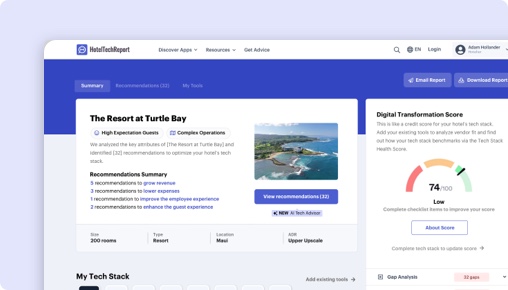
抱歉,此功能仅向已认证的酒店从业者开放
项目面板是一款免费工具,仅向已认证的酒店从业者开放。它通过简化调研流程和沟通环节,让采用新技术变得更轻松。

Fornova 对比 RateGain:按酒店细分市场排名
各产品在不同酒店规模、类型和区域的 商业智能 供应商中的排名——基于各细分市场中酒店经营者的经验证评价。
按酒店规模
| 细分市场 |
 Fornova |
 RateGain |
|---|---|---|
| 小型(10-24 间客房) | #23 0 条评价 | #11 4 条评价 |
| 中型(25-74 间客房) ▾ | #20 4 条评价 | #6 18 条评价 |
| 大型(75-199 间客房) ▾ | #12 8 条评价 | #9 13 条评价 |
| 超大型(200+ 间客房) | #19 1 条评价 | #10 4 条评价 |
按酒店类型
| 细分市场 |
Fornova
|
RateGain
|
|---|---|---|
| 精品酒店 ▾ | #19 8 条评价 | #6 19 条评价 |
| 豪华酒店 ▾ | #13 11 条评价 | #7 21 条评价 |
| 品牌/连锁酒店 ▾ | #18 5 条评价 | #12 12 条评价 |
| 长住酒店 | #24 0 条评价 | #6 4 条评价 |
按区域
| 细分市场 |
Fornova
|
RateGain
|
|---|---|---|
| 北美 | #12 2 条评价 | #17 0 条评价 |
| 欧洲 | #19 2 条评价 | #21 1 条评价 |
| 亚太 ▾ | #7 8 条评价 | #3 21 条评价 |
| 中东 ▾ | #9 1 条评价 | #2 10 条评价 |
Is FornovaRI or Demand.AI Better for Hotels?
FornovaRI and Demand.AI both serve hotel revenue management but diverge significantly in scope and integration depth. FornovaRI focuses on unified revenue and operational analytics with features like multi-property management and revenue pacing dashboards, targeting hotels that demand detailed data visualization and automation. Demand.AI emphasizes predictive demand forecasting over a 75-day horizon and granular locality demand mapping, appealing to hotels needing forward-looking market intelligence and dynamic channel management.
Both products address the challenge of making data-driven pricing and distribution decisions to maximize revenue. They reduce reliance on manual spreadsheets and fragmented data sources, providing hotel teams with centralized insights to respond swiftly to market conditions. However, their approaches reflect different operational priorities: FornovaRI leans toward analytics and integration across properties, while Demand.AI prioritizes demand prediction and channel optimization.
FornovaRI vs Demand.AI: Which Should Your Hotel Choose?
If your hotel operates multiple properties or requires complex revenue pacing and role-based access controls, FornovaRI is the better fit. Its seven unique features, including an open API and centralized user management, support these workflows, according to its 15 reviews highlighting ease of report reading and distribution insights. For independent and boutique hotels in Europe and North America, FornovaRI’s user base and 4.6 overall rating across 15 reviews provide solid evidence of fit.
Conversely, if your hotel prioritizes detailed market demand forecasting, especially in diverse localities, and needs deep channel management integration, Demand.AI by RateGain is preferable. With 40 reviews averaging 4.8 overall and 96 verified integrations including major PMS providers, Demand.AI suits branded and city-center hotels in Asia Pacific and India where RateGain has stronger market presence. Its rate shopping and channel manager tools are praised for managing dynamic pricing and OTA coordination.
Both products lack recent review activity, so current user experience is less certain. Demand.AI has a broader integration ecosystem and a larger user base, which may favor hotels valuing connectivity and scale. FornovaRI’s distinct analytics capabilities appeal to hotels seeking detailed revenue intelligence beyond basic demand forecasting.
Is FornovaRI or Demand.AI Easier to Use?
FornovaRI and Demand.AI have near-identical ease of use ratings: 4.6 and 4.8 respectively, based on 15 and 40 reviews. Reviewers of FornovaRI emphasize its user-friendly dashboards and clear report visibility, which simplify monitoring distribution and rate parity. Demand.AI users find its interface generally navigable but note complexity and occasional slow loading times, especially in inventory calendars.
Both platforms receive praise for onboarding experiences, with FornovaRI scoring 4.5 and RateGain 4.6. FornovaRI users highlight excellent customer success management that aids staff adoption, while RateGain reviewers mention friendly regional support teams that assist with initial setup. Neither product presents significant barriers for front desk or revenue teams, but Demand.AI’s learning curve may be steeper due to more extensive features and integrations.
Edge: Even.
Which Has Better Features: FornovaRI or Demand.AI?
FornovaRI offers seven unique features not found in Demand.AI, including dashboarding and data visualization, automated data gathering, revenue pacing, multi-property management, analytics dashboards, centralized user and role management, and an open API. These features enable hotels to automate reporting, manage multiple properties from one platform, and tailor access by user role—functions that streamline revenue operations and reduce manual tasks.
Demand.AI does not list proprietary features exclusive to its platform in the source material, focusing instead on demand forecasting and channel management tools. While RateGain’s channel manager and rate shopping are strong revenue management aids, these are not unique to Demand.AI in this comparison.
FornovaRI’s capabilities significantly change workflows by enabling users to track revenue pacing and segment data across properties, enhancing strategic decision-making. Demand.AI’s strength lies in predictive analytics and local demand tracking, but these are not explicitly flagged as distinct features here.
Edge: FornovaRI.
Which Has Better Customer Support: FornovaRI or Demand.AI?
Customer support ratings are close: FornovaRI scores 4.8/5 and RateGain 4.9/5 from 15 and 40 reviews respectively. FornovaRI reviewers praise the responsiveness and expertise of their Enterprise Customer Success Manager, citing inestimable advice and rapid assistance. RateGain users similarly commend the 24/7 availability and accommodating nature of their support teams, noting friendly staff in regional offices.
Both platforms receive positive remarks on onboarding support, with FornovaRI’s 4.5 rating and RateGain’s 4.6 confirming effective initial training and setup assistance. Neither product stands out decisively in support quality, and reviewers mention minor areas for improvement such as enhanced training materials for RateGain and deeper analysis capabilities for FornovaRI’s support.
Edge: Even.
Which Has More Integrations: FornovaRI or Demand.AI?
RateGain leads substantially with 96 verified integrations compared to FornovaRI’s 8, sharing 7 common partners like RMS, Oracle Hospitality, and Mews. RateGain’s unique integrations include Hospitality Software Development Services, RoomRaccoon, Profitroom, and apaleo GmbH, expanding connectivity options for hotels using diverse PMS and distribution systems.
FornovaRI’s limited integration portfolio may restrict connectivity to newer or niche software, affecting hotels requiring broad system interoperability. RateGain’s extensive integration ecosystem supports complex channel and inventory management workflows, crucial for branded hotels or those managing multiple OTAs.
Edge: Demand.AI.
Which Do Hoteliers Rate Higher: FornovaRI or Demand.AI?
FornovaRI has a 4.6 average rating from 15 reviews, while Demand.AI holds a 4.8 average from 40 reviews. Neither product has reviews in the last six months, so current ratings reflect past experiences. Demand.AI’s larger review volume and higher overall rating indicate stronger user satisfaction, but both products maintain high likelihood-to-recommend scores, 92% for FornovaRI and 95% for Demand.AI.
Segment ratings show FornovaRI performing well in luxury hotels (4.7/5 over 11 reviews) and boutique hotels (4.7/5 over 8 reviews). Demand.AI excels in branded hotels (5/5 over 12 reviews), airport/conference hotels (4.9/5 over 16 reviews), and limited service/budget hotels (5/5 over 11 reviews). Bed & Breakfasts and city center hotels rate Demand.AI slightly higher as well.
Edge: Even.
How Much Do FornovaRI and Demand.AI Cost?
Neither FornovaRI nor Demand.AI publishes base pricing, monthly flat fees, or per-room fees. Both products do not offer freemium plans or trials, and no implementation fees are listed. The lack of transparent pricing requires hotels to engage vendors directly for quotes, potentially reflecting custom pricing based on property size, features, or integration needs.
What Type of Hotel Should Use FornovaRI?
- Hotels managing multiple properties needing centralized user and role management.
- Luxury and boutique hotels valuing detailed revenue pacing and analytics dashboards.
- Teams requiring automated data integration to reduce manual reporting.
- Properties focused on distribution insights and rate parity monitoring.
- Hotels seeking an open API for custom integrations with existing systems.
Not ideal if:
- Your hotel requires extensive third-party software integrations beyond the 8 verified partners.
- You need forward-looking demand forecasting and localized market intelligence.
- Your property prefers a platform with a larger user base and more frequent updates.
What Type of Hotel Should Use Demand.AI?
- Branded and city center hotels that rely on extensive PMS and channel integrations.
- Hotels needing predictive demand insights across localities for the next 75 days.
- Properties that benefit from robust rate shopping and channel management tools.
- Teams prioritizing a comprehensive dashboard for dynamic pricing and OTA coordination.
- Hotels operating in Asia Pacific and India, aligning with RateGain’s regional presence.
Not ideal if:
- Your hotel requires advanced revenue pacing and multi-property analytics features.
- You prefer a system with fewer but more focused integrations.
- Your team finds complex interfaces a barrier and values simplicity over breadth.
FornovaRI vs Demand.AI: The Bottom Line for Hotels
FornovaRI and Demand.AI serve overlapping but distinct needs in hotel revenue intelligence. FornovaRI centers on unified, automated revenue analytics with multi-property capabilities and customizable user access, ideal for hotels emphasizing operational control and detailed data visualization. Demand.AI focuses on predictive demand forecasting and wide-ranging channel management, fitting properties that prioritize market anticipation and OTA coordination.
Choose FornovaRI if you need seven unique features like centralized role management and revenue pacing dashboards, supported by positive reviews praising ease of report use and distribution insight. Its tight integration with major PMS partners and focus on analytics suits luxury and boutique hotels managing multiple locations.
Opt for Demand.AI if your property benefits from a broad integration network of 96 partners, advanced demand prediction for localized markets, and practical rate shopping tools. Its higher overall rating and extensive review volume reflect strong user satisfaction, especially among branded and city center hotels needing comprehensive channel management.
The decision hinges on whether your hotel values deep analytics and automation (FornovaRI) or extensive connectivity and predictive market intelligence (Demand.AI). Both platforms deliver high customer support and ease of use, but their feature sets and integration ecosystems define their operational impact.
功能对比:FornovaRI (Revenue Intelligence) 与 Demand.AI (by RateGain)
这些是每个供应商配置的功能,按功能组进行整理——与供应商后台中显示的数据相同。展开任意功能组即可并排比较功能。
| 功能 |
Fornova
|
RateGain
|
|---|---|---|
|
▾
Analytics
|
|
|
| 自定义报告和模板 | ||
| 净收入 KPI | ||
| 其他收入预测、报告和分析 | ||
| 食品和饮料报告、分析和预测 | ||
| 企业和旅行社账户跟踪 | ||
| 分析仪表板 | ||
| 销售团队生产力跟踪 | ||
| 收入节奏 | ||
| 仪表板和数据可视化 | ||
| 分销成本分析 | ||
| 定期报告 | ||
| 多资产及投资组合层级追踪 | ||
| 定价决策影响跟踪 | ||
| 客户盈利贡献 | ||
| 共享需求日历 | ||
| 灵活的投资组合分组 | ||
| 人工智能 | ||
|
▾
Forecasting, Budgeting & Planning
|
|
|
| 收入节奏 | ||
| 预测锁定和工作流程 | ||
| 基于驾驶员的模型 | ||
| 食品和饮料报告、分析和预测 | ||
| 其他收入预测、报告和分析 | ||
| 商业和营销计划 | ||
| 版本控制 | ||
| 基于 Web | ||
| 定价决策影响跟踪 | ||
| 共享需求日历 | ||
| 灵活的投资组合分组 | ||
|
▾
Data Management
|
|
|
| 多物业管理 | ||
| 集中的用户和角色管理 | ||
| 开放式 API | ||
| 自动数据收集和集成 | ||
| 可定制的数据层次结构 | ||
| 应用内数据管理 | ||
| 灵活的投资组合分组 | ||
|
▾
Collaboration
|
|
|
| 协作与评论 | ||
| 可共享的模板和计划 | ||
| 文件附件 | ||
| 基于 Web | ||
| 警报源 |
Fornova 对比 RateGain:总结
排名更高的方面
独特功能
酒店经营者喜爱的方面
RateGain 的支持团队反应迅速、乐于助人且全天候待命,因此备受赞誉。尽管客户服务非常出色,但仍需要更全面的培训课程和更好的 GDS 系统支持。
RateGain 的渠道管理器因其易用性和与其他平台的集成而广受好评,简化了客房库存管理并实现了有效的价格调整。一些用户强调需要进一步更新和增强移动应用功能。
许多用户都喜欢 RateGain 的综合仪表板和详细报告,这有助于制定定价策略、进行数据分析和跟踪整体酒店绩效。然而,有些人认为界面复杂,数据加载时间缓慢。
酒店经营者提出异议的方面
RateGain 的渠道管理器因其易用性和与其他平台的集成而广受好评,简化了客房库存管理并实现了有效的价格调整。一些用户强调需要进一步更新和增强移动应用功能。
虽然用户界面普遍被描述为用户友好且易于导航,但一些用户认为它很复杂且功能冗余。有改进建议,尤其是关于用户界面响应能力和移动兼容性。
排名更高的方面
关于 FornovaRI (Revenue Intelligence) 与 Demand.AI (by RateGain) 的常见问题
FornovaRI (Revenue Intelligence) 能否替代 Demand.AI (by RateGain)?
这取决于您的需求。FornovaRI (Revenue Intelligence) 和 Demand.AI (by RateGain) 共享许多核心 Business Intelligence 功能,但各有独特的能力。FornovaRI (Revenue Intelligence) 提供 8 个经验证的集成合作伙伴,而 Demand.AI (by RateGain) 提供 96 个。在切换之前,请查看上方的功能对比以了解它们的差异。
哪个更适合小型或独立酒店?
小型酒店应优先考虑易用性和快速上手。Demand.AI (by RateGain) 在易用性方面领先,评分为 4.8/5 对比 4.6/5。寻找透明定价以及试用或演示选项。在各产品页面上按酒店规模筛选评价,了解与您类似的酒店的反馈。
FornovaRI (Revenue Intelligence) 或 Demand.AI (by RateGain) 是否提供免费方案?
FornovaRI (Revenue Intelligence):否。Demand.AI (by RateGain):否。 两款产品目前均不提供免费版。大多数 Business Intelligence 供应商提供演示或试用——在做出承诺之前,请分别向各供应商申请体验。
HTR 如何评估和排名 FornovaRI (Revenue Intelligence) 和 Demand.AI (by RateGain)?
HT Score 是一个综合排名,考虑 4 个标准组和十多个变量,帮助酒店经营者客观比较酒店科技产品。Fornova 的 HT Score 为 0,RateGain 的为 26。以下是评分的计算方式。
| 标准组 | 权重 | 衡量内容 |
|---|---|---|
| 客户评分与评价 |
|
用户对该产品的推荐度如何? 评分分数、评价数量、声量份额、评价深度、评价时效性、成功案例 ▾ 权重最高的因素。分析平均满意度评分(推荐可能性、易用性、支持、投资回报率)、相对于同类产品的评价总数、评价时效性(最近 6 个月内至少 20 条评价)以及跨独立酒店客户的声量份额以检测选择偏差。 |
| 合作伙伴生态系统 |
|
技术合作伙伴对该公司的推荐度如何? 合作伙伴推荐、集成数量、集成质量 ▾ 评估合作伙伴推荐作为专家信心投票、经验证集成的数量以及生态系统质量——集成合作伙伴的平均 HT Score。拥有更高质量集成生态系统的产品更有可能提供互联互通的技术栈。 |
| 以客户为中心 |
|
该组织以客户为中心的程度如何? 认证支持、评价一致性、资料完整性 ▾ 评估公司是否获得 HTR 客户支持认证、是否保持持续的评价收集(反馈驱动文化的指标)以及产品资料是否完整,包括功能、截图、定价和特性。 |
| 覆盖范围、持久力与资源 |
|
该公司的覆盖范围和资源有多广泛? 地理覆盖、持久力、公司资源、趋势评分 ▾ 衡量全球覆盖(服务的国家和区域)、经营年限作为稳定性指标、团队规模作为资源指标,以及基于近十二个月买家咨询、评价、合作伙伴推荐和媒体活动的趋势评分。 |
客户评分和评价是 HT Score 算法中最重要的因素。HTR 不接受付费以提高排名。所有评价均经过验证——只有经确认从属关系的酒店行业从业者才能提交评分。 查看完整 HT Score 评估方法 →
酒店经营者还在阅读哪些 商业智能 对比?
探索更多基于经验证酒店经营者评价的一对一对比。






获取您的免费人工智能分析师报告
根据您酒店的情况量身定制的推荐


