

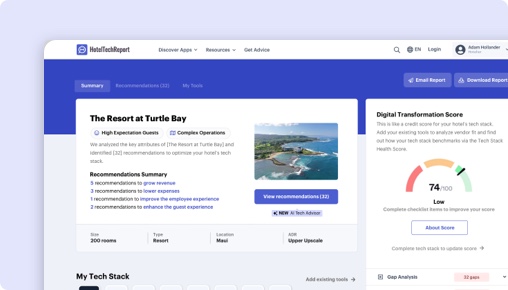
抱歉,此功能仅向已认证的酒店从业者开放
项目面板是一款免费工具,仅向已认证的酒店从业者开放。它通过简化调研流程和沟通环节,让采用新技术变得更轻松。

Juyo vs. Thynk Business Intelligence:
哪个更适合您?
摘要
我们分析了 42 条经验证的酒店经营者评价,比较了功能集、定价和真实案例研究,以全面解析每个平台的优势。最佳选择取决于您的酒店类型和优先事项:
Juyo 在预测和收入管理方面表现出色,尤其适合豪华住宿设施(4.9/5),并拥有收入节奏以及食品和饮料报告、分析和预测等独家功能。
Juyo 对比 Thynk:按酒店细分市场排名
各产品在不同酒店规模、类型和区域的 商业智能 供应商中的排名——基于各细分市场中酒店经营者的经验证评价。
按酒店规模
| 细分市场 |
 Juyo |
 Thynk |
|---|---|---|
| 小型(10-24 间客房) | #21 1 条评价 | #25 0 条评价 |
| 中型(25-74 间客房) ▾ | #17 13 条评价 | #21 3 条评价 |
| 大型(75-199 间客房) ▾ | #11 13 条评价 | #18 1 条评价 |
| 超大型(200+ 间客房) ▾ | #7 7 条评价 | #17 1 条评价 |
按酒店类型
| 细分市场 |
Juyo
|
Thynk
|
|---|---|---|
| 精品酒店 ▾ | #16 19 条评价 | #22 2 条评价 |
| 豪华酒店 ▾ | #17 10 条评价 | #19 3 条评价 |
| 品牌/连锁酒店 ▾ | #13 20 条评价 | #22 2 条评价 |
| 长住酒店 | — | #25 0 条评价 |
按区域
| 细分市场 |
Juyo
|
Thynk
|
|---|---|---|
| 北美 | #11 4 条评价 | #25 0 条评价 |
| 欧洲 ▾ | #8 30 条评价 | #16 4 条评价 |
| 中东 | — | #10 1 条评价 |
Is Juyo by Juyo or Thynk Business Intelligence Better for Hotels?
Juyo and Thynk Business Intelligence both serve the hotel industry by aggregating performance data into dashboards to aid commercial decision-making. They diverge primarily in depth and focus: Juyo integrates a broader variety of hotel data sources—including finance, food & beverage, and market demand metrics—and features AI-driven insights tailored for detailed revenue management. Thynk centers on multi-property commercial analytics with real-time dashboards built on Salesforce CRM Analytics, emphasizing speed and accessibility for hotel commercial teams.
Juyo fits hotels needing comprehensive, AI-enhanced business intelligence that unifies scattered operational data, while Thynk suits hotel groups seeking centralized, multi-property commercial reporting on an established CRM platform. Both products address the challenge hotels face in synthesizing fragmented data sources to make informed revenue and operational decisions faster.
Juyo by Juyo vs Thynk Business Intelligence: Which Should Your Hotel Choose?
If you operate a branded or city center hotel in Europe or Asia-Pacific with complex data streams across F&B, revenue, and finance, Juyo’s 34 reviews averaging 4.6/5 and its AI-powered data integration will provide the depth and strategic insight needed. Boutique and luxury hotels with forecasting and distribution cost tracking demands also benefit, supported by Juyo’s unique 19-feature advantage and integrations with key partners like STR and TravelClick.
If your hotel is part of a multi-property portfolio in North America or Europe prioritizing straightforward commercial analytics, Thynk’s platform—trusted by over 2,500 hoteliers and built on Salesforce—fits smaller groups or conference hotels that value ease of use and real-time reporting. However, with only 7 reviews averaging 4.2/5 and fewer unique features, Thynk’s offering is more limited and less tailored to complex forecasting or operational integration.
Data for limited-service and budget hotels is thin for both platforms, but Juyo’s flexibility and feature set may better serve such properties willing to invest in customization. Conversely, Thynk’s simplicity may appeal to smaller operations without extensive data integration needs, though its limited review volume constrains confidence in this segment.
Is Juyo by Juyo or Thynk Business Intelligence Easier to Use?
Both platforms share identical ease of use ratings at 4.6/5, with onboarding scores of 4.6/5 for Juyo and 4.5/5 for Thynk. Juyo reviewers commend its intuitive navigation that consolidates all necessary data on single screens, enabling faster decision-making without toggling between multiple views. However, some users note the learning curve caused by system complexity and the need for education on advanced features.
Thynk users praise its simplicity, clean interface, and quick online access, which help new team members ramp up efficiently. Yet, reviewers mention the need for more intensive training due to some functional complexity and report that onboarding was at times rushed, leading to unlearning habits.
Staff adoption for both requires investment in training, but Juyo’s comprehensive toolset demands more initial user education, while Thynk’s streamlined design aids faster familiarity. The identical ease of use scores and overlapping onboarding experiences point to parity in usability.
Edge: Even.
Which Has Better Features: Juyo by Juyo or Thynk Business Intelligence?
Juyo offers a significant feature advantage with 19 unique capabilities that Thynk lacks, including automated data gathering and integration, revenue pacing, an open API, food and beverage forecasting, distribution cost analytics, pricing decision impact tracking, version control, customizable data hierarchies, collaboration tools, and AI-driven insights. These features transform workflows by enabling front desks, revenue managers, and finance teams to jointly monitor operational performance, forecast more accurately, and evaluate distribution channel profitability without manual data consolidation.
Thynk does not list any features exclusive to its platform beyond the 11 shared capabilities, which include standard dashboards and reporting tools. Its reliance on Salesforce CRM Analytics provides strong multi-property commercial reporting but lacks Juyo’s depth in operational and financial integration.
Juyo’s unique distribution cost analytics and AI forecasting modules reduce manual spreadsheet work, while its collaboration features enhance team alignment on revenue strategies. Thynk’s strength lies in multi-property centralized dashboards but without the granular, cross-departmental data capabilities of Juyo.
Edge: Juyo by Juyo.
Which Has Better Customer Support: Juyo by Juyo or Thynk Business Intelligence?
Juyo receives a 4.8/5 customer support rating, slightly above Thynk’s 4.4/5, with onboarding ratings also favoring Juyo at 4.6/5 versus 4.5/5. Juyo reviewers consistently highlight professionalism, responsiveness, and the vendor’s willingness to implement user feedback promptly. One user noted that Juyo’s support team was “great to work with and very open-minded,” reflecting a collaborative approach.
Thynk users recognize helpful and quick responses from support and praise individual trainers as “amazing and very helpful.” However, some report onboarding was too fast and training should be more intense, indicating room for improvement in initial user setup.
With close ratings and positive comments on both sides, neither platform demonstrates a decisive support advantage.
Edge: Even.
Which Has More Integrations: Juyo by Juyo or Thynk Business Intelligence?
Juyo has 16 verified integrations compared to Thynk’s 13, a 23% difference that falls just below the 25% threshold to call an edge. Both share four common partners: Stayntouch, Oracle Hospitality, Mews, and Get Into More. Juyo uniquely integrates with industry benchmarks and revenue management tools such as Fairmas, STR, TravelClick, Revinate, protel, and Amadeus, supporting advanced revenue and distribution analytics.
Thynk’s unique integrations focus on event and sales management tools like MeetingPackage, Sertifi by Flywire, Spazious, and payment processing via Stripe, aligning with its commercial sales orientation.
Hotels emphasizing revenue management and distribution cost analysis benefit from Juyo’s broader integration ecosystem. Those prioritizing sales event management may find Thynk’s integrations more relevant. However, overall integration breadth favors Juyo marginally.
Edge: Even.
Which Do Hoteliers Rate Higher: Juyo by Juyo or Thynk Business Intelligence?
Juyo’s overall rating stands at 4.6/5 across 34 reviews, while Thynk scores 4.2/5 from 7 reviews. Both have no recent reviews from the last six months meeting the 10-review threshold for updated rating comparison, so current data reliability favors Juyo’s larger sample size.
In hotel segments with sufficient reviews, Juyo leads in branded (4.7/5, 20 reviews), city center (4.6/5, 22), boutique (4.6/5, 19), luxury (4.9/5, 10), and bed & breakfast (4.9/5, 7). Thynk rates slightly lower in these segments: branded hotels (4.5/5, 3 reviews), boutique (4.3/5, 3), city center (4.7/5, 3), luxury (4.4/5, 4), and bed & breakfast (5/5, 1 review).
In airport/conference hotels, Thynk has a higher representation (29% of users) but rates 4.3/5 on 3 reviews, while Juyo rates 4.2/5 on 9 reviews. Limited-service and budget hotels rate Juyo higher (4.2/5, 7 reviews) than Thynk (3.5/5, 1 review), but sample sizes are small.
Juyo’s larger and more diverse review base provides stronger evidence of higher satisfaction across segments.
Edge: Even.
How Much Do Juyo by Juyo and Thynk Business Intelligence Cost?
Juyo charges a base price of $200 with no additional implementation fee, monthly flat fee, or per-room pricing. Thynk’s base price is $600, also without implementation fees or per-room pricing. Neither platform offers a free trial.
Juyo’s substantially lower base price makes it more accessible for hotels seeking comprehensive business intelligence without high upfront costs. Thynk’s pricing may reflect its Salesforce-based platform and focus on multi-property commercial analytics but lacks published flexibility.
What Type of Hotel Should Use Juyo by Juyo?
- Hotels that require consolidated revenue, finance, F&B, and market data in one dashboard for comprehensive strategic analysis.
- Teams seeking AI-driven insights and next-step recommendations to improve forecasting and revenue management accuracy.
- Branded, boutique, city center, and luxury hotels with complex distribution cost analysis needs, supported by integrations with STR, TravelClick, and Amadeus.
- Properties with users willing to invest in onboarding due to system complexity but rewarded with deep data visibility and collaboration.
- Hotels aiming to replace manual Excel workflows with automated data gathering and forecasting modules.
Not ideal if:
- Your property prioritizes simplicity and minimal training over depth; some reviewers find Juyo complex and requiring extensive education.
- You need real-time data updates; Juyo currently loads data once daily, limiting live visibility.
- You operate a small portfolio seeking streamlined multi-property dashboards with minimal feature requirements.
What Type of Hotel Should Use Thynk Business Intelligence?
- Hotel groups managing multiple properties desiring centralized, real-time commercial dashboards accessible online.
- Airport and conference hotels that value straightforward analytics and integration with event and sales management tools.
- Teams preferring a Salesforce CRM-based analytics platform with a faster learning curve.
- Hotels with smaller commercial teams that benefit from easy navigation and less complex feature sets.
- Properties that prioritize ease of use and quick onboarding with available training support.
Not ideal if:
- You require advanced forecasting, distribution cost analytics, or AI-driven decision support, features Thynk does not provide.
- Your hotel needs extensive data integration across finance, F&B, and market sources; Thynk’s integrations focus more on sales and event tools.
- You seek a hotel intelligence platform with a higher volume of user feedback and validated long-term performance.
Juyo by Juyo vs Thynk Business Intelligence: The Bottom Line for Hotels
Juyo and Thynk both centralize hotel data into dashboards that support revenue and commercial decision-making, but they differ fundamentally in scope and capability. Juyo offers a deeper, AI-enhanced analytics platform that integrates diverse operational data, including finance and F&B metrics, with a broad partner ecosystem. Thynk delivers multi-property commercial analytics with simpler dashboards built on Salesforce CRM.
Choose Juyo if your hotel demands comprehensive data integration, AI-powered forecasting, and detailed distribution cost analytics to improve profitability. Its lower base price and larger, higher-rated user base support complex revenue management at branded, boutique, and luxury properties.
Select Thynk if you manage multiple properties requiring centralized, easy-to-use commercial dashboards with integrations for event and sales management. Its Salesforce foundation and straightforward interface suit airport and conference hotels seeking real-time visibility with less operational complexity.
Where Juyo excels in feature depth and user satisfaction, Thynk offers a streamlined commercial analytics experience. The choice depends on your property’s data complexity, strategic priorities, and team readiness to adopt advanced analytics versus simpler reporting.
功能对比:Juyo 与 Thynk Business Intelligence
这些是每个供应商配置的功能,按功能组进行整理——与供应商后台中显示的数据相同。展开任意功能组即可并排比较功能。
| 功能 |
Juyo
|
Thynk
|
|---|---|---|
|
▾
Analytics
|
|
|
| 自定义报告和模板 | ||
| 净收入 KPI | ||
| 其他收入预测、报告和分析 | ||
| 食品和饮料报告、分析和预测 | ||
| 企业和旅行社账户跟踪 | ||
| 分析仪表板 | ||
| 销售团队生产力跟踪 | ||
| 收入节奏 | ||
| 仪表板和数据可视化 | ||
| 分销成本分析 | ||
| 定期报告 | ||
| 多资产及投资组合层级追踪 | ||
| 定价决策影响跟踪 | ||
| 客户盈利贡献 | ||
| 共享需求日历 | ||
| 灵活的投资组合分组 | ||
| 人工智能 | ||
|
▾
Forecasting, Budgeting & Planning
|
|
|
| 收入节奏 | ||
| 预测锁定和工作流程 | ||
| 基于驾驶员的模型 | ||
| 食品和饮料报告、分析和预测 | ||
| 其他收入预测、报告和分析 | ||
| 商业和营销计划 | ||
| 版本控制 | ||
| 基于 Web | ||
| 定价决策影响跟踪 | ||
| 共享需求日历 | ||
| 灵活的投资组合分组 | ||
|
▾
Data Management
|
|
|
| 多物业管理 | ||
| 集中的用户和角色管理 | ||
| 开放式 API | ||
| 自动数据收集和集成 | ||
| 可定制的数据层次结构 | ||
| 应用内数据管理 | ||
| 灵活的投资组合分组 | ||
|
▾
Collaboration
|
|
|
| 协作与评论 | ||
| 可共享的模板和计划 | ||
| 文件附件 | ||
| 基于 Web | ||
| 警报源 |
Juyo 对比 Thynk:总结
酒店经营者喜爱的方面
用户强调 Juyo 有效的预测能力及其通过详细分析和战略制定帮助优化收入的能力。一些用户还建议改进更复杂的预测功能。
评论者对 Juyo 将各种数据源(例如 PMS、费率购物和 CRM 数据)集成到综合仪表板中的能力表示赞赏,该仪表板有助于战略决策并简化日常运营。
Juyo 直观且用户友好的界面是酒店经营者强调的一大优势,使其易于导航并有效利用不同的模块。
酒店经营者提出异议的方面
尽管反馈积极,但一些用户仍指出了需要改进的具体领域,例如更详细的预测模块、对某些数据的更好概览以及用户友好设计的增强。
一些用户提到,虽然安装过程可能很耗时,但他们认为,由于 Juyo 在完全配置后提供的广泛功能和优势,这种努力是值得的。
排名更高的方面
独特功能
关于 Juyo 与 Thynk Business Intelligence 的常见问题
Juyo 能否替代 Thynk Business Intelligence?
这取决于您的需求。Juyo 和 Thynk Business Intelligence 共享许多核心 Business Intelligence 功能,但各有独特的能力。Juyo 提供 16 个经验证的集成合作伙伴,而 Thynk Business Intelligence 提供 13 个。在切换之前,请查看上方的功能对比以了解它们的差异。
哪个更适合小型或独立酒店?
小型酒店应优先考虑易用性和快速上手。Juyo 在易用性方面领先,评分为 4.6/5 对比 4.5/5。寻找透明定价以及试用或演示选项。在各产品页面上按酒店规模筛选评价,了解与您类似的酒店的反馈。
Juyo 或 Thynk Business Intelligence 是否提供免费方案?
Juyo:否。Thynk Business Intelligence:否。 两款产品目前均不提供免费版。大多数 Business Intelligence 供应商提供演示或试用——在做出承诺之前,请分别向各供应商申请体验。
HTR 如何评估和排名 Juyo 和 Thynk Business Intelligence?
HT Score 是一个综合排名,考虑 4 个标准组和十多个变量,帮助酒店经营者客观比较酒店科技产品。Juyo 的 HT Score 为 24,Thynk 的为 0。以下是评分的计算方式。
| 标准组 | 权重 | 衡量内容 |
|---|---|---|
| 客户评分与评价 |
|
用户对该产品的推荐度如何? 评分分数、评价数量、声量份额、评价深度、评价时效性、成功案例 ▾ 权重最高的因素。分析平均满意度评分(推荐可能性、易用性、支持、投资回报率)、相对于同类产品的评价总数、评价时效性(最近 6 个月内至少 20 条评价)以及跨独立酒店客户的声量份额以检测选择偏差。 |
| 合作伙伴生态系统 |
|
技术合作伙伴对该公司的推荐度如何? 合作伙伴推荐、集成数量、集成质量 ▾ 评估合作伙伴推荐作为专家信心投票、经验证集成的数量以及生态系统质量——集成合作伙伴的平均 HT Score。拥有更高质量集成生态系统的产品更有可能提供互联互通的技术栈。 |
| 以客户为中心 |
|
该组织以客户为中心的程度如何? 认证支持、评价一致性、资料完整性 ▾ 评估公司是否获得 HTR 客户支持认证、是否保持持续的评价收集(反馈驱动文化的指标)以及产品资料是否完整,包括功能、截图、定价和特性。 |
| 覆盖范围、持久力与资源 |
|
该公司的覆盖范围和资源有多广泛? 地理覆盖、持久力、公司资源、趋势评分 ▾ 衡量全球覆盖(服务的国家和区域)、经营年限作为稳定性指标、团队规模作为资源指标,以及基于近十二个月买家咨询、评价、合作伙伴推荐和媒体活动的趋势评分。 |
客户评分和评价是 HT Score 算法中最重要的因素。HTR 不接受付费以提高排名。所有评价均经过验证——只有经确认从属关系的酒店行业从业者才能提交评分。 查看完整 HT Score 评估方法 →
酒店经营者还在阅读哪些 商业智能 对比?
探索更多基于经验证酒店经营者评价的一对一对比。





获取您的免费人工智能分析师报告
根据您酒店的情况量身定制的推荐


