
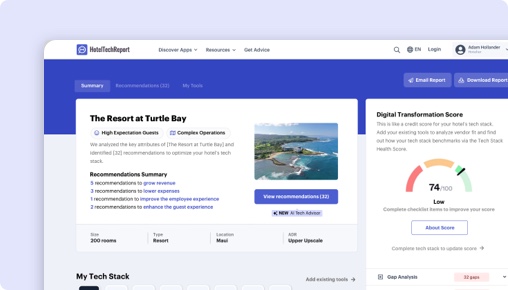
Sorry, this functionality is only available for verified hoteliers
The project dashboard is a free tool that is only available to verified hoteliers to make adopting new technology easier by streamlining their research and simplifying their communication workflow.

RateGain 对比 Tableau:按酒店细分市场排名
各产品在不同物业规模、类型和区域的 商业智能 供应商中的排名——基于各细分市场中酒店从业者的经验证评价。
按酒店规模
| 细分市场 |
 RateGain RateGain
|
 Tableau Tableau
|
|---|---|---|
| 小型(10-24 间客房) | #13 4 条评价 | — |
| 中型(25-74 间客房) ▾ | #7 21 条评价 | — |
| 大型(75-199 间客房) ▾ | #11 9 条评价 | — |
| 超大型(200+ 间客房) ▾ | #8 5 条评价 | — |
按物业类型
| 细分市场 |
RateGain
|
Tableau
|
|---|---|---|
| 精品酒店 ▾ | #7 19 条评价 | — |
| 豪华酒店 ▾ | #8 20 条评价 | — |
| 品牌/连锁酒店 ▾ | #14 11 条评价 | — |
| 长住酒店 | #7 4 条评价 | — |
按区域
| 细分市场 |
RateGain
|
Tableau
|
|---|---|---|
| 北美 | #17 0 条评价 | — |
| 欧洲 | #22 1 条评价 | — |
| 亚太 ▾ | #3 21 条评价 | — |
| 中东 ▾ | #3 10 条评价 | — |
The Decision
When evaluating business intelligence tools for your hotel, Demand.AI by RateGain and Tableau stand out as options with vastly different profiles. Demand.AI is tailored specifically for hospitality, focusing on demand forecasting, revenue management, and distribution insights, while Tableau is a versatile data visualization platform serving multiple industries. Your decision hinges on whether you need a hotel-specific solution or a more flexible, general-purpose BI tool. But which will better serve your hotel’s unique needs?
Is Demand.AI or Tableau Better for Hotels?
Demand.AI is designed to help hoteliers anticipate demand patterns, optimize revenue strategies, and manage distribution channels more effectively. It offers detailed market intelligence, including demand forecasts for the next 75 days and insights into which localities will see surges, making it highly relevant for hotel revenue teams.
Tableau, by contrast, provides broad data visualization capabilities for any industry, including hotels, but lacks specific features tailored to hospitality demand forecasting or revenue management. It excels at creating custom dashboards and exploring data but requires more setup and expertise to generate hotel-specific insights.
Given Demand.AI’s focus on hospitality and recent reviews showing robust performance and support, it’s clearer that for hotel revenue optimization, Demand.AI has the edge. Are you primarily looking for a hotel-focused tool or a general BI platform?
Demand.AI vs Tableau: Which Should Your Hotel Choose?
If your hotel needs a platform that predicts future demand, offers localized market insights, and simplifies revenue management, Demand.AI is the logical pick. Its reviews highlight its ease of use, strong support, and proven ROI, with a 4.91/5 support rating and 34 reviews, the most recent being in the last six months.
If, however, your team requires a flexible data analysis tool capable of creating custom visualizations across multiple data sources—beyond hospitality—Tableau is the better choice. But note, Tableau has zero hotel-specific reviews, which diminishes confidence in its suitability for your hotel’s specialized needs. Given the lack of recent reviews and zero user ratings in the hotel context, Demand.AI clearly offers more targeted value.
Is Demand.AI or Tableau Easier to Use?
Demand.AI boasts a high ease-of-use rating of 4.85/5 and positive reviews praising its straightforward interface and intuitive workflow. Users report that despite some complexity, the platform is accessible for hotel teams, with onboarding rated at 4.62/5 and support highly rated at 4.91/5.
Tableau, by comparison, has no recent reviews or ratings, making its user experience difficult to assess. Its reputation in the broader BI space indicates a steep learning curve and complex setup, especially for hotel-specific applications.
Edge: Demand.AI.
Which Has Better Features: Demand.AI or Tableau?
Demand.AI offers core hospitality features like demand forecasting for 75 days, localized demand insights, rate shopping, channel management, and revenue analysis. Its ability to predict demand at the locality level and adjust pricing accordingly is unique among hotel BI tools.
Tableau, however, provides extensive data visualization features, custom dashboards, and broad connectivity options across multiple data sources. But it lacks hotel-specific features like demand forecasting or integrated revenue management modules.
Edge: Demand.AI.
Which Has Better Customer Support: Demand.AI or Tableau?
Demand.AI’s customer support ratings are exceptional, with a 4.91/5 score based on recent reviews. Users describe the support team as helpful, responsive, and knowledgeable, with ongoing training sessions, which is critical for hotel teams implementing new revenue strategies.
Tableau, with no recent hotel-specific reviews, has a less transparent support profile. While generally regarded as a reliable platform, the absence of recent feedback makes it difficult to assess support quality for hotel customers.
Edge: Demand.AI.
Which Has More Integrations: Demand.AI or Tableau?
Demand.AI boasts 95 verified integration partners, including prominent hospitality software like PMS, CRS, and channel managers such as RoomRaccoon and Profitroom. This extensive network ensures smooth data flow and operational efficiency across hotel systems.
Tableau currently has zero verified hotel-specific integrations, although it offers broad connectivity with various data sources in other industries. Its lack of hotel-focused integrations limits its immediate usefulness for your property.
Edge: Demand.AI.
Which Do Hoteliers Rate Higher: Demand.AI or Tableau?
Demand.AI’s recent reviews indicate high satisfaction among hotel users, with a 95% likelihood to recommend and positive feedback on its intuitive demand forecasting and support. The platform’s hotel-centric features resonate strongly with property management teams.
Tableau has no recent hotel reviews or ratings, making it impossible to gauge hotelier satisfaction in this context. Its broader reputation in data visualization does not directly translate to hotel-specific usability or value.
Edge: Demand.AI.
How Much Do Demand.AI and Tableau Cost?
Pricing details for Demand.AI are not publicly disclosed, but it operates on a subscription model tailored for hotels, often involving a monthly fee with no implementation or trial information available. Its ROI ratings suggest it offers good value within hospitality.
Tableau’s licensing costs are typically enterprise-based, with no specific pricing for hotel use disclosed publicly. Its licensing can be expensive for smaller properties, and setup may require significant consultancy.
Given the clear hotel focus and reviews, Demand.AI likely offers better value for your property’s specific needs.
What Type of Hotel Should Use Demand.AI?
- Hotels that want to predict demand surges and optimize rates accordingly.
- Revenue managers seeking localized insights into city or neighborhood demand.
- Properties looking to streamline distribution and channel management.
- Hotels aiming to improve occupancy and revenue through data-driven decisions.
- Teams that prefer an easy-to-use platform with strong support.
Not ideal if you require a broad analytics tool not tailored for hospitality or if your property has minimal reliance on dynamic pricing.
What Type of Hotel Should Use Tableau?
- Hotels with large, complex data sets needing advanced visualization.
- Teams that want flexible dashboards connecting multiple sources.
- Properties with in-house data analysts comfortable configuring custom reports.
- Multi-use organizations requiring BI tools across various industries.
Not ideal if your hotel needs demand forecasting, revenue management, or hospitality-specific features out of the box. Small or mid-sized properties might find Tableau too complex or costly.
Demand.AI vs Tableau: The Bottom Line for Hotels
Demand.AI delivers a specialized, demand-focused revenue management platform with an outstanding recent review base, high user ratings, and extensive integrations tailored for hotels. Its core functions directly support increasing occupancy and revenue through localized insights and rate optimization.
Tableau, while a powerful data visualization tool, lacks hotel-specific features and recent reviews, making it less suitable for property managers seeking targeted revenue solutions. It’s better suited for organizations needing broad, customizable BI across industries.
If your hotel prioritizes demand forecasting, revenue management, and ease of use, Demand.AI is the clear choice. For broader data analysis with minimal hospitality focus, Tableau might suffice—but in this comparison, Demand.AI’s recent, detailed hotel-centric reviews and features tip the balance firmly in its favor.
RateGain 对比 Tableau:总结
酒店从业者喜爱的方面
RateGain 的支持团队反应迅速、乐于助人且全天候待命,因此备受赞誉。尽管客户服务非常出色,但仍需要更全面的培训课程和更好的 GDS 系统支持。
RateGain 的渠道管理器因其易用性和与其他平台的集成而广受好评,简化了客房库存管理并实现了有效的价格调整。一些用户强调需要进一步更新和增强移动应用功能。
许多用户都喜欢 RateGain 的综合仪表板和详细报告,这有助于制定定价策略、进行数据分析和跟踪整体酒店绩效。然而,有些人认为界面复杂,数据加载时间缓慢。
酒店从业者提出异议的方面
RateGain 的渠道管理器因其易用性和与其他平台的集成而广受好评,简化了客房库存管理并实现了有效的价格调整。一些用户强调需要进一步更新和增强移动应用功能。
虽然用户界面普遍被描述为用户友好且易于导航,但一些用户认为它很复杂且功能冗余。有改进建议,尤其是关于用户界面响应能力和移动兼容性。
评分差异最大的方面
关于 Demand.AI (by RateGain) 与 Tableau 的常见问题
Demand.AI (by RateGain) 能否替代 Tableau?
这取决于您的需求。Demand.AI (by RateGain) 和 Tableau 共享许多核心 Business Intelligence 功能,但各有独特的能力。Demand.AI (by RateGain) 提供 95 个经验证的集成合作伙伴,而 Tableau 提供 0 个。在切换之前,请查看上方的功能对比以了解它们的差异。
哪个更适合小型或独立酒店?
小型酒店应优先考虑易用性和快速入职。Demand.AI (by RateGain) 在易用性方面领先,评分为 4.8/5 对比 0.0/5。寻找透明定价以及试用或演示选项。在各产品页面上按物业规模筛选评价,了解与您类似的酒店的反馈。
Demand.AI (by RateGain) 或 Tableau 是否提供免费方案?
Demand.AI (by RateGain):否。Tableau:否。 两款产品目前均不提供免费版。大多数 Business Intelligence 供应商提供演示或试用——在做出承诺之前,请分别向各供应商申请体验。
HTR 如何评估和排名 Demand.AI (by RateGain) 和 Tableau?
HT Score 是一个综合排名,考虑 4 个标准组和十多个变量,帮助酒店从业者客观比较酒店科技产品。RateGain 的 HT Score 为 33,Tableau 的为 0。以下是评分的计算方式。
| 标准组 | 权重 | 衡量内容 |
|---|---|---|
| 客户评分与评价 |
|
用户对该产品的推荐度如何? 评分分数、评价数量、声量份额、评价深度、评价时效性、成功案例 ▾ 权重最高的因素。分析平均满意度评分(推荐可能性、易用性、支持、投资回报率)、相对于同类产品的评价总数、评价时效性(最近 6 个月内至少 20 条评价)以及跨独立酒店客户的声量份额以检测选择偏差。 |
| 合作伙伴生态系统 |
|
技术合作伙伴对该公司的推荐度如何? 合作伙伴推荐、集成数量、集成质量 ▾ 评估合作伙伴推荐作为专家信心投票、经验证集成的数量以及生态系统质量——集成合作伙伴的平均 HT Score。拥有更高质量集成生态系统的产品更有可能提供互联互通的技术栈。 |
| 以客户为中心 |
|
该组织以客户为中心的程度如何? 认证支持、评价一致性、资料完整性 ▾ 评估公司是否获得 HTR 客户支持认证、是否保持持续的评价收集(反馈驱动文化的指标)以及产品资料是否完整,包括功能、截图、定价和特性。 |
| 覆盖范围、持久力与资源 |
|
该公司的覆盖范围和资源有多广泛? 地理覆盖、持久力、公司资源、趋势评分 ▾ 衡量全球覆盖(服务的国家和区域)、经营年限作为稳定性指标、团队规模作为资源指标,以及基于近十二个月买家咨询、评价、合作伙伴推荐和媒体活动的趋势评分。 |
客户评分和评价是 HT Score 算法中最重要的因素。HTR 不接受付费以提高排名。所有评价均经过验证——只有经确认从属关系的酒店行业从业者才能提交评分。 查看完整 HT Score 评估方法 →
酒店从业者还在阅读哪些 商业智能 对比?
探索更多基于经验证酒店从业者评价的一对一对比。




获取您的免费人工智能分析师报告
根据您的房产情况量身定制的推荐方案


