
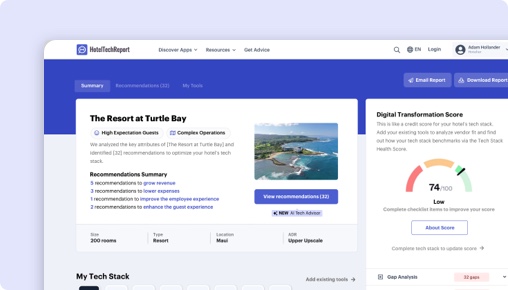
Sorry, this functionality is only available for verified hoteliers
The project dashboard is a free tool that is only available to verified hoteliers to make adopting new technology easier by streamlining their research and simplifying their communication workflow.

RateGain 对比 Tickr:按酒店细分市场排名
各产品在不同物业规模、类型和区域的 商业智能 供应商中的排名——基于各细分市场中酒店从业者的经验证评价。
按酒店规模
| 细分市场 |
|
|
|---|---|---|
| 小型(10-24 间客房) | #13 4 条评价 | — |
| 中型(25-74 间客房) ▾ | #7 21 条评价 | — |
| 大型(75-199 间客房) ▾ | #11 9 条评价 | — |
| 超大型(200+ 间客房) ▾ | #8 5 条评价 | — |
按物业类型
| 细分市场 |
|
|
|---|---|---|
| 精品酒店 ▾ | #7 19 条评价 | — |
| 豪华酒店 ▾ | #8 20 条评价 | — |
| 品牌/连锁酒店 ▾ | #14 11 条评价 | — |
| 长住酒店 | #7 4 条评价 | — |
按区域
| 细分市场 |
|
|
|---|---|---|
| 北美 | #17 0 条评价 | — |
| 欧洲 | #22 1 条评价 | — |
| 亚太 ▾ | #3 21 条评价 | — |
| 中东 ▾ | #3 10 条评价 | — |
The Decision
Choosing between Demand.AI by RateGain and Tickr hinges on your hotel’s core needs for data-driven revenue management versus comprehensive performance tracking. Demand.AI is specifically tailored for hoteliers seeking to optimize rates, forecast demand, and streamline distribution, while Tickr offers a broader platform to unify business metrics across industries, including hospitality. Which solution aligns better with your operational priorities?
Demand.AI focuses on demand forecasting, rate optimization, and channel management, designed to boost revenue through precise analytics and market insights. Tickr, on the other hand, serves as a performance dashboard, integrating various business data sources into a single interface to improve decision-making across departments. Do you need specialized revenue tools or a broader performance overview?
Is Demand.AI or Tickr Better for Hotels?
Demand.AI is built to meet the needs of hotels that want to predict demand, optimize pricing, and enhance revenue management strategies. With a focus on the hospitality industry, it provides detailed demand forecasts for 75 days ahead, along with localized insights via map view, making it ideal for hoteliers aiming to maximize occupancy and revenue.
Tickr appeals to hotels that require a unified performance dashboard, integrating marketing, financial, and operational metrics into one platform. Its strength lies in consolidating data from multiple sources across industries, offering a holistic view that supports strategic decisions beyond just revenue management.
RateGain’s Demand.AI has a proven track record within hospitality, with more recent reviews and a higher review count (34 reviews in the last six months), demonstrating active user engagement. Tickr’s platform is more generic, with no recent reviews or verified hotel industry use, making Demand.AI the more reliable choice for hotels committed to data-driven revenue strategies.
Demand.AI vs Tickr: Which Should Your Hotel Choose?
If your hotel’s primary goal is to improve revenue through demand forecasting, dynamic pricing, and channel management, Demand.AI is clearly the better option. It offers specific features like local demand insights, rate shopping, and integration with PMS and CRS, backed by a 4.91/5 customer support rating from hotel users.
If your team needs a performance dashboard that consolidates marketing, CRM, social media, and financial data for comprehensive operational oversight, Tickr might seem appealing. However, with no recent hotel industry reviews and no verified integrations, it’s less proven in the hospitality context.
For hotels seeking proven, revenue-focused tools with active hospitality user feedback, Demand.AI’s higher review count and recent positive ratings make it the safer and more strategic investment.
Is Demand.AI or Tickr Easier to Use?
Demand.AI scores highly with a 4.85/5 ease of use rating, praised for its intuitive interface, straightforward navigation, and quick onboarding process. Users highlight that despite some complexity in advanced features, the platform remains accessible with helpful support and training.
Tickr’s interface is not rated, and there are no recent reviews to gauge ease of use within the hotel industry. Given its broad, generalized approach, it’s likely less tailored and potentially more complex to adapt to hospitality-specific workflows.
Edge: Demand.AI, because its dedicated hotel features and recent user feedback demonstrate a more user-friendly experience for hoteliers.
Which Has Better Features: Demand.AI or Tickr?
Demand.AI offers 11 distinct features including demand forecasting, local demand insights via map view, rate shopping, channel management, revenue analytics, market intelligence, and integration with PMS and CRS. It provides detailed tools for dynamic rate management and localized demand predictions, critical for maximizing occupancy and revenue.
Tickr does not list any shared or unique features explicitly, indicating a potential gap in specialized capabilities. Its core strength is data unification, but it lacks hotel-specific functionalities like demand forecasting or channel management.
Edge: Demand.AI, with its extensive suite of features tailored for hotel revenue management and demand prediction.
Which Has Better Customer Support: Demand.AI or Tickr?
Demand.AI’s support is highly rated at 4.91/5, with reviews praising its responsiveness, helpfulness, and availability 24/7. Users mention that support staff are proactive in training and troubleshooting, crucial for smooth operations.
Tickr’s customer support ratings are unavailable, and there are no recent reviews from hotel clients to assess its support quality. Given the complexity of hotel operations, reliable support is vital, and Demand.AI’s proven high ratings make it the more dependable option.
Edge: Demand.AI, due to its consistent positive feedback on customer service from hotel users.
Which Has More Integrations: Demand.AI or Tickr?
Demand.AI boasts 95 verified integration partners, including hospitality-specific platforms like RoomRaccoon, Profitroom, and HotelTime, alongside general business tools. Its extensive partner network enables seamless connectivity with PMS, CRS, and distribution channels, reducing manual work and data inconsistencies.
Tickr has no verified integrations listed, limiting its ability to connect with specialized hospitality systems. Its broader industry focus means it’s less tailored for hotel-specific workflows.
Edge: Demand.AI, with its extensive integrations critical for hospitality operations.
Which Do Hoteliers Rate Higher: Demand.AI or Tickr?
Demand.AI’s hotel-centric reviews are recent, with a 77.84 HTR Score and a 95% likelihood to recommend, reflecting strong satisfaction among users managing various hotel segments, including luxury, boutique, and city center hotels. The platform’s ease of use, support, and revenue impact are highly praised.
Tickr lacks recent reviews or ratings from hotel users, making it impossible to assess satisfaction levels in the hotel industry.
Edge: Demand.AI, due to its active, positive hotel-specific reviews and higher ratings.
How Much Do Demand.AI and Tickr Cost?
Pricing details for Demand.AI are not publicly available, but it typically involves a subscription model tailored to hotel size and needs, with no implementation fee or trial info specified. Its ROI rating suggests a focus on value, but costs may vary.
Tickr also does not publicly list pricing, and as a broader performance platform, its cost structure is likely industry-agnostic, with no trial or freemium options.
Both products require direct contact for quotes, emphasizing the importance of assessing value based on features and support rather than list prices.
What Type of Hotel Should Use Demand.AI?
- Hotels that want to predict demand accurately for the next 75 days.
- Teams seeking to optimize dynamic rates based on local market intelligence.
- Properties with multiple channels needing real-time updates and rate parity management.
- Hotels looking for localized demand insights through map and table views.
- Hotels that want to improve revenue, occupancy, and market positioning with detailed analytics.
Not ideal if your hotel primarily needs broad data unification without a focus on revenue management.
What Type of Hotel Should Use Tickr?
- Hotels that require a unified view of operational, marketing, and financial metrics in one dashboard.
- Teams looking to move away from static documents and spreadsheets.
- Businesses seeking a performance platform that can serve multiple industries beyond hospitality.
- Hotels interested in broad data visualization and strategic oversight.
Not ideal if your hotel’s priority is demand forecasting, rate management, or revenue optimization.
Demand.AI vs Tickr: The Bottom Line for Hotels
Demand.AI is a dedicated revenue management tool designed specifically for hoteliers aiming to optimize pricing, forecast demand, and manage distribution channels effectively. Its recent reviews, high ratings, and active hotel user base make it a reliable choice for revenue-focused hotels.
Tickr functions as a general business performance platform that unifies multiple data sources into one interface. While it excels at broad data aggregation, it lacks hotel-specific features and recent hotel industry reviews, making it less suited for revenue optimization.
If your hotel prioritizes revenue growth, demand forecasting, and channel management, Demand.AI is your clear choice. For holistic business performance monitoring across industries, Tickr might be suitable, but it falls short for hotel-specific needs.
RateGain 对比 Tickr:总结
酒店从业者喜爱的方面
RateGain 的支持团队反应迅速、乐于助人且全天候待命,因此备受赞誉。尽管客户服务非常出色,但仍需要更全面的培训课程和更好的 GDS 系统支持。
RateGain 的渠道管理器因其易用性和与其他平台的集成而广受好评,简化了客房库存管理并实现了有效的价格调整。一些用户强调需要进一步更新和增强移动应用功能。
许多用户都喜欢 RateGain 的综合仪表板和详细报告,这有助于制定定价策略、进行数据分析和跟踪整体酒店绩效。然而,有些人认为界面复杂,数据加载时间缓慢。
酒店从业者提出异议的方面
RateGain 的渠道管理器因其易用性和与其他平台的集成而广受好评,简化了客房库存管理并实现了有效的价格调整。一些用户强调需要进一步更新和增强移动应用功能。
虽然用户界面普遍被描述为用户友好且易于导航,但一些用户认为它很复杂且功能冗余。有改进建议,尤其是关于用户界面响应能力和移动兼容性。
评分差异最大的方面
关于 Demand.AI (by RateGain) 与 Tickr 的常见问题
Demand.AI (by RateGain) 能否替代 Tickr?
这取决于您的需求。Demand.AI (by RateGain) 和 Tickr 共享许多核心 Business Intelligence 功能,但各有独特的能力。Demand.AI (by RateGain) 提供 95 个经验证的集成合作伙伴,而 Tickr 提供 0 个。在切换之前,请查看上方的功能对比以了解它们的差异。
哪个更适合小型或独立酒店?
小型酒店应优先考虑易用性和快速入职。Demand.AI (by RateGain) 在易用性方面领先,评分为 4.8/5 对比 0.0/5。寻找透明定价以及试用或演示选项。在各产品页面上按物业规模筛选评价,了解与您类似的酒店的反馈。
Demand.AI (by RateGain) 或 Tickr 是否提供免费方案?
Demand.AI (by RateGain):否。Tickr:否。 两款产品目前均不提供免费版。大多数 Business Intelligence 供应商提供演示或试用——在做出承诺之前,请分别向各供应商申请体验。
HTR 如何评估和排名 Demand.AI (by RateGain) 和 Tickr?
HT Score 是一个综合排名,考虑 4 个标准组和十多个变量,帮助酒店从业者客观比较酒店科技产品。RateGain 的 HT Score 为 78,Tickr 的为 0。以下是评分的计算方式。
| 标准组 | 权重 | 衡量内容 |
|---|---|---|
| 客户评分与评价 |
|
用户对该产品的推荐度如何? 评分分数、评价数量、声量份额、评价深度、评价时效性、成功案例 ▾ 权重最高的因素。分析平均满意度评分(推荐可能性、易用性、支持、投资回报率)、相对于同类产品的评价总数、评价时效性(最近 6 个月内至少 20 条评价)以及跨独立酒店客户的声量份额以检测选择偏差。 |
| 合作伙伴生态系统 |
|
技术合作伙伴对该公司的推荐度如何? 合作伙伴推荐、集成数量、集成质量 ▾ 评估合作伙伴推荐作为专家信心投票、经验证集成的数量以及生态系统质量——集成合作伙伴的平均 HT Score。拥有更高质量集成生态系统的产品更有可能提供互联互通的技术栈。 |
| 以客户为中心 |
|
该组织以客户为中心的程度如何? 认证支持、评价一致性、资料完整性 ▾ 评估公司是否获得 HTR 客户支持认证、是否保持持续的评价收集(反馈驱动文化的指标)以及产品资料是否完整,包括功能、截图、定价和特性。 |
| 覆盖范围、持久力与资源 |
|
该公司的覆盖范围和资源有多广泛? 地理覆盖、持久力、公司资源、趋势评分 ▾ 衡量全球覆盖(服务的国家和区域)、经营年限作为稳定性指标、团队规模作为资源指标,以及基于近十二个月买家咨询、评价、合作伙伴推荐和媒体活动的趋势评分。 |
客户评分和评价是 HT Score 算法中最重要的因素。HTR 不接受付费以提高排名。所有评价均经过验证——只有经确认从属关系的酒店行业从业者才能提交评分。 查看完整 HT Score 评估方法 →
酒店从业者还在阅读哪些 商业智能 对比?
探索更多基于经验证酒店从业者评价的一对一对比。
获取个性化的产品推荐
产品推荐顾问
