

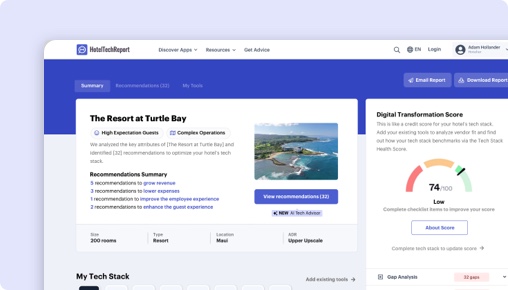
申し訳ございません。この機能は認証済みのホテル運営者のみご利用いただけます
プロジェクトダッシュボードは、認証済みのホテル運営者のみが利用できる無料ツールです。調査を効率化し、コミュニケーションの流れを簡素化することで、新しいテクノロジーの導入を容易にします。

Amadeus vs RateGain:ホテルセグメント別ランキング
各セグメントのホテル経営者による認証済みレビューに基づく、施設規模・タイプ・地域別のホテルメタサーチ管理ソフトウェアベンダー内ランキング。
ホテル規模別
| セグメント |
 Amadeus Amadeus
|
 RateGain RateGain
|
|---|---|---|
| 小規模(10〜24室) | #16 0件のレビュー | #6 4件のレビュー |
| 中規模(25〜74室) ▾ | #13 1件のレビュー | #8 10件のレビュー |
| 大規模(75〜199室) ▾ | #14 1件のレビュー | #6 4件のレビュー |
| 特大規模(200室以上) | #11 0件のレビュー | #8 0件のレビュー |
施設タイプ別
| セグメント |
Amadeus
|
RateGain
|
|---|---|---|
| ブティック ▾ | #14 2件のレビュー | #7 9件のレビュー |
| ラグジュアリー ▾ | #13 2件のレビュー | #7 8件のレビュー |
| ブランド/チェーン ▾ | #12 1件のレビュー | #8 6件のレビュー |
| 長期滞在型 | #15 0件のレビュー | #5 1件のレビュー |
地域別
| セグメント |
Amadeus
|
RateGain
|
|---|---|---|
| 北米 | #10 0件のレビュー | #14 0件のレビュー |
| ヨーロッパ ▾ | #14 1件のレビュー | #8 13件のレビュー |
| アジア太平洋 ▾ | #13 0件のレビュー | #2 5件のレビュー |
| 中東 | — | #1 1件のレビュー |
The Decision
Choosing between Amadeus-Travel Seller Media and Demand Booster by RateGain hinges on your hotel’s specific distribution goals. Both products aim to optimize your hotel’s visibility and bookings but do so with different core strengths. Amadeus’s platform is primarily focused on GDS advertising and travel agent targeting, while RateGain’s Demand Booster emphasizes direct booking growth through data-driven marketing and distribution automation. Your decision should depend on whether your hotel needs to boost GDS revenue or maximize direct bookings.
Amadeus’s offering is rooted in traditional global distribution system (GDS) advertising, making it ideal if your hotel relies heavily on travel agents and corporate channels. Conversely, RateGain excels at leveraging extensive travel intent data to increase direct bookings and reduce OTA dependency. Do you prioritize GDS influence or direct channel control? That choice defines the better fit.
Is Amadeus-Travel Seller Media or Demand Booster Better for Hotels?
If your hotel’s primary distribution challenge is increasing GDS visibility and influencing travel agents, Amadeus offers a robust solution. Its core strength lies in targeting travel sellers on major GDS platforms, with over 80% of GDS hotel ads managed by Amadeus’s experts. It’s particularly suited for luxury hotels or properties that depend on corporate and travel agency channels, where GDS performance is critical. However, it has limited features beyond GDS advertising, which may restrict your broader distribution needs.
Demand Booster, on the other hand, is designed for hotels that want to grow direct bookings and control their guest journey. With access to the largest database of travel intent traffic globally and a suite of marketing tools, Demand Booster makes it easier to target prospective travelers and re-engage past guests. It supports over 300 brands and boasts a 22x ROAS, making it a compelling choice if your focus is on digital marketing and direct revenue.
In summary, if your hotel relies heavily on GDS channels and travel agents, Amadeus is a better choice. If your goal is to boost direct bookings and leverage rich data for marketing, Demand Booster is the clear leader. Which of these priorities aligns more closely with your hotel’s strategy?
Edge: Demand Booster
Amadeus-Travel Seller Media vs Demand Booster: Which Should Your Hotel Choose?
If your hotel needs to influence travel agents and increase GDS bookings, go with Amadeus. It’s especially suited for luxury properties or hotels targeting corporate clients, given its proven effectiveness in GDS advertising and travel seller engagement. Its longstanding presence and the expertise managing over 80% of GDS ads make it a reliable partner for distribution on Sabre, Travelport, and Amadeus.
Choose Demand Booster if your hotel aims to grow direct bookings, reduce OTA reliance, and target travelers more precisely. Its proprietary travel intent data, connected booking engines, and ability to deliver at least 30% increase in direct revenue make it highly effective for independent hotels, boutique properties, and those prioritizing digital marketing.
In essence, select Amadeus for GDS-centric strategies, and Demand Booster for data-driven, direct booking growth. Which goal is more urgent for your team?
Edge: Demand Booster
Is Amadeus-Travel Seller Media or Demand Booster Easier to Use?
Amadeus scores a 4.5/5 for ease of use, with a user-friendly interface and a straightforward onboarding process. Its platform is built for travel sellers and distribution managers, but some users note it could be more modern and intuitive, with suggestions for more flexible reporting. Customer support is rated a perfect 5/5, with reviews highlighting their professionalism and consistent assistance, making adoption smoother.
Demand Booster boasts an impressive 4.71/5 ease-of-use rating, credited to its clear dashboards, quick distribution capabilities, and automation features. Its interface is designed to handle complex marketing and distribution tasks efficiently, which is especially helpful for teams that want to control campaigns without technical barriers. Customer reviews underscore responsive support and a seamless onboarding experience.
Edge: Demand Booster
Which Has Better Features: Amadeus or Demand Booster?
Demand Booster offers five features exclusive to its platform, including metasearch marketing, connectivity, surveillance, a marketing dashboard, and e-commerce consulting—none of which Amadeus provides. Its integrated features support digital marketing efforts, real-time demand intelligence, and distribution automation, totaling a significantly broader feature set.
Amadeus’s platform primarily focuses on GDS advertising and travel seller targeting, with only one shared feature (GDS advertising) with Demand Booster. It lacks the advanced marketing and analytics tools Demand Booster provides, which are crucial for hotels aiming for comprehensive digital growth.
In conclusion, if your hotel values advanced marketing features and data-driven campaigns, Demand Booster’s richer feature set is more suitable. For GDS-focused distribution, Amadeus’s narrower but specialized offerings suffice.
Edge: Demand Booster
Which Has Better Customer Support: Amadeus or Demand Booster?
Amadeus’s customer support is rated a perfect 5/5, with reviews emphasizing their professionalism, consistent support, and long-term partnership. Clients appreciate their proactive approach and expert guidance, which simplifies the onboarding and ongoing use of the platform.
Demand Booster also boasts a 4.92/5 support rating, with reviewers praising their quick, friendly responses, detailed reporting, and strategic advice. Many long-term clients mention how the support team helped double their direct visits and improve online visibility without increasing costs.
Overall, both products excel in customer support, but Amadeus’s older, more established support structure receives slightly higher praise.
Edge: Amadeus
Which Has More Integrations: Amadeus or Demand Booster?
Amadeus has 104 verified partners, slightly ahead of Demand Booster’s 95. Shared integrations include key hospitality systems like Profitroom, Cendyn, and HotelTime, ensuring compatibility with your existing tech stack. Unique integrations for Amadeus include Priority Software and Orange Hotel Marketing, focusing on distribution and hotel management tools.
Demand Booster connects with over 140 booking engines and offers integrations with major platforms like WuBook and GuestCentric, emphasizing its digital marketing and distribution automation capabilities. Its extensive network supports faster distribution and campaign management.
While both are well-integrated, Amadeus’s broader partner network, especially in hospitality software, makes it marginally superior for hotels with complex systems.
Edge: Amadeus
Which Do Hoteliers Rate Higher: Amadeus or Demand Booster?
Demand Booster’s recent reviews reflect a 4.93/5 rating based on 19 reviews, with many praising its ability to increase direct bookings and ROI. Hotels especially appreciate its data-driven insights and user-friendly interface, with comments like “great results in performance” and “efficient and flexible.”
Amadeus’s reviews are fewer and more dated, with a 0/5 rating based on just 2 reviews, both emphasizing their long-standing reputation but offering limited recent feedback. The older reviews highlight professionalism but lack recent performance data.
Given the recent volume and high ratings for Demand Booster, it clearly enjoys higher user satisfaction among hoteliers today.
Edge: Demand Booster
How Much Do Amadeus-Travel Seller Media and Demand Booster Cost?
Amadeus does not publicly list its pricing; it typically offers customized quotes based on distribution needs, making it less transparent. Expect to negotiate a tailored plan, potentially with higher costs depending on GDS advertising scope.
Demand Booster charges $1,000 per month as a base price, with no additional implementation fees or trial options. Its predictable pricing model allows easier budgeting, especially for hotels focused on digital marketing and direct bookings.
If transparent and fixed pricing is important, Demand Booster provides a clear and accessible structure. Otherwise, Amadeus’s custom quotes may accommodate larger or more complex distribution strategies.
What Type of Hotel Should Use Amadeus-Travel Seller Media?
- Hotels that rely heavily on GDS channels and travel agents.
- Properties targeting corporate, luxury, or high-end markets.
- Teams that prioritize GDS advertising and travel seller influence.
- Hotels needing proven distribution on Sabre, Travelport, or Amadeus.
- Hotels with existing GDS partnerships looking to optimize spend.
Not ideal if your hotel’s focus is on direct bookings, digital marketing, or rapid distribution automation. Smaller or boutique hotels with limited GDS engagement may find Amadeus’s main strengths unnecessary.
What Type of Hotel Should Use Demand Booster?
- Hotels seeking to increase direct bookings by at least 30%.
- Independent, boutique, or city-center hotels targeting digital travelers.
- Teams wanting to harness extensive travel intent data.
- Hotels that need quick, automated distribution to OTAs and Meta.
- Properties aiming to reduce dependency on OTAs and improve guest retargeting.
Not ideal if your hotel primarily depends on established GDS or travel agent channels. Hotels with minimal focus on digital marketing or those unwilling to invest in comprehensive data-driven campaigns may find Demand Booster less relevant.
The Bottom Line for Hotels: Amadeus or Demand Booster?
Amadeus’s platform is built for hotels heavily invested in GDS and travel agent distribution, excelling in influencing the traditional distribution channels. Its longstanding reputation, broad partner network, and support make it the choice for luxury and corporate-focused properties seeking targeted GDS advertising.
Demand Booster is designed for hotels that prioritize direct revenue growth and digital marketing. Its extensive travel intent database, automation features, and high recent ratings indicate it’s the better option for independent hotels and those focused on modern, data-driven strategies.
In conclusion, if your hotel’s main goal is to grow GDS bookings and engage travel agents, Amadeus is the clear choice. If increasing direct bookings and leveraging sophisticated marketing tools are your priorities, Demand Booster provides a stronger, more recent track record.
This comprehensive comparison aims to help your team make a well-informed decision based on your hotel’s distribution needs and strategic goals.
実際の成果:ビジネス目標別のAmadeus vs RateGain
1件の認証済みケーススタディを分析し、4つの主要ビジネス目標において各プラットフォームでホテルが実際に達成した成果を比較しました。
Amadeus
この目標に関するケーススタディはまだ公開されていません。
Safir Hotels & Resorts
中規模
"The partnership with RateGain has been transformative for Safir Hotels & Resorts, yielding 4x growth in our revenue."

Amadeus vs RateGain:まとめ
高評価の分野
高評価の分野
独自の機能
評価が最も分かれる分野
Amadeus- Travel Seller Media vs Demand Boosterに関するよくある質問
Amadeus- Travel Seller MediaはDemand Boosterの代わりになりますか?
お客様の要件次第です。Amadeus- Travel Seller MediaとDemand Boosterは多くの主要なHotel Metasearch Management Software機能を共有していますが、それぞれに独自の機能があります。Amadeus- Travel Seller Mediaは107件の認証済み連携パートナーを持ち、Demand Boosterは96件を持っています。切り替え前に、上記の機能比較で違いをご確認ください。
小規模または独立系ホテルにはどちらが適していますか?
小規模ホテルは使いやすさと迅速なオンボーディングを優先すべきです。Demand Boosterは使いやすさで4.7/5対4.5/5とリードしています。透明性のある料金設定とトライアルまたはデモのオプションを探しましょう。各製品ページで施設規模別にレビューをフィルタリングして、同様のホテルからの声を確認してください。
Amadeus- Travel Seller MediaまたはDemand Boosterに無料プランはありますか?
Amadeus- Travel Seller Media:いいえ。Demand Booster:いいえ。 どちらの製品も現在無料プランを提供していません。ほとんどのHotel Metasearch Management Softwareベンダーはデモまたはトライアルを提供しています — 契約する前に各社にご依頼ください。
HTRはAmadeus- Travel Seller MediaとDemand Boosterをどのように評価・ランク付けしていますか?
HT Scoreは、ホテル経営者がホテルテクノロジー製品を客観的に比較できるよう、4個の基準グループと十数の変数を考慮した総合ランキングです。AmadeusのHT Scoreは0、RateGainは0です。以下がスコアの算出方法です。
| 基準グループ | ウェイト | 測定内容 |
|---|---|---|
| 顧客評価とレビュー |
|
ユーザーはこの製品をどの程度推奨していますか? 評価スコア、レビュー数、シェアオブボイス、レビューの深さ、レビューの新しさ、成功事例 ▾ 最も重みの大きい要素です。平均満足度評価(推奨度、使いやすさ、サポート、ROI)、カテゴリー内の競合に対するレビュー総数、レビューの新しさ(直近6か月間に20件以上のレビュー)、固有のホテルクライアント全体のシェアオブボイスを分析して選択バイアスを検出します。 |
| パートナーエコシステム |
|
テクノロジーパートナーはこの企業をどの程度推奨していますか? パートナー推奨、連携数、連携品質 ▾ パートナー推奨を専門家の信頼票として評価し、認証済み連携の数、エコシステムの品質 — 連携パートナーの平均HT Scoreを評価します。より高品質な連携エコシステムを持つ製品は、接続されたテックスタックを提供する可能性が高くなります。 |
| 顧客中心主義 |
|
この組織はどの程度顧客中心ですか? 認定サポート、レビューの一貫性、プロフィールの完全性 ▾ 企業がHTRカスタマーサポート認定を取得しているか、長期にわたり一貫したレビュー収集を維持しているか(フィードバック主導の文化の指標)、機能、スクリーンショット、料金、特徴を含む完全な製品プロフィールを維持しているかを評価します。 |
| リーチ、継続性、リソース |
|
この企業のリーチとリソースはどの程度広範ですか? 地理的リーチ、継続性、企業リソース、トレンドスコア ▾ グローバルプレゼンス(対応国・地域)、安定性の指標としての事業年数、リソースの指標としてのチーム人数、直近12か月の購入者からの問い合わせ・レビュー・パートナー推奨・プレス活動に基づくトレンドスコアを測定します。 |
顧客評価とレビューは、HT Scoreアルゴリズムにおいて最も重要な要素です。HTRはランキング向上のための支払いを受け付けていません。すべてのレビューは認証済みです — 所属が確認されたホテル業界の実務者のみが評価を投稿できます。 HT Scoreの詳細な算出方法を見る →
ホテル経営者が読んでいるその他のホテルメタサーチ管理ソフトウェア比較
認証済みホテル経営者レビューに基づく、その他の一対一比較をご覧ください。





無料のAIアナリストレポートを入手しよう
お客様の施設に合わせたカスタム提案


ホテル情報を調べてみましょう
まだ ホテルメタサーチ管理ソフトウェア の選択肢を検討中ですか?
当社の ホテルメタサーチ管理ソフトウェア ガイドから、人気の高いシステムをいくつかご紹介します。または、当社のAIがお客様のホテルに合わせて各システムを約2分で評価することも可能です。


