
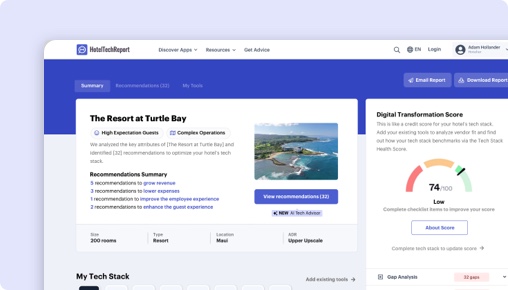
Sorry, this functionality is only available for verified hoteliers
The project dashboard is a free tool that is only available to verified hoteliers to make adopting new technology easier by streamlining their research and simplifying their communication workflow.

Attendance On Demand vs. Unifocus:
Welke past bij u?

Samenvatting
We hebben 40 geverifieerde hotelierbeoordelingen geanalyseerd, functiesets, prijzen en praktijkcasestudies vergeleken om te bepalen waar elk platform uitblinkt. De juiste keuze hangt af van uw type accommodatie en prioriteiten:
Attendance on Demand blinkt uit .
Unifocus blinkt uit in ease of use and customer support — vooral voor brand accommodaties (4.3/5) , met exclusieve functies zoals Mobile App and Reporting & Analytics.
Hoe verhoudt Attendance On Demand zich tot Unifocus?
Zij-aan-zij beoordelingen op basis van 40 geverifieerde hotelierbeoordelingen op HTR.
| HTScore |
|
|
| Waarschijnlijkheid om aan te bevelen |
|
|
| Gebruiksgemak |
|
|
| Klantenondersteuning |
|
|
| Prijs-kwaliteitverhouding |
|
|
| Vanafprijs | Contact sales | Contact sales |
| Geverifieerde beoordelingen | 0 | 40 |
Wat zijn de voor- en nadelen van Attendance On Demand vs Unifocus?
Na analyse van 40 geverifieerde beoordelingen waarderen Attendance on Demand-gebruikers vooral de , terwijl Unifocus-gebruikers de arbeidsmanagement, gebruiksvriendelijke interface, opleiding en ondersteuning benadrukken. Klik op een thema om te zien wat beoordelaars zeggen.
|
Attendance on Demand
|
Unifocus
|
|---|---|
| Voordelen | |
|
+
Arbeidsmanagement
▾
|
|
|
+
Gebruiksvriendelijke interface
▾
|
|
|
+
Opleiding en ondersteuning
▾
|
|
|
+
Naadloze integratie
▾
|
|
| Nadelen | |
|
−
Aanpassingsbehoeften
▾
|
|
|
−
Snelheid en reactievermogen
▾
|
|
|
−
Kritiek op de nieuwe versie
▾
|
|
Attendance on Demand vs Unifocus: Ranglijst per hotelsegment
Hoe elk product scoort onder Planning en personeelsbeheer-leveranciers voor verschillende accommodatiegroottes, -typen en regio's — op basis van geverifieerde beoordelingen van hoteliers in elk segment.
Op hotelgrootte
| Segment |
Attendance on Demand
|
Unifocus
|
|---|---|---|
| Klein (10-24 kamers) | — | #4 2 beoordelingen |
| Middelgroot (25-74 kamers) ▾ | — | #5 10 beoordelingen |
| Groot (75-199 kamers) ▾ | — | #4 17 beoordelingen |
| Extra groot (200+ kamers) ▾ | — | #4 7 beoordelingen |
Op accommodatietype
| Segment |
Attendance on Demand
|
Unifocus
|
|---|---|---|
| Boutique ▾ | — | #5 6 beoordelingen |
| Luxe ▾ | — | #4 19 beoordelingen |
| Merk / Keten ▾ | — | #4 17 beoordelingen |
| Langverblijf ▾ | — | #4 5 beoordelingen |
Op regio
| Segment |
Attendance on Demand
|
Unifocus
|
|---|---|---|
| Noord-Amerika ▾ | — | #4 34 beoordelingen |
| Europa | — | #2 3 beoordelingen |
| Azië-Pacific | — | #1 0 beoordelingen |
The Decision
Choosing the right workforce management solution for your hotel can be a game of precision. Attendance On Demand and Unifocus both aim to automate employee scheduling and labor tracking, but they differ significantly in features, user experience, and market presence. While Attendance On Demand is a cloud-based, straightforward system with no recent reviews or high ratings, Unifocus boasts a robust feature set, a large user base, and a more recent, highly-rated reputation. So, which is better suited for your hotel’s needs?
Both products aim to improve labor efficiency, reduce errors, and streamline scheduling. Attendance On Demand provides basic automation with a simple, cloud-based platform, but its lack of recent reviews and zero ratings suggest limited ongoing support or updates. Unifocus, meanwhile, offers an extensive array of features and continues to evolve, supported by over 37 reviews in the last six months. This active feedback loop provides a clearer picture of current performance and user satisfaction. Are you ready to lean toward a more established platform with a proven track record?
Is Attendance On Demand or Unifocus Better for Hotels?
Attendance On Demand is a basic, cloud-based employee time and labor tracking tool designed to fully automate scheduling and attendance management. However, it has no recent reviews, ratings, or user feedback, which makes assessing its current effectiveness impossible. Conversely, Unifocus, with a 4.25/5 rating based on 37 recent reviews, is a comprehensive platform that includes forecasting, real-time scheduling, task management, and more—for over a decade, it has been trusted by many hotels worldwide.
The key divergence lies in depth: Attendance On Demand offers limited features and no recent customer insights, making it hard to judge whether it truly meets modern hotel demands. Unifocus's recent reviews highlight satisfaction with its forecasting accuracy, ease of use, and support, making it the more reliable choice for active hotels. Do you need a basic system that might lack ongoing support, or a robust platform proven in the field?
Unifocus vs Attendance On Demand: Which Should Your Hotel Choose?
If your hotel requires a comprehensive, feature-rich workforce management solution that integrates with your existing PMS and scales across multiple properties, Unifocus is the clear winner. Its 14 unique features—like auto scheduling, labor standards, tip pooling, and mobile apps—are unmatched by Attendance On Demand, which has no unique features listed and no recent reviews to support functionality.
On the other hand, if your hotel needs a simple, straightforward tool for basic attendance tracking without the complexity or cost of advanced features, Attendance On Demand might suffice—though its lack of recent feedback makes this a risky assumption. Given Unifocus's positive reviews, ease of use (4.01/5), and 84% likelihood to recommend, it’s the safer, more future-proof investment if your goal is operational efficiency.
Is Attendance On Demand or Unifocus Easier to Use?
Unifocus's user interface receives a 4.01/5 rating, with many reviewers praising its intuitive design and straightforward navigation. The platform offers onboarding rated at 4/5, and users find it easy to manage tasks like scheduling, payroll, and reporting, with some noting that its mobile app simplifies communication and task management on the go.
In contrast, Attendance On Demand has no ratings or recent reviews, leaving its ease of use entirely unverified. With no current user feedback or support data, it’s impossible to confirm how intuitive or user-friendly it truly is. Edge: Unifocus.
Which Has Better Features: Attendance On Demand or Unifocus?
Unifocus offers 14 distinct features, including labor standards, dynamic scheduling, auto scheduling, tip pooling, mobile app, reporting & analytics, and team communication, among others. These features empower your team with automation, insight, and flexibility, supporting large and complex hotel operations.
Attendance On Demand, however, lists no features beyond basic employee attendance and labor tracking, with no unique or advanced capabilities. Its limited feature set and lack of recent updates suggest it may not meet the demands of modern hotel management. Edge: Unifocus.
Which Has Better Customer Support: Attendance On Demand or Unifocus?
Unifocus’s customer support scores a 4.19/5, with recent reviews lauding on-site training and responsive service. Customers appreciate its ongoing support, with one reviewer noting that the team “continues to update it with new processes which are user-friendly and easy for associates to use.”
Attendance On Demand has no ratings or recent reviews, making it impossible to evaluate support quality. The absence of recent feedback casts doubt on its ability to deliver timely, effective assistance. Edge: Unifocus.
Which Has More Integrations: Attendance On Demand or Unifocus?
Unifocus integrates with 32 verified partners, including PMS, payroll, and third-party systems like Kronos and Otelier. Its extensive integration options facilitate smooth data flow and operational cohesion across departments.
Attendance On Demand has only one verified integration partner, Actabl, which limits its ability to connect with other systems your hotel may rely on. For scalable, multi-system environments, Unifocus clearly leads. Edge: Unifocus.
Which Do Hoteliers Rate Higher: Attendance On Demand or Unifocus?
Unifocus’s recent reviews reflect a 4.25/5 rating and an 84% likelihood to recommend, indicating high current user satisfaction. Hotels across segments—resorts, branded, and regional hotels—rate it favorably, especially praising its forecasting and ease of use.
Attendance On Demand has no recent reviews or ratings, so its user satisfaction level remains unknown. The lack of recent feedback suggests it’s not actively used or supported in the field today. Edge: Unifocus.
How Much Do Attendance On Demand and Unifocus Cost?
Both products do not publish specific pricing details. They are offered as subscription-based services without upfront implementation fees or free trial options. Your hotel will need to contact sales for custom quotes.
What Type of Hotel Should Use Attendance On Demand?
- Hotels that need a simple, cloud-based employee attendance and labor tracking system.
- Small properties with minimal complexity or scheduling needs.
- Teams seeking a basic automation tool without extensive training or features.
- Hotels prioritizing low-cost, straightforward solutions with minimal integration requirements.
Not ideal if your hotel:
- Is looking for a comprehensive workforce management platform.
- Operates multiple properties requiring advanced scheduling tools.
- Needs real-time forecasting, analytics, or mobile management.
- Seeks ongoing support, training, and feature updates.
What Type of Hotel Should Use Unifocus?
- Hotels that require a full-featured workforce management platform.
- Properties with complex scheduling, labor standards, and multi-department needs.
- Hotel groups managing multiple locations and requiring seamless integration.
- Teams that value real-time data, forecasting, and detailed analytics.
Not ideal if your hotel:
- Prefers a minimal, low-cost attendance solution.
- Has very limited staffing needs or operates as a small boutique hotel.
- Needs quick setup with minimal training.
- Seeks a product with no recent customer reviews or active support.
Unifocus vs Attendance On Demand: The Bottom Line for Hotels
Unifocus is a comprehensive, feature-rich workforce management platform supported by recent reviews and a strong user base. Its 14 features, positive user feedback, and integration options make it suitable for hotels seeking operational efficiency and scalability.
Attendance On Demand offers a basic, cloud-based solution with no recent feedback or ratings, making it a risky choice for hotels that need ongoing support or advanced features. Its limited capabilities may suit very small properties with minimal scheduling complexity but fall short for larger or more dynamic operations.
If your hotel needs a proven, scalable platform with active support, go with Unifocus. Its extensive feature set and recent positive reviews make it the safer, more effective choice.
Choose Attendance On Demand only if you require a minimal, budget-friendly tool and are prepared to accept limited support and future growth potential.
For long-term success, especially in a competitive hospitality environment, Unifocus delivers the automation, insights, and integration your team needs to operate smarter and serve guests better.
Hoeveel kosten Attendance On Demand en Unifocus?
Prijzen voor Planning en personeelsbeheer zijn zelden eenvoudig. Dit is wat we weten op basis van de openbare prijsgegevens van elke leverancier. Vraag altijd een offerte op maat aan voor uw accommodatie.
|
Attendance on Demand
|
Unifocus
|
|---|
Functievergelijking: Attendance On Demand vs Unifocus
Dit zijn de functies die elke leverancier heeft geconfigureerd, geordend per functiegroep — dezelfde gegevens als in het leveranciersdashboard. Vouw een groep uit om functies naast elkaar te vergelijken.
| Functie |
Attendance on Demand
|
Unifocus
|
|---|---|---|
|
▾
Ploegen en planning
|
|
|
| Shift Swappen | ||
| Automatische planning | ||
| Tijdklok-app | ||
| Dynamische planning | ||
| Arbeidsnormen | ||
|
▾
Tijdregistratie
|
|
|
| Tijdklok-app | ||
|
▾
Analyse en benchmarking
|
|
|
| Benchmarking | ||
| Rapportage en analyse | ||
| Bedrijfszichtbaarheid | ||
| Geautomatiseerde arbeidsbewaking | ||
| Arbeidsnormen | ||
| Integratie van bezettingsprognose | ||
|
▾
Taken & Checklists
|
|
|
| Taken en takenlijsten | ||
|
▾
Berichten en communicatie
|
|
|
| Teamcommunicatie | ||
| Applicatie voor de mobiele telefoon | ||
|
▾
Beheer van voordelen
|
|
|
| Opgebouwde uitkeringen | ||
| Tip poolen |
Attendance on Demand vs Unifocus: De conclusie
Wat hoteliers waarderen
Gebruikers prijzen de software voor zijn robuuste arbeidsbeheermogelijkheden, waaronder planning, scheduling en analyse van arbeidsbehoeften. Het is v... Gebruikers prijzen de software voor zijn robuuste arbeidsbeheermogelijkheden, waaronder planning, scheduling en analyse van arbeidsbehoeften. Het is vooral handig voor het beheren van zowel kleine als grootschalige operaties, met de mogelijkheid om gegevens uit verschillende systemen te halen om prognoses te stroomlijnen.
Veel reviewers waarderen de gebruiksvriendelijke interface van UniFocus, met nadruk op de intuïtieve front-end en georganiseerde back-end. Gebruikers... Veel reviewers waarderen de gebruiksvriendelijke interface van UniFocus, met nadruk op de intuïtieve front-end en georganiseerde back-end. Gebruikers vinden het makkelijk om te navigeren en taken zoals planning en arbeidsbeheer te beheren, waardoor het toegankelijk is voor nieuwe managers en supervisors.
Hoewel de software hoge cijfers krijgt voor on-site training en support, vinden gebruikers dat de initiële online training verbeterd kan worden. On-si... Hoewel de software hoge cijfers krijgt voor on-site training en support, vinden gebruikers dat de initiële online training verbeterd kan worden. On-site training wordt benadrukt als zeer effectief en boeiend.
Waar hoteliers kritiek op hebben
Sommige gebruikers geven aan dat ze behoefte hebben aan meer aanpassingsopties in de gebruikersinterface en de mogelijkheid om toegang te krijgen tot... Sommige gebruikers geven aan dat ze behoefte hebben aan meer aanpassingsopties in de gebruikersinterface en de mogelijkheid om toegang te krijgen tot de uitgebreide rapportagegeschiedenis zonder dat ze op specifieke tijdstippen rapporten hoeven te genereren en op te slaan.
Een aantal reviewers uiten hun frustratie over de trage snelheid en het gebrek aan responsiviteit van de UniFocus-software. Dit is met name problemati... Een aantal reviewers uiten hun frustratie over de trage snelheid en het gebrek aan responsiviteit van de UniFocus-software. Dit is met name problematisch tijdens piekmomenten zoals goedkeuring van de salarisadministratie.
Unieke mogelijkheden
Waar de beoordelingen het meest uiteenlopen
Veelgestelde vragen over Attendance On Demand vs Unifocus
Kan Attendance On Demand Unifocus vervangen?
Dat hangt af van uw eisen. Attendance On Demand en Unifocus delen veel kern-Scheduling & Workforce Management-functies, maar elk heeft unieke mogelijkheden. Attendance On Demand biedt 1 geverifieerde integratiepartners, terwijl Unifocus er 32 biedt. Bekijk de functievergelijking hierboven om te zien waar ze verschillen voordat u overstapt.
Welke is beter voor kleine of onafhankelijke hotels?
Kleine hotels moeten prioriteit geven aan gebruiksgemak en snelle onboarding. Unifocus scoort het hoogst op gebruiksgemak met 4.0/5 vs 0.0/5. Let op transparante prijzen en de mogelijkheid van een proefperiode of demo. Filter beoordelingen op elke productpagina op accommodatiegrootte om te horen van hotels zoals het uwe.
Bieden Attendance On Demand of Unifocus een gratis abonnement aan?
Attendance On Demand: Nee. Unifocus: Nee. Geen van beide producten biedt momenteel een gratis abonnement aan. De meeste Scheduling & Workforce Management-leveranciers bieden demo's of proefperiodes aan — vraag er bij beide een aan om te evalueren voordat u zich vastlegt.
Hoe evalueert en rangschikt HTR Attendance On Demand en Unifocus?
De HT Score is een samengestelde ranglijst die 4 criteriagroepen en meer dan tien variabelen meeweegt om hoteliers te helpen hoteltechnologieproducten objectief te vergelijken. Attendance on Demand heeft een HT Score van 0 en Unifocus heeft 74. Zo wordt de score berekend.
| Criteriagroep | Weging | Wat het meet |
|---|---|---|
| Klantbeoordelingen & reviews |
|
Hoe hoog beoordelen gebruikers dit product? Beoordelingsscore, reviewvolume, marktaandeel, reviewdiepte, reviewrecentheid, succesverhalen ▾ De zwaarst gewogen factor. Analyseert gemiddelde tevredenheidsbeoordelingen (waarschijnlijkheid om aan te bevelen, gebruiksgemak, ondersteuning, ROI), het totale aantal reviews ten opzichte van categoriegenoten, recentheid van reviews (minimaal 20 reviews in de afgelopen 6 maanden) en marktaandeel over unieke hotelklanten om selectiebias te detecteren. |
| Partnerecosysteem |
|
Hoe hoog beoordelen technologiepartners dit bedrijf? Partneraanbevelingen, integratieaantal, integratiekwaliteit ▾ Evalueert partneraanbevelingen als expertstemmen van vertrouwen, het aantal geverifieerde integraties en ecosysteemkwaliteit — de gemiddelde HT Scores van integratiepartners. Producten met een kwalitatief beter integratie-ecosysteem leveren waarschijnlijker een verbonden technologiearchitectuur. |
| Klantgerichtheid |
|
Hoe klantgericht is deze organisatie? Gecertificeerde ondersteuning, reviewconsistentie, profielvolledigheid ▾ Beoordeelt of het bedrijf HTR Customer Support-certificering heeft verdiend, consistente reviewverzameling in de loop der tijd onderhoudt (een indicator van feedbackgedreven cultuur) en productprofielen compleet houdt met mogelijkheden, schermafbeeldingen, prijzen en functies. |
| Bereik, stabiliteit & middelen |
|
Hoe uitgebreid is het bereik en de middelen van dit bedrijf? Geografisch bereik, stabiliteit, bedrijfsmiddelen, trendscore ▾ Meet wereldwijde aanwezigheid (bediende landen en regio's), aantal jaren in bedrijf als stabiliteitsindicator, teamgrootte als middelenproxy en een trendscore op basis van kopersaanvragen, reviews, partneraanbevelingen en persactiviteit in de afgelopen twaalf maanden. |
Klantbeoordelingen en reviews zijn veruit de belangrijkste factor in het HT Score-algoritme. HTR accepteert geen betaling voor hogere ranglijstposities. Alle reviews zijn geverifieerd — alleen professionals uit de hotelbranche met bevestigde affiliaties kunnen beoordelingen indienen. Bekijk de volledige HT Score-methodologie →
Welke andere Planning en personeelsbeheer-vergelijkingen lezen hoteliers?
Ontdek meer directe vergelijkingen op basis van geverifieerde hotelierbeoordelingen.

Inhoud
Ontvang uw gratis AI-analyserapport
Aanbevelingen op maat, afgestemd op uw woning.


