

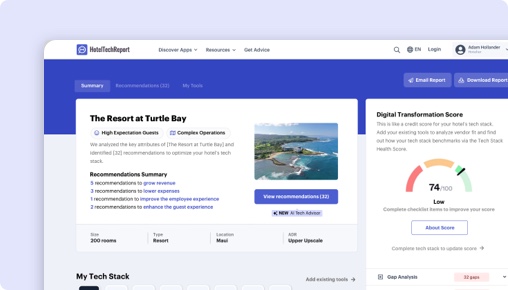
抱歉,此功能仅向已认证的酒店从业者开放
项目面板是一款免费工具,仅向已认证的酒店从业者开放。它通过简化调研流程和沟通环节,让采用新技术变得更轻松。

Apaleo Open PMS vs. Clock PMS:
哪个更适合您?
摘要
我们分析了 359 条经验证的酒店经营者评价,比较了功能集、定价和真实案例研究,以全面解析每个平台的优势。最佳选择取决于您的酒店类型和优先事项:
apaleo GmbH 表现出色 在 频繁更新和社区参与 方面 .
Clock 表现出色 在 ease of use and intuitive design 方面 — 尤其适合 independent 类型的住宿设施 (4.9/5) ,拥有独特功能如 Revenue management module and Guest profiles.
Apaleo Open PMS 与 Clock PMS 相比如何?
基于 HTR 上 359 条经验证的酒店经营者评价的并排评分。
| HTScore |
|
|
| 推荐可能性 |
|
|
| 易用性 |
|
|
| 客户支持 |
|
|
| 性价比 |
|
|
| 起始价格 | 起价 $900/月 | 起价 $600/月 |
| 经验证的评价 | 30 | 329 |
Apaleo Open PMS 与 Clock PMS 的优缺点是什么?
在分析了 359 条经验证的评价后,apaleo GmbH 用户最看重其 频繁更新和社区参与, 定制化和灵活性, open api and integration,而 Clock 用户则强调 ease of use and intuitive design, 预订和客房管理, 集成与自动化。点击任意主题查看评价者的反馈。
 apaleo GmbH
|
 Clock
Clock
|
|---|---|
| 优点 | |
|
+
频繁更新和社区参与
▾
|
+
Ease of Use and Intuitive Design
▾
|
|
+
定制化和灵活性
▾
|
+
预订和客房管理
▾
|
|
+
Open API and Integration
▾
|
+
集成与自动化
▾
|
|
+
App Store and Third-Party Integrations
▾
|
+
培训和入职
▾
|
| 缺点 | |
|
−
报告功能
▾
|
−
功能更新和可用性
▾
|
|
−
团体和预订管理
▾
|
−
报告和分析
▾
|
|
−
连接性和同步性
▾
|
|
apaleo GmbH 对比 Clock:按酒店细分市场排名
各产品在不同酒店规模、类型和区域的 酒店运营软件(PMS) 供应商中的排名——基于各细分市场中酒店经营者的经验证评价。
按酒店规模
| 细分市场 |
apaleo GmbH
|
Clock
|
|---|---|---|
| 小型(10-24 间客房) ▾ | #42 7 条评价 | #11 117 条评价 |
| 中型(25-74 间客房) ▾ | #27 19 条评价 | #7 157 条评价 |
| 大型(75-199 间客房) ▾ | #41 1 条评价 | #17 9 条评价 |
| 超大型(200+ 间客房) ▾ | #14 3 条评价 | #11 5 条评价 |
按酒店类型
| 细分市场 |
apaleo GmbH
|
Clock
|
|---|---|---|
| 精品酒店 ▾ | #34 14 条评价 | #8 165 条评价 |
| 豪华酒店 ▾ | #43 4 条评价 | #11 80 条评价 |
| 品牌/连锁酒店 ▾ | #40 4 条评价 | #8 62 条评价 |
| 长住酒店 ▾ | #19 9 条评价 | #9 27 条评价 |
按区域
| 细分市场 |
apaleo GmbH
|
Clock
|
|---|---|---|
| 北美 ▾ | #38 2 条评价 | #17 30 条评价 |
| 欧洲 ▾ | #18 26 条评价 | #3 228 条评价 |
| 亚太 ▾ | — | #11 13 条评价 |
| 中东 | — | #17 2 条评价 |
The Decision
Choosing between apaleo Open PMS and Clock PMS hinges on your hotel's specific operational needs and growth plans. Both systems aim to streamline hotel management, but they approach this goal differently—apaleo excels with its open API, while Clock offers an all-in-one platform. Your decision should consider your current tech infrastructure, customization desires, and future expansion.
The key is understanding which features and support structures align best with your hotel's size, segment, and technological sophistication. Are you seeking a highly flexible, integrative system or a comprehensive, easy-to-implement solution? Let’s compare.
Is apaleo Open PMS or Clock PMS Better for Hotels?
Both apaleo and Clock address core hotel management challenges—reservations, billing, guest communication, and operations. Apaleo’s open API enables extensive customization and integration, allowing your team to build a tailored tech stack, but it requires more setup time and technical resources. Clock, on the other hand, provides a ready-to-go, feature-rich platform that covers most operational needs without extensive customization.
In recent reviews, Clock's higher user ratings (4.8/5 vs. 0/5 for apaleo’s overall rating, which reflects limited total reviews) and more recent feedback (6 reviews for Clock in the last 6 months versus 1 for apaleo) give it a clearer edge. Are you comfortable with a platform that’s flexible but may need more setup, or prefer a system with proven, comprehensive features?
Clock PMS vs apaleo Open PMS: Which Should Your Hotel Choose?
If your hotel needs a robust, all-in-one system that minimizes setup and training, Clock is the better choice. Its extensive feature set—including reservations, rates, invoicing, guest messaging, and integrations like booking engines and payment automation—serves properties that want a streamlined, out-of-the-box solution.
Conversely, if your team values customization, integration flexibility, and the ability to create a personalized tech ecosystem, apaleo is preferable. Its open API and active app store appeal to hotels with dedicated IT resources or those planning to scale and leverage third-party integrations.
Is apaleo Open PMS or Clock PMS Easier to Use?
Both platforms score highly for ease of use—apaleo at 4.9/5 and Clock at 4.78/5—indicating user-friendly interfaces. Apaleo’s onboarding gets a slight nod for its quick setup, with reviews highlighting its simplicity and friendly design. Clock’s intuitive interface and straightforward workflows make training new staff easier, especially for properties emphasizing quick adaptation.
However, apaleo’s flexibility might lead to a steeper learning curve initially, especially when integrating multiple systems. Clock’s all-in-one approach reduces the need for extensive customization, making it more straightforward for teams to adopt.
Edge: Clock.
Which Has Better Features: apaleo Open PMS or Clock PMS?
Clock boasts 21 features exclusive to its system—booking engine, EPoS, revenue management, guest CRM, multi-currency, guest app, and more—making it highly comprehensive. Apaleo, with 37 shared features, relies heavily on integrations to extend functionality but offers zero features solely in its native system.
If your hotel values a built-in suite of features out of the box, Clock has a clear advantage. If you prefer to customize and tailor your operations with specific apps and integrations, apaleo’s open API provides more options, but at the cost of added complexity.
Edge: Clock.
Which Has Better Customer Support: apaleo Open PMS or Clock PMS?
Review scores indicate both platforms are well-supported—apaleo at 4.83/5 and Clock at 4.75/5. Apaleo’s community and support are praised for responsiveness, with reviews stating, “They always listen to the community,” and “Excellent support.” Clock’s team is also commended, with users appreciating quick responses, saying, “The staff have been very efficient in helping us.”
However, apaleo’s support is slightly more recent in reviews and has a higher overall rating, suggesting a marginal edge for hotels prioritizing support quality.
Edge: apaleo.
Which Has More Integrations: apaleo Open PMS or Clock PMS?
apaleo features 120 verified partners, including popular integrations like HQ Revenue, Profitroom, and hotelkit. Clock offers 111 verified partners, with shared integrations such as Revenue, Profitroom, and Fairmas, plus unique ones like hotel investor apps and mobile key solutions.
While apaleo’s broader partner network offers more flexibility, Clock’s strong integration suite is ample for most operational needs. If extensive third-party integration is critical, apaleo has a slight edge; otherwise, Clock’s existing ecosystem is sufficient.
Edge: apaleo.
Which Do Hoteliers Rate Higher: apaleo Open PMS or Clock PMS?
Clock's reviews are more numerous and recent, with a 4.8/5 rating based on 251 reviews, compared to apaleo’s 29 reviews and a 77.5 score. For property types like independent hotels, boutique hotels, and hostels, Clock's ratings are consistently high, with users praising its simplicity, speed, and reliability.
apaleo's limited review count and older reviews make its ratings less reliable. Given recent feedback, Clock is clearly the more highly-rated product among hoteliers.
Edge: Clock.
How Much Do apaleo and Clock Cost?
apaleo charges a flat $900 monthly fee, with no free tier, trial, or per-room charges currently reported. Clock’s pricing is lower at $600 per month, also without free or trial options.
Though apaleo is more expensive, its flexible API can justify costs for hotels needing extensive customization. For properties seeking a straightforward, cost-effective solution, Clock offers a more accessible price point.
What Type of Hotel Should Use apaleo Open PMS?
- Hotels that need extensive customization and integration, such as chains with unique workflows.
- Properties aiming for a flexible tech ecosystem, including serviced apartments and boutique hotels.
- Teams that have dedicated IT staff to manage integrations and ongoing development.
- Hotels looking to future-proof their tech stack with an open platform.
Not ideal if:
- You prefer a ready-to-use system with minimal setup.
- Your hotel has limited technical resources.
- You need out-of-the-box features without extensive third-party integrations.
What Type of Hotel Should Use Clock PMS?
- Hotels seeking a comprehensive, all-in-one platform with minimal setup.
- Properties that value ease of use, quick onboarding, and consistent updates.
- Hotels that want to streamline operations across reservations, invoicing, guest messaging, and more.
- Businesses that prioritize automation and guest engagement features.
Not ideal if:
- Your property requires highly customized workflows.
- You intend to build a tech ecosystem with extensive third-party apps.
- You prefer open access to APIs for personalized integrations beyond Clock’s offerings.
Clock vs apaleo: The Bottom Line for Hotels
Clock’s strong points are its extensive feature set, ease of use, and high guest satisfaction ratings. Its all-in-one approach reduces setup time and simplifies staff training, making it ideal for properties seeking immediate operational improvements.
apaleo shines with its open API and integration flexibility, best suited for hotels with dedicated tech teams aiming to customize and grow their digital infrastructure. Its community support and recent updates also add value for tech-savvy operators.
If your hotel values simplicity and rapid deployment, Clock is the clear choice. If customization, integrations, and future growth matter more, apaleo is the better fit.
In summary, for most hotels looking for a reliable, easy-to-implement solution backed by recent positive reviews, Clock is the recommended option. However, if your hotel’s strategy involves building a tailored, scalable tech ecosystem, apaleo remains a compelling choice.
Apaleo Open PMS 和 Clock PMS 的价格是多少?
酒店运营软件(PMS) 的定价很少是简单明了的。以下是我们从各供应商公开定价数据中了解到的信息。请务必根据您的酒店规模申请定制报价。
|
apaleo GmbH
|
Clock
|
|
|---|---|---|
| 起始价格 | 起价 $900/月 | 起价 $600/月 |
功能对比:Apaleo Open PMS 与 Clock PMS
这些是每个供应商配置的功能,按功能组进行整理——与供应商后台中显示的数据相同。展开任意功能组即可并排比较功能。
| 功能 |
apaleo GmbH
|
Clock
|
|---|---|---|
|
▾
会计与金融
|
|
|
| 直接计费 | ||
| RevPaR 和 ADR 报告 | ||
| 多币种 | ||
| 交易电子邮件(预订、作品集等) | ||
| 自动夜间审计 | ||
|
▾
营销与电子商务
|
|
|
| 访客通信(短信) | ||
| 原生电子邮件营销 | ||
| 客人资料 | ||
| 客户关系管理 | ||
| 礼品卡 | ||
| 频道管理员 | ||
| 预订引擎 | ||
| 交易电子邮件(预订、作品集等) | ||
|
▾
管理和配置
|
|
|
| 集中的用户和角色管理 | ||
| 多种语言 | ||
| 基于云 | ||
| 在前提 | ||
|
▾
用户管理
|
|
|
| 访客通信(短信) | ||
| 客人资料 | ||
| 集中消息传递 | ||
| 交易电子邮件(预订、作品集等) | ||
|
▾
前台
|
|
|
| 移动设备笔记和任务(语音转文本) | ||
| 移动应用 | ||
| 自动夜间审计 | ||
| 日历视图 | ||
| 多种语言 | ||
| 任务管理 | ||
| 自动提醒 | ||
| 客人资料 | ||
| 平板电脑/自助服务终端值机 | ||
| 付款请求 | ||
| 集中消息传递 | ||
| 自动空间优化 | ||
|
▾
群组管理
|
|
|
| 组功能 | ||
| 自动空间优化 | ||
|
▾
宾客体验
|
|
|
| 集成身份证和护照扫描仪 | ||
| 数字注册 | ||
| 访客应用 | ||
| 网上值机 | ||
| 在线结帐 | ||
| 来宾消息 | ||
| 交易电子邮件(预订、作品集等) | ||
| 身份证扫描和注册预填 | ||
| 大堂售货亭 | ||
|
▾
家政
|
|
|
| 管家模块 | ||
| 家政移动应用程序 | ||
| 实时状态更新 | ||
| 自动分配 | ||
| 实时报告 | ||
| 轮班计划 | ||
| 员工信息 | ||
| 在线结帐 | ||
|
▾
付款
|
|
|
| 集成支付终端和读卡器 | ||
| 直接计费 | ||
| 多币种 | ||
| 交付过程 | ||
| 付款请求 | ||
|
▾
预订管理
|
|
|
| RevPaR 和 ADR 报告 | ||
| 礼品卡 | ||
| 频道管理员 | ||
| 综合 CRS | ||
| 拖放磁带图 | ||
| 费率管理 | ||
| 自动空间优化 | ||
| 基于规则的房间分配 | ||
| 交易电子邮件(预订、作品集等) | ||
|
▾
收入管理
|
|
|
| RevPaR 和 ADR 报告 | ||
| 自定义费率 | ||
| 辅助收入跟踪 | ||
| 收益管理模块 | ||
| 基本定价 | ||
|
▾
税务与合规
|
|
|
| 符合 PCI 标准 | ||
| 符合 GDPR | ||
| SOC2 投诉 | ||
| 税务配置 | ||
|
▾
支持与培训
|
|
|
| 在线 24/7 支持 | ||
|
▾
食品与饮料
|
|
|
| EPoS | ||
|
▾
温泉
|
|
|
| 水疗和健康模块 |
实际成果:apaleo GmbH 对比 Clock(按业务目标)
我们分析了 11 个经验证的案例研究,比较了酒店在四个关键业务目标上使用每个平台实际取得的成果。
apaleo GmbH
该目标暂无已发布的案例研究。
Events Hotels WICC
大型
"Clock is best all-in-one platform for managing hotel and event operations in one connected environment. It makes it easy to track bookings, organize group reservations, and handle..."
 mk | hotels
中型
mk | hotels
中型
"One of the biggest impacts for us has been the vast array of implementation options available on Apaleo. We’re now able to think outside the box and customise solutions in ways we..."
 Elegancia Hotels Paris
中型
Elegancia Hotels Paris
中型
"Elegancia selected Clock for its flexibility, strong integration capabilities, and robust multi-property management—an essential requirement for a growing hotel group. The ability..."
 apaleo GmbH
该目标暂无已发布的案例研究。
Hotel Mitland
小型
"Quicker service, reduced request errors, and more consistent operations, resulting in higher guest satisfaction"

apaleo GmbH 对比 Clock:总结
酒店经营者喜爱的方面
该平台致力于定期更新和社区参与,并广受好评,用户也非常重视平台对用户反馈和持续改进的关注。活跃的社区构建了一个支持网络,提升了用户体验。
用户高度评价 Apaleo 在定制化方面的优势,它支持定制化工作流程和流程自动化。这种灵活性有助于酒店创建完全符合其运营需求的系统,从而提高效率并改善宾客服务... 用户高度评价 Apaleo 在定制化方面的优势,它支持定制化工作流程和流程自动化。这种灵活性有助于酒店创建完全符合其运营需求的系统,从而提高效率并改善宾客服务。
Apaleo's open API is uniquely praised for enabling custom tech stacks and seamless integration with various systems, greatly enhancing efficiency and... Apaleo's open API is uniquely praised for enabling custom tech stacks and seamless integration with various systems, greatly enhancing efficiency and flexibility in operations. Reviewers appreciate the ability to create their own applications and tech ecosystems, significantly setting Apaleo apart from its competitors.
酒店经营者提出异议的方面
虽然用户重视基本的报告功能,但 Apaleo 的高级报告功能需求也十分明显。许多人发现当前的选项有限,因此不得不依赖其他工具进行更深入的分析。
Apaleo 的群组管理功能因其用户友好性而受到称赞,但一些评论指出仍有需要改进的地方,特别是在综合功能和直观性方面。
排名更高的方面
酒店经营者喜爱的方面
Many users are impressed with Clock PMS+ for its user-friendly interface and intuitive design, which simplifies the training process for new employees... Many users are impressed with Clock PMS+ for its user-friendly interface and intuitive design, which simplifies the training process for new employees and enhances operational efficiency. The software's straightforward navigation and learnability make it ideal for fast-paced environments.
评论者经常提到,Clock PMS+ 提供了高效的预订和客房管理工具。它将预订、客房管理和宾客沟通等各种运营环节整合到一个平台上,从而节省时间并减少错误。
用户非常欣赏 Clock PMS+ 的广泛集成和自动化功能,它可以与其他系统无缝连接,节省重复性任务的时间,并增强日常运营。
酒店经营者提出异议的方面
一些评论者表示,他们在适应新功能更新方面遇到了一些挑战,他们认为,虽然这些改进是有益的,但有时会影响用户体验。因此,他们呼吁制定更平滑的过渡流程来更好... 一些评论者表示,他们在适应新功能更新方面遇到了一些挑战,他们认为,虽然这些改进是有益的,但有时会影响用户体验。因此,他们呼吁制定更平滑的过渡流程来更好地适应这些更新。
一些用户指出,虽然 Clock PMS+ 提供了全面的报告,但在数据收集和呈现方式方面仍有改进的空间,这可以增强收入管理和战略规划。
排名更高的方面
独特功能
评分差异最大的方面
关于 Apaleo Open PMS 与 Clock PMS 的常见问题
Apaleo Open PMS 能否替代 Clock PMS?
这取决于您的需求。Apaleo Open PMS 和 Clock PMS 共享许多核心 Property Management Systems 功能,但各有独特的能力。Apaleo Open PMS 提供 122 个经验证的集成合作伙伴,而 Clock PMS 提供 109 个。在切换之前,请查看上方的功能对比以了解它们的差异。
哪个更适合小型或独立酒店?
小型酒店应优先考虑易用性和快速上手。Apaleo Open PMS 在易用性方面领先,评分为 4.9/5 对比 4.8/5。寻找透明定价以及试用或演示选项。在各产品页面上按酒店规模筛选评价,了解与您类似的酒店的反馈。
Apaleo Open PMS 或 Clock PMS 是否提供免费方案?
Apaleo Open PMS:否。Clock PMS:否。 两款产品目前均不提供免费版。大多数 Property Management Systems 供应商提供演示或试用——在做出承诺之前,请分别向各供应商申请体验。
HTR 如何评估和排名 Apaleo Open PMS 和 Clock PMS?
HT Score 是一个综合排名,考虑 4 个标准组和十多个变量,帮助酒店经营者客观比较酒店科技产品。apaleo GmbH 的 HT Score 为 75,Clock 的为 87。以下是评分的计算方式。
| 标准组 | 权重 | 衡量内容 |
|---|---|---|
| 客户评分与评价 |
|
用户对该产品的推荐度如何? 评分分数、评价数量、声量份额、评价深度、评价时效性、成功案例 ▾ 权重最高的因素。分析平均满意度评分(推荐可能性、易用性、支持、投资回报率)、相对于同类产品的评价总数、评价时效性(最近 6 个月内至少 20 条评价)以及跨独立酒店客户的声量份额以检测选择偏差。 |
| 合作伙伴生态系统 |
|
技术合作伙伴对该公司的推荐度如何? 合作伙伴推荐、集成数量、集成质量 ▾ 评估合作伙伴推荐作为专家信心投票、经验证集成的数量以及生态系统质量——集成合作伙伴的平均 HT Score。拥有更高质量集成生态系统的产品更有可能提供互联互通的技术栈。 |
| 以客户为中心 |
|
该组织以客户为中心的程度如何? 认证支持、评价一致性、资料完整性 ▾ 评估公司是否获得 HTR 客户支持认证、是否保持持续的评价收集(反馈驱动文化的指标)以及产品资料是否完整,包括功能、截图、定价和特性。 |
| 覆盖范围、持久力与资源 |
|
该公司的覆盖范围和资源有多广泛? 地理覆盖、持久力、公司资源、趋势评分 ▾ 衡量全球覆盖(服务的国家和区域)、经营年限作为稳定性指标、团队规模作为资源指标,以及基于近十二个月买家咨询、评价、合作伙伴推荐和媒体活动的趋势评分。 |
客户评分和评价是 HT Score 算法中最重要的因素。HTR 不接受付费以提高排名。所有评价均经过验证——只有经确认从属关系的酒店行业从业者才能提交评分。 查看完整 HT Score 评估方法 →
酒店经营者还在阅读哪些 酒店运营软件(PMS) 对比?
探索更多基于经验证酒店经营者评价的一对一对比。






获取您的免费人工智能分析师报告
根据您酒店的情况量身定制的推荐


让我们查找您的酒店信息
还在权衡您的 酒店运营软件(pms) 选项吗?
我们 酒店运营软件(pms) 指南中的一些热门系统——或者让我们的 AI 在大约两分钟内根据您酒店的具体情况为每个系统评分。


