

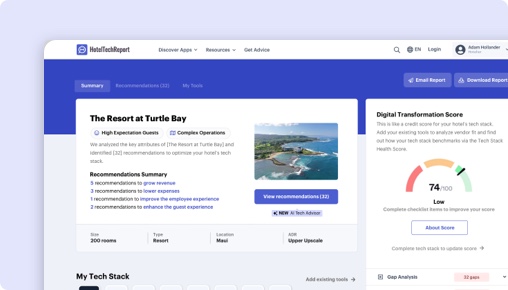
מצטערים, פונקציונליות זו זמינה רק למלונאים מאומתים
לוח המחוונים של הפרויקטים הוא כלי חינמי הזמין רק למלונאים מאומתים, והוא מקל על אימוץ טכנולוגיות חדשות באמצעות ייעול המחקר ופישוט תהליכי התקשורת.

Demand Calendar vs. happyhotel:
מה מתאים לכם?


בקצרה
ניתחנו 222 ביקורות מאומתות של מלונאים, השווינו מערכי תכונות, תמחור ומקרי בוחן מהשטח כדי לפרק היכן כל פלטפורמה מצטיינת. הבחירה הנכונה תלויה בסוג המלון ובסדרי העדיפויות שלכם:
Demand Calendar AB בולט בתכונות בלעדיות כמו דיווח על תובנות שוק.
happyhotel מצטיין בתמיכה, הדרכה והטמעה — במיוחד עבור אתרי אירוח מרכז העיר (4.9/5), עם תכונות ייחודיות כמו ניהול הכנסות אוטומטי לחלוטין ועיצוב ידידותי לנייד.
איך Demand Calendar משתווה ל-happyhotel?
דירוגים זה לצד זה על סמך 222 ביקורות מאומתות של מלונאים ב-HTR.
| HTScore |
|
|
| סבירות להמלצה |
|
|
| קלות שימוש |
|
|
| תמיכת לקוחות |
|
|
| תמורה לכסף |
|
|
| מחיר התחלתי | החל מ-$600/חודש | החל מ-$500/חודש |
| ביקורות מאומתות | 7 | 215 |
מהם היתרונות והחסרונות של Demand Calendar מול happyhotel?
לאחר ניתוח 222 ביקורות מאומתות, משתמשי Demand Calendar AB מעריכים ביותר את , בעוד משתמשי happyhotel מדגישים את תמיכה, הדרכה והטמעה, דוחות, לוחות מחוונים וניתוחים, השפעת ההכנסות וחיסכון בזמן. לחצו על כל נושא כדי לראות מה אומרים המבקרים.
|
Demand Calendar AB
|
happyhotel
|
|---|---|
| יתרונות | |
|
+
תמיכה, הדרכה והטמעה
▾
|
|
|
+
דוחות, לוחות מחוונים וניתוחים
▾
|
|
|
+
השפעת ההכנסות וחיסכון בזמן
▾
|
|
|
+
טייס אוטומטי / תמחור אוטומטי
▾
|
|
| חסרונות | |
Demand Calendar AB מול happyhotel: דירוגים לפי פלח מלונאות
כיצד כל מוצר מדורג בין ספקי מערכות ניהול הכנסות עבור גדלי מלונות, סוגים ואזורים שונים — על סמך ביקורות מאומתות ממלונאים בכל פלח.
לפי גודל מלון
| פלח |
Demand Calendar AB
|
happyhotel
|
|---|---|---|
| קטן (10-24 חדרים) ▾ | #39 2 ביקורות | #4 98 ביקורות |
| בינוני (25-74 חדרים) ▾ | #34 5 ביקורות | #7 83 ביקורות |
| גדול (75-199 חדרים) ▾ | — | #11 11 ביקורות |
| גדול במיוחד (200+ חדרים) | — | #21 1 ביקורות |
לפי סוג מלון
| פלח |
Demand Calendar AB
|
happyhotel
|
|---|---|---|
| בוטיק ▾ | #39 5 ביקורות | #10 54 ביקורות |
| יוקרה ▾ | #40 2 ביקורות | #16 26 ביקורות |
| רשת / מותג ▾ | #37 2 ביקורות | #7 33 ביקורות |
| שהייה מורחבת ▾ | — | #7 23 ביקורות |
לפי אזור
| פלח |
Demand Calendar AB
|
happyhotel
|
|---|---|---|
| אירופה ▾ | #29 5 ביקורות | #6 196 ביקורות |
| אסיה פסיפיק | #13 2 ביקורות | #25 1 ביקורות |
Is Demand Calendar by Demand Calendar AB or happyhotel by happyhotel Better for Hotels?
Demand Calendar and happyhotel both address revenue management challenges but diverge significantly in scope and target users. Demand Calendar functions primarily as a hotel business intelligence tool, aggregating PMS, RMS, STR, and budget data to forecast total revenue and profit across rooms, F&B, meetings, and spa. It is tailored for hotel groups seeking strategic alignment across departments. In contrast, happyhotel is a cloud-based revenue management system focused on real-time dynamic pricing automation designed for hotels of all sizes, especially small to medium properties aiming to increase revenue through algorithm-driven price optimization.
Both tools solve the core problem of revenue predictability and pricing efficiency. Demand Calendar provides a consolidated forecast platform to identify budget risks and opportunities across multiple revenue streams, aiding operational coordination. happyhotel automates pricing decisions with autopilot features, competitor benchmarking, and demand signals, reducing manual intervention and improving rate agility. Hotels that want a holistic business intelligence view with manual pricing controls may lean towards Demand Calendar, while those prioritizing automated yield management and frequent rate updates will find happyhotel a more complete revenue management solution.
Demand Calendar vs happyhotel: Which Should Your Hotel Choose?
If you operate a multi-department or multi-property hotel group that requires consolidated forecasting across rooms, F&B, meetings, and spa, Demand Calendar’s integration of PMS, RMS, and market data offers a strategic advantage by aligning revenue, sales, marketing, and operations around one forecast. This insight fits properties with complex revenue streams and organizational layers, reflected in its user base with 44% boutique hotels and 14% branded hotels, predominantly in Europe and North America.
If your hotel is a small to medium-sized property or a chain seeking automated pricing to maximize occupancy and ADR, happyhotel’s dynamic pricing algorithms, autopilot function, and real-time market benchmarking provide superior operational value. Its extensive feature set (32 unique features) and integration with 25 verified partners including top PMS systems like Opera Cloud and protel support rapid adoption and ongoing revenue optimization. Review data from 215 hoteliers, including 50 recent reviews at 4.8/5, confirms its suitability for properties ranging from boutique hotels to luxury resorts.
Data for luxury hotels and boutique hotels is robust for both products, but happyhotel has broader segment coverage and more recent reviews. Demand Calendar’s limited review count (7 total, none recent) suggests its current market presence is narrower, making happyhotel the safer choice for broader hotel segments and chains requiring automated, scalable revenue management.
Is Demand Calendar or happyhotel Easier to Use?
Demand Calendar and happyhotel share nearly identical ease of use and onboarding scores: Demand Calendar with 4.7 and 4.3, happyhotel with 4.8 and 4.7 respectively. Reviewers of Demand Calendar appreciate its time-saving dashboards and centralized data views that simplify complex revenue work, though some note a slightly cluttered layout and occasional syncing issues with PMS Suite8. happyhotel users highlight its intuitive interface, rapid onboarding, and ease of use for non-revenue management specialists, enabling quick team adoption even during staff shortages.
Both products facilitate user adoption but happyhotel’s higher onboarding rating (4.7 vs 4.3) and numerous reviews praising friendly, responsive support during setup give it a modest operational edge for properties new to revenue management systems. Demand Calendar’s fewer reviews limit confidence in broad usability claims.
Edge: Even.
Which Has Better Features: Demand Calendar or happyhotel?
happyhotel offers 32 unique features not found in Demand Calendar, including dynamic pricing, fully automated revenue management, price sensitivity modeling, “what-if” scenario analysis, guided workflows, group pricing and evaluation, and AI optimization. These features enable real-time price optimization, bulk adjustments, and multi-month forward pricing (up to 24 months), directly reducing manual workload for revenue teams and increasing pricing agility. For example, happyhotel’s automated room-type pricing and controlled algorithm customization allow hoteliers to fine-tune pricing strategies without daily manual intervention, benefiting front desk and revenue managers by ensuring rates reflect current demand and market conditions.
Demand Calendar’s 4 unique features focus on business intelligence: future market demand data, lost business data, market insights reporting, and booking pattern analysis. These support strategic decision-making by revealing market trends and revenue leakage but do not automate pricing. This suits hotels needing comprehensive revenue forecasting across departments rather than dynamic pricing automation.
The extensive feature set of happyhotel translates into operational efficiency gains through automation and detailed analytics, while Demand Calendar provides broader revenue visibility without pricing automation. Given the scale and scope difference, happyhotel’s feature advantage is decisive for hotels wanting automated, dynamic revenue management.
Edge: happyhotel.
Which Has Better Customer Support: Demand Calendar or happyhotel?
Demand Calendar scores a perfect 5.0 for customer support, while happyhotel scores 4.8. Both products have onboarding ratings close to each other (4.3 vs 4.7). Demand Calendar reviewers emphasize prompt, easy communication and rapid responses to improvement suggestions, with one reviewer noting, “If you have any suggestion for improvement or any problems it is very easy to make contact and get a response.” happyhotel users commonly praise the personal, fast, and competent support that provides individualized responses instead of boilerplate answers, with some calling it “fantastic” and “excellent.” However, a minority report slower support responses and occasional technical issues with PMS integration.
With just 7 total reviews, Demand Calendar’s support ratings rest on less evidence compared to happyhotel’s 215 reviews, including 50 recent ones. The volume and recency of happyhotel’s positive feedback provide stronger operational assurance. Both vendors appear committed to support quality, but happyhotel’s scale and consistency make its support reliability more verifiable.
Edge: Even.
Which Has More Integrations: Demand Calendar or happyhotel?
Happyhotel leads with 25 verified integration partners versus Demand Calendar’s 5. Both share three common partners: Mews, Clock, and Oracle Hospitality. Demand Calendar integrates uniquely with IDeaS and HQ Revenue, focusing on revenue systems. Happyhotel’s broader partner list includes major PMS and channel managers like RoomRaccoon, apaleo GmbH, SiteMinder, protel, Access Hospitality, and others.
For hotels relying on a wide ecosystem of PMS and distribution software, happyhotel’s larger integration portfolio facilitates smoother data exchange, real-time rate updates, and reduced manual workload for front desk and revenue teams. Demand Calendar’s integrations emphasize BI data sources, aligning with its forecasting role but limiting operational connectivity.
Edge: happyhotel.
Which Do Hoteliers Rate Higher: Demand Calendar or happyhotel?
Both products share an identical overall rating of 4.8/5. However, happyhotel’s rating is based on 215 reviews with 50 in the last six months, while Demand Calendar’s 4.8 rating comes from only 7 reviews with no recent activity. happyhotel’s stable last-6-month rating of 4.8 confirms consistency in current performance, whereas Demand Calendar’s lack of recent reviews limits confidence in its present state.
By segment, Demand Calendar’s highest ratings come from small samples in boutique hotels (4.7 from 5 reviews), luxury hotels (5.0 from 2 reviews), and city center hotels (4.7 from 5 reviews). However, these counts are low. happyhotel maintains strong ratings across multiple hotel types with substantial review counts: boutique hotels (4.8/5, 58 reviews), branded hotels (4.8/5, 36), city center hotels (4.9/5, 56), airport/conference hotels (4.8/5, 70), and luxury hotels (4.9/5, 27). happyhotel also shows high ratings in limited service, hostels, resorts, and extended stay segments, reflecting broad acceptance.
The volume, recency, and segment diversity of happyhotel’s reviews give it a more reliable rating benchmark for buyers.
Edge: Even.
How Much Do Demand Calendar and happyhotel Cost?
Demand Calendar has a base price of $600.00 with no implementation fee or trial. happyhotel’s base price is $500.00, also without implementation fees or trials. Neither product publishes monthly flat or per-room pricing, and neither offers a freemium or free trial. This fixed base price model suggests a predictable upfront investment for both, with happyhotel being slightly more affordable by $100.
Without detailed pricing tiers or published volume discounts, cost comparisons rely on base price alone, where happyhotel offers a modest price advantage.
What Type of Hotel Should Use Demand Calendar?
- Hotels that operate multiple revenue streams (rooms, F&B, meetings, spa) and need consolidated forecasting to align revenue, sales, marketing, and operations within one view.
- Boutique and branded hotel groups with complex organizational structures requiring shared total revenue forecasts.
- Properties located in Europe, North America, or the Middle East where Demand Calendar has verified presence and partner integrations.
- Teams prioritizing business intelligence over automated pricing, focusing on strategic decision-making and market insights.
- Hotels currently using Suite8 PMS or Oracle Hospitality RMS, though with some reported integration limitations.
Not ideal if:
- You require automated, dynamic pricing adjustments or real-time rate optimization.
- You operate a small to medium hotel or chain seeking easy-to-use, hands-off revenue management.
- Seamless integration with a broad range of PMS and channel management systems is critical.
- You need frequent price updates and flexible rate controls for pricing agility.
- You depend on active vendor support and regular product updates, given Demand Calendar’s limited recent review activity.
What Type of Hotel Should Use happyhotel?
- Small to medium hotels and chains seeking automated revenue management with dynamic pricing algorithms.
- Hotels that value real-time price optimization, including forward pricing up to 24 months and bulk rate adjustments.
- Properties using popular PMS platforms like Opera Cloud, protel, apaleo, and RoomRaccoon benefiting from 25 verified integrations.
- Hotels requiring strong competitor benchmarking, event and holiday demand signals, and “what-if” scenario analysis.
- Teams that want fast onboarding, personal support, and a user-friendly interface for staff without extensive revenue management expertise.
Not ideal if:
- Your hotel requires deep business intelligence integration across multiple revenue streams beyond pricing.
- You operate in regions outside happyhotel’s primary European market presence.
- Advanced multi-property workflows and special group pricing controls are mission-critical but currently limited.
- You prefer a system focused primarily on strategic forecasting rather than operational pricing automation.
Demand Calendar vs happyhotel: The Bottom Line for Hotels
Demand Calendar and happyhotel serve distinctly different revenue management needs. Demand Calendar excels as a hotel business intelligence platform that aggregates multiple data sources to forecast total revenue and profit across rooms, F&B, meetings, and spa. It supports strategic alignment across hotel departments but does not automate pricing. happyhotel delivers a comprehensive, cloud-based revenue management system with advanced automation, dynamic pricing, and extensive integrations that streamline daily rate management and optimize hotel profitability.
Choose Demand Calendar if your property operates multiple revenue streams and requires consolidated forecasting and business intelligence to guide strategic decisions. Its unique features like lost business data and market insights reporting support this need. Choose happyhotel if you prioritize automated, real-time price optimization with AI-driven algorithms, autopilot pricing, and broad PMS/channel integrations that reduce manual tasks and increase revenue agility. happyhotel’s 215 reviews, including 50 recent ones at 4.8/5, demonstrate operational reliability and satisfaction across diverse hotel segments.
For most small to medium hotels and chains seeking scalable, data-driven revenue management with ease of use and automation, happyhotel represents the stronger choice. Demand Calendar suits hotel groups with complex forecasting needs who are prepared to manage pricing separately. The decision hinges on whether your hotel’s primary need is strategic revenue intelligence or automated pricing execution.
כמה עולים Demand Calendar ו-happyhotel?
תמחור מערכות ניהול הכנסות הוא לעיתים רחוקות פשוט. הנה מה שידוע לנו מנתוני התמחור הפומביים של כל ספק. תמיד בקשו הצעת מחיר מותאמת לגודל המלון שלכם.
|
Demand Calendar AB
|
happyhotel
|
|
|---|---|---|
| מחיר התחלתי | החל מ-$600/חודש | החל מ-$500/חודש |
השוואת תכונות: Demand Calendar מול happyhotel
אלה התכונות שכל ספק הגדיר, מאורגנות לפי קבוצת תכונות — אותם הנתונים המוצגים בלוח הבקרה של הספק. הרחיבו קבוצה כדי להשוות תכונות זו לצד זו.
| תכונה |
Demand Calendar AB
|
happyhotel
|
|---|---|---|
|
▾
אופטימיזציה של תמחור
|
|
|
| הסבר מחיר | ||
| הנחיות לעסקים ארגוניים | ||
| המלצות על תאריך שהייה חלופי | ||
| המלצות על נכס חלופי | ||
| אופטימיזציה של מחירים בזמן אמת | ||
| בקרת היררכיית מחירים דינמית | ||
| תמחור פתוח | ||
| תהליכי עבודה מודרכים | ||
| ניתוח תרחיש "מה אם". | ||
| תמחור דינמי | ||
| להציב גבולות | ||
| ניהול חריגים | ||
| תמחור קבוצתי | ||
| נהל הגבלות | ||
| ניהול מכירה וביטולים | ||
| אופטימיזציה של תמהיל עסקי | ||
| הגדר מחזורים | ||
| תשואה סוגי חדרים בנפרד | ||
| התאמות בכמות גדולה | ||
| תמחור וחיזוי ל-24 חודשים | ||
| תמחור של רכיבים/חדרים וירטואליים | ||
| תמחור שהייה ממושכת | ||
| תמחור מכירה נוספת | ||
| קצב משוכות | ||
|
▾
מודיעין ותחזית שוק
|
|
|
| חיזוי לחמש שנים | ||
| תמחור 365 ימים קדימה | ||
| נתונים STR | ||
| תמחור קדימה ל-18 חודשים | ||
| מודלים של רגישות למחיר | ||
| לוח מחוונים מרובה נכסים | ||
| נתוני מודיעין שוק | ||
| לוחות מחוונים אינטראקטיביים הניתנים להתאמה אישית | ||
| נתוני ביקוש בשוק העתידי | ||
| בונה תחזיות פיננסיות | ||
| תחזית שהייה ממושכת | ||
| תחזית ערוצים | ||
| הסבר התחזית | ||
| נתוני מתחרים גמישים | ||
|
▾
לוחות מחוונים ודיווח
|
|
|
| דוחות מותאמים אישית | ||
| דוחות מתוזמנים | ||
| נתונים עסקיים אבודים | ||
| לוח המחוונים של Analytics | ||
| לוחות מחוונים אינטראקטיביים הניתנים להתאמה אישית | ||
| דיווח על תובנות שוק | ||
| ניתוח איסוף | ||
| ניתוח דפוסי הזמנה | ||
| נתוני אירועים | ||
| יומני שינוי מחירים | ||
| התראות והתראות הניתנות להתאמה אישית | ||
| ניתוח תזוזה | ||
| תמחור והערכה קבוצתית | ||
| לוח מחוונים מרובה נכסים | ||
| מדידת תועלת המערכת | ||
|
▾
אוטומציה
|
|
|
| אוטומציה מבוקרת/התאמה אישית של אלגוריתם | ||
| תמחור אוטומטי מסוג חדר | ||
| ניהול הכנסות אוטומטי לחלוטין | ||
| תמחור דינמי | ||
| אופטימיזציה של AI | ||
| עדכוני תמחור אוטומטיים | ||
|
▾
פונקציונליות ריבוי נכסים
|
|
|
| ניהול מלאי | ||
| ניהול ריבוי נכסים | ||
| לוח מחוונים מרובה נכסים | ||
|
▾
עסקים קבוצתיים
|
|
|
| תמחור והערכה קבוצתית | ||
| ניתוח תרחיש "מה אם". | ||
| ניתוח תזוזה | ||
| תחזית קבוצתית ושטיפה | ||
|
▾
אינטגרציות
|
|
|
| פתח את ה-API | ||
| מנהל ערוץ | ||
| מודיעין עסקי | ||
| נתונים STR | ||
| מערכת ניהול נכסים | ||
| אימות רב-גורמי | ||
|
▾
Other
|
|
|
| תמחור והערכה קבוצתית | ||
| אפליקציה לנייד | ||
| טכנולוגיית פיזור חכמה | ||
| כניסה יחידה | ||
| עיצוב ידידותי לנייד |
תוצאות מהשטח: Demand Calendar AB מול happyhotel לפי יעד עסקי
ניתחנו 4 מקרי בוחן מאומתים כדי להשוות מה מלונות באמת משיגים עם כל פלטפורמה בארבעה יעדים עסקיים מרכזיים.
Demand Calendar AB
עדיין אין מקרה בוחן מפורסם ליעד זה.
Natur- & Wellnesshotels Brunner Hof 4****S (45 rooms, luxury resort, Germany)
קטן
"Before happyhotel, we handled prices manually and tracked everything in Excel. Now we have all key metrics in one place and save a lot of time every day."
 Demand Calendar AB
עדיין אין מקרה בוחן מפורסם ליעד זה.
Hotel Öschberghof (127 rooms, luxury resort, Germany)
קטן
"Before we started using happyhotel, I manually entered prices into our PMS using self-made Excel sheets. We didn’t have a flexible pricing system and worked with seasonal tables, o..."

Demand Calendar AB מול happyhotel: השורה התחתונה
מדורג גבוה יותר עבור
יכולות ייחודיות
מה מלונאים אוהבים
התמיכה היא נושא חיובי מרכזי: המבקרים מתארים שוב ושוב את ההדרכה כפרסונלית, מהירה, מקצועית וממוקדת פתרונות. זה חשוב כי המוצר לעיתים קרובות מאומץ על ידי... התמיכה היא נושא חיובי מרכזי: המבקרים מתארים שוב ושוב את ההדרכה כפרסונלית, מהירה, מקצועית וממוקדת פתרונות. זה חשוב כי המוצר לעיתים קרובות מאומץ על ידי צוותים חדשים ל-RMS, והטמעה טובה מקצרת את זמן ההגעה לתוצאות. התלונות העיקריות הן תגובות איטיות יותר במקרים מסוימים, צורך בהכשרות נוספות להתקנות מורכבות, ורצון להכוונה טובה יותר במהלך ההעברה או ההגדרות הטכניות.
המשתמשים מעריכים שוב ושוב את לוחות המחוונים הברורים, התרשימים המותאמים אישית וגישה מהירה ל-KPI, תחזיות, הכנסה לחדר זמין, ADR, תפוסה ואיסוף. Happyhotel... המשתמשים מעריכים שוב ושוב את לוחות המחוונים הברורים, התרשימים המותאמים אישית וגישה מהירה ל-KPI, תחזיות, הכנסה לחדר זמין, ADR, תפוסה ואיסוף. Happyhotel נתפסת כעוזרת במיוחד בהפיכת נתוני מלון מורכבים להחלטות יומיות מעשיות. בקשות לשיפור כוללות לעיתים קרובות סינונים גמישים יותר, השוואות מעמיקות יותר, ניתוח STLY טוב יותר וניווט אינטואיטיבי יותר בדוחות.
נושא עקבי הוא ש-Happyhotel חוסך זמן לעובדים תוך כדי העלאת ה-ADR, התפוסה וההכנסות הכוללות. המבקרים מתארים לעיתים קרובות את זה ככלי עסקי מעשי שמאפשר לצו... נושא עקבי הוא ש-Happyhotel חוסך זמן לעובדים תוך כדי העלאת ה-ADR, התפוסה וההכנסות הכוללות. המבקרים מתארים לעיתים קרובות את זה ככלי עסקי מעשי שמאפשר לצוותים קטנים להתחרות ביעילות רבה יותר ולהתמקד במשימות אחרות. כמה מהם מציינים רווחים מדידים, בעוד שקבוצה קטנה יותר אומרת שהתוצאות תלויות באיכות ההגדרה או שהיתרונות דרשו זמן להופיע.
מדורג גבוה יותר עבור
יכולות ייחודיות
שאלות נפוצות על Demand Calendar מול happyhotel
האם Demand Calendar יכול להחליף את happyhotel?
זה תלוי בדרישות שלכם. ל-Demand Calendar ול-happyhotel תכונות ליבה רבות של Revenue Management Systems במשותף, אך לכל אחד יכולות ייחודיות. Demand Calendar מציע 5 שותפי אינטגרציה מאומתים, בעוד happyhotel מציע 25. עיינו בהשוואת התכונות למעלה כדי לראות היכן הם נבדלים לפני המעבר.
מה עדיף למלונות קטנים או עצמאיים?
מלונות קטנים צריכים לתת עדיפות לקלות שימוש וקליטה מהירה. happyhotel מוביל בקלות שימוש עם 4.8/5 מול 4.7/5. חפשו תמחור שקוף ואפשרות לתקופת ניסיון או הדגמה. סננו ביקורות בעמוד כל מוצר לפי גודל מלון כדי לשמוע ממלונות כמו שלכם.
האם Demand Calendar או happyhotel מציעים תוכנית חינמית?
Demand Calendar: לא. happyhotel: לא. אף אחד מהמוצרים אינו מציע כרגע רמה חינמית. רוב ספקי Revenue Management Systems מציעים הדגמות או תקופות ניסיון — בקשו אחת מכל ספק כדי להעריך לפני ההתחייבות.
כיצד HTR מעריך ומדרג את Demand Calendar ו-happyhotel?
HT Score הוא דירוג מורכב הלוקח בחשבון 4 קבוצות קריטריונים ויותר מתריסר משתנים כדי לעזור למלונאים להשוות באופן אובייקטיבי מוצרי טכנולוגיה למלונות. ל-Demand Calendar AB יש HT Score של 0 ול-happyhotel יש 95. כך מחושב הציון.
| קבוצת קריטריונים | משקל | מה זה מודד |
|---|---|---|
| דירוגי לקוחות וביקורות |
|
עד כמה משתמשים ממליצים על מוצר זה? ציון דירוגים, היקף ביקורות, נתח קול, עומק ביקורות, עדכניות ביקורות, סיפורי הצלחה ▾ הגורם בעל המשקל הגבוה ביותר. מנתח דירוגי שביעות רצון ממוצעים (סבירות להמלצה, קלות שימוש, תמיכה, החזר השקעה), מספר ביקורות כולל ביחס לעמיתים בקטגוריה, עדכניות ביקורות (לפחות 20 ביקורות ב-6 החודשים האחרונים), ונתח קול בין לקוחות מלון ייחודיים לזיהוי הטיית בחירה. |
| מערכת אקולוגית של שותפים |
|
עד כמה שותפים טכנולוגיים ממליצים על חברה זו? המלצות שותפים, כמות אינטגרציות, איכות אינטגרציות ▾ מעריך המלצות שותפים כהצבעות אמון של מומחים, את מספר האינטגרציות המאומתות, ואת איכות המערכת האקולוגית — ממוצע ציוני HT Score של שותפי האינטגרציה. מוצרים עם מערכות אקולוגיות איכותיות יותר צפויים לספק מערך טכנולוגי מחובר. |
| מוכוונות לקוח |
|
עד כמה הארגון הזה ממוקד לקוח? תמיכה מוסמכת, עקביות ביקורות, שלמות פרופיל ▾ בודק האם החברה קיבלה הסמכת תמיכת לקוחות של HTR, שומרת על איסוף ביקורות עקבי לאורך זמן (אינדיקטור לתרבות מונחית משוב), ושומרת על פרופילי מוצר מלאים עם יכולות, צילומי מסך, תמחור ותכונות. |
| טווח, יציבות ומשאבים |
|
מה היקף הטווח והמשאבים של חברה זו? טווח גיאוגרפי, יציבות, משאבי חברה, ציון מגמה ▾ מודד נוכחות גלובלית (מדינות ואזורים מכוסים), שנות פעילות כמדד יציבות, מספר עובדים כמדד משאבים, וציון מגמה המבוסס על פניות קונים, ביקורות, המלצות שותפים ופעילות עיתונאית ב-12 החודשים האחרונים. |
דירוגי לקוחות וביקורות הם ללא ספק הגורם החשוב ביותר באלגוריתם HT Score. HTR אינו מקבל תשלום עבור דירוגים גבוהים יותר. כל הביקורות מאומתות — רק אנשי מקצוע בתעשיית המלונאות עם שיוך מאושר יכולים לשלוח דירוגים. צפו במתודולוגיית HT Score המלאה →
אילו השוואות מערכות ניהול הכנסות נוספות קוראים מלונאים?
גלו עוד השוואות ישירות המבוססות על ביקורות מאומתות של מלונאים.





תוכן העניינים
קבלו את דוח אנליסט הבינה המלאכותית שלכם בחינם
המלצות מותאמות אישית לנכס שלכם


בואו נחפש את פרטי המלון שלכם
עדיין שוקל את אפשרויות המערכות ניהול הכנסות שלך?
כמה מערכות פופולריות ממדריך המערכות ניהול הכנסות שלנו - או תן לבינה המלאכותית שלנו לדרג כל אחת מהן מול המלון שלך תוך כשתי דקות.


