

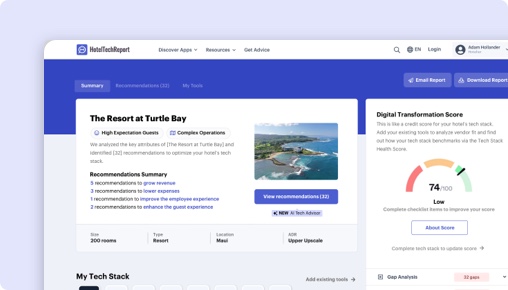
Sorry, deze functionaliteit is alleen beschikbaar voor geverifieerde hoteliers
Het projectdashboard is een gratis tool dat alleen beschikbaar is voor geverifieerde hoteliers. Het maakt het invoeren van nieuwe technologie eenvoudiger door hun onderzoek te stroomlijnen en hun communicatie te vereenvoudigen.

Demand Calendar vs. happyhotel:
Welke past bij u?


Samenvatting
We hebben 222 geverifieerde hotelierbeoordelingen geanalyseerd, functiesets, prijzen en praktijkcasestudies vergeleken om te bepalen waar elk platform uitblinkt. De juiste keuze hangt af van uw hoteltype en prioriteiten:
Demand Calendar AB onderscheidt zich met exclusieve functies zoals Rapportage over marktinzichten.
happyhotel blinkt uit in ondersteuning, onboarding en implementatie — vooral voor stadscentrum-accommodaties (4,9/5), met exclusieve functies zoals Volledig geautomatiseerd inkomstenbeheer en Mobielvriendelijk ontwerp.
Hoe verhoudt Demand Calendar zich tot happyhotel?
Zij-aan-zij beoordelingen op basis van 222 geverifieerde hotelierbeoordelingen op HTR.
| HTScore |
|
|
| Waarschijnlijkheid om aan te bevelen |
|
|
| Gebruiksgemak |
|
|
| Klantenondersteuning |
|
|
| Prijs-kwaliteitverhouding |
|
|
| Vanafprijs | Vanaf $600/mnd | Vanaf $500/mnd |
| Geverifieerde beoordelingen | 7 | 215 |
Wat zijn de voor- en nadelen van Demand Calendar vs happyhotel?
Na analyse van 222 geverifieerde beoordelingen waarderen Demand Calendar AB-gebruikers vooral de , terwijl happyhotel-gebruikers de ondersteuning, onboarding en implementatie, rapportage, dashboards en analyses, inkomstenimpact en tijdsbesparing benadrukken. Klik op een thema om te zien wat beoordelaars zeggen.
|
Demand Calendar AB
|
happyhotel
|
|---|---|
| Voordelen | |
|
+
Ondersteuning, onboarding en implementatie
▾
|
|
|
+
Rapportage, dashboards en analyses
▾
|
|
|
+
Inkomstenimpact en tijdsbesparing
▾
|
|
|
+
Autopilot / geautomatiseerde prijsbepaling
▾
|
|
| Nadelen | |
Demand Calendar AB vs happyhotel: Ranglijst per hotelsegment
Hoe elk product scoort onder Omzetbeheersystemen-leveranciers voor verschillende accommodatiegroottes, hoteltypen en regio's — op basis van geverifieerde beoordelingen van hoteliers in elk segment.
Op hotelgrootte
| Segment |
Demand Calendar AB
|
happyhotel
|
|---|---|---|
| Klein (10-24 kamers) ▾ | #39 2 beoordelingen | #4 98 beoordelingen |
| Middelgroot (25-74 kamers) ▾ | #34 5 beoordelingen | #7 83 beoordelingen |
| Groot (75-199 kamers) ▾ | — | #11 11 beoordelingen |
| Extra groot (200+ kamers) | — | #21 1 beoordelingen |
Op hoteltype
| Segment |
Demand Calendar AB
|
happyhotel
|
|---|---|---|
| Boutique ▾ | #39 5 beoordelingen | #10 54 beoordelingen |
| Luxe ▾ | #40 2 beoordelingen | #16 26 beoordelingen |
| Merk / Keten ▾ | #37 2 beoordelingen | #7 33 beoordelingen |
| Langverblijf ▾ | — | #7 23 beoordelingen |
Op regio
| Segment |
Demand Calendar AB
|
happyhotel
|
|---|---|---|
| Europa ▾ | #29 5 beoordelingen | #6 196 beoordelingen |
| Azië-Pacific | #13 2 beoordelingen | #25 1 beoordelingen |
Is Demand Calendar by Demand Calendar AB or happyhotel by happyhotel Better for Hotels?
Demand Calendar and happyhotel both address revenue management challenges but diverge significantly in scope and target users. Demand Calendar functions primarily as a hotel business intelligence tool, aggregating PMS, RMS, STR, and budget data to forecast total revenue and profit across rooms, F&B, meetings, and spa. It is tailored for hotel groups seeking strategic alignment across departments. In contrast, happyhotel is a cloud-based revenue management system focused on real-time dynamic pricing automation designed for hotels of all sizes, especially small to medium properties aiming to increase revenue through algorithm-driven price optimization.
Both tools solve the core problem of revenue predictability and pricing efficiency. Demand Calendar provides a consolidated forecast platform to identify budget risks and opportunities across multiple revenue streams, aiding operational coordination. happyhotel automates pricing decisions with autopilot features, competitor benchmarking, and demand signals, reducing manual intervention and improving rate agility. Hotels that want a holistic business intelligence view with manual pricing controls may lean towards Demand Calendar, while those prioritizing automated yield management and frequent rate updates will find happyhotel a more complete revenue management solution.
Demand Calendar vs happyhotel: Which Should Your Hotel Choose?
If you operate a multi-department or multi-property hotel group that requires consolidated forecasting across rooms, F&B, meetings, and spa, Demand Calendar’s integration of PMS, RMS, and market data offers a strategic advantage by aligning revenue, sales, marketing, and operations around one forecast. This insight fits properties with complex revenue streams and organizational layers, reflected in its user base with 44% boutique hotels and 14% branded hotels, predominantly in Europe and North America.
If your hotel is a small to medium-sized property or a chain seeking automated pricing to maximize occupancy and ADR, happyhotel’s dynamic pricing algorithms, autopilot function, and real-time market benchmarking provide superior operational value. Its extensive feature set (32 unique features) and integration with 25 verified partners including top PMS systems like Opera Cloud and protel support rapid adoption and ongoing revenue optimization. Review data from 215 hoteliers, including 50 recent reviews at 4.8/5, confirms its suitability for properties ranging from boutique hotels to luxury resorts.
Data for luxury hotels and boutique hotels is robust for both products, but happyhotel has broader segment coverage and more recent reviews. Demand Calendar’s limited review count (7 total, none recent) suggests its current market presence is narrower, making happyhotel the safer choice for broader hotel segments and chains requiring automated, scalable revenue management.
Is Demand Calendar or happyhotel Easier to Use?
Demand Calendar and happyhotel share nearly identical ease of use and onboarding scores: Demand Calendar with 4.7 and 4.3, happyhotel with 4.8 and 4.7 respectively. Reviewers of Demand Calendar appreciate its time-saving dashboards and centralized data views that simplify complex revenue work, though some note a slightly cluttered layout and occasional syncing issues with PMS Suite8. happyhotel users highlight its intuitive interface, rapid onboarding, and ease of use for non-revenue management specialists, enabling quick team adoption even during staff shortages.
Both products facilitate user adoption but happyhotel’s higher onboarding rating (4.7 vs 4.3) and numerous reviews praising friendly, responsive support during setup give it a modest operational edge for properties new to revenue management systems. Demand Calendar’s fewer reviews limit confidence in broad usability claims.
Edge: Even.
Which Has Better Features: Demand Calendar or happyhotel?
happyhotel offers 32 unique features not found in Demand Calendar, including dynamic pricing, fully automated revenue management, price sensitivity modeling, “what-if” scenario analysis, guided workflows, group pricing and evaluation, and AI optimization. These features enable real-time price optimization, bulk adjustments, and multi-month forward pricing (up to 24 months), directly reducing manual workload for revenue teams and increasing pricing agility. For example, happyhotel’s automated room-type pricing and controlled algorithm customization allow hoteliers to fine-tune pricing strategies without daily manual intervention, benefiting front desk and revenue managers by ensuring rates reflect current demand and market conditions.
Demand Calendar’s 4 unique features focus on business intelligence: future market demand data, lost business data, market insights reporting, and booking pattern analysis. These support strategic decision-making by revealing market trends and revenue leakage but do not automate pricing. This suits hotels needing comprehensive revenue forecasting across departments rather than dynamic pricing automation.
The extensive feature set of happyhotel translates into operational efficiency gains through automation and detailed analytics, while Demand Calendar provides broader revenue visibility without pricing automation. Given the scale and scope difference, happyhotel’s feature advantage is decisive for hotels wanting automated, dynamic revenue management.
Edge: happyhotel.
Which Has Better Customer Support: Demand Calendar or happyhotel?
Demand Calendar scores a perfect 5.0 for customer support, while happyhotel scores 4.8. Both products have onboarding ratings close to each other (4.3 vs 4.7). Demand Calendar reviewers emphasize prompt, easy communication and rapid responses to improvement suggestions, with one reviewer noting, “If you have any suggestion for improvement or any problems it is very easy to make contact and get a response.” happyhotel users commonly praise the personal, fast, and competent support that provides individualized responses instead of boilerplate answers, with some calling it “fantastic” and “excellent.” However, a minority report slower support responses and occasional technical issues with PMS integration.
With just 7 total reviews, Demand Calendar’s support ratings rest on less evidence compared to happyhotel’s 215 reviews, including 50 recent ones. The volume and recency of happyhotel’s positive feedback provide stronger operational assurance. Both vendors appear committed to support quality, but happyhotel’s scale and consistency make its support reliability more verifiable.
Edge: Even.
Which Has More Integrations: Demand Calendar or happyhotel?
Happyhotel leads with 25 verified integration partners versus Demand Calendar’s 5. Both share three common partners: Mews, Clock, and Oracle Hospitality. Demand Calendar integrates uniquely with IDeaS and HQ Revenue, focusing on revenue systems. Happyhotel’s broader partner list includes major PMS and channel managers like RoomRaccoon, apaleo GmbH, SiteMinder, protel, Access Hospitality, and others.
For hotels relying on a wide ecosystem of PMS and distribution software, happyhotel’s larger integration portfolio facilitates smoother data exchange, real-time rate updates, and reduced manual workload for front desk and revenue teams. Demand Calendar’s integrations emphasize BI data sources, aligning with its forecasting role but limiting operational connectivity.
Edge: happyhotel.
Which Do Hoteliers Rate Higher: Demand Calendar or happyhotel?
Both products share an identical overall rating of 4.8/5. However, happyhotel’s rating is based on 215 reviews with 50 in the last six months, while Demand Calendar’s 4.8 rating comes from only 7 reviews with no recent activity. happyhotel’s stable last-6-month rating of 4.8 confirms consistency in current performance, whereas Demand Calendar’s lack of recent reviews limits confidence in its present state.
By segment, Demand Calendar’s highest ratings come from small samples in boutique hotels (4.7 from 5 reviews), luxury hotels (5.0 from 2 reviews), and city center hotels (4.7 from 5 reviews). However, these counts are low. happyhotel maintains strong ratings across multiple hotel types with substantial review counts: boutique hotels (4.8/5, 58 reviews), branded hotels (4.8/5, 36), city center hotels (4.9/5, 56), airport/conference hotels (4.8/5, 70), and luxury hotels (4.9/5, 27). happyhotel also shows high ratings in limited service, hostels, resorts, and extended stay segments, reflecting broad acceptance.
The volume, recency, and segment diversity of happyhotel’s reviews give it a more reliable rating benchmark for buyers.
Edge: Even.
How Much Do Demand Calendar and happyhotel Cost?
Demand Calendar has a base price of $600.00 with no implementation fee or trial. happyhotel’s base price is $500.00, also without implementation fees or trials. Neither product publishes monthly flat or per-room pricing, and neither offers a freemium or free trial. This fixed base price model suggests a predictable upfront investment for both, with happyhotel being slightly more affordable by $100.
Without detailed pricing tiers or published volume discounts, cost comparisons rely on base price alone, where happyhotel offers a modest price advantage.
What Type of Hotel Should Use Demand Calendar?
- Hotels that operate multiple revenue streams (rooms, F&B, meetings, spa) and need consolidated forecasting to align revenue, sales, marketing, and operations within one view.
- Boutique and branded hotel groups with complex organizational structures requiring shared total revenue forecasts.
- Properties located in Europe, North America, or the Middle East where Demand Calendar has verified presence and partner integrations.
- Teams prioritizing business intelligence over automated pricing, focusing on strategic decision-making and market insights.
- Hotels currently using Suite8 PMS or Oracle Hospitality RMS, though with some reported integration limitations.
Not ideal if:
- You require automated, dynamic pricing adjustments or real-time rate optimization.
- You operate a small to medium hotel or chain seeking easy-to-use, hands-off revenue management.
- Seamless integration with a broad range of PMS and channel management systems is critical.
- You need frequent price updates and flexible rate controls for pricing agility.
- You depend on active vendor support and regular product updates, given Demand Calendar’s limited recent review activity.
What Type of Hotel Should Use happyhotel?
- Small to medium hotels and chains seeking automated revenue management with dynamic pricing algorithms.
- Hotels that value real-time price optimization, including forward pricing up to 24 months and bulk rate adjustments.
- Properties using popular PMS platforms like Opera Cloud, protel, apaleo, and RoomRaccoon benefiting from 25 verified integrations.
- Hotels requiring strong competitor benchmarking, event and holiday demand signals, and “what-if” scenario analysis.
- Teams that want fast onboarding, personal support, and a user-friendly interface for staff without extensive revenue management expertise.
Not ideal if:
- Your hotel requires deep business intelligence integration across multiple revenue streams beyond pricing.
- You operate in regions outside happyhotel’s primary European market presence.
- Advanced multi-property workflows and special group pricing controls are mission-critical but currently limited.
- You prefer a system focused primarily on strategic forecasting rather than operational pricing automation.
Demand Calendar vs happyhotel: The Bottom Line for Hotels
Demand Calendar and happyhotel serve distinctly different revenue management needs. Demand Calendar excels as a hotel business intelligence platform that aggregates multiple data sources to forecast total revenue and profit across rooms, F&B, meetings, and spa. It supports strategic alignment across hotel departments but does not automate pricing. happyhotel delivers a comprehensive, cloud-based revenue management system with advanced automation, dynamic pricing, and extensive integrations that streamline daily rate management and optimize hotel profitability.
Choose Demand Calendar if your property operates multiple revenue streams and requires consolidated forecasting and business intelligence to guide strategic decisions. Its unique features like lost business data and market insights reporting support this need. Choose happyhotel if you prioritize automated, real-time price optimization with AI-driven algorithms, autopilot pricing, and broad PMS/channel integrations that reduce manual tasks and increase revenue agility. happyhotel’s 215 reviews, including 50 recent ones at 4.8/5, demonstrate operational reliability and satisfaction across diverse hotel segments.
For most small to medium hotels and chains seeking scalable, data-driven revenue management with ease of use and automation, happyhotel represents the stronger choice. Demand Calendar suits hotel groups with complex forecasting needs who are prepared to manage pricing separately. The decision hinges on whether your hotel’s primary need is strategic revenue intelligence or automated pricing execution.
Hoeveel kosten Demand Calendar en happyhotel?
Prijzen voor Omzetbeheersystemen zijn zelden eenvoudig. Dit is wat we weten op basis van de openbare prijsgegevens van elke leverancier. Vraag altijd een offerte op maat aan voor uw accommodatie.
|
Demand Calendar AB
|
happyhotel
|
|
|---|---|---|
| Vanafprijs | Vanaf $600/mnd | Vanaf $500/mnd |
Functievergelijking: Demand Calendar vs happyhotel
Dit zijn de functies die elke leverancier heeft geconfigureerd, geordend per functiegroep — dezelfde gegevens als in het leveranciersdashboard. Vouw een groep uit om functies naast elkaar te vergelijken.
| Functie |
Demand Calendar AB
|
happyhotel
|
|---|---|---|
|
▾
Prijsoptimalisatie
|
|
|
| Prijs Uitleg | ||
| Zakelijke richtlijnen voor ondernemingen | ||
| Aanbevelingen voor alternatieve verblijfsdatum | ||
| Alternatieve accommodatieaanbevelingen | ||
| Realtime prijsoptimalisatie | ||
| Dynamisch prijshiërarchiebeheer | ||
| Prijzen openen | ||
| Begeleide workflows | ||
| "Wat-als" scenario-analyse | ||
| Dynamisch prijzen | ||
| Grenzen stellen | ||
| Uitzonderingen beheren | ||
| Groepsprijzen | ||
| Beperkingen beheren | ||
| Uitverkopen en annuleringen beheren | ||
| Optimalisatie van de bedrijfsmix | ||
| Cycli definiëren | ||
| Opbrengst kamertypes afzonderlijk | ||
| Bulkaanpassingen | ||
| 24-maanden prijsbepaling en prognose | ||
| Component-/virtuele kamerprijzen | ||
| Prijzen voor verlengd verblijf | ||
| Upsell-prijzen | ||
| Hurdle rate | ||
|
▾
Marktintelligentie en prognoses
|
|
|
| Voorspelling voor vijf jaar | ||
| Prijzen voor 365 dagen vooruit | ||
| STR-gegevens | ||
| Vooruitprijzen van 18 maanden | ||
| Prijsgevoeligheidsmodellering | ||
| Dashboard voor meerdere woningen | ||
| Marktintelligentiegegevens | ||
| Interactieve aanpasbare dashboards | ||
| Toekomstige marktvraaggegevens | ||
| Financiële prognosebouwer | ||
| Verlengde verblijfsprognose | ||
| Kanaalvoorspelling | ||
| Toelichting prognose | ||
| Flexibele concurrentiegegevens | ||
|
▾
Dashboards en rapportage
|
|
|
| Aangepaste rapporten | ||
| Geplande rapporten | ||
| Verloren zakelijke gegevens | ||
| Analytics-dashboard | ||
| Interactieve aanpasbare dashboards | ||
| Rapportage over marktinzichten | ||
| Ophaalanalyse | ||
| Analyse van boekingspatronen | ||
| Gebeurtenisgegevens | ||
| Prijswijzigingslogboeken | ||
| Aanpasbare meldingen en waarschuwingen | ||
| Verplaatsingsanalyse | ||
| Groepsprijzen en evaluatie | ||
| Dashboard voor meerdere woningen | ||
| Systeemvoordeelmeting | ||
|
▾
Automatisering
|
|
|
| Gecontroleerde automatisering/aanpassing van algoritmen | ||
| Geautomatiseerde kamertypeprijzen | ||
| Volledig geautomatiseerd inkomstenbeheer | ||
| Dynamisch prijzen | ||
| AI-optimalisatie | ||
| Automatische prijsupdates | ||
|
▾
Multi-property-functionaliteit
|
|
|
| Voorraadbeheer | ||
| Beheer van meerdere panden | ||
| Dashboard voor meerdere woningen | ||
|
▾
Groepszaken
|
|
|
| Groepsprijzen en evaluatie | ||
| "Wat-als" scenario-analyse | ||
| Verplaatsingsanalyse | ||
| Groepsvoorspelling en wasbeurt | ||
|
▾
Integraties
|
|
|
| API openen | ||
| Kanaal manager | ||
| Bedrijfsintelligentie | ||
| STR-gegevens | ||
| Eigendom management systeem | ||
| Multi-factor authenticatie | ||
|
▾
Other
|
|
|
| Groepsprijzen & evaluatie | ||
| Applicatie voor de mobiele telefoon | ||
| Slimme strooitechnologie | ||
| Eenmalig inloggen | ||
| Mobielvriendelijk ontwerp |
Resultaten uit de praktijk: Demand Calendar AB vs happyhotel per bedrijfsdoel
We hebben 4 geverifieerde casestudies geanalyseerd om te vergelijken wat hotels daadwerkelijk bereiken met elk platform op vier belangrijke bedrijfsdoelstellingen.
Demand Calendar AB
Nog geen gepubliceerde casestudy voor dit doel.
Natur- & Wellnesshotels Brunner Hof 4****S (45 rooms, luxury resort, Germany)
Klein
"Before happyhotel, we handled prices manually and tracked everything in Excel. Now we have all key metrics in one place and save a lot of time every day."
 Demand Calendar AB
Nog geen gepubliceerde casestudy voor dit doel.
Hotel Öschberghof (127 rooms, luxury resort, Germany)
Klein
"Before we started using happyhotel, I manually entered prices into our PMS using self-made Excel sheets. We didn’t have a flexible pricing system and worked with seasonal tables, o..."

Demand Calendar AB vs happyhotel: De conclusie
Scoort hoger op
Unieke mogelijkheden
Wat hoteliers waarderen
Ondersteuning is een belangrijk positief thema: reviewers beschrijven onboarding herhaaldelijk als persoonlijk, snel, vakkundig en oplossingsgericht.... Ondersteuning is een belangrijk positief thema: reviewers beschrijven onboarding herhaaldelijk als persoonlijk, snel, vakkundig en oplossingsgericht. Dit is belangrijk omdat het product vaak wordt overgenomen door teams die nieuw zijn met RMS, en goede implementatie verkort de tijd tot waarde. De belangrijkste klachten zijn in sommige gevallen langzamere reacties, meer training nodig voor complexe opstellingen, en een wens voor betere begeleiding tijdens migratie of technische configuratie.
Gebruikers waarderen herhaaldelijk de overzichtelijke dashboards, aanpasbare grafieken en snelle toegang tot KPI’s, prognoses, RevPAR, ADR, bezettings... Gebruikers waarderen herhaaldelijk de overzichtelijke dashboards, aanpasbare grafieken en snelle toegang tot KPI’s, prognoses, RevPAR, ADR, bezettingsgraad en pickup. Happyhotel wordt als bijzonder nuttig ervaren voor het vertalen van complexe hotelgegevens naar bruikbare dagelijkse beslissingen. Verbeterverzoeken noemen vaak flexibelere filters, diepere vergelijkingen, betere STLY-analyse en een meer intuïtieve rapportage-navigatie.
Een terugkerend thema is dat Happyhotel personeelstijd bespaart terwijl het ADR, bezetting en de totale omzet verhoogt. Beoordelaars omschrijven het v... Een terugkerend thema is dat Happyhotel personeelstijd bespaart terwijl het ADR, bezetting en de totale omzet verhoogt. Beoordelaars omschrijven het vaak als een praktisch zakelijk hulpmiddel waarmee kleine teams efficiënter kunnen concurreren en zich op andere taken kunnen richten. Verschillende noemen meetbare winst, terwijl een kleinere groep aangeeft dat de resultaten afhankelijk zijn van de kwaliteit van de implementatie of dat de voordelen tijd nodig hadden om zichtbaar te worden.
Scoort hoger op
Unieke mogelijkheden
Veelgestelde vragen over Demand Calendar vs happyhotel
Kan Demand Calendar happyhotel vervangen?
Dat hangt af van uw eisen. Demand Calendar en happyhotel delen veel kern-Revenue Management Systems-functies, maar elk heeft unieke mogelijkheden. Demand Calendar biedt 5 geverifieerde integratiepartners, terwijl happyhotel er 25 biedt. Bekijk de functievergelijking hierboven om te zien waar ze verschillen voordat u overstapt.
Welke is beter voor kleine of onafhankelijke hotels?
Kleine hotels moeten prioriteit geven aan gebruiksgemak en snelle onboarding. happyhotel scoort het hoogst op gebruiksgemak met 4,8/5 vs 4,7/5. Let op transparante prijzen en de mogelijkheid van een proefperiode of demo. Filter beoordelingen op elke productpagina op accommodatiegrootte om te horen van hotels zoals het uwe.
Bieden Demand Calendar of happyhotel een gratis abonnement aan?
Demand Calendar: Nee. happyhotel: Nee. Geen van beide producten biedt momenteel een gratis abonnement aan. De meeste Revenue Management Systems-leveranciers bieden demo's of proefperiodes aan — vraag er bij beide een aan om te evalueren voordat u zich vastlegt.
Hoe evalueert en rangschikt HTR Demand Calendar en happyhotel?
De HT Score is een samengestelde ranglijst die 4 criteriagroepen en meer dan een dozijn variabelen meeweegt om hoteliers te helpen hoteltechnologieproducten objectief te vergelijken. Demand Calendar AB heeft een HT Score van 0 en happyhotel heeft 95. Zo wordt de score berekend.
| Criteriagroep | Weging | Wat het meet |
|---|---|---|
| Klantbeoordelingen & reviews |
|
Hoe hoog beoordelen gebruikers dit product? Beoordelingsscore, reviewvolume, share of voice, reviewdiepte, reviewrecentheid, succesverhalen ▾ De zwaarst gewogen factor. Analyseert gemiddelde tevredenheidsbeoordelingen (waarschijnlijkheid om aan te bevelen, gebruiksgemak, ondersteuning, ROI), het totale aantal reviews ten opzichte van categoriegenoten, recentheid van reviews (minimaal 20 reviews in de afgelopen 6 maanden) en share of voice over unieke hotelklanten om selectiebias te detecteren. |
| Partnerecosysteem |
|
Hoe hoog beoordelen technologiepartners dit bedrijf? Partneraanbevelingen, integratieaantal, integratiekwaliteit ▾ Evalueert partneraanbevelingen als expertstemmen van vertrouwen, het aantal geverifieerde integraties en ecosysteemkwaliteit — de gemiddelde HT Scores van integratiepartners. Producten met een kwalitatief beter integratie-ecosysteem leveren waarschijnlijker een verbonden tech stack. |
| Klantgerichtheid |
|
Hoe klantgericht is deze organisatie? Gecertificeerde ondersteuning, reviewconsistentie, profielvolledigheid ▾ Beoordeelt of het bedrijf HTR Customer Support-certificering heeft verdiend, consistente reviewverzameling in de loop der tijd onderhoudt (een indicator van feedbackgedreven cultuur) en productprofielen compleet houdt met mogelijkheden, schermafbeeldingen, prijzen en functies. |
| Bereik, stabiliteit & middelen |
|
Hoe uitgebreid is het bereik en de middelen van dit bedrijf? Geografisch bereik, stabiliteit, bedrijfsmiddelen, trendscore ▾ Meet wereldwijde aanwezigheid (bediende landen en regio's), aantal jaren in bedrijf als stabiliteitsindicator, teamgrootte als middelenproxy en een trendscore op basis van kopersaanvragen, reviews, partneraanbevelingen en persactiviteit in de afgelopen twaalf maanden. |
Klantbeoordelingen en reviews zijn veruit de belangrijkste factor in het HT Score-algoritme. HTR accepteert geen betaling voor hogere ranglijstposities. Alle reviews zijn geverifieerd — alleen professionals uit de hotelbranche met bevestigde affiliaties kunnen beoordelingen indienen. Bekijk de volledige HT Score-methodologie →
Welke andere Omzetbeheersystemen-vergelijkingen lezen hoteliers?
Ontdek meer directe vergelijkingen op basis van geverifieerde hotelierbeoordelingen.





Ontvang uw gratis AI-analyserapport
Aanbevelingen op maat, afgestemd op uw accommodatie.


Laten we uw hotelinformatie opzoeken
Twijfelt u nog over uw omzetbeheersystemen-opties?
Enkele populaire systemen uit onze gids over omzetbeheersystemen — of laat onze AI elk systeem beoordelen voor uw hotel, in ongeveer twee minuten.


