

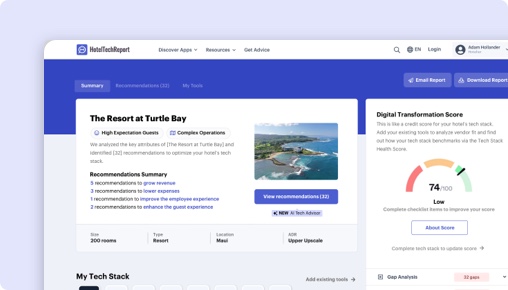
Desculpe, esta funcionalidade está disponível apenas para hoteleiros verificados
O painel de projetos é uma ferramenta gratuita disponível apenas para hoteleiros verificados, que facilita a adoção de novas tecnologias ao agilizar a pesquisa e simplificar os fluxos de comunicação.

Demand Booster vs. Metadesk:
Qual é o Ideal para Você?
TLDR
Analisamos 22 avaliações verificadas de hoteleiros, comparamos conjuntos de funcionalidades, preços e estudos de caso reais para detalhar onde cada plataforma se destaca. A escolha certa depende do tipo de hotel e das suas prioridades:
RateGain se destaca por recursos exclusivos como Painel de marketing.
Como Demand Booster se Compara a Metadesk?
Avaliações lado a lado baseadas em 22 avaliações verificadas de hoteleiros no HTR.
| HTScore |
|
|
| Probabilidade de Recomendar |
|
|
| Facilidade de Uso |
|
|
| Suporte ao Cliente |
|
|
| Custo-Benefício |
|
|
| Preço Inicial | A partir de $1.000/mês | A partir de $900/mês |
| Avaliações Verificadas | 19 | 3 |
RateGain vs GCommerce: Rankings por Segmento Hoteleiro
Como cada produto se classifica entre os fornecedores de Software de gestão de metabusca para hotéis para diferentes tamanhos, tipos e regiões de hotéis — com base em avaliações verificadas de hoteleiros em cada segmento.
Por Tamanho do Hotel
| Segmento |
RateGain
|
GCommerce
|
|---|---|---|
| Pequeno (10-24 quartos) | #8 4 avaliações | — |
| Médio (25-74 quartos) ▾ | #8 10 avaliações | — |
| Grande (75-199 quartos) ▾ | #7 5 avaliações | — |
| Extra Grande (200+ quartos) | #9 0 avaliações | — |
Por Tipo de Hotel
| Segmento |
RateGain
|
GCommerce
|
|---|---|---|
| Boutique ▾ | #7 9 avaliações | — |
| Luxo ▾ | #7 8 avaliações | — |
| Rede / Cadeia ▾ | #8 6 avaliações | — |
| Estadia Prolongada | #5 1 avaliações | — |
Por Região
| Segmento |
RateGain
|
GCommerce
|
|---|---|---|
| América do Norte | #12 0 avaliações | — |
| Europa ▾ | #8 13 avaliações | — |
| Ásia-Pacífico ▾ | #2 5 avaliações | — |
| Oriente Médio | #1 1 avaliações | — |
Is Demand Booster by RateGain or Metadesk by GCommerce Better for Hotels?
Demand Booster by RateGain and Metadesk by GCommerce both serve hotels aiming to increase direct bookings through metasearch campaign management. They share the core problem of reducing OTA dependency and improving direct revenue. Demand Booster suits medium to large hotels and branded properties with a global footprint and complex distribution needs, supported by its 300+ global brands and 140+ connected booking engines. Metadesk fits smaller boutique hotels or those seeking a more hands-on, personalized approach with direct campaign specialist access, evidenced by its boutique hotel user base and case study results.
Both platforms improve direct booking conversion by leveraging metasearch channels and data-driven campaign management. Demand Booster emphasizes control over the guest journey and wide integration, while Metadesk offers transparent pricing and close client collaboration. Their shared goal is boosting direct revenue, but their approach diverges significantly in scale and operational focus.
Demand Booster by RateGain vs Metadesk by GCommerce: Which Should Your Hotel Choose?
If your hotel is a medium or large property with a branded portfolio and requires extensive integration with multiple booking engines, Demand Booster is the more suitable choice. This is supported by its user base composition—26% branded hotels and 21% city center hotels—and its 96 verified integrations, which provide operational flexibility for complex channel management. Its marketing dashboard feature also supports data-driven strategy adjustments for revenue teams.
Conversely, if you operate a smaller boutique hotel or a property valuing direct access to campaign optimization specialists, Metadesk is preferable. Its boutique hotel segment rating is a perfect 5/5, though based on a single review, indicating limited but highly positive feedback. The standout case study from Hotel Emma demonstrates Metadesk’s ability to deliver a 340% increase in direct bookings and a 44:1 ROAS for a small portfolio, highlighting its effectiveness for smaller, focused operations.
Data for larger luxury or airport/conference hotels is insufficient for Metadesk, while RateGain supports a wider range of segments with multiple reviews per segment. Thus, Demand Booster is the safer choice for hotels with diverse guest profiles and scale, while Metadesk targets smaller, boutique properties with personalized service needs.
Is Demand Booster by RateGain or Metadesk by GCommerce Easier to Use?
Reviewers rate both platforms highly on ease of use and onboarding. Demand Booster scores 4.7 for ease of use and 4.6 for onboarding across 19 reviews, with users praising its knowledgeable and patient staff and clear reporting despite a dated dashboard UI. Metadesk rates a perfect 5/5 for both ease of use and onboarding, though this is based on a single recent review highlighting quick request resolutions and immediate response times.
Both products facilitate staff adoption through responsive support and clear workflows, but Demand Booster’s larger review sample provides more confidence in its usability for diverse teams. Metadesk’s perfect scores reflect strong user satisfaction but require more validation.
Edge: Even.
Which Has Better Features: Demand Booster by RateGain or Metadesk by GCommerce?
Both platforms share five core features essential to metasearch management. Demand Booster uniquely offers a marketing dashboard that provides real-time campaign insights, enabling revenue managers to optimize marketing spend and guest targeting proactively. This feature changes operational workflows by centralizing data visualization and campaign adjustments within one interface.
Metadesk does not list any exclusive features but emphasizes direct access to campaign optimization specialists and on-demand data insights, which, while not a software feature per se, affect the operational support workflow for hotels.
Given the unique marketing dashboard that directly impacts campaign management efficiency, Demand Booster holds a feature advantage.
Edge: Demand Booster by RateGain.
Which Has Better Customer Support: Demand Booster by RateGain or Metadesk by GCommerce?
Demand Booster’s customer support rating is 4.9 with onboarding at 4.6 across 19 reviews. Reviewers most often praise its promptness, professionalism, and proactive consultation, with phrases like “super fast and friendly support” and “always patient and friendly.” Metadesk holds a perfect 5/5 in both categories but from only one review that highlights “quick resolution to any request” and “immediate response.”
Although Metadesk’s single review praises responsiveness, Demand Booster’s broader review base confirms consistently strong support experiences over multiple years and hotel segments.
Edge: Even.
Which Has More Integrations: Demand Booster by RateGain or Metadesk by GCommerce?
Demand Booster connects to 96 verified partners, including 140+ booking engines and global brands. Its integrations cover major systems like RoomRaccoon, Profitroom, Mirai, and apaleo GmbH, supporting diverse operational needs from small properties to large chains. GCommerce’s Metadesk has 7 verified partners, including proprietary GCommerce integrations and partners like Revinate and The Guestbook.
Common integrations include OpenHotel, Lighthouse, The Hotels Network, and Duetto. Demand Booster’s 13 times larger integration ecosystem supports hotels requiring flexible connections to multiple OTAs, booking engines, and channel managers, critical for large or branded hotels managing complex distribution. Metadesk’s limited integrations suit boutique hotels with fewer connectivity demands.
Edge: Demand Booster by RateGain.
Which Do Hoteliers Rate Higher: Demand Booster by RateGain or Metadesk by GCommerce?
Demand Booster’s overall rating is 4.8/5 based on 19 reviews with no recent reviews in the last six months. This volume provides a representative, stable picture of user satisfaction across multiple hotel segments—boutique (4.9/5), branded (4.9/5), city center (4.8/5), and luxury (4.8/5). Metadesk has a 5/5 rating from a single recent review in the boutique hotel segment, insufficient to generalize beyond that niche.
The lack of multiple recent reviews for either platform limits visibility into current product iterations. However, Demand Booster’s 97% likelihood to recommend across a broad user base contrasts with Metadesk’s 100% but singular rating. Larger properties and branded hotels clearly favor Demand Booster, while boutique properties rate Metadesk highly but with limited data.
Edge: Even.
How Much Do Demand Booster by RateGain and Metadesk by GCommerce Cost?
Demand Booster lists a base price of $1,000 with no freemium, monthly flat, or per-room pricing, and no implementation fee or trial availability. Metadesk’s base price is $900 under the same conditions—no freemium, monthly flat, or per-room pricing, no implementation fee, and no trial.
The $100 price difference is small relative to the scale and integration breadth each platform offers. Both use pay-on-stay commission models as part of their commercial terms, but these details are not explicitly priced here. Hotels should assess total cost of ownership considering service scope, integrations, and support.
What Type of Hotel Should Use Demand Booster by RateGain?
- Hotels that manage medium to large portfolios with branded or city center properties, supported by 26% and 21% user base segments.
- Teams requiring extensive integrations with over 140 booking engines and 96 verified partners to handle complex distribution.
- Properties aiming to increase direct booking contribution by at least 30%, leveraging Demand Booster’s proprietary 1.7 billion+ digital identities and travel intent data.
- Operations benefiting from a marketing dashboard that consolidates campaign data and allows proactive performance optimization.
- Hotels seeking a pay-on-stay commission model and 100% control over the guest journey to enable retargeting and reduce OTA dependency.
Not ideal if:
- Your property is a small boutique hotel without complex integration needs or prefers hands-on campaign specialist support.
- You require a modern user interface; reviewers have noted the dated dashboard design.
- You want frequent recent review feedback, as no reviews were posted in the last six months.
What Type of Hotel Should Use Metadesk by GCommerce?
- Boutique hotels seeking personalized service and direct access to campaign optimization specialists.
- Small portfolios aiming to improve visibility and direct bookings through tailored, granular campaigns, as demonstrated by Hotel Emma’s 340% booking increase.
- Hotels valuing straightforward pricing and quick response times for campaign amendments and updates.
- Properties without extensive integration requirements, given the limited verified partners count.
- Teams preferring a high-touch approach to campaign management rather than automated or dashboard-driven interfaces.
Not ideal if:
- You operate a medium or large branded hotel portfolio requiring complex channel integrations.
- You need a broad partner ecosystem or marketing dashboard tools.
- You seek extensive recent customer feedback for confidence in product performance.
Demand Booster by RateGain vs Metadesk by GCommerce: The Bottom Line for Hotels
Demand Booster and Metadesk both solve the problem of increasing direct hotel bookings via metasearch management but diverge sharply in scale and operational focus. Demand Booster offers a mature, integrated platform with a marketing dashboard and extensive partner ecosystem, fitting medium to large hotels with complex distribution needs. Metadesk focuses on smaller boutique hotels needing close collaboration with campaign specialists and simple pricing.
Choose Demand Booster if your hotel requires robust integrations (96 verified partners), wants to control the guest journey with 1.7 billion+ digital identities, and needs a centralized marketing dashboard for campaign optimization. It supports a broad hotel segment base and has a proven track record of increasing direct bookings by at least 30%.
Choose Metadesk if you operate a boutique property seeking personalized, specialist-driven campaign management and prioritize straightforward pricing and quick support responses. Its demonstrated 44:1 ROAS and 340% booking increase for a small hotel portfolio are strong evidence of its effectiveness in this niche.
The data supports Demand Booster as the better fit for hotels with scale and integration complexity, while Metadesk is preferable for boutique hotels valuing hands-on service and campaign agility.
Quanto Custam Demand Booster e Metadesk?
Os preços de Software de gestão de metabusca para hotéis raramente são simples. Aqui está o que sabemos com base nos dados públicos de preços de cada fornecedor. Sempre solicite uma cotação personalizada para o tamanho do seu hotel.
|
RateGain
|
GCommerce
|
|
|---|---|---|
| Preço Inicial | A partir de $1.000/mês | A partir de $900/mês |
Comparação de funcionalidades: Demand Booster vs Metadesk
Estas são as funcionalidades que cada fornecedor configurou, organizadas por grupo de funcionalidades — os mesmos dados mostrados no painel do fornecedor. Expanda um grupo para comparar as funcionalidades lado a lado.
| Recurso |
RateGain
|
GCommerce
|
|---|---|---|
|
▾
Serviços
|
|
|
| Consultoria em comércio eletrônico | ||
| Monitoramento de Metasearch | ||
| Conectividade metabusca | ||
| Marketing de metabuscadores | ||
|
▾
Relatórios e Análises
|
|
|
| Painel de marketing |
Resultados Reais: RateGain vs GCommerce por Objetivo de Negócio
Analisamos 2 estudos de caso verificados para comparar o que os hotéis realmente alcançam com cada plataforma em quatro objetivos de negócio principais.
Safir Hotels & Resorts
Médio
"The partnership with RateGain has been transformative for Safir Hotels & Resorts, yielding 4x growth in our revenue."
 GCommerce
Nenhum estudo de caso publicado para este objetivo ainda.
RateGain
Nenhum estudo de caso publicado para este objetivo ainda.
Hotel Emma
Pequeno
"In today’s luxury hotel market, visibility is everything. By restructuring Hotel Emma’s metasearch campaigns across Google and Tripadvisor, we ensured the property consistently sta..."

RateGain vs GCommerce: Conclusão Final
Capacidades exclusivas
Perguntas Frequentes Sobre Demand Booster vs Metadesk
Demand Booster pode substituir Metadesk?
Depende dos seus requisitos. Demand Booster e Metadesk compartilham muitas funcionalidades principais de Hotel Metasearch Management Software, mas cada um tem capacidades únicas. Demand Booster oferece 96 parceiros de integração verificados, enquanto Metadesk oferece 7. Revise a comparação de funcionalidades acima para ver onde eles diferem antes de migrar.
Qual é melhor para hotéis pequenos ou independentes?
Hotéis pequenos devem priorizar facilidade de uso e onboarding rápido. Metadesk lidera em facilidade de uso com 5,0/5 vs 4,7/5. Procure preços transparentes e opção de teste ou demonstração. Filtre as avaliações na página de cada produto por tamanho de hotel para ouvir hotéis como o seu.
Demand Booster ou Metadesk oferecem um plano gratuito?
Demand Booster: Não. Metadesk: Não. Nenhum dos produtos oferece um plano gratuito atualmente. A maioria dos fornecedores de Hotel Metasearch Management Software oferece demonstrações ou períodos de teste — solicite um de cada para avaliar antes de se comprometer.
Como o HTR Avalia e Classifica Demand Booster e Metadesk?
O HT Score é um ranking composto que considera 4 grupos de critérios e mais de uma dúzia de variáveis para ajudar hoteleiros a comparar objetivamente produtos de tecnologia hoteleira. RateGain tem um HT Score de 0 e GCommerce tem 0. Veja como a pontuação é calculada.
| Grupo de Critérios | Peso | O Que Mede |
|---|---|---|
| Avaliações e Reviews de Clientes |
|
O quanto os usuários recomendam este produto? Pontuação de Avaliações, Volume de Reviews, Participação de Voz, Profundidade das Reviews, Recência das Reviews, Casos de Sucesso ▾ O fator com maior peso. Analisa as avaliações médias de satisfação (probabilidade de recomendar, facilidade de uso, suporte, ROI), contagem total de reviews em relação aos pares da categoria, recência das reviews (pelo menos 20 reviews nos últimos 6 meses) e participação de voz entre clientes hoteleiros únicos para detectar viés de seleção. |
| Ecossistema de Parceiros |
|
O quanto os parceiros de tecnologia recomendam esta empresa? Recomendações de Parceiros, Quantidade de Integrações, Qualidade das Integrações ▾ Avalia recomendações de parceiros como votos de confiança de especialistas, o número de integrações verificadas e a qualidade do ecossistema — a média dos HT Scores dos parceiros de integração. Produtos com ecossistemas de integração de maior qualidade têm mais chances de entregar uma stack tecnológica conectada. |
| Foco no Cliente |
|
Qual o nível de foco no cliente desta organização? Suporte Certificado, Consistência de Reviews, Completude do Perfil ▾ Avalia se a empresa obteve a certificação HTR Customer Support, mantém coleta consistente de reviews ao longo do tempo (um indicador de cultura orientada por feedback) e mantém perfis de produtos completos com capacidades, capturas de tela, preços e funcionalidades. |
| Alcance, Solidez e Recursos |
|
Qual a extensão do alcance e dos recursos desta empresa? Alcance Geográfico, Solidez, Recursos da Empresa, Pontuação de Tendência ▾ Mede a presença global (países e regiões atendidos), anos de operação como indicador de estabilidade, tamanho da equipe como indicador de recursos e uma pontuação de tendência baseada em consultas de compradores, reviews, recomendações de parceiros e atividade na imprensa dos últimos doze meses. |
As avaliações e reviews de clientes são, de longe, o fator mais importante no algoritmo do HT Score. O HTR não aceita pagamento por rankings mais altos. Todas as reviews são verificadas — apenas profissionais do setor hoteleiro com afiliações confirmadas podem enviar avaliações. Ver metodologia completa do HT Score →
Que Outras Comparações de Software de gestão de metabusca para hotéis os Hoteleiros Estão Lendo?
Explore mais comparações diretas baseadas em avaliações verificadas de hoteleiros.




Sumário
Obtenha seu relatório gratuito de análise de IA
Recomendações personalizadas para o seu hotel.


Vamos pesquisar as informações do seu hotel
Ainda está avaliando suas opções de software de gestão de metabusca para hotéis?
Alguns sistemas populares do nosso guia sobre software de gestão de metabusca para hotéis — ou deixe nossa IA avaliar cada um deles para o seu hotel em cerca de dois minutos.


