
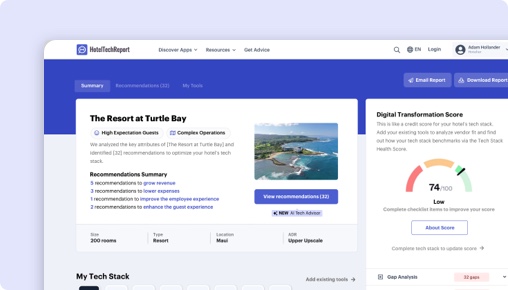
Sorry, this functionality is only available for verified hoteliers
The project dashboard is a free tool that is only available to verified hoteliers to make adopting new technology easier by streamlining their research and simplifying their communication workflow.

Dharma Operations Platform vs. Three Angular:
Welches ist das Richtige für Sie?


Kurzfassung
Wir haben 14 verifizierte Hotelier-Bewertungen analysiert, Funktionsumfänge, Preise und Praxisbeispiele verglichen, um aufzuzeigen, wo jede Plattform ihre Stärken hat. Die richtige Wahl hängt von Ihrem Betriebstyp und Ihren Prioritäten ab:
Dharma überzeugt bei ease of use and customer support .
Three Angular überzeugt .
Wie schneidet Dharma Operations Platform im Vergleich zu Three Angular ab?
Bewertungen im direkten Vergleich basierend auf 14 verifizierten Hotelier-Bewertungen auf HTR.
| HTScore |
|
|
| Weiterempfehlungswahrscheinlichkeit |
|
|
| Benutzerfreundlichkeit |
|
|
| Kundensupport |
|
|
| Preis-Leistungs-Verhältnis |
|
|
| Einstiegspreis | Contact sales | Contact sales |
| Verifizierte Bewertungen | 13 | 1 |
Dharma vs Three Angular: Rankings nach Hotelsegment
Wie jedes Produkt unter den Reinigung und Betrieb-Anbietern für verschiedene Betriebsgrößen, -typen und Regionen abschneidet — basierend auf verifizierten Bewertungen von Hoteliers in jedem Segment.
Nach Hotelgröße
| Segment |
Dharma
|
Three Angular
|
|---|---|---|
| Klein (10–24 Zimmer) ▾ | #1 13 Bewertungen | — |
| Mittelgroß (25–74 Zimmer) | — | #3 1 Bewertungen |
| Sehr groß (200+ Zimmer) | — | #3 0 Bewertungen |
Nach Betriebstyp
| Segment |
Dharma
|
Three Angular
|
|---|---|---|
| Boutique ▾ | #1 10 Bewertungen | #4 1 Bewertungen |
| Luxus | #2 2 Bewertungen | — |
| Marke / Kette | — | #3 0 Bewertungen |
| Langzeitaufenthalt | #1 3 Bewertungen | — |
Nach Region
| Segment |
Dharma
|
Three Angular
|
|---|---|---|
| Nordamerika ▾ | #2 12 Bewertungen | #5 0 Bewertungen |
| Europa | #1 1 Bewertungen | #2 1 Bewertungen |
The Decision
Choosing between Dharma Operations Platform and Three Angular hinges on your hotel’s operational needs and the quality of support you require. Dharma’s platform aims to streamline property management, guest communications, and issue handling, while Three Angular offers a broader data analysis tool designed to provide insights from customer feedback. Both address operational efficiency but diverge significantly in focus and user experience. Your hotel must decide whether a dedicated operations system or an AI-driven feedback analysis aligns better with your goals.
Dharma’s platform is more comprehensive in managing daily hotel functions, whereas Three Angular emphasizes understanding customer sentiment through analytics. Both solutions lack free trials and detailed pricing info, but Dharma’s more recent reviews and larger user base give it a distinct advantage. Are you prioritizing operational efficiency or customer insights?
Dharma Operations Platform vs Three Angular: Which Should Your Hotel Choose?
If your hotel needs a unified operations system that consolidates communications, manages work orders, and supports staff training, Dharma is the clear choice. Its focus on task management, issue resolution, and guest profiles makes it ideal for properties that want to improve operational workflows and guest satisfaction simultaneously.
If your hotel requires a tool that analyzes guest feedback across platforms, identifies trends, and offers actionable insights to improve services, Three Angular fits better. Its AI-driven sentiment analysis and recommendation engine help hotels adapt based on customer data, especially if your team is data-savvy and wants to leverage feedback for strategic decisions.
In essence, opt for Dharma if your priority is day-to-day operational management; choose Three Angular if insights from customer feedback are your main focus. For hotels seeking a proven, support-backed platform with recent positive reviews, Dharma is the recommended choice.
Is Dharma or Three Angular Easier to Use?
Dharma scores highly for ease of use, with a 4.62/5 rating and onboarding rated at 4.69/5. Customers praise its intuitive interface and straightforward workflows, often describing it as easy for staff to adopt and integrate into daily routines. Support is also highly rated at 4.92/5, with reviews emphasizing quick, helpful responses and a smooth onboarding process.
Three Angular, however, ranks lower in ease of use, with a 3/5 rating and support rated at only 1/5. Users describe the system as slow, with a complex design that involves too many steps for task management and frequent API errors. Customers also mention that the platform can be frustrating, especially for teams expecting quick, reliable performance.
Edge: Dharma.
Which Has Better Features: Dharma or Three Angular?
Dharma offers a suite of features tailored for hotel operations, including an AI assistant, issue and work order management, unified messaging, and guest profile enhancements. While it does not list additional features beyond these core tools, they are specifically designed for hospitality needs, helping staff deliver better service.
Three Angular, on the other hand, functions primarily as a business intelligence platform for analyzing customer feedback. It provides sentiment summaries and actionable recommendations but lacks dedicated hotel operations features like work order management or messaging tools. Its feature set is more suited for strategic feedback analysis rather than daily management.
Edge: Dharma.
Which Has Better Customer Support: Dharma or Three Angular?
Dharma’s customer support is highly rated at 4.92/5, with reviewers frequently praising the responsiveness and helpfulness of support staff. One reviewer highlighted, “The support team makes onboarding seamless and always responds quickly to inquiries.” Customers also appreciate the onboarding process, rated at 4.69/5, which indicates a smooth start for new users.
Three Angular’s support, rated at just 1/5, is described as slow and unresponsive, with users complaining about errors and lack of guidance. The limited support and poor review scores suggest that hotels relying on timely assistance could face significant frustrations using this platform.
Edge: Dharma.
Which Has More Integrations: Dharma or Three Angular?
Dharma has one verified integration with SiteMinder, a widely used distribution platform, showing some degree of compatibility with other hotel systems. Three Angular, by contrast, does not list any verified integrations, limiting its ability to connect with existing property management or booking systems.
If your hotel relies on multiple systems working together, Dharma’s existing integration with SiteMinder provides a useful starting point, and future integrations could be added. Three Angular’s lack of integrations may hinder its usefulness for hotels seeking a connected tech stack.
Edge: Dharma.
Which Do Hoteliers Rate Higher: Dharma or Three Angular?
Dharma’s user reviews are more recent, with 13 reviews in the last six months, and it boasts a 98% likelihood to recommend. Hoteliers in vacation rentals and villas specifically rate Dharma highly, praising its operational efficiency and support.
Three Angular, with only a single review, receives a 10% likelihood to recommend and no recent feedback, making it difficult to gauge hotel satisfaction. Its poor support and slow system dampen overall ratings, especially among hotels needing reliable tools.
Edge: Dharma.
How Much Do Dharma and Three Angular Cost?
Neither platform lists clear pricing models or trial options. Dharma does not specify its fees, but given its extensive feature set and support, it’s likely a paid enterprise solution. Three Angular similarly omits pricing details, but reports of slow performance and frequent errors suggest it might not be a cost-effective choice without clear ROI.
Your hotel will need to request custom quotes from both providers. However, based on support and reviews, Dharma appears to be the more reliable investment.
What Type of Hotel Should Use Dharma?
- Hotels that want a centralized operations platform for managing work orders, messages, and guest profiles.
- Properties seeking to improve staff efficiency and guest satisfaction through streamlined workflows.
- Larger properties that need dedicated support and multiple communication channels.
- Hotels that prioritize comprehensive onboarding, ongoing support, and reliable performance.
Not ideal if your hotel is very small, casual, or looking for a lightweight, budget-friendly system with minimal features.
What Type of Hotel Should Use Three Angular?
- Hotels interested in leveraging customer feedback and sentiment analysis to inform strategic decisions.
- Properties with a strong focus on data-driven improvements, especially in online reputation management.
- Teams that are comfortable with AI tools and want recommendations to enhance guest experiences.
- Hotels with existing infrastructure capable of managing API errors and slower system responses.
Not ideal if your hotel needs daily operational management, real-time task handling, or reliable integrations.
The Bottom Line for Hotels
Dharma’s platform is a dedicated, well-supported operations solution that excels in task management, communication, and staff training. It’s especially suited for hotels that want to streamline daily tasks, improve guest satisfaction, and rely on a proven system complemented by excellent support.
Three Angular offers powerful sentiment analysis and customer feedback insights, but its slow, error-prone platform and limited hotel-specific features make it less suitable for day-to-day operations. It’s best for hotels that have a strong data strategy and can handle a more complex, less integrated tool.
If your hotel needs a reliable, easy-to-use operations platform with recent positive reviews and solid support, Dharma is the clear choice. For strategic feedback analysis and insights, and if your team can tolerate some system flaws, Three Angular may serve your needs—though support and reliability are concerns. Overall, Dharma’s recent review volume and support quality make it the stronger recommendation.
Was kosten Dharma Operations Platform und Three Angular?
Die Preise für Reinigung und Betrieb sind selten unkompliziert. Hier ist, was wir aus den öffentlichen Preisdaten der Anbieter wissen. Fordern Sie immer ein individuelles Angebot für Ihre Betriebsgröße an.
|
Dharma
|
Three Angular
|
|---|
Dharma vs Three Angular: Das Fazit
Höher bewertet bei
Wo die Bewertungen am stärksten auseinandergehen
Häufig gestellte Fragen zu Dharma Operations Platform vs Three Angular
Kann Dharma Operations Platform Three Angular ersetzen?
Das hängt von Ihren Anforderungen ab. Dharma Operations Platform und Three Angular teilen viele zentrale Cleaning & Operations-Funktionen, aber jedes hat einzigartige Fähigkeiten. Dharma Operations Platform bietet 1 verifizierte Integrationspartner, während Three Angular 0 bietet. Überprüfen Sie den Funktionsvergleich oben, um die Unterschiede vor einem Wechsel zu sehen.
Welches ist besser für kleine oder unabhängige Hotels?
Kleine Hotels sollten Benutzerfreundlichkeit und schnelles Onboarding priorisieren. Dharma Operations Platform führt bei der Benutzerfreundlichkeit mit 4.6/5 vs 3.0/5. Achten Sie auf transparente Preise und eine Test- oder Demo-Option. Filtern Sie die Bewertungen auf jeder Produktseite nach Betriebsgröße, um von Hotels wie Ihrem zu hören.
Bieten Dharma Operations Platform oder Three Angular einen kostenlosen Plan an?
Dharma Operations Platform: Nein. Three Angular: Nein. Keines der Produkte bietet derzeit eine kostenlose Version an. Die meisten Cleaning & Operations-Anbieter bieten Demos oder Testversionen an — fordern Sie von jedem eine an, um vor der Entscheidung zu evaluieren.
Wie bewertet und rankt HTR Dharma Operations Platform und Three Angular?
Der HT Score ist ein zusammengesetztes Ranking, das 4 Kriteriengruppen und über ein Dutzend Variablen berücksichtigt, um Hoteliers einen objektiven Vergleich von Hoteltechnologie-Produkten zu ermöglichen. Dharma hat einen HT Score von 0 und Three Angular hat 0. So wird der Score berechnet.
| Kriteriengruppe | Gewichtung | Was wird gemessen |
|---|---|---|
| Kundenbewertungen & Rezensionen |
|
Wie stark empfehlen Nutzer dieses Produkt? Bewertungspunktzahl, Bewertungsvolumen, Marktanteil, Bewertungstiefe, Bewertungsaktualität, Erfolgsgeschichten ▾ Der am stärksten gewichtete Faktor. Analysiert die durchschnittlichen Zufriedenheitsbewertungen (Weiterempfehlungswahrscheinlichkeit, Benutzerfreundlichkeit, Support, ROI), die Gesamtzahl der Bewertungen im Vergleich zu Kategorie-Mitbewerbern, die Aktualität der Bewertungen (mindestens 20 Bewertungen in den letzten 6 Monaten) und den Marktanteil über einzigartige Hotelkunden zur Erkennung von Auswahlverzerrungen. |
| Partner-Ökosystem |
|
Wie stark empfehlen Technologiepartner dieses Unternehmen? Partner-Empfehlungen, Integrationsanzahl, Integrationsqualität ▾ Bewertet Partner-Empfehlungen als Expertenvertrauensvoten, die Anzahl verifizierter Integrationen und die Ökosystemqualität — die durchschnittlichen HT Scores der Integrationspartner. Produkte mit hochwertigeren Integrations-Ökosystemen liefern mit größerer Wahrscheinlichkeit einen vernetzten Tech-Stack. |
| Kundenorientierung |
|
Wie kundenorientiert ist dieses Unternehmen? Zertifizierter Support, Bewertungskonsistenz, Profilvollständigkeit ▾ Bewertet, ob das Unternehmen die HTR Customer Support Certification erhalten hat, eine konsistente Bewertungserfassung über die Zeit aufrechterhält (ein Indikator für feedbackgetriebene Kultur) und Produktprofile vollständig mit Funktionen, Screenshots, Preisen und Features pflegt. |
| Reichweite, Beständigkeit & Ressourcen |
|
Wie umfangreich sind Reichweite und Ressourcen dieses Unternehmens? Geografische Reichweite, Beständigkeit, Unternehmensressourcen, Trending Score ▾ Misst die globale Präsenz (bediente Länder und Regionen), die Geschäftsjahre als Stabilitätsindikator, die Teamgröße als Ressourcenindikator und einen Trending Score basierend auf Käuferanfragen, Bewertungen, Partner-Empfehlungen und Presseaktivitäten der letzten zwölf Monate. |
Kundenbewertungen und Rezensionen sind bei weitem der wichtigste Faktor im HT Score-Algorithmus. HTR akzeptiert keine Zahlungen für höhere Rankings. Alle Bewertungen sind verifiziert — nur Fachleute der Hotelbranche mit bestätigten Zugehörigkeiten können Bewertungen abgeben. Vollständige HT Score-Methodik ansehen →
Welche anderen Reinigung und Betrieb-Vergleiche lesen Hoteliers?
Entdecken Sie weitere Direktvergleiche basierend auf verifizierten Hotelier-Bewertungen.

Inhalt
Sichern Sie sich Ihren kostenlosen KI-Analystenbericht
Maßgeschneiderte Empfehlungen, die auf Ihre Immobilie zugeschnitten sind


