

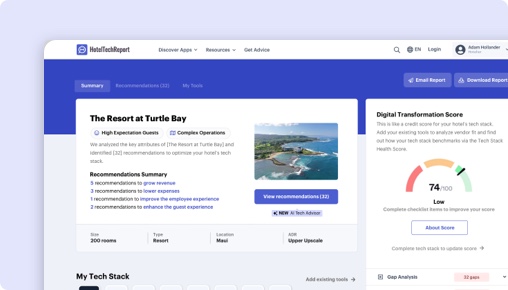
Lo sentimos, esta funcionalidad solo está disponible para hoteleros verificados
El panel de proyectos es una herramienta gratuita disponible únicamente para hoteleros verificados, que facilita la adopción de nuevas tecnologías al agilizar su investigación y simplificar sus flujos de comunicación.

Demand Booster vs. Hotelchamp Metasearch:
¿Cuál es el adecuado para usted?

Resumen
Analizamos 31 reseñas verificadas de hoteleros, comparamos funcionalidades, precios y casos de estudio reales para desglosar dónde destaca cada plataforma. La elección correcta depende de su tipo de hotel y de sus prioridades:
RateGain se destaca por funcionalidades exclusivas como Panel de marketing y Consultoría de comercio electrónico.
Hotelchamp destaca en Incorporación — especialmente para alojamientos de lujo (4,9/5).
¿Cómo se compara Demand Booster con Hotelchamp Metasearch?
Calificaciones comparadas basadas en 31 reseñas verificadas de hoteleros en HTR.
| HTScore |
|
|
| Probabilidad de recomendar |
|
|
| Facilidad de uso |
|
|
| Soporte al cliente |
|
|
| Relación calidad-precio |
|
|
| Precio inicial | Desde $1.000/mes | Contactar a ventas |
| Reseñas verificadas | 19 | 12 |
RateGain vs Hotelchamp: Rankings por segmento hotelero
Cómo se posiciona cada producto entre los proveedores de Software de gestión de metabúsqueda para hoteles para hoteles de diferentes tamaños, tipos y regiones, basado en reseñas verificadas de hoteleros en cada segmento.
Por tamaño de hotel
| Segmento |
RateGain
|
Hotelchamp
|
|---|---|---|
| Pequeño (10-24 habitaciones) | #8 4 reseñas | — |
| Mediano (25-74 habitaciones) ▾ | #8 10 reseñas | #12 8 reseñas |
| Grande (75-199 habitaciones) ▾ | #7 5 reseñas | #15 1 reseñas |
| Extra grande (200+ habitaciones) | #9 0 reseñas | #6 3 reseñas |
Por tipo de hotel
| Segmento |
RateGain
|
Hotelchamp
|
|---|---|---|
| Boutique ▾ | #7 9 reseñas | #12 7 reseñas |
| Lujo ▾ | #7 8 reseñas | #11 7 reseñas |
| Marca / Cadena ▾ | #8 6 reseñas | #16 1 reseñas |
| Estancia prolongada | #5 1 reseñas | #11 1 reseñas |
Por región
| Segmento |
RateGain
|
Hotelchamp
|
|---|---|---|
| Norteamérica | #12 0 reseñas | — |
| Europa ▾ | #8 13 reseñas | #11 8 reseñas |
| Asia Pacífico ▾ | #2 5 reseñas | #9 2 reseñas |
| Medio Oriente | #1 1 reseñas | #10 1 reseñas |
Is Demand Booster by RateGain or Hotelchamp Metasearch by Hotelchamp Better for Hotels?
Demand Booster by RateGain and Hotelchamp Metasearch serve the same core purpose: to increase direct bookings and reduce dependence on third-party channels through metasearch campaign management. They both address a critical revenue challenge for hotels—capturing more direct business by leveraging metasearch platforms like Google Hotel Ads.
These two platforms diverge in scale and operational depth. Demand Booster emphasizes a data-driven approach with access to over 1.7 billion digital identities and integrates with 140+ booking engines, positioning it for hotels seeking extensive global reach and granular marketing control. Hotelchamp Metasearch, by contrast, prioritizes easy-to-use tools and strong customer support with a smaller but focused partner network, fitting hotels looking for streamlined campaign management and personalized service.
Both products help hotels increase direct bookings and improve conversion by managing metasearch spend and visibility, but the choice hinges on property size, tech ecosystem complexity, and the value placed on support versus scale.
Demand Booster by RateGain vs Hotelchamp Metasearch: Which Should Your Hotel Choose?
If your hotel is a boutique or branded property with complex distribution needs and a global or multi-market presence, Demand Booster’s integration with 140+ booking engines and access to 1.7 billion digital identities supports advanced retargeting and parity management. This is backed by 19 reviews with a 4.8 overall rating and a 97% likelihood to recommend, signaling strong operator satisfaction in segments including boutique hotels (4.9/5 across 9 reviews) and branded hotels (4.9/5 across 6 reviews).
If you operate a luxury or independent property prioritizing ease of use, customer support, and direct revenue growth without complex integration needs, Hotelchamp Metasearch offers a more user-friendly setup and personalized service. It has a 4.8 overall rating from 12 reviews, with recent review activity showing consistent satisfaction. Luxury hotels form 34% of its user base, rating it 4.9/5 on average across 7 reviews. However, data for some segments like branded hotels is limited (one review at 4.5/5).
For smaller properties or those that value close vendor relationships and faster onboarding, Hotelchamp is a strong fit. Demand Booster suits hotels needing scale, data-driven marketing, and extensive partner connectivity. Both products demonstrate strong results but differ in operational focus and ecosystem compatibility.
Is Demand Booster by RateGain or Hotelchamp Metasearch Easier to Use?
Reviewers rate Hotelchamp Metasearch higher on ease of use and onboarding, with ratings of 4.9/5 each, compared to Demand Booster’s 4.7 and 4.6 respectively. Hotelchamp users praise its user-friendly platform and flexible campaign setup that front-desk or marketing teams can adopt quickly. For example, one reviewer highlighted that even without deep tech expertise, the platform supports targeted campaigns and behavioral triggers effectively.
Demand Booster users acknowledge its powerful features but note the dashboard feels dated and could benefit from modernization, potentially increasing the learning curve for some staff. While support is prompt, the interface may require more training for non-technical users to navigate complex data and campaign settings.
Edge: Hotelchamp.
Which Has Better Features: Demand Booster by RateGain or Hotelchamp Metasearch?
Demand Booster offers two exclusive features lacking in Hotelchamp Metasearch: a marketing dashboard and e-commerce consulting. The marketing dashboard provides operators with detailed analytics and campaign performance data in one place, allowing revenue managers to make data-driven decisions quickly. E-commerce consulting adds strategic support, enabling hotels to optimize direct booking strategies beyond software capabilities.
Hotelchamp shares four features with Demand Booster but does not offer unique hotel-specific functionalities beyond those. Its strength lies more in conversion tools like personalized messaging, exit intent offers, and segmentation, which reviewers say improve direct revenue and brand perception but are standard within the category.
Because Demand Booster couples software with consulting and analytics tools, it offers more comprehensive operational support for hotels seeking to enhance their digital marketing maturity.
Edge: Demand Booster.
Which Has Better Customer Support: Demand Booster by RateGain or Hotelchamp Metasearch?
Hotelchamp Metasearch scores slightly higher on customer support (4.8) and onboarding (4.9) than Demand Booster (4.9 and 4.6 respectively). Hotelchamp’s reviews frequently mention friendly, responsive teams with named contacts such as Jesmine, Beatriz, and Yada who provide proactive recommendations and smooth collaboration. One user praised the support as “extremely helpful, responsive and proactive,” highlighting its impact on campaign optimization.
Demand Booster also receives praise for prompt, friendly, and professional support. Reviewers note open conversations and efficient responses that help with campaign management and strategy. However, some comment that the platform’s expansion sometimes requires more staff involvement, suggesting a heavier operational footprint.
Both platforms provide strong support, but Hotelchamp’s personalized approach and higher onboarding marks give it a clear edge.
Edge: Hotelchamp.
Which Has More Integrations: Demand Booster by RateGain or Hotelchamp Metasearch?
Demand Booster integrates with 96 verified partners, more than twice Hotelchamp’s 44. Both share 23 common integrations, including key PMS and distribution partners like RateGain itself, WuBook, Net Affinity / Smarthotel, Bookassist, SHR Group, and RoomKey PMS.
Demand Booster’s unique integrations include Hospitality Software Development Services (HSDS), RoomRaccoon, Profitroom, Mirai, BookLogic, and Fairmas, which benefit hotels with complex PMS and revenue management ecosystems, especially branded and city center hotels with multiple sales channels.
Hotelchamp’s unique partners such as Swayy, Customer Alliance, Positioner, HiJiffy, and TrustYou focus more on digital marketing and guest feedback, which may appeal to luxury and boutique hotels prioritizing guest experience and brand presence.
Given Demand Booster’s significantly larger integration footprint supporting broader distribution and technology stacks, it better fits properties with complex connectivity needs.
Edge: Demand Booster.
Which Do Hoteliers Rate Higher: Demand Booster by RateGain or Hotelchamp Metasearch?
Both products share an identical overall rating of 4.8/5, but Demand Booster has a larger review sample (19 vs 12), though no recent reviews in the last six months. Hotelchamp has 2 recent reviews, consistent with earlier ratings, indicating stable satisfaction.
Segment-wise, Demand Booster scores highest with boutique hotels (4.9/5, 9 reviews) and branded hotels (4.9/5, 6 reviews). Hotelchamp rates best with luxury hotels (4.9/5, 7 reviews), boutique hotels (4.8/5, 7 reviews), and resorts (5/5, 3 reviews). Hotelchamp shows more diversity in luxury and resort segments; Demand Booster has stronger representation in boutique and branded segments.
Recent review volume favors Hotelchamp, suggesting its ratings reflect the current product experience more accurately. Both have high likelihood to recommend scores (97% Demand Booster, 96% Hotelchamp).
Edge: Even.
How Much Do Demand Booster by RateGain and Hotelchamp Metasearch Cost?
Demand Booster publishes a base price of $1,000 with no freemium, monthly flat, or per-room pricing, and no implementation fees or trial periods. This indicates a mid-market pricing model suited for hotels with dedicated budgets for metasearch marketing.
Hotelchamp Metasearch does not publish pricing, implementation fees, or trial details, requiring direct vendor contact for cost estimates. This lack of pricing transparency can complicate budget planning for hotels evaluating solutions.
Without published pricing from Hotelchamp, a side-by-side cost comparison is not possible.
What Type of Hotel Should Use Demand Booster by RateGain?
- Hotels that require broad and deep integration with over 90 technology partners including PMS and revenue management systems.
- Teams managing boutique or branded hotels with complex distribution and seeking data-driven marketing dashboards.
- Properties targeting at least a 30% increase in direct booking contribution, supported by proprietary travel intent data and retargeting features.
- Hotels that want e-commerce consulting to supplement software capabilities with strategic direction.
- Operators with marketing teams comfortable using detailed analytics and managing multi-channel campaigns.
Not ideal if:
- Your hotel values a modern UI and simplicity over comprehensive features.
- You need rapid onboarding with minimal training.
- You prefer transparent pricing models below $1,000 base or trial options.
What Type of Hotel Should Use Hotelchamp Metasearch?
- Luxury and independent hotels prioritizing ease of use and personalized customer support.
- Properties that want to quickly deploy targeted campaigns with behavioral triggers without extensive technical staff.
- Teams valuing proactive vendor collaboration and responsive communication to optimize direct booking strategies.
- Hotels focused on improving brand perception through personalized messaging and conversion tools.
- Operators with simpler integration needs or who rely on digital marketing and guest experience platforms.
Not ideal if:
- You require extensive PMS and channel manager integrations beyond a limited partner network.
- You want detailed e-commerce consulting or advanced marketing dashboards.
- Pricing transparency is critical for your purchasing decision.
Demand Booster by RateGain vs Hotelchamp Metasearch: The Bottom Line for Hotels
Demand Booster by RateGain and Hotelchamp Metasearch both improve direct booking performance through metasearch management but differ in scale and operational focus. Demand Booster offers a comprehensive platform with the largest partner network, access to extensive travel intent data, and consulting services geared toward boutique and branded hotels with complex distribution needs. Hotelchamp excels in ease of use, customer support, and targeted conversion tools favored by luxury and independent hotels.
Choose Demand Booster if you want the largest integration ecosystem (96 partners vs 44), a marketing dashboard for actionable insights, and e-commerce consulting that supports a 30%+ increase in direct bookings. It suits teams that can leverage data depth and require global reach.
Choose Hotelchamp if your priority is a user-friendly platform with superior onboarding and customer support scores, plus effective personalization tools that enhance brand presence. It fits properties seeking quick setup, strong vendor partnership, and a focus on luxury or independent hotel segments.
The decision rests on your hotel’s scale, operational complexity, and preference for support versus data-driven marketing breadth. Both products maintain excellent overall ratings (4.8/5) and high recommendation likelihood, so your choice should align with these specific operational priorities.
¿Cuánto cuestan Demand Booster y Hotelchamp Metasearch?
Los precios de Software de gestión de metabúsqueda para hoteles rara vez son sencillos. Esto es lo que sabemos de los datos de precios públicos de cada proveedor. Solicite siempre un presupuesto personalizado para el tamaño de su hotel.
|
RateGain
|
Hotelchamp
|
|
|---|---|---|
| Precio inicial | Desde $1.000/mes | — |
Comparación de funcionalidades: Demand Booster vs Hotelchamp Metasearch
Estas son las funcionalidades que cada proveedor ha configurado, organizadas por grupo de funcionalidades — los mismos datos que se muestran en el panel del proveedor. Expanda un grupo para comparar las funcionalidades en paralelo.
| Funcionalidad |
RateGain
|
Hotelchamp
|
|---|---|---|
|
▾
Servicios
|
|
|
| Consultoría de comercio electrónico | ||
| Vigilancia de Metabúsqueda | ||
| Conectividad metasearch | ||
| Marketing de metabúsqueda | ||
|
▾
Reportes y análisis
|
|
|
| Panel de marketing |
Resultados reales: RateGain vs Hotelchamp por objetivo de negocio
Analizamos 1 casos de estudio verificados para comparar lo que los hoteles realmente logran con cada plataforma en cuatro objetivos clave de negocio.
Safir Hotels & Resorts
Mediano
"The partnership with RateGain has been transformative for Safir Hotels & Resorts, yielding 4x growth in our revenue."
 Hotelchamp
Aún no hay caso de estudio publicado para este objetivo.
RateGain vs Hotelchamp: Conclusión final
Mejor posicionado en
Capacidades únicas
Mejor posicionado en
Donde más difieren las calificaciones
Preguntas frecuentes sobre Demand Booster vs Hotelchamp Metasearch
¿Puede Demand Booster reemplazar a Hotelchamp Metasearch?
Depende de sus requerimientos. Demand Booster y Hotelchamp Metasearch comparten muchas funcionalidades principales de Hotel Metasearch Management Software, pero cada uno tiene capacidades únicas. Demand Booster ofrece 96 socios de integración verificados, mientras que Hotelchamp Metasearch ofrece 44. Revise la comparación de funcionalidades anterior para ver en qué difieren antes de cambiar.
¿Cuál es mejor para hoteles pequeños o independientes?
Los hoteles pequeños deben priorizar la facilidad de uso y una incorporación rápida. Hotelchamp Metasearch lidera en facilidad de uso con 4,9/5 vs 4,7/5. Busque precios transparentes y una opción de prueba o demostración. Filtre las reseñas en la página de cada producto por tamaño de hotel para conocer la opinión de hoteles como el suyo.
¿Ofrecen Demand Booster o Hotelchamp Metasearch un plan gratuito?
Demand Booster: No. Hotelchamp Metasearch: No. Ninguno de los dos productos ofrece actualmente un nivel gratuito. La mayoría de los proveedores de Hotel Metasearch Management Software ofrecen demostraciones o pruebas. Solicite una de cada uno para evaluar antes de comprometerse.
¿Cómo evalúa y clasifica HTR a Demand Booster y Hotelchamp Metasearch?
El HT Score es un ranking compuesto que considera 4 grupos de criterios y más de una docena de variables para ayudar a los hoteleros a comparar objetivamente los productos de tecnología hotelera. RateGain tiene un HT Score de 0 y Hotelchamp tiene 0. Así se calcula la puntuación.
| Grupo de criterios | Peso | Qué mide |
|---|---|---|
| Calificaciones y reseñas de clientes |
|
¿Qué tanto recomiendan los usuarios este producto? Puntuación de calificaciones, Volumen de reseñas, Participación de voz, Profundidad de reseñas, Actualidad de reseñas, Casos de éxito ▾ El factor con mayor ponderación. Analiza las calificaciones promedio de satisfacción (probabilidad de recomendar, facilidad de uso, soporte, ROI), el total de reseñas en relación con los competidores de la categoría, la actualidad de las reseñas (al menos 20 reseñas en los últimos 6 meses) y la participación de voz entre clientes hoteleros únicos para detectar sesgo de selección. |
| Ecosistema de socios |
|
¿Qué tanto recomiendan los socios tecnológicos a esta empresa? Recomendaciones de socios, Cantidad de integraciones, Calidad de integraciones ▾ Evalúa las recomendaciones de socios como votos de confianza de expertos, la cantidad de integraciones verificadas y la calidad del ecosistema, es decir, el promedio de HT Scores de los socios de integración. Los productos con ecosistemas de integración de mayor calidad tienen más probabilidades de ofrecer un stack tecnológico conectado. |
| Enfoque en el cliente |
|
¿Qué tan centrada en el cliente es esta organización? Soporte certificado, Consistencia de reseñas, Completitud del perfil ▾ Evalúa si la empresa ha obtenido la Certificación de Soporte al Cliente de HTR, mantiene una recolección consistente de reseñas a lo largo del tiempo (un indicador de cultura orientada al feedback) y mantiene los perfiles de producto completos con capacidades, capturas de pantalla, precios y funcionalidades. |
| Alcance, solidez y recursos |
|
¿Qué tan extensos son el alcance y los recursos de esta empresa? Alcance geográfico, Solidez, Recursos de la empresa, Puntuación de tendencia ▾ Mide la presencia global (países y regiones atendidos), los años en el negocio como indicador de estabilidad, el tamaño del equipo como indicador de recursos y una puntuación de tendencia basada en consultas de compradores, reseñas, recomendaciones de socios y actividad en prensa de los últimos doce meses. |
Las calificaciones y reseñas de clientes son con diferencia el factor más importante en el algoritmo del HT Score. HTR no acepta pagos a cambio de mejores posiciones en el ranking. Todas las reseñas son verificadas: solo profesionales de la industria hotelera con afiliaciones confirmadas pueden enviar calificaciones. Ver metodología completa del HT Score →
¿Qué otras comparaciones de Software de gestión de metabúsqueda para hoteles están leyendo los hoteleros?
Explore más comparaciones directas basadas en reseñas verificadas de hoteleros.





Contenido
Obtenga su informe gratuito de analista de IA.
Recomendaciones personalizadas adaptadas a su hotel


Busquemos la información de tu hotel
¿Sigues sopesando tus opciones de software de gestión de metabúsqueda para hoteles?
Algunos sistemas populares de nuestra guía sobre software de gestión de metabúsqueda para hoteles — o deja que nuestra IA evalúe cada uno para tu hotel concreto en unos dos minutos.


