

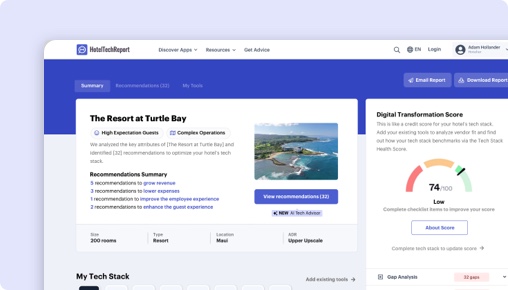
Lo sentimos, esta funcionalidad solo está disponible para hoteleros verificados
El panel de proyectos es una herramienta gratuita disponible únicamente para hoteleros verificados, que facilita la adopción de nuevas tecnologías al agilizar su investigación y simplificar sus flujos de comunicación.

Demand Calendar vs. Pricepoint:
¿Cuál es el adecuado para usted?


Resumen
Analizamos 152 reseñas verificadas de hoteleros, comparamos funcionalidades, precios y casos de estudio reales para desglosar dónde destaca cada plataforma. La elección correcta depende de su tipo de hotel y de sus prioridades:
Demand Calendar AB destaca , con funcionalidades exclusivas como Five-Year Forecasting and Lost Business Data.
Pricepoint destaca en ROI and onboarding — especialmente en el segmento brand (0.0/5) , con funcionalidades exclusivas como Controlled Automation/Algorithm Customization and Fully automated revenue management.
¿Cómo se compara Demand Calendar con Pricepoint?
Calificaciones comparadas basadas en 152 reseñas verificadas de hoteleros en HTR.
| HTScore |
|
|
| Probabilidad de recomendar |
|
|
| Facilidad de uso |
|
|
| Soporte al cliente |
|
|
| Relación calidad-precio |
|
|
| Precio inicial | Desde $600/mes | Desde $500/mes |
| Reseñas verificadas | 7 | 145 |
¿Cuáles son los pros y contras de Demand Calendar vs Pricepoint?
Tras analizar 152 reseñas verificadas, los usuarios de Demand Calendar AB valoran más su , mientras que los usuarios de Pricepoint destacan soporte, incorporación y gestión de cuentas, facilidad de uso y flujo de trabajo intuitivo, incremento en ingresos y mejoras en adr / ocupación. Haga clic en cualquier tema para ver qué dicen los evaluadores.
|
Demand Calendar AB
|
Pricepoint
|
|---|---|
| Pros | |
|
+
Soporte, incorporación y gestión de cuentas
▾
|
|
|
+
Facilidad de uso y flujo de trabajo intuitivo
▾
|
|
|
+
Incremento en ingresos y mejoras en ADR / ocupación
▾
|
|
|
+
La automatización ahorra tiempo y reduce el trabajo manual en la fijación de precios
▾
|
|
| Contras | |
|
−
Flexibilidad en la configuración y controles avanzados de precios
▾
|
|
|
−
Profundidad de informes, análisis y personalización de paneles
▾
|
|
|
−
Rendimiento de integración de PMS y canales y sincronización de tarifas
▾
|
|
Demand Calendar AB vs Pricepoint: Rankings por segmento hotelero
Cómo se posiciona cada producto entre los proveedores de Sistemas de gestión de ingresos para hoteles de diferentes tamaños, tipos y regiones, basado en reseñas verificadas de hoteleros en cada segmento.
Por tamaño de hotel
| Segmento |
Demand Calendar AB
|
Pricepoint
|
|---|---|---|
| Pequeño (10-24 habitaciones) ▾ | #36 2 reseñas | #14 28 reseñas |
| Mediano (25-74 habitaciones) ▾ | #34 5 reseñas | #31 7 reseñas |
| Grande (75-199 habitaciones) | — | #36 0 reseñas |
Por tipo de hotel
| Segmento |
Demand Calendar AB
|
Pricepoint
|
|---|---|---|
| Boutique ▾ | #36 5 reseñas | #18 22 reseñas |
| Lujo ▾ | #38 2 reseñas | #28 7 reseñas |
| Marca / Cadena ▾ | #33 2 reseñas | #36 2 reseñas |
| Estancia prolongada ▾ | — | #24 3 reseñas |
Por región
| Segmento |
Demand Calendar AB
|
Pricepoint
|
|---|---|---|
| Norteamérica ▾ | — | #10 22 reseñas |
| Europa ▾ | #27 5 reseñas | #22 12 reseñas |
| Asia Pacífico | #13 2 reseñas | #18 1 reseñas |
| Medio Oriente | — | #15 1 reseñas |
The Decision
Choosing between Demand Calendar by Demand Calendar AB and Pricepoint hinges on your hotel’s specific revenue management needs. Demand Calendar focuses on broad data analytics and forecast accuracy, while Pricepoint emphasizes real-time, AI-powered dynamic pricing. Both systems aim to boost your revenue, but they approach this goal through different methods and feature sets. With Demand Calendar’s reputation for detailed analytics and Pricepoint’s automation and ease of use, which suits your hotel’s operational style?
Demand Calendar offers a comprehensive business intelligence platform with advanced forecasting and multi-source data integration, whereas Pricepoint leverages AI to adjust prices automatically based on demand signals. Do you prioritize deep analytics or automated price adjustments? Let’s examine both options.
Is Demand Calendar or Pricepoint Better for Hotels?
Demand Calendar aims to provide your team with detailed insights into revenue streams, forecast accuracy, and market trends. Its core strength lies in multi-property data consolidation, advanced forecasting, and reporting tools, perfect for hotels that need to understand complex revenue drivers. Conversely, Pricepoint is designed for hotels that want to automate their pricing decisions, reducing manual work and reacting swiftly to market changes.
Demand Calendar’s review count is just 7, with recent reviews scarce, indicating limited recent user feedback. Pricepoint, with over 83 reviews and recent feedback from 44 users, paints a more current picture of user satisfaction. Given this, Pricepoint’s proven track record and widespread use make it the stronger choice for most hotels actively seeking reliable revenue management solutions today.
Pricepoint vs Demand Calendar: Which Should Your Hotel Choose?
If your hotel needs a platform to analyze multiple revenue streams and gain strategic insights, Demand Calendar’s detailed dashboards and forecasting tools are ideal. It suits hotels that prioritize understanding patterns over quick price changes, especially those with complex operations or multi-property portfolios.
If your focus is on maximizing revenue through automated, demand-based pricing with minimal manual intervention, Pricepoint is the better pick. Its AI-driven system adapts prices in real-time, boosting ADR and occupancy, particularly beneficial for small to medium-sized hotels seeking simplicity alongside efficacy.
In summary, choose Demand Calendar for deep analytics and broader revenue insights; opt for Pricepoint if automation and quick responsiveness are your priorities.
Is Demand Calendar or Pricepoint Easier to Use?
Demand Calendar’s user rating for ease of use is 4.71/5, with reviews citing its intuitive, Google-based interface that consolidates complex data into accessible dashboards. Onboarding is rated 4.33/5, and users appreciate its straightforward setup, though some mention connectivity issues with PMS integrations that could be smoother.
Pricepoint scores slightly higher in ease of use at 4.75/5, with reviews highlighting its simple setup and clear, understandable pricing and forecasting features. Support responsiveness and intuitive workflows make it accessible for smaller teams or those new to revenue management.
Edge: Pricepoint.
Which Has Better Features: Demand Calendar or Pricepoint?
Demand Calendar offers 13 shared features plus 5 unique capabilities, including five-year forecasting and open API access. It excels in analytics, multi-source data integration, and detailed revenue tracking—features suited for strategic planning.
Pricepoint, with 32 exclusive features, leads in automation and dynamic pricing. Its offerings include real-time price optimization, AI-driven adjustments, "what-if" scenario analysis, and inventory management—features that enable rapid, demand-based pricing adjustments.
Edge: Pricepoint.
Which Has Better Customer Support: Demand Calendar or Pricepoint?
Demand Calendar’s support is rated a perfect 5/5, with reviews emphasizing quick responses and helpful onboarding. Users describe it as “a fantastic tool for revenue work,” appreciating the dedicated support for connectivity and data issues.
Pricepoint’s support is nearly as highly rated at 4.95/5, with reviews praising the responsiveness and professionalism of their team. Users often mention how support helps them troubleshoot and optimize their system, making daily operations smoother.
Edge: Demand Calendar.
Which Has More Integrations: Demand Calendar or Pricepoint?
Demand Calendar integrates with 5 verified partners, including IDeaS, Clock, HQ revenue, and Oracle Hospitality. Its open API enables connection to other data sources but is limited compared to Pricepoint’s broad ecosystem.
Pricepoint boasts 18 verified partners, with shared integrations like Mews and numerous unique ones such as Omnibees, Guesty, and Channel Manager solutions. Its extensive integration network makes it easier to connect with existing PMS and distribution platforms.
Edge: Pricepoint.
Which Do Hoteliers Rate Higher: Demand Calendar or Pricepoint?
Demand Calendar has only 7 reviews, with no recent feedback, making it difficult to gauge current satisfaction levels. Its niche user base includes boutique and luxury hotels but lacks broad recent validation.
Pricepoint, with 83 reviews and an average rating of 85.38, garners more recent praise. Hotels of all sizes, especially boutique and small properties, rate it highly for usability and revenue gains, making it the more trusted choice based on current feedback.
Edge: Pricepoint.
How Much Do Demand Calendar and Pricepoint Cost?
Demand Calendar’s pricing details are not publicly available, suggesting it may be customized based on hotel size and needs. Its higher feature count and enterprise capabilities imply a premium price.
Pricepoint costs $500 monthly, with no setup or implementation fees, making it accessible for small to medium-sized hotels. Its lower price point combined with extensive features offers strong value for revenue-minded properties.
What Type of Hotel Should Use Demand Calendar?
- Hotels that need detailed multi-source revenue insights and forecasting.
- Teams managing multiple properties seeking unified performance views.
- Hotels focusing on long-term strategic revenue planning.
- Properties with complex revenue streams like food & beverage, spa, and events.
- Hotels that value comprehensive analytics over quick pricing adjustments.
Not ideal if you want rapid, automated price changes or have a smaller team needing straightforward tools.
What Type of Hotel Should Use Pricepoint?
- Hotels that want automated, real-time demand-based pricing.
- Small to medium-sized properties seeking an easy-to-use system.
- Hotels aiming to boost ADR and occupancy with minimal manual effort.
- Properties needing quick, accurate pricing adjustments based on market signals.
- Hotels with limited revenue management resources or technical expertise.
Not ideal if you require extensive analytics, deep forecasting, or multi-source data integration.
Pricepoint vs Demand Calendar: The Bottom Line for Hotels
Demand Calendar specializes in strategic revenue analytics and forecasts, suited for hotels with complex, multi-source revenue streams. Its strengths include multi-property management and detailed reporting, but its user experience can be hindered by connectivity issues and limited recent feedback.
Pricepoint excels in automated, demand-driven pricing with a broad feature set that adapts to market signals in real-time. Its intuitive interface, extensive integrations, and high recent ratings make it the top choice for most properties today.
If your hotel prioritizes data analysis and strategic planning, Demand Calendar is worth considering. However, for hotels seeking quick, effective revenue boosts through automation, Pricepoint delivers current, verified results.
In conclusion, if recent reviews and active user feedback are your priority, Pricepoint’s compelling combination of ease of use, automation, and extensive features make it the superior choice for most hotels aiming to maximize revenue efficiently.
¿Cuánto cuestan Demand Calendar y Pricepoint?
Los precios de Sistemas de gestión de ingresos rara vez son sencillos. Esto es lo que sabemos de los datos de precios públicos de cada proveedor. Solicite siempre un presupuesto personalizado para el tamaño de su hotel.
|
Demand Calendar AB
|
Pricepoint
|
|
|---|---|---|
| Precio inicial | Desde $600/mes | Desde $500/mes |
Comparación de funcionalidades: Demand Calendar vs Pricepoint
Estas son las funcionalidades que cada proveedor ha configurado, organizadas por grupo de funcionalidades — los mismos datos que se muestran en el panel del proveedor. Expanda un grupo para comparar las funcionalidades en paralelo.
| Funcionalidad |
Demand Calendar AB
|
Pricepoint
|
|---|---|---|
|
▾
Optimización de Precios
|
|
|
| Explicación de precios | ||
| Directrices comerciales empresariales | ||
| Recomendaciones de fechas de estadía alternativas | ||
| Recomendaciones de propiedad alternativa | ||
| Optimización de precios en tiempo real | ||
| Control dinámico de jerarquía de precios | ||
| Precios abiertos | ||
| Flujos de trabajo guiados | ||
| Análisis de escenarios hipotéticos | ||
| Precio dinamico | ||
| Set Boundaries | ||
| Manage Exceptions | ||
| Group Pricing | ||
| Manage Restrictions | ||
| Manage Sell-Outs & Cancellations | ||
| Business Mix Optimization | ||
| Define Cycles | ||
| Yield Room Types Individually | ||
| Bulk Adjustments | ||
| Precios y previsiones a 24 meses | ||
| Precios de componentes/salas virtuales | ||
| Precios para estancias prolongadas | ||
| Precios de venta adicional | ||
| tasa de obstáculo | ||
|
▾
Inteligencia de mercado y pronóstico
|
|
|
| Pronóstico quinquenal | ||
| Precios a plazo de 365 días | ||
| STR Data | ||
| 18-Month Forward Pricing | ||
| Modelado de sensibilidad al precio | ||
| Multi-Property Dashboard | ||
| Market Intelligence Data | ||
| Interactive Customizable Dashboards | ||
| Datos de demanda del mercado futuro | ||
| Generador de pronósticos financieros | ||
| Previsión de estancias prolongadas | ||
| Previsión de canales | ||
| Explicación del pronóstico | ||
| Datos flexibles de la competencia | ||
|
▾
Tableros e informes
|
|
|
| Reportes personalizados | ||
| Informes programados | ||
| Datos comerciales perdidos | ||
| Panel de análisis | ||
| Interactive Customizable Dashboards | ||
| Market Insights Reporting | ||
| Pickup Analysis | ||
| Booking Pattern Analysis | ||
| Event Data | ||
| Price Change Logs | ||
| Customizable Notifications & Alerts | ||
| Displacement Analysis | ||
| Group Pricing & Evaluation | ||
| Multi-Property Dashboard | ||
| Medición de los beneficios del sistema | ||
|
▾
Automatización
|
|
|
| Controlled Automation/Algorithm Customization | ||
| Precios automatizados por tipo de habitación | ||
| Gestión de ingresos totalmente automatizada | ||
| Precio dinamico | ||
| AI Optimization | ||
| Automatic Pricing Updates | ||
|
▾
Funcionalidad multipropiedad
|
|
|
| La gestión del inventario | ||
| Gestión de propiedades múltiples | ||
| Multi-Property Dashboard | ||
|
▾
negocio del grupo
|
|
|
| Group Pricing & Evaluation | ||
| Análisis de escenarios hipotéticos | ||
| Displacement Analysis | ||
| Pronóstico y lavado de grupo | ||
|
▾
integraciones
|
|
|
| API abierta | ||
| Gestión de canales | ||
| Business Intelligence | ||
| STR Data | ||
| Property Management System | ||
| Autenticación multifactor |
Resultados reales: Demand Calendar AB vs Pricepoint por objetivo de negocio
Analizamos 3 casos de estudio verificados para comparar lo que los hoteles realmente logran con cada plataforma en cuatro objetivos clave de negocio.
Demand Calendar AB
Aún no hay caso de estudio publicado para este objetivo.
Pricepoint
Pequeño
"For sure our revenue wouldn't be what it was if it wasn't for Pricepoint. That's the super easy thing to say."

Demand Calendar AB vs Pricepoint: Conclusión final
Mejor posicionado en
Capacidades únicas
Lo que les encanta a los hoteleros
La calidad del soporte es un aspecto muy valorado en las reseñas, con muchos usuarios elogiando respuestas rápidas, una incorporación con conocimiento... La calidad del soporte es un aspecto muy valorado en las reseñas, con muchos usuarios elogiando respuestas rápidas, una incorporación con conocimiento y gestores de cuentas proactivos. Varios revisores mencionan que el equipo detrás del producto los ayudó a implementar el sistema con éxito y les brindó confianza durante la configuración y el uso continuo.
Muchos revisores dicen que Pricepoint es fácil de entender, fácil de navegar y sencillo de configurar una vez ajustado. Esto es especialmente importan... Muchos revisores dicen que Pricepoint es fácil de entender, fácil de navegar y sencillo de configurar una vez ajustado. Esto es especialmente importante para hoteles más pequeños que no cuentan con un equipo de ingresos dedicado y necesitan una herramienta práctica en lugar de excesivamente técnica.
Los revisores afirman consistentemente que Pricepoint genera mejoras medibles en los ingresos, mencionando a menudo un ADR más alto, mejor ocupación y... Los revisores afirman consistentemente que Pricepoint genera mejoras medibles en los ingresos, mencionando a menudo un ADR más alto, mejor ocupación y mayor RevPAR tras su implementación. Muchos lo describen como que se amortiza solo al captar tarifas que habrían perdido con precios manuales.
Donde los hoteleros objetan
Una solicitud recurrente es mayor flexibilidad en la configuración de tarifas, incluyendo reglas específicas por fecha, ventanas de precios a más larg... Una solicitud recurrente es mayor flexibilidad en la configuración de tarifas, incluyendo reglas específicas por fecha, ventanas de precios a más largo plazo, manejo de tipos de habitación y límites en precios mínimos/máximos. A los usuarios les gusta la automatización, pero desean un control más preciso para casos especiales como tarifas con desayuno incluido, múltiples tarifas principales, habitaciones agrupadas y lógica de precios específica para cada hotel.
Los usuarios suelen buscar informes más detallados, personalizables y fáciles de interpretar, incluso cuando elogian los conocimientos actuales. La br... Los usuarios suelen buscar informes más detallados, personalizables y fáciles de interpretar, incluso cuando elogian los conocimientos actuales. La brecha es especialmente evidente en revisiones mensuales, análisis visual y comprensión del significado detrás de métricas y pronósticos.
Mejor posicionado en
Capacidades únicas
Donde más difieren las calificaciones
Preguntas frecuentes sobre Demand Calendar vs Pricepoint
¿Puede Demand Calendar reemplazar a Pricepoint?
Depende de sus requerimientos. Demand Calendar y Pricepoint comparten muchas funcionalidades principales de Revenue Management Systems, pero cada uno tiene capacidades únicas. Demand Calendar ofrece 5 socios de integración verificados, mientras que Pricepoint ofrece 21. Revise la comparación de funcionalidades anterior para ver en qué difieren antes de cambiar.
¿Cuál es mejor para hoteles pequeños o independientes?
Los hoteles pequeños deben priorizar la facilidad de uso y una incorporación rápida. Demand Calendar lidera en facilidad de uso con 4.7/5 vs 4.7/5. Busque precios transparentes y una opción de prueba o demostración. Filtre las reseñas en la página de cada producto por tamaño de hotel para conocer la opinión de hoteles como el suyo.
¿Ofrecen Demand Calendar o Pricepoint un plan gratuito?
Demand Calendar: No. Pricepoint: No. Ninguno de los dos productos ofrece actualmente un nivel gratuito. La mayoría de los proveedores de Revenue Management Systems ofrecen demostraciones o pruebas. Solicite una de cada uno para evaluar antes de comprometerse.
¿Cómo evalúa y clasifica HTR a Demand Calendar y Pricepoint?
El HT Score es un ranking compuesto que considera 4 grupos de criterios y más de una docena de variables para ayudar a los hoteleros a comparar objetivamente los productos de tecnología hotelera. Demand Calendar AB tiene un HT Score de 0 y Pricepoint tiene 93. Así se calcula la puntuación.
| Grupo de criterios | Peso | Qué mide |
|---|---|---|
| Calificaciones y reseñas de clientes |
|
¿Qué tanto recomiendan los usuarios este producto? Puntuación de calificaciones, Volumen de reseñas, Participación de voz, Profundidad de reseñas, Actualidad de reseñas, Casos de éxito ▾ El factor con mayor ponderación. Analiza las calificaciones promedio de satisfacción (probabilidad de recomendar, facilidad de uso, soporte, ROI), el total de reseñas en relación con los competidores de la categoría, la actualidad de las reseñas (al menos 20 reseñas en los últimos 6 meses) y la participación de voz entre clientes hoteleros únicos para detectar sesgo de selección. |
| Ecosistema de socios |
|
¿Qué tanto recomiendan los socios tecnológicos a esta empresa? Recomendaciones de socios, Cantidad de integraciones, Calidad de integraciones ▾ Evalúa las recomendaciones de socios como votos de confianza de expertos, la cantidad de integraciones verificadas y la calidad del ecosistema, es decir, el promedio de HT Scores de los socios de integración. Los productos con ecosistemas de integración de mayor calidad tienen más probabilidades de ofrecer un stack tecnológico conectado. |
| Enfoque en el cliente |
|
¿Qué tan centrada en el cliente es esta organización? Soporte certificado, Consistencia de reseñas, Completitud del perfil ▾ Evalúa si la empresa ha obtenido la Certificación de Soporte al Cliente de HTR, mantiene una recolección consistente de reseñas a lo largo del tiempo (un indicador de cultura orientada al feedback) y mantiene los perfiles de producto completos con capacidades, capturas de pantalla, precios y funcionalidades. |
| Alcance, solidez y recursos |
|
¿Qué tan extensos son el alcance y los recursos de esta empresa? Alcance geográfico, Solidez, Recursos de la empresa, Puntuación de tendencia ▾ Mide la presencia global (países y regiones atendidos), los años en el negocio como indicador de estabilidad, el tamaño del equipo como indicador de recursos y una puntuación de tendencia basada en consultas de compradores, reseñas, recomendaciones de socios y actividad en prensa de los últimos doce meses. |
Las calificaciones y reseñas de clientes son con diferencia el factor más importante en el algoritmo del HT Score. HTR no acepta pagos a cambio de mejores posiciones en el ranking. Todas las reseñas son verificadas: solo profesionales de la industria hotelera con afiliaciones confirmadas pueden enviar calificaciones. Ver metodología completa del HT Score →
¿Qué otras comparaciones de Sistemas de gestión de ingresos están leyendo los hoteleros?
Explore más comparaciones directas basadas en reseñas verificadas de hoteleros.





Contenido
Obtenga su informe gratuito de analista de IA.
Recomendaciones personalizadas adaptadas a su hotel


Busquemos la información de tu hotel
¿Sigues sopesando tus opciones de sistemas de gestión de ingresos?
Algunos sistemas populares de nuestra guía sobre sistemas de gestión de ingresos — o deja que nuestra IA evalúe cada uno para tu hotel concreto en unos dos minutos.


