
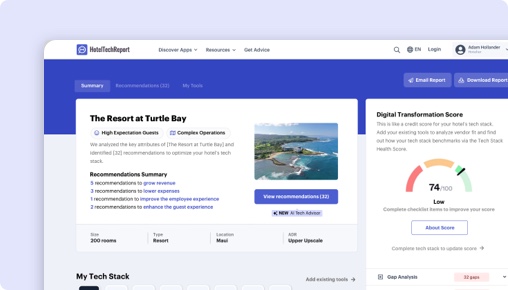
Sorry, this functionality is only available for verified hoteliers
The project dashboard is a free tool that is only available to verified hoteliers to make adopting new technology easier by streamlining their research and simplifying their communication workflow.

Price Seeker vs. Roompulse:
¿Cuál es el adecuado para ti?


Resumen
Analizamos 17 reseñas verificadas de hoteleros, comparamos funcionalidades, precios y casos de estudio reales para desglosar dónde destaca cada plataforma. La elección correcta depende de tu tipo de propiedad y prioridades:
Paraty Tech destaca , con funcionalidades exclusivas como Historical Trend Analysis.
Roompulse destaca en ease of use and customer support , con funcionalidades exclusivas como Performance Reporting.
¿Cómo se compara Price Seeker con Roompulse?
Calificaciones comparadas basadas en 17 reseñas verificadas de hoteleros en HTR.
| HTScore |
|
|
| Probabilidad de recomendar |
|
|
| Facilidad de uso |
|
|
| Soporte al cliente |
|
|
| Relación calidad-precio |
|
|
| Precio inicial | From $200/mo | From $200/mo |
| Reseñas verificadas | 14 | 3 |
Paraty Tech vs Roompulse: Rankings por segmento hotelero
Cómo se posiciona cada producto entre los proveedores de Tarifa de compras para diferentes tamaños de propiedad, tipos y regiones, basado en reseñas verificadas de hoteleros en cada segmento.
Por tamaño de hotel
| Segmento |
Paraty Tech
|
Roompulse
|
|---|---|---|
| Pequeño (10-24 habitaciones) | #10 4 reseñas | #19 1 reseñas |
| Mediano (25-74 habitaciones) ▾ | #7 6 reseñas | — |
| Grande (75-199 habitaciones) | #16 0 reseñas | #11 2 reseñas |
| Extra grande (200+ habitaciones) | #5 4 reseñas | — |
Por tipo de propiedad
| Segmento |
Paraty Tech
|
Roompulse
|
|---|---|---|
| Boutique ▾ | #10 5 reseñas | #20 1 reseñas |
| Lujo ▾ | #13 6 reseñas | #19 1 reseñas |
| Cadena / Marca | #11 4 reseñas | — |
| Estancia prolongada | #10 1 reseñas | — |
Por región
| Segmento |
Paraty Tech
|
Roompulse
|
|---|---|---|
| Norteamérica | #9 2 reseñas | #13 1 reseñas |
| Europa ▾ | #6 8 reseñas | #16 2 reseñas |
| Medio Oriente | #10 1 reseñas | — |
The Decision
Choosing between Price Seeker by Paraty Tech and Roompulse by Roompulse hinges on your hotel's specific needs for rate shopping. Both aim to monitor competitor prices and help optimize revenue, but they diverge in features, support, and market presence. Your decision should consider recent reviews, feature depth, and the integration capacity each offers.
While Price Seeker has a broader regional presence and more verified integrations, Roompulse boasts more recent reviews and higher user ratings. Which aligns better with your hotel’s growth trajectory?
Is Price Seeker or Roompulse Better for Hotels?
Price Seeker and Roompulse are both rate shopping tools designed to give hoteliers a competitive edge through real-time pricing insights. Price Seeker monitors over 200 sites with a focus on high-market-share sources, offering contextual price data and expert support, especially beneficial for larger or multi-property hotels. Roompulse, on the other hand, emphasizes simplicity and ease of use, providing an intuitive dashboard and highly customizable alerts that are ideal for smaller hotels or properties seeking quick, actionable insights.
Price Seeker's strength lies in its extensive site coverage, historical trend analysis, and multi-property consolidation, which can be vital for large hotel groups. Roompulse excels in delivering straightforward, real-time competitor pricing with less complexity, making it suitable for hoteliers who prioritize speed over detailed analytics. Do you prefer comprehensive data analysis or quick, easy-to-understand insights?
Price Seeker vs Roompulse: Which Should Your Hotel Choose?
If your hotel needs detailed competitor analysis, extensive regional coverage, and support for multiple properties, go with Price Seeker. Its ability to monitor over 200 sites and offer historical trend analysis makes it ideal for revenue managers handling complex portfolios. Its higher number of verified integrations and broader market presence also give it an edge for larger or multi-venue hotels.
If, however, your team values ease of use, fast insights, and customizable alerts without the need for detailed historical data, Roompulse is a better fit. Its user-friendly interface and recent reviews—more numerous and current than Price Seeker’s—suggest it will be easier for your staff to adopt quickly and generate actionable pricing strategies.
Ultimately, choose Price Seeker if your hotel needs comprehensive data and multi-property management; opt for Roompulse if simplicity and rapid decision-making are your priorities.
Is Price Seeker or Roompulse Easier to Use?
Price Seeker scores a 4.46/5 for ease of use, reflecting a generally positive experience despite its more complex features. Reviewers note that support and onboarding are strong, with one praising the “seamless communication” and “support team trained in the tourism sector.” However, some mention that the interface could be more intuitive when navigating detailed reports or historical data.
Roompulse receives a perfect 5/5, with reviews emphasizing its user-friendly, intuitive dashboard, and low learning curve. Users find it quick to understand, with highly customizable alerts that simplify daily revenue management tasks. Many reviewers highlight how fast they could incorporate Roompulse into their operations without extensive training.
Edge: Roompulse.
Which Has Better Features: Price Seeker or Roompulse?
Price Seeker offers 18 shared features with Roompulse and uniquely includes historical trend analysis, a crucial tool for understanding pricing patterns over time. It monitors more than 200 sites, including package rates and tour operators, giving a broader competitive picture. Its multi-property consolidation and detailed market context are features that support larger hotel groups.
Roompulse provides six features unique to its platform, including real-time competitor pricing, highly customizable alerts, and a simplified dashboard. While it lacks historical trend analysis, it emphasizes quick, actionable insights, such as instant market trend highlights and competitor availability.
Overall, Price Seeker’s broader feature set and historical analysis give it an advantage for hotels requiring in-depth, long-term insights. Edge: Price Seeker.
Which Has Better Customer Support: Price Seeker or Roompulse?
Price Seeker’s support scores a strong 4.69/5, with many reviews praising the responsiveness and proactive assistance from their dedicated account managers. One reviewer called their support “excellent,” highlighting the team’s problem-solving skills and availability. Support quality appears consistent, especially for larger hotels needing ongoing assistance.
Roompulse also scores a perfect 5/5 for support, with reviewers describing their team as “knowledgeable, considerate, and helpful.” Since Roompulse has fewer reviews overall, the data suggests consistently high support levels, but less long-term feedback.
Edge: Roompulse.
Which Has More Integrations: Price Seeker or Roompulse?
Price Seeker has a significant advantage with 28 verified integrations, including major partners like Omnibees, Dingus, and Cendyn. These integrations facilitate seamless connection with property management and booking systems, supporting larger or multi-property hotel portfolios.
Roompulse currently has no verified integrations, which could limit its ability to connect with existing hotel tech stacks. This makes it less suitable if your hotel relies heavily on third-party systems for operations.
Edge: Price Seeker.
Which Do Hoteliers Rate Higher: Price Seeker or Roompulse?
Price Seeker has only 13 reviews, with an overall score of 0/5, which limits the ability to gauge its user satisfaction. The reviews are older and less recent, making the data less reliable for current performance.
Roompulse, despite fewer reviews (3), has a perfect 5/5 rating, with all recent reviews emphasizing ease of use, fast rate shopping, and helpful alerts. The recency and unanimity of positive feedback make Roompulse the more highly-rated product among hoteliers today.
Edge: Roompulse.
How Much Do Price Seeker and Roompulse Cost?
Both Price Seeker and Roompulse are priced at $200 per month, with no mention of implementation or setup fees. There are no free versions or trials available, so your team should be prepared for the full subscription cost from the start.
What Type of Hotel Should Use Price Seeker?
- Hotels that manage multiple properties or have a large regional footprint.
- Revenue teams requiring historical trend analysis and detailed market context.
- Hotels looking for extensive integrations with other systems.
- Hotels focused on long-term, data-driven pricing strategies.
- Larger hotels with dedicated revenue management staff.
Not ideal if your hotel prefers a simple, quick-to-implement tool without extensive historical data or integrations.
What Type of Hotel Should Use Roompulse?
- Hotels of any size seeking an easy-to-use, fast rate shopping tool.
- Properties that prioritize real-time alerts and instant market insights.
- Hotels with limited tech support resources.
- Small to medium hotels looking for straightforward revenue management.
- Hotels that value quick onboarding and minimal training.
Not ideal if your hotel needs comprehensive historical data, multi-property management, or extensive integrations.
The Bottom Line for Hotels
Price Seeker and Roompulse serve different hotel types with distinct strengths. Price Seeker stands out with its detailed analytics, historical trend analysis, and extensive integrations, making it suitable for larger or multi-property hotels. Roompulse offers a simplified, highly rated experience with recent positive reviews, ideal for hotels seeking quick, actionable insights without complexity.
If your hotel requires in-depth data and robust system connections, Price Seeker is the clear choice. However, if ease of use, recent reviews, and rapid onboarding are your priorities, Roompulse is the better option.
In conclusion, for hotels with more complex needs, Price Seeker’s extensive features and regional presence justify its higher capacity. For properties that want straightforward, reliable rate shopping with quick results, Roompulse excels in delivering that experience—especially given its more recent, consistent positive feedback.
¿Cuánto cuestan Price Seeker y Roompulse?
Los precios de Tarifa de compras rara vez son sencillos. Esto es lo que sabemos de los datos de precios públicos de cada proveedor. Solicita siempre un presupuesto personalizado para el tamaño de tu propiedad.
|
Paraty Tech
|
Roompulse
|
|
|---|---|---|
| Starting Price | From $200/mo | From $200/mo |
¿Qué funcionalidades tiene Price Seeker que Roompulse no tiene (y viceversa)?
Según la base de datos de productos de HTR, Price Seeker y Roompulse comparten 18 funcionalidades. Estas son las diferencias clave: funcionalidades que uno tiene y el otro no.
| Funcionalidad |
Paraty Tech
|
Roompulse
|
|---|---|---|
| Análisis de tendencias históricas | ||
| Comparaciones en los libros (OTB) | ||
| Consolidación de propiedades múltiples | ||
| Informes de rendimiento | ||
| Inteligencia de tarifas de alquiler vacacional | ||
| Monitoreo de eventos locales y base de datos | ||
| Panel de análisis |
Paraty Tech vs Roompulse: Conclusión final
Mejor posicionado en
Capacidades únicas
Mejor posicionado en
Capacidades únicas
Donde más difieren las calificaciones
Preguntas frecuentes sobre Price Seeker vs Roompulse
¿Puede Price Seeker reemplazar a Roompulse?
Depende de tus requerimientos. Price Seeker y Roompulse comparten muchas funcionalidades principales de Rate Shopping, pero cada uno tiene capacidades únicas. Price Seeker ofrece 28 socios de integración verificados, mientras que Roompulse ofrece 0. Revisa la comparativa de funcionalidades anterior para ver en qué difieren antes de cambiar.
¿Cuál es mejor para hoteles pequeños o independientes?
Los hoteles pequeños deben priorizar la facilidad de uso y una incorporación rápida. Roompulse lidera en facilidad de uso con 5.0/5 vs 4.5/5. Busca precios transparentes y una opción de prueba o demostración. Filtra las reseñas en la página de cada producto por tamaño de propiedad para conocer la opinión de hoteles como el tuyo.
¿Ofrecen Price Seeker o Roompulse un plan gratuito?
Price Seeker: No. Roompulse: No. Ninguno de los dos productos ofrece actualmente un nivel gratuito. La mayoría de los proveedores de Rate Shopping ofrecen demostraciones o pruebas. Solicita una de cada uno para evaluar antes de comprometerte.
¿Cómo evalúa y clasifica HTR a Price Seeker y Roompulse?
El HT Score es un ranking compuesto que considera 4 grupos de criterios y más de una docena de variables para ayudar a los hoteleros a comparar objetivamente los productos de tecnología hotelera. Paraty Tech tiene un HT Score de 0 y Roompulse tiene 0. Así se calcula la puntuación.
| Grupo de criterios | Peso | Qué mide |
|---|---|---|
| Calificaciones y reseñas de clientes |
|
¿Qué tanto recomiendan los usuarios este producto? Puntuación de calificaciones, Volumen de reseñas, Participación de voz, Profundidad de reseñas, Antigüedad de reseñas, Casos de éxito ▾ El factor con mayor ponderación. Analiza las calificaciones promedio de satisfacción (probabilidad de recomendar, facilidad de uso, soporte, ROI), el total de reseñas en relación con los competidores de la categoría, la antigüedad de las reseñas (al menos 20 reseñas en los últimos 6 meses) y la participación de voz entre clientes hoteleros únicos para detectar sesgo de selección. |
| Ecosistema de socios |
|
¿Qué tanto recomiendan los socios tecnológicos a esta empresa? Recomendaciones de socios, Cantidad de integraciones, Calidad de integraciones ▾ Evalúa las recomendaciones de socios como votos de confianza de expertos, la cantidad de integraciones verificadas y la calidad del ecosistema, es decir, el promedio de HT Scores de los socios de integración. Los productos con ecosistemas de integración de mayor calidad tienen más probabilidades de ofrecer un stack tecnológico conectado. |
| Enfoque en el cliente |
|
¿Qué tan centrada en el cliente es esta organización? Soporte certificado, Consistencia de reseñas, Completitud del perfil ▾ Evalúa si la empresa ha obtenido la Certificación de Soporte al Cliente de HTR, mantiene una recolección consistente de reseñas a lo largo del tiempo (un indicador de cultura orientada al feedback) y mantiene los perfiles de producto completos con capacidades, capturas de pantalla, precios y funcionalidades. |
| Alcance, solidez y recursos |
|
¿Qué tan extenso es el alcance y los recursos de esta empresa? Alcance geográfico, Solidez, Recursos de la empresa, Puntuación de tendencia ▾ Mide la presencia global (países y regiones atendidos), los años en el negocio como indicador de estabilidad, el tamaño del equipo como indicador de recursos y una puntuación de tendencia basada en consultas de compradores, reseñas, recomendaciones de socios y actividad en prensa de los últimos doce meses. |
Las calificaciones y reseñas de clientes son con diferencia el factor más importante en el algoritmo del HT Score. HTR no acepta pagos a cambio de mejores posiciones en el ranking. Todas las reseñas son verificadas: solo profesionales de la industria hotelera con afiliaciones confirmadas pueden enviar calificaciones. Ver metodología completa del HT Score →
¿Qué otras comparativas de Tarifa de compras están leyendo los hoteleros?
Explora más comparativas directas basadas en reseñas verificadas de hoteleros.




Contenido
Obtén tu informe gratuito de analista de IA.
Recomendaciones personalizadas adaptadas a su propiedad.


