

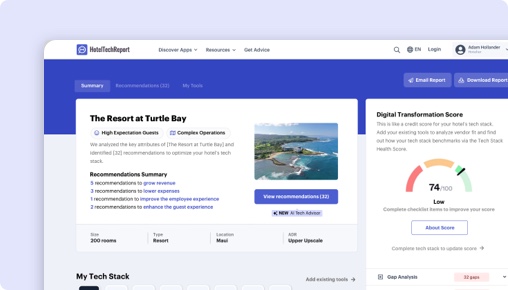
Spiacenti, questa funzionalità è disponibile solo per gli albergatori verificati
La dashboard dei progetti è uno strumento gratuito disponibile solo per gli albergatori verificati, che semplifica l'adozione di nuove tecnologie snellendo la ricerca e i flussi di comunicazione.

Demand Booster vs. Metadesk:
Qual è Quello Giusto per Te?

TLDR
Abbiamo analizzato 19 recensioni verificate di albergatori, confrontato funzionalità, prezzi e casi studio reali per evidenziare dove ciascuna piattaforma eccelle. La scelta giusta dipende dal tipo di hotel e dalle tue priorità:
RateGain eccelle in ease of use and customer support , con funzionalità esclusive come Marketing dashboard.
GCommerce eccelle .
Come si Confronta Demand Booster con Metadesk?
Valutazioni fianco a fianco basate su 19 recensioni verificate di albergatori su HTR.
| HTScore |
|
|
| Probabilità di Raccomandazione |
|
|
| Facilità d'Uso |
|
|
| Assistenza Clienti |
|
|
| Rapporto Qualità-Prezzo |
|
|
| Prezzo di Partenza | Da $1,000/mese | Da $900/mese |
| Recensioni Verificate | 19 | 0 |
RateGain vs GCommerce: Classifiche per Segmento Alberghiero
Come si classifica ciascun prodotto tra i fornitori di Software di gestione dei metaricerchi per hotel per diverse dimensioni di struttura, tipologie di hotel e regioni — basato su recensioni verificate di albergatori in ogni segmento.
Per Dimensione Hotel
| Segmento |
RateGain
|
GCommerce
|
|---|---|---|
| Piccolo (10-24 camere) | #6 4 recensioni | — |
| Medio (25-74 camere) ▾ | #8 10 recensioni | — |
| Grande (75-199 camere) ▾ | #6 4 recensioni | — |
| Extra-Grande (200+ camere) | #8 0 recensioni | — |
Per Tipo di Hotel
| Segmento |
RateGain
|
GCommerce
|
|---|---|---|
| Boutique ▾ | #7 9 recensioni | — |
| Lusso ▾ | #7 8 recensioni | — |
| Brand / Catena ▾ | #8 6 recensioni | — |
| Soggiorno Prolungato | #5 1 recensioni | — |
Per Regione
| Segmento |
RateGain
|
GCommerce
|
|---|---|---|
| Nord America | #14 0 recensioni | — |
| Europa ▾ | #8 13 recensioni | — |
| Asia Pacifico ▾ | #2 5 recensioni | — |
| Medio Oriente | #1 1 recensioni | — |
The Decision
Choosing between Demand Booster by RateGain and Metadesk by GCommerce hinges on your hotel’s specific needs and priorities. While both products aim to maximize your hotel’s visibility and direct bookings through metasearch management, their approaches, features, and proven track records differ considerably. RateGain’s Demand Booster boasts a robust review history, extensive integrations, and a comprehensive platform, whereas GCommerce’s Metadesk is newer with fewer reviews but offers straightforward access and flexible pricing. Which aligns better with your hotel’s goals?
Is Demand Booster by RateGain or Metadesk by GCommerce Better for Hotels?
Demand Booster and Metadesk are designed to improve your hotel's metasearch advertising efficiency, but they diverge in maturity, support, and market presence. Demand Booster, with 19 recent reviews and a 4.93/5 rating, demonstrates a long-standing reputation, large global database, and proven success stories like Safir Hotels. GCommerce, with no recent reviews and a 0/5 rating, is less established, offering a simpler yet less proven solution. Do you prioritize a tested platform with extensive support or a newer, flexible tool?
Demand Booster’s strength lies in its global reach, 95 verified integrations, and strategic features like the marketing dashboard, which GCommerce currently lacks. Conversely, GCommerce emphasizes ease of use, direct access to campaign insights, and flexible, transparent pricing. If your hotel values a platform with proven results and a broad integration network, Demand Booster is the safer choice. If you prefer straightforward management and cost control, GCommerce might appeal—but beware of limited review data.
Demand Booster vs GCommerce: Which Should Your Hotel Choose?
If your hotel needs a mature, feature-rich platform with proven performance, Demand Booster is the clear leader. Its large global database, 22x ROAS, and extensive partner network support hotels seeking significant growth in direct bookings and distribution control. For hotels that want a platform backed by positive reviews, comprehensive marketing tools, and strong support, Demand Booster is the ideal fit.
GCommerce, on the other hand, suits smaller or newer properties looking for simplicity and transparency. Its lower base price, on-demand data insights, and direct access to campaign specialists appeal to hotels that prioritize ease of management and flexible budgets. If your hotel prefers a more hands-on, lightweight approach without extensive feature sets, GCommerce might suffice—but lack of recent reviews makes its long-term reliability uncertain.
Is Demand Booster by RateGain or Metadesk by GCommerce Easier to Use?
Demand Booster scores a 4.71/5 for ease of use and has a well-designed onboarding process rated at 4.65/5, supported by extensive customer testimonials praising its user-friendly interface and responsive support team. GCommerce’s simplicity is a key selling point, emphasizing on-demand insights and straightforward campaign management, although specific usability ratings are not available. Given the lack of recent reviews, it’s hard to gauge the user experience thoroughly.
Demand Booster’s large, established user base and detailed reporting features make it a more reliable choice for hotels that need comprehensive guidance. GCommerce’s focus on ease and flexibility makes it appealing for smaller teams or properties that want quick results with minimal training. Edge: Demand Booster.
Which Has Better Features: Demand Booster or GCommerce?
Demand Booster offers 5 shared features with GCommerce but stands out with one exclusive feature: a marketing dashboard that consolidates campaign insights. It also provides proprietary business intelligence, digital identities, and a unified distribution system, totaling over 140 connected booking engines. GCommerce provides core metasearch management but lacks advanced marketing or analytics tools.
Demand Booster’s unique marketing dashboard and extensive integration network give your team more control and data-driven insights, supporting more strategic decision-making. GCommerce’s simplicity may suffice for basic needs but limits scalability. Edge: Demand Booster.
Which Has Better Customer Support: Demand Booster or GCommerce?
Demand Booster’s support team has a 4.92/5 rating based on recent reviews, with hoteliers praising prompt, friendly, and professional assistance. Customers mention proactive consultations and detailed reporting, emphasizing high satisfaction levels. GCommerce’s reviews are unavailable, leaving its support quality uncertain.
Given its high ratings and positive feedback, Demand Booster’s support is a key advantage, especially for hotels that require reliable help during onboarding and ongoing operations. GCommerce’s support reputation is unverified, making Demand Booster the safer choice for peace of mind. Edge: Demand Booster.
Which Has More Integrations: Demand Booster or GCommerce?
Demand Booster boasts 95 verified partners, including major players like The Hotels Network, Duetto, and Profitroom. It also integrates with many industry-specific solutions, giving your hotel extensive options for distribution, revenue management, and guest engagement. GCommerce, with only 5 verified partners, offers fewer connection points and shared integrations with Demand Booster include The Hotels Network and Visit.
The broader and more verified partner network of Demand Booster ensures your hotel can connect to critical systems and channels, supporting a more integrated approach to distribution and marketing. GCommerce’s limited integrations may restrict your flexibility and future growth. Edge: Demand Booster.
Which Do Hoteliers Rate Higher: Demand Booster or GCommerce?
Demand Booster’s hoteliers rate it at 4.93/5 based on 19 reviews, with a 97% likelihood to recommend. Recent reviews highlight increased direct bookings, high support quality, and measurable performance improvements. GCommerce has no recent reviews or ratings, making it impossible to compare customer satisfaction or property segment preferences.
The high, recent ratings for Demand Booster reflect strong ongoing performance and user confidence. For hotels considering long-term reliability backed by proven reviews, Demand Booster is the clear leader. Edge: Demand Booster.
How Much Do Demand Booster and GCommerce Cost?
Demand Booster’s pricing starts at $1,000 per month, with no freemium option or trial period. GCommerce offers a slightly lower base price at $900 per month, also without free trials or upfront costs. Both platforms operate on a flat monthly fee, but Demand Booster’s higher cost may reflect its broader feature set and support.
Your choice here depends on your budget and feature needs. If you seek a comprehensive platform with extensive integrations and proven results, the additional expense for Demand Booster may be justified. If budget is tight and your needs are basic, GCommerce’s lower price could be appealing but comes with less proven backing.
What Type of Hotel Should Use Demand Booster?
Hotels that should consider Demand Booster:
- Hotels seeking to significantly boost direct bookings (aiming for at least 30% increase).
- Properties that value extensive data, integrations, and advanced marketing tools.
- Large hotels or brands with complex distribution needs.
- Hotels willing to invest in a mature platform supported by proven success stories.
- Hotels looking for detailed reporting and strategic guidance from a well-supported vendor.
Not ideal if:
- Your hotel is very small with limited staff or resources.
- You require a lightweight, straightforward solution without extensive features.
- Your budget is strictly limited, and you prefer a less expensive, simpler platform.
- You need a new, less proven system and are comfortable with limited review data.
What Type of Hotel Should Use GCommerce?
Hotels that should consider GCommerce:
- Small or boutique hotels that prioritize ease of use and quick setup.
- Hotels with tight budgets seeking transparent, predictable costs.
- Properties that want on-demand insights and direct access to campaign specialists.
- Hotels that prefer a straightforward metasearch management system without complex features.
- Hotels in regions where GCommerce has a presence and established partnerships.
Not ideal if:
- Your hotel needs proven, long-term reliability backed by extensive reviews.
- You require a broad network of integrations or advanced marketing dashboards.
- You want a platform with a strong global presence and large-scale support.
- Your hotel is part of a large chain that demands proven enterprise solutions.
Demand Booster vs GCommerce: The Bottom Line for Hotels
Demand Booster by RateGain provides an established, feature-rich platform with a proven track record of boosting direct bookings through extensive integrations and advanced analytics. Its high customer satisfaction ratings and broad global presence make it the safer choice for hotels that want a dependable, scalable solution.
GCommerce’s Metadesk offers a simpler, more flexible approach, with transparent pricing and targeted campaign management, suitable for smaller hotels or those new to metasearch advertising. However, its limited reviews and smaller integration network pose risks for long-term growth.
If your hotel values reliability, proven results, and extensive support, Demand Booster is the clear choice. If you’re seeking a straightforward, budget-friendly platform with on-demand insights, GCommerce could work—though the lack of recent reviews warrants caution.
Quanto Costano Demand Booster e Metadesk?
I prezzi di Software di gestione dei metaricerchi per hotel raramente sono semplici. Ecco cosa sappiamo dai dati pubblici sui prezzi di ciascun fornitore. Richiedi sempre un preventivo personalizzato per la dimensione della tua struttura.
|
RateGain
|
GCommerce
|
|
|---|---|---|
| Prezzo di Partenza | Da $1,000/mese | Da $900/mese |
Confronto delle funzionalità: Demand Booster vs Metadesk
Queste sono le funzionalità configurate da ciascun fornitore, organizzate per gruppo di funzionalità — gli stessi dati mostrati nella dashboard del fornitore. Espandi un gruppo per confrontare le funzionalità affiancate.
| Funzionalità |
RateGain
|
GCommerce
|
|---|---|---|
|
▾
Servizi
|
|
|
| Consulenza e-commerce | ||
| Sorveglianza metaricerca | ||
| Connettività metaricerca | ||
| Meta marketing di ricerca | ||
|
▾
Rapporti e analisi
|
|
|
| Cruscotto di marketing |
Risultati Reali: RateGain vs GCommerce per Obiettivo di Business
Abbiamo analizzato 2 casi studio verificati per confrontare cosa gli hotel ottengono realmente con ciascuna piattaforma su quattro obiettivi di business chiave.
Safir Hotels & Resorts
Medio
"The partnership with RateGain has been transformative for Safir Hotels & Resorts, yielding 4x growth in our revenue."
 GCommerce
Nessun caso studio ancora pubblicato per questo obiettivo.
RateGain
Nessun caso studio ancora pubblicato per questo obiettivo.
Hotel Emma
Piccolo
"In today’s luxury hotel market, visibility is everything. By restructuring Hotel Emma’s metasearch campaigns across Google and Tripadvisor, we ensured the property consistently sta..."

RateGain vs GCommerce: Il Verdetto Finale
Funzionalità uniche
Dove le valutazioni divergono di più
Domande Frequenti su Demand Booster vs Metadesk
Demand Booster può sostituire Metadesk?
Dipende dalle tue esigenze. Demand Booster e Metadesk condividono molte funzionalità di base di Hotel Metasearch Management Software, ma ciascuno ha capacità uniche. Demand Booster offre 96 partner di integrazione verificati, mentre Metadesk ne offre 7. Consulta il confronto delle funzionalità sopra per vedere dove differiscono prima di cambiare.
Qual è migliore per hotel piccoli o indipendenti?
Gli hotel piccoli dovrebbero dare priorità alla facilità d'uso e a un onboarding rapido. Demand Booster è in testa per facilità d'uso con 4.7/5 vs 0.0/5. Cerca prezzi trasparenti e un'opzione di prova o demo. Filtra le recensioni su ogni pagina prodotto per dimensione della struttura per sentire le opinioni di hotel simili al tuo.
Demand Booster o Metadesk offrono un piano gratuito?
Demand Booster: No. Metadesk: No. Nessuno dei due prodotti offre attualmente un livello gratuito. La maggior parte dei fornitori di Hotel Metasearch Management Software offre demo o prove gratuite — richiedine una a ciascuno per valutare prima di impegnarti.
Come Valuta e Classifica HTR Demand Booster e Metadesk?
L'HT Score è una classifica composita che considera 4 gruppi di criteri e oltre una dozzina di variabili per aiutare gli albergatori a confrontare oggettivamente i prodotti tecnologici per hotel. RateGain ha un HT Score di 0 e GCommerce ha 0. Ecco come viene calcolato il punteggio.
| Gruppo di Criteri | Peso | Cosa Misura |
|---|---|---|
| Valutazioni e Recensioni dei Clienti |
|
Quanto raccomandano gli utenti questo prodotto? Punteggio Valutazioni, Volume Recensioni, Quota di Voce, Profondità Recensioni, Recenza Recensioni, Storie di Successo ▾ Il fattore con il peso maggiore. Analizza le valutazioni medie di soddisfazione (probabilità di raccomandazione, facilità d'uso, assistenza, ROI), il numero totale di recensioni rispetto ai concorrenti nella categoria, la recenza delle recensioni (almeno 20 recensioni negli ultimi 6 mesi) e la quota di voce tra clienti hotel unici per rilevare bias di selezione. |
| Ecosistema dei Partner |
|
Quanto raccomandano i partner tecnologici questa azienda? Raccomandazioni dei Partner, Quantità Integrazioni, Qualità Integrazioni ▾ Valuta le raccomandazioni dei partner come voti di fiducia degli esperti, il numero di integrazioni verificate e la qualità dell'ecosistema — la media degli HT Score dei partner di integrazione. I prodotti con ecosistemi di integrazione di qualità superiore hanno maggiori probabilità di offrire uno stack tecnologico connesso. |
| Centralità del Cliente |
|
Quanto è orientata al cliente questa organizzazione? Assistenza Certificata, Coerenza delle Recensioni, Completezza del Profilo ▾ Valuta se l'azienda ha ottenuto la Certificazione di Assistenza Clienti HTR, mantiene una raccolta di recensioni costante nel tempo (un indicatore di cultura orientata al feedback) e mantiene i profili prodotto completi con funzionalità, screenshot, prezzi e caratteristiche. |
| Portata, Solidità e Risorse |
|
Quanto sono estese la portata e le risorse di questa azienda? Portata Geografica, Solidità nel Tempo, Risorse Aziendali, Punteggio di Tendenza ▾ Misura la presenza globale (paesi e regioni servite), gli anni di attività come indicatore di stabilità, il numero di dipendenti come indicatore di risorse e un punteggio di tendenza basato su richieste degli acquirenti, recensioni, raccomandazioni dei partner e attività stampa degli ultimi dodici mesi. |
Le valutazioni e le recensioni dei clienti sono di gran lunga il fattore più importante nell'algoritmo dell'HT Score. HTR non accetta pagamenti per classifiche più alte. Tutte le recensioni sono verificate — solo i professionisti del settore alberghiero con affiliazioni confermate possono inviare valutazioni. Visualizza la metodologia completa dell'HT Score →
Quali Altri Confronti di Software di gestione dei metaricerchi per hotel Stanno Leggendo gli Albergatori?
Esplora altri confronti diretti basati su recensioni verificate di albergatori.




Indice
Ottieni il tuo report gratuito di analisi AI
Consigli personalizzati su misura per la tua struttura


Cerchiamo le informazioni sul tuo hotel
Stai ancora valutando le tue opzioni di software di gestione dei metaricerchi per hotel?
Alcuni sistemi popolari dalla nostra guida su software di gestione dei metaricerchi per hotel — oppure lascia che la nostra IA valuti ciascuno di essi in base alla tua struttura in circa due minuti.


