
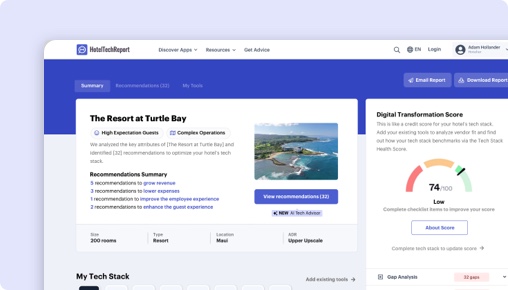
Sorry, this functionality is only available for verified hoteliers
The project dashboard is a free tool that is only available to verified hoteliers to make adopting new technology easier by streamlining their research and simplifying their communication workflow.

happyhotel vs. Ramsi:
Welches ist das Richtige für Sie?


Kurzfassung
Wir haben 184 verifizierte Hotelier-Bewertungen analysiert, Funktionsumfänge, Preise und Praxisbeispiele verglichen, um aufzuzeigen, wo jede Plattform ihre Stärken hat. Die richtige Wahl hängt von Ihrem Betriebstyp und Ihren Prioritäten ab:
happyhotel überzeugt wenn es um support and onboarding service geht , mit exklusiven Funktionen wie Mobile Friendly Design.
Ramsi überzeugt bei ROI , mit exklusiven Funktionen wie Price Explanation and Component/virtual room pricing.
Wie schneidet happyhotel im Vergleich zu Ramsi ab?
Bewertungen im direkten Vergleich basierend auf 184 verifizierten Hotelier-Bewertungen auf HTR.
| HTScore |
|
|
| Weiterempfehlungswahrscheinlichkeit |
|
|
| Benutzerfreundlichkeit |
|
|
| Kundensupport |
|
|
| Preis-Leistungs-Verhältnis |
|
|
| Einstiegspreis | From $500/mo | From $600/mo |
| Verifizierte Bewertungen | 179 | 5 |
Was sind die Vor- und Nachteile von happyhotel vs Ramsi?
Nach der Analyse von 184 verifizierten Bewertungen schätzen happyhotel-Nutzer besonders support and onboarding service, dynamic pricing automation, berichterstattung, dashboards und analysen, während Ramsi-Nutzer hervorheben. Klicken Sie auf ein Thema, um zu sehen, was die Bewerter sagen.
|
happyhotel
|
Ramsi
|
|---|---|
| Vorteile | |
|
+
Support and onboarding service
▾
|
|
|
+
Dynamic pricing automation
▾
|
|
|
+
Berichterstattung, Dashboards und Analysen
▾
|
|
|
+
Ease of use and onboarding
▾
|
|
| Nachteile | |
|
−
Preistransparenz und -kontrolle
▾
|
|
happyhotel vs Ramsi: Rankings nach Hotelsegment
Wie jedes Produkt unter den Revenue-Management-Systeme-Anbietern für verschiedene Betriebsgrößen, -typen und Regionen abschneidet — basierend auf verifizierten Bewertungen von Hoteliers in jedem Segment.
Nach Hotelgröße
| Segment |
happyhotel
|
Ramsi
|
|---|---|---|
| Klein (10–24 Zimmer) ▾ | #9 55 Bewertungen | — |
| Mittelgroß (25–74 Zimmer) ▾ | #7 77 Bewertungen | — |
| Groß (75–199 Zimmer) ▾ | #31 1 Bewertungen | — |
| Sehr groß (200+ Zimmer) | #15 2 Bewertungen | — |
Nach Betriebstyp
| Segment |
happyhotel
|
Ramsi
|
|---|---|---|
| Boutique ▾ | #13 36 Bewertungen | — |
| Luxus ▾ | #17 23 Bewertungen | — |
| Marke / Kette ▾ | #13 23 Bewertungen | — |
| Langzeitaufenthalt ▾ | #9 18 Bewertungen | — |
Nach Region
| Segment |
happyhotel
|
Ramsi
|
|---|---|---|
| Europa ▾ | #9 139 Bewertungen | — |
| Asien-Pazifik | #23 1 Bewertungen | — |
The Decision
Choosing the right revenue management system (RMS) for your hotel hinges on several factors: automation, ease of use, feature depth, support, and regional presence. happyhotel by happyhotel has established itself as a leading platform with extensive reviews, high ratings, and a wide array of features tailored to various hotel types. Ramsi by Ramsi, despite its promising AI-driven approach, remains a newcomer with no reviews and limited market presence. Your decision should favor the product with proven performance and ongoing user satisfaction.
happyhotel boasts over 158 reviews, with 27 in the past six months, highlighting recent, positive feedback. Ramsi, on the other hand, has no reviews or user feedback available, making it difficult to gauge real-world performance. Given this, happyhotel’s extensive and current review data makes it the stronger choice for most hoteliers seeking reliability and proven results. But how do these two compare across specific areas?
Is happyhotel or Ramsi Better for Hotels?
happyhotel and Ramsi aim to improve hotel revenue through automated pricing and demand insights. happyhotel offers a comprehensive suite of more than 45 exclusive features, including real-time price optimization, multi-property management, and detailed analytics dashboards, all built into a user-friendly interface. Ramsi relies on AI to analyze market conditions continuously and recommend or execute prices, but it lacks detailed feature disclosure and has no user reviews to confirm its capabilities.
happyhotel has a well-established track record, with high ratings (5/5 overall, 4.77/5 ease of use, 4.78/5 customer support) backed by over 158 reviews, primarily from European hotels. Ramsi’s lack of reviews and regional presence in North America, Middle East, and Asia make it less transparent and less proven for hotels outside its initial target markets. Are you comfortable adopting a platform without proven user feedback, or do you prefer a solution with a track record?
happyhotel vs Ramsi: Which Should Your Hotel Choose?
If your hotel needs a trusted, full-featured RMS with proven support and extensive integrations, go with happyhotel. It is ideal for small to medium-sized hotels or chains that value automation, detailed analytics, and a user-friendly onboarding process. Ramsi may appeal to boutique or independent hotels seeking an AI-driven solution but should be approached cautiously given the absence of reviews and real-world validation.
For hotels prioritizing automation, multi-property management, and a mature support network, happyhotel’s comprehensive feature set (45 features, including dynamic pricing, scenario analysis, and open API) makes it the clear choice. Conversely, if you are an innovative hotel with a tech-savvy team comfortable with untested platforms and seeking AI-driven pricing, Ramsi could be worth monitoring once reviews and case studies emerge.
Is happyhotel or Ramsi Easier to Use?
happyhotel’s user interface has a 4.77/5 rating, praised for its clarity, ease of onboarding, and intuitive workflows. Users frequently mention its quick setup, with many reporting they could start optimizing rates within days, thanks to guided workflows and automation. Support is rated 4.78/5, with reviews highlighting personal, responsive service that helps new users get started smoothly.
Ramsi, by contrast, offers a platform with no publicly available usability data or user reviews, making it difficult to assess its ease of use. Its reliance on AI and automation might suggest a more complex setup, but without user feedback, it’s uncertain whether hoteliers find it as straightforward as happyhotel. Edge: happyhotel.
Which Has Better Features: happyhotel or Ramsi?
happyhotel significantly outperforms Ramsi in feature depth, boasting 45 unique features such as dynamic pricing, open API, multi-property management, analytics dashboards, fully automated revenue management, price sensitivity modeling, "what-if" scenario analysis, and multi-year forecasting. Ramsi’s feature set remains undisclosed, with no unique or advanced capabilities publicly listed, limiting the ability to compare.
happyhotel’s features enable comprehensive control and automation, supporting complex pricing strategies across multiple properties and market conditions. Ramsi’s AI-driven approach may offer real-time adjustments, but without detailed feature documentation or user reviews, it’s impossible to determine if it matches happyhotel’s depth. Edge: happyhotel.
Which Has Better Customer Support: happyhotel or Ramsi?
happyhotel’s support scores a high 4.78/5, with reviews describing its personal, quick, and effective customer service. Hoteliers praise the team’s responsiveness during onboarding and ongoing use, which is critical when implementing a new RMS. Many users note that support has helped them maximize platform benefits and troubleshoot issues efficiently.
Ramsi’s customer support data is unavailable, and with no reviews, there is no indication of its service quality. As a newer entrant lacking user feedback, Ramsi’s support experience remains unknown. Hoteliers seeking reassurance should favor happyhotel’s proven, high-rated support. Edge: happyhotel.
Which Has More Integrations: happyhotel or Ramsi?
happyhotel integrates with 24 verified partners, including major PMS and channel management platforms like RoomRaccoon, apaleo, SiteMinder, Mews, and ibelsa. These integrations facilitate smooth data exchange, enabling real-time rate updates and simplified workflows. Ramsi’s integration ecosystem is unlisted, with no verified partners, which raises questions about its compatibility and ease of deployment.
If your hotel relies on existing PMS or channel management systems, happyhotel’s extensive integrations offer reassurance that your current infrastructure can be leveraged effectively. Ramsi’s limited or unknown integration capabilities make it a riskier choice. Edge: happyhotel.
Which Do Hoteliers Rate Higher: happyhotel or Ramsi?
happyhotel’s ratings reflect strong user satisfaction, with an overall score of 5/5 and a 96% likelihood to recommend based on 158 reviews, primarily from European hotels. Hotels across segments like city center, boutique, and resort properties rate it highly, with recent reviews praising its automation and support.
Ramsi has no publicly available reviews, making it impossible to determine user sentiment or satisfaction levels. Without real-world feedback, it’s prudent to rely on proven, highly-rated solutions like happyhotel. Edge: happyhotel.
How Much Do happyhotel and Ramsi Cost?
happyhotel charges a straightforward $500 monthly fee, with no freemium or trial options. Its transparent pricing simplifies budgeting and aligns with its feature-rich offering. Ramsi’s pricing remains undisclosed, which can be typical for newer AI platforms, but this obscurity might hinder decision-making for cost-conscious hotels.
Since happyhotel’s price is clear and backed by extensive reviews, it offers better value for reliable, proven functionality. Ramsi’s unknown costs introduce uncertainty, especially without trail or demo options. Edge: happyhotel.
What Type of Hotel Should Use happyhotel?
- Hotels that need a reliable, proven RMS with extensive automation and analytics.
- Teams that want a platform with quick onboarding and excellent support.
- Hotels with multiple properties seeking centralized management.
- Hotels aiming for dynamic, real-time pricing adjustments.
- Hotels that value transparency and strong integration options.
- Small to medium-sized hotels, chains, or properties looking for straightforward but powerful revenue management.
Not ideal if:
- Your hotel requires highly customized or niche features not listed publicly.
- You prefer to test unreviewed, emerging platforms.
- Your hotel operates in regions where happyhotel is not yet present.
Edge: happyhotel.
What Type of Hotel Should Use Ramsi?
- Independent or boutique hotels looking for autonomous, AI-powered revenue management.
- Hotels that are tech-savvy and comfortable with unverified platforms.
- Properties seeking continuous demand forecasting and market intelligence.
- Hotels willing to adopt a newer platform once it gains reviews and validation.
- Hotels that prioritize automation and real-time adjustments over detailed manual controls.
Not ideal if:
- You prefer a proven, extensively supported RMS with documented features.
- Your hotel operates in regions outside Ramsi’s current presence.
- You need detailed, customizable reporting options unavailable in Ramsi.
Edge: happyhotel.
The Bottom Line for Hotels
happyhotel and Ramsi approach revenue management differently: happyhotel offers a broad, transparent, and proven platform, while Ramsi provides an AI-driven, autonomous approach still lacking real-world validation. For hotels seeking reliability, support, and extensive features, happyhotel’s proven track record makes it the superior choice.
Choose happyhotel if you want a mature, supported, and extensively integrated system with proven results across diverse hotel types. It’s especially suitable for small to medium hotels, chains, or properties needing a trusted, user-friendly platform. Ramsi may appeal to innovative properties with the resources to pilot new technology, but its lack of reviews makes it a risk for most.
In conclusion, for most hoteliers, happyhotel’s combination of recent reviews, high ratings, and feature depth makes it the clear leader. Ramsi’s potential is promising, but until it gathers similar validation, it remains a platform to watch rather than a primary choice.
Was kosten happyhotel und Ramsi?
Die Preise für Revenue-Management-Systeme sind selten unkompliziert. Hier ist, was wir aus den öffentlichen Preisdaten der Anbieter wissen. Fordern Sie immer ein individuelles Angebot für Ihre Betriebsgröße an.
|
happyhotel
|
Ramsi
|
|
|---|---|---|
| Starting Price | From $500/mo | From $600/mo |
Funktionsvergleich: happyhotel vs. Ramsi
Dies sind die von jedem Anbieter konfigurierten Funktionen, geordnet nach Funktionsgruppe — dieselben Daten wie im Anbieter-Dashboard. Erweitern Sie eine Gruppe, um die Funktionen nebeneinander zu vergleichen.
| Funktion |
happyhotel
|
Ramsi
|
|---|---|---|
|
▾
Preisoptimierung
|
|
|
| Preiserklärung | ||
| Unternehmensrichtlinien | ||
| Empfehlungen für alternative Aufenthaltsdaten | ||
| Alternative Unterkunftsempfehlungen | ||
| Preisoptimierung in Echtzeit | ||
| Dynamische Steuerung der Preishierarchie | ||
| Offene Preise | ||
| Geführte Arbeitsabläufe | ||
| „Was-wäre-wenn“-Szenarioanalyse | ||
| Dynamische Preise | ||
| Set Boundaries | ||
| Manage Exceptions | ||
| Group Pricing | ||
| Manage Restrictions | ||
| Manage Sell-Outs & Cancellations | ||
| Business Mix Optimization | ||
| Define Cycles | ||
| Yield Room Types Individually | ||
| Bulk Adjustments | ||
| 24-Monats-Preise und -Prognosen | ||
| Komponenten-/virtuelle Raumpreise | ||
| Preise für längere Aufenthalte | ||
| Upsell-Preise | ||
| Mindestrendite | ||
|
▾
Marktinformationen und Prognosen
|
|
|
| Fünfjahresprognose | ||
| 365-Tage-Forward-Preise | ||
| STR Data | ||
| 18-Month Forward Pricing | ||
| Preissensitivitätsmodellierung | ||
| Multi-Property Dashboard | ||
| Market Intelligence Data | ||
| Interactive Customizable Dashboards | ||
| Daten zur zukünftigen Marktnachfrage | ||
| Erstellung von Finanzprognosen | ||
| Prognose für längere Aufenthalte | ||
| Kanalprognose | ||
| Erklärung der Prognose | ||
| Flexible Wettbewerbsdaten | ||
|
▾
Dashboards und Berichte
|
|
|
| Benutzerdefinierte Berichte | ||
| Geplante Berichte | ||
| Verlorene Geschäftsdaten | ||
| Analytics-Dashboard | ||
| Interactive Customizable Dashboards | ||
| Market Insights Reporting | ||
| Pickup Analysis | ||
| Booking Pattern Analysis | ||
| Event Data | ||
| Price Change Logs | ||
| Customizable Notifications & Alerts | ||
| Displacement Analysis | ||
| Group Pricing & Evaluation | ||
| Multi-Property Dashboard | ||
| Systemnutzenmessung | ||
|
▾
Automatisierung
|
|
|
| Controlled Automation/Algorithm Customization | ||
| Automatisierte Preisgestaltung nach Zimmertyp | ||
| Vollautomatisches Revenue Management | ||
| Dynamische Preise | ||
| AI Optimization | ||
| Automatic Pricing Updates | ||
|
▾
Multi-Property-Funktionalität
|
|
|
| Bestandsverwaltung | ||
| Multi-Property-Management | ||
| Multi-Property Dashboard | ||
|
▾
Gruppengeschäft
|
|
|
| Group Pricing & Evaluation | ||
| „Was-wäre-wenn“-Szenarioanalyse | ||
| Displacement Analysis | ||
| Gruppenprognose und Wäsche | ||
|
▾
Integrationen
|
|
|
| Offene API | ||
| Kanalverwaltung | ||
| Business Intelligence | ||
| STR Data | ||
| Property Management System | ||
| Multi-Faktor-Authentifizierung | ||
|
▾
Other
|
|
|
| Gruppenpreise & Bewertung | ||
| App | ||
| Intelligente Streutechnologie | ||
| Einmalige Anmeldung | ||
| Mobilfreundliches Design |
Praxisergebnisse: happyhotel vs Ramsi nach Geschäftsziel
Wir haben 4 verifizierte Fallstudien analysiert, um zu vergleichen, was Hotels mit jeder Plattform in vier zentralen Geschäftszielen tatsächlich erreichen.
Natur- & Wellnesshotels Brunner Hof 4****S (45 rooms, luxury resort, Germany)
Klein
"Before happyhotel, we handled prices manually and tracked everything in Excel. Now we have all key metrics in one place and save a lot of time every day."
Ramsi
Noch keine veröffentlichte Fallstudie für dieses Ziel.
Hotel Öschberghof (127 rooms, luxury resort, Germany)
Klein
"Before we started using happyhotel, I manually entered prices into our PMS using self-made Excel sheets. We didn’t have a flexible pricing system and worked with seasonal tables, o..."
 Ramsi
Ramsi
Noch keine veröffentlichte Fallstudie für dieses Ziel.
happyhotel vs Ramsi: Das Fazit
Was Hoteliers schätzen
Support is one of HappyHotel’s strongest themes: reviewers consistently describe the team as fast, competent, friendly and solution-oriented, especial... Support is one of HappyHotel’s strongest themes: reviewers consistently describe the team as fast, competent, friendly and solution-oriented, especially during onboarding and troubleshooting. The main criticism is not the quality of help, but responsiveness or access channels, with some asking for faster feedback, better phone availability or improved communication.
Users most often say HappyHotel automates rate changes based on demand, occupancy, booking pace and market conditions, reducing manual work and helpin... Users most often say HappyHotel automates rate changes based on demand, occupancy, booking pace and market conditions, reducing manual work and helping hotels capture more revenue. Many note that autopilot pricing is reliable and frees staff to focus elsewhere, while still allowing manual overrides when needed.
Viele Rezensenten heben die übersichtlichen Dashboards, die gute Sichtbarkeit der KPIs und die hilfreichen Berichte hervor, die das Revenue Management... Viele Rezensenten heben die übersichtlichen Dashboards, die gute Sichtbarkeit der KPIs und die hilfreichen Berichte hervor, die das Revenue Management verständlicher und umsetzbarer machen. Gleichzeitig wünschen sich Nutzer häufig flexiblere Filter, benutzerdefinierte Kennzahlen, detailliertere Vergleiche und ausgereiftere Analyseansichten, insbesondere für komplexe Hotelstrukturen.
Wo Hoteliers Kritik äußern
Viele Nutzer wünschen sich mehr Transparenz hinsichtlich der Berechnung der Empfehlungen und mehr Kontrolle über das Verhalten der Algorithmen, insbes... Viele Nutzer wünschen sich mehr Transparenz hinsichtlich der Berechnung der Empfehlungen und mehr Kontrolle über das Verhalten der Algorithmen, insbesondere bei abgeleiteten Tarifen und benutzerdefinierten Preisregeln. Obwohl viele dem System nach der Nutzung vertrauen, fordern Rezensenten weiterhin Erklärbarkeit, anpassbare Empfehlungsintensität, benutzerdefinierte Algorithmen und eine bessere Handhabung von Einzel-/Doppel- oder kategoriebasierten Zuschlägen.
Einzigartige Funktionen
Einzigartige Funktionen
Wo die Bewertungen am stärksten auseinandergehen
Häufig gestellte Fragen zu happyhotel vs Ramsi
Kann happyhotel Ramsi ersetzen?
Das hängt von Ihren Anforderungen ab. happyhotel und Ramsi teilen viele zentrale Revenue Management Systems-Funktionen, aber jedes hat einzigartige Fähigkeiten. happyhotel bietet 24 verifizierte Integrationspartner, während Ramsi 4 bietet. Überprüfen Sie den Funktionsvergleich oben, um die Unterschiede vor einem Wechsel zu sehen.
Welches ist besser für kleine oder unabhängige Hotels?
Kleine Hotels sollten Benutzerfreundlichkeit und schnelles Onboarding priorisieren. Ramsi führt bei der Benutzerfreundlichkeit mit 5.0/5 vs 4.8/5. Achten Sie auf transparente Preise und eine Test- oder Demo-Option. Filtern Sie die Bewertungen auf jeder Produktseite nach Betriebsgröße, um von Hotels wie Ihrem zu hören.
Bieten happyhotel oder Ramsi einen kostenlosen Plan an?
happyhotel: Nein. Ramsi: Nein. Keines der Produkte bietet derzeit eine kostenlose Version an. Die meisten Revenue Management Systems-Anbieter bieten Demos oder Testversionen an — fordern Sie von jedem eine an, um vor der Entscheidung zu evaluieren.
Wie bewertet und rankt HTR happyhotel und Ramsi?
Der HT Score ist ein zusammengesetztes Ranking, das 4 Kriteriengruppen und über ein Dutzend Variablen berücksichtigt, um Hoteliers einen objektiven Vergleich von Hoteltechnologie-Produkten zu ermöglichen. happyhotel hat einen HT Score von 94 und Ramsi hat 0. So wird der Score berechnet.
| Kriteriengruppe | Gewichtung | Was wird gemessen |
|---|---|---|
| Kundenbewertungen & Rezensionen |
|
Wie stark empfehlen Nutzer dieses Produkt? Bewertungspunktzahl, Bewertungsvolumen, Marktanteil, Bewertungstiefe, Bewertungsaktualität, Erfolgsgeschichten ▾ Der am stärksten gewichtete Faktor. Analysiert die durchschnittlichen Zufriedenheitsbewertungen (Weiterempfehlungswahrscheinlichkeit, Benutzerfreundlichkeit, Support, ROI), die Gesamtzahl der Bewertungen im Vergleich zu Kategorie-Mitbewerbern, die Aktualität der Bewertungen (mindestens 20 Bewertungen in den letzten 6 Monaten) und den Marktanteil über einzigartige Hotelkunden zur Erkennung von Auswahlverzerrungen. |
| Partner-Ökosystem |
|
Wie stark empfehlen Technologiepartner dieses Unternehmen? Partner-Empfehlungen, Integrationsanzahl, Integrationsqualität ▾ Bewertet Partner-Empfehlungen als Expertenvertrauensvoten, die Anzahl verifizierter Integrationen und die Ökosystemqualität — die durchschnittlichen HT Scores der Integrationspartner. Produkte mit hochwertigeren Integrations-Ökosystemen liefern mit größerer Wahrscheinlichkeit einen vernetzten Tech-Stack. |
| Kundenorientierung |
|
Wie kundenorientiert ist dieses Unternehmen? Zertifizierter Support, Bewertungskonsistenz, Profilvollständigkeit ▾ Bewertet, ob das Unternehmen die HTR Customer Support Certification erhalten hat, eine konsistente Bewertungserfassung über die Zeit aufrechterhält (ein Indikator für feedbackgetriebene Kultur) und Produktprofile vollständig mit Funktionen, Screenshots, Preisen und Features pflegt. |
| Reichweite, Beständigkeit & Ressourcen |
|
Wie umfangreich sind Reichweite und Ressourcen dieses Unternehmens? Geografische Reichweite, Beständigkeit, Unternehmensressourcen, Trending Score ▾ Misst die globale Präsenz (bediente Länder und Regionen), die Geschäftsjahre als Stabilitätsindikator, die Teamgröße als Ressourcenindikator und einen Trending Score basierend auf Käuferanfragen, Bewertungen, Partner-Empfehlungen und Presseaktivitäten der letzten zwölf Monate. |
Kundenbewertungen und Rezensionen sind bei weitem der wichtigste Faktor im HT Score-Algorithmus. HTR akzeptiert keine Zahlungen für höhere Rankings. Alle Bewertungen sind verifiziert — nur Fachleute der Hotelbranche mit bestätigten Zugehörigkeiten können Bewertungen abgeben. Vollständige HT Score-Methodik ansehen →
Welche anderen Revenue-Management-Systeme-Vergleiche lesen Hoteliers?
Entdecken Sie weitere Direktvergleiche basierend auf verifizierten Hotelier-Bewertungen.






Inhalt
Sichern Sie sich Ihren kostenlosen KI-Analystenbericht
Maßgeschneiderte Empfehlungen, die auf Ihre Immobilie zugeschnitten sind


Lassen Sie uns Ihre Hotelinformationen nachschlagen
Wägen Sie noch Ihre revenue-management-systeme-Optionen ab?
Einige beliebte Systeme aus unserem revenue-management-systeme-Leitfaden – oder lassen Sie unsere KI jedes System in etwa zwei Minuten anhand Ihrer spezifischen Eigenschaften bewerten.


