

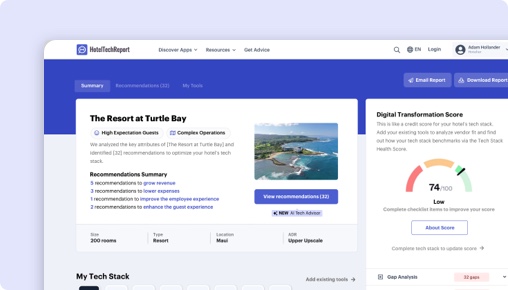
Lo sentimos, esta funcionalidad solo está disponible para hoteleros verificados
El panel de proyectos es una herramienta gratuita disponible únicamente para hoteleros verificados, que facilita la adopción de nuevas tecnologías al agilizar su investigación y simplificar sus flujos de comunicación.

buku vs. Shiny:
¿Cuál es el adecuado para usted?


Resumen
Analizamos 24 reseñas verificadas de hoteleros, comparamos funcionalidades, precios y casos de estudio reales para desglosar dónde destaca cada plataforma. La elección correcta depende de su tipo de hotel y de sus prioridades:
Buku destaca .
Shiny destaca en ease of use and customer support , con funcionalidades exclusivas como Credit & Debit Card Payments and Employee tip reporting.
¿Cómo se compara buku con Shiny?
Calificaciones comparadas basadas en 24 reseñas verificadas de hoteleros en HTR.
| HTScore |
|
|
| Probabilidad de recomendar |
|
|
| Facilidad de uso |
|
|
| Soporte al cliente |
|
|
| Relación calidad-precio |
|
|
| Precio inicial | Contactar a ventas | Desde $100/mes |
| Reseñas verificadas | 0 | 24 |
Buku vs Shiny: Rankings por segmento hotelero
Cómo se posiciona cada producto entre los proveedores de Soluciones digitales para propinas para hoteles de diferentes tamaños, tipos y regiones, basado en reseñas verificadas de hoteleros en cada segmento.
Por tamaño de hotel
| Segmento |
Buku
|
Shiny
|
|---|---|---|
| Pequeño (10-24 habitaciones) | — | #3 1 reseñas |
| Mediano (25-74 habitaciones) ▾ | — | #3 14 reseñas |
| Grande (75-199 habitaciones) ▾ | — | #3 7 reseñas |
| Extra grande (200+ habitaciones) | — | #3 2 reseñas |
Por tipo de hotel
| Segmento |
Buku
|
Shiny
|
|---|---|---|
| Boutique ▾ | — | #3 14 reseñas |
| Lujo ▾ | — | #3 9 reseñas |
| Marca / Cadena ▾ | — | #3 20 reseñas |
| Estancia prolongada | — | #3 3 reseñas |
Por región
| Segmento |
Buku
|
Shiny
|
|---|---|---|
| Norteamérica ▾ | — | #3 24 reseñas |
The Decision
Choosing the right digital tipping platform for your hotel involves understanding the strengths of each product. Buku by Buku aims to simplify cashless tipping with a QR code-based system, while Shiny by Shiny offers a comprehensive, feature-rich platform that enhances guest experience and employee engagement. Both tackle the challenge of facilitating tips without cash, but they diverge sharply in usability, features, and market presence.
Given that Shiny has more recent reviews, a higher review count, and substantially more features, it currently provides a more tested and versatile solution. Are you ready to see which platform fits your hotel’s needs best?
Is Buku or Shiny Better for Hotels?
Buku and Shiny serve the same core purpose: enabling cashless tips for hotel staff. Buku’s main advantage lies in its simplicity and ease of use, allowing customers to scan a QR code and tip immediately without any app download. Shiny, however, offers a suite of advanced features, including multiple payment options, employee dashboards, and detailed analytics, aimed at improving internal processes and staff motivation.
While Buku’s straightforward approach might appeal to smaller properties or hotels seeking minimal setup, Shiny’s broader capabilities make it suitable for hotels aiming for a more integrated and engaging guest experience. Both aim to boost staff earnings and guest satisfaction but do so via different strategies. Which approach aligns better with your hotel’s operational goals?
Shiny vs Buku: Which Should Your Hotel Choose?
If your hotel prioritizes a feature-rich platform that offers multiple payment options like Apple Pay, Google Pay, and credit card payments, Shiny is the clear choice. Its advanced functions, including location management, employee dashboards, and satisfaction surveys, suit mid-to-large properties or hotel groups seeking operational insights.
Conversely, if your hotel needs a simple, no-fuss digital tip solution with minimal implementation costs, Buku’s QR code-based system may suffice. Since Buku lacks reviews in the last six months and has a limited feature set, it’s better for properties that want quick, easy tips without extensive management tools. For hotels looking for versatility and depth, Shiny’s comprehensive platform is the stronger pick.
Is Buku or Shiny Easier to Use?
Ease of use is a decisive factor, especially when staff adoption is critical. Shiny boasts a near-perfect usability rating of 4.96/5 from 24 recent reviews, with users praising its straightforward, intuitive interface and the minimal training needed. Its onboarding is rated 4.91/5, indicating a smooth transition for staff.
Buku, however, has no recent reviews or usability ratings, making it impossible to assess. Its core offering—scan-to-tip—is inherently simple but lacks detailed feedback on user experience. Edge: Shiny.
Which Has Better Features: Buku or Shiny?
Buku’s feature set is limited to its core tip collection method—no additional features are listed. Shiny, on the other hand, provides 16 distinct features, including Apple Pay, Google Pay, credit card payments, QR codes, tip links, automatic tip distribution, location and shift management, contactless and app-less options, employee tip reporting, data exporting, employee ratings dashboards, satisfaction surveys, payroll integration, and 1099-K & Form 4070 issuing.
This extensive feature list makes Shiny a more versatile platform capable of integrating into various operational processes. Edge: Shiny.
Which Has Better Customer Support: Buku or Shiny?
Customer support and onboarding ratings favor Shiny, which scores 4.96/5 from 24 recent reviews, with reviewers emphasizing its responsiveness and helpfulness. One user noted, “Shiny’s support team has been incredibly responsive and easy to work with during onboarding.”
Buku has no recent reviews or official ratings, leaving its support quality uncertain. Given the importance of reliable support during implementation and ongoing use, Shiny’s proven support system makes it the preferable option. Edge: Shiny.
Which Has More Integrations: Buku or Shiny?
Neither Buku nor Shiny currently reports verified integration partners, suggesting limited or no official integrations at this time. However, Shiny’s platform offers features like payroll integration and data exporting, hinting at potential integrations with HR or accounting systems in the future.
Given the absence of verified third-party integrations, the edge is currently neutral but leaning towards Shiny for its broader feature set, which often implies future expansion capabilities. Edge: Shiny.
Which Do Hoteliers Rate Higher: Buku or Shiny?
Since Buku has no recent reviews, it lacks current ratings or feedback from hoteliers. Shiny, however, has 24 reviews, all recent, and a NPS score of 9.92/10—an outstanding indicator of customer satisfaction.
Hotels of all types, especially those in branded, luxury, or larger properties, rate Shiny highly for its ease of use, support, and features. Buku’s absence of recent feedback makes it difficult to compare, but based on current data, Shiny’s reputation is significantly stronger. Edge: Shiny.
How Much Do Buku and Shiny Cost?
Buku does not list any pricing information, implying it might be a free or custom-quoted service. Shiny charges a flat rate of $100 per month, with no additional implementation fees or tiered pricing, making it transparent and predictable.
Without detailed pricing for Buku, it’s hard to compare directly, but Shiny’s clear monthly fee offers predictable budgeting. If Buku's free or cheaper, it might appeal to smaller hotels; if you need a full-featured platform, Shiny’s investment is justified.
What Type of Hotel Should Use Buku?
- Hotels that need a simple, quick-to-implement digital tipping solution.
- Properties with limited staff training capacity or minimal operational complexity.
- Small boutique hotels or independent properties seeking to add cashless tipping without heavy tech investment.
- Hotels prioritizing cashless tips over detailed analytics or employee management.
- Not ideal if your hotel wants advanced features, detailed reporting, or multi-department tipping.
Buku is best suited for properties seeking a straightforward, no-fuss solution for cashless tipping.
What Type of Hotel Should Use Shiny?
- Hotels that want a comprehensive, feature-rich tipping platform.
- Properties aiming to improve guest satisfaction and staff engagement simultaneously.
- Mid-sized to large hotels or hotel groups needing detailed reporting and integrations.
- Hotels interested in contactless, app-less, or multi-payment options.
- Teams that want to monitor employee performance and gather guest feedback.
- Not ideal if you prefer a minimal, low-cost solution without the need for extensive features.
Shiny fits hotels looking to modernize their tipping process with a full suite of management tools.
Shiny vs Buku: The Bottom Line for Hotels
The core difference is that Buku offers a straightforward, QR-based digital tipping method with minimal setup, while Shiny provides a comprehensive platform with multiple payment options, employee dashboards, and guest feedback tools.
If your hotel values simplicity and quick deployment, Buku can serve your needs, especially if cost is a primary concern. However, for hotels seeking a scalable, feature-packed platform with proven support and recent positive reviews, Shiny is the clear winner.
Choose Buku if you want a basic, easy-to-use tip solution that requires little training. Opt for Shiny if your goal is to enhance employee engagement, guest satisfaction, and operational insights through a versatile platform.
In summary, Shiny’s larger review base, recent positive feedback, and extensive features make it the stronger choice for most hotels aiming for a modern, integrated tipping experience. Buku may suit smaller or more budget-conscious properties, but it lacks the validation and capabilities that Shiny currently offers.
Comparación de funcionalidades: buku vs Shiny
Estas son las funcionalidades que cada proveedor ha configurado, organizadas por grupo de funcionalidades — los mismos datos que se muestran en el panel del proveedor. Expanda un grupo para comparar las funcionalidades en paralelo.
| Funcionalidad |
Buku
|
Shiny
|
|---|---|---|
|
▾
Mecanismo de entrega
|
|
|
| Escaneo NFC | ||
| Enlaces de sugerencias | ||
| Códigos QR | ||
|
▾
Métodos de pago
|
|
|
| Apple Pay | ||
| Google Pay | ||
| Pagos con tarjeta de crédito y débito | ||
|
▾
Pagos y Cumplimiento
|
|
|
| Distribución automática de propinas | ||
| Gestión de ubicaciones y turnos | ||
| Integración de nóminas | ||
|
▾
Personalización y marca
|
|
|
| Marca blanca | ||
| Sin contacto | ||
| Sin aplicaciones | ||
|
▾
Recopilación de comentarios
|
|
|
| Panel de calificaciones de empleados | ||
| Encuestas de satisfacción | ||
|
▾
Cumplimiento tributario
|
|
|
| Exportación de datos | ||
| Informe de propinas de empleados | ||
| Integración de nóminas | ||
| Emisión del formulario 1099-K y del formulario 4070 |
Buku vs Shiny: Conclusión final
Capacidades únicas
Donde más difieren las calificaciones
Preguntas frecuentes sobre buku vs Shiny
¿Puede buku reemplazar a Shiny?
Depende de sus requerimientos. buku y Shiny comparten muchas funcionalidades principales de Digital Tipping Solutions, pero cada uno tiene capacidades únicas. buku ofrece 0 socios de integración verificados, mientras que Shiny ofrece 0. Revise la comparación de funcionalidades anterior para ver en qué difieren antes de cambiar.
¿Cuál es mejor para hoteles pequeños o independientes?
Los hoteles pequeños deben priorizar la facilidad de uso y una incorporación rápida. Shiny lidera en facilidad de uso con 5.0/5 vs 0.0/5. Busque precios transparentes y una opción de prueba o demostración. Filtre las reseñas en la página de cada producto por tamaño de hotel para conocer la opinión de hoteles como el suyo.
¿Ofrecen buku o Shiny un plan gratuito?
buku: No. Shiny: No. Ninguno de los dos productos ofrece actualmente un nivel gratuito. La mayoría de los proveedores de Digital Tipping Solutions ofrecen demostraciones o pruebas. Solicite una de cada uno para evaluar antes de comprometerse.
¿Cómo evalúa y clasifica HTR a buku y Shiny?
El HT Score es un ranking compuesto que considera 4 grupos de criterios y más de una docena de variables para ayudar a los hoteleros a comparar objetivamente los productos de tecnología hotelera. Buku tiene un HT Score de 0 y Shiny tiene 0. Así se calcula la puntuación.
| Grupo de criterios | Peso | Qué mide |
|---|---|---|
| Calificaciones y reseñas de clientes |
|
¿Qué tanto recomiendan los usuarios este producto? Puntuación de calificaciones, Volumen de reseñas, Participación de voz, Profundidad de reseñas, Actualidad de reseñas, Casos de éxito ▾ El factor con mayor ponderación. Analiza las calificaciones promedio de satisfacción (probabilidad de recomendar, facilidad de uso, soporte, ROI), el total de reseñas en relación con los competidores de la categoría, la actualidad de las reseñas (al menos 20 reseñas en los últimos 6 meses) y la participación de voz entre clientes hoteleros únicos para detectar sesgo de selección. |
| Ecosistema de socios |
|
¿Qué tanto recomiendan los socios tecnológicos a esta empresa? Recomendaciones de socios, Cantidad de integraciones, Calidad de integraciones ▾ Evalúa las recomendaciones de socios como votos de confianza de expertos, la cantidad de integraciones verificadas y la calidad del ecosistema, es decir, el promedio de HT Scores de los socios de integración. Los productos con ecosistemas de integración de mayor calidad tienen más probabilidades de ofrecer un stack tecnológico conectado. |
| Enfoque en el cliente |
|
¿Qué tan centrada en el cliente es esta organización? Soporte certificado, Consistencia de reseñas, Completitud del perfil ▾ Evalúa si la empresa ha obtenido la Certificación de Soporte al Cliente de HTR, mantiene una recolección consistente de reseñas a lo largo del tiempo (un indicador de cultura orientada al feedback) y mantiene los perfiles de producto completos con capacidades, capturas de pantalla, precios y funcionalidades. |
| Alcance, solidez y recursos |
|
¿Qué tan extensos son el alcance y los recursos de esta empresa? Alcance geográfico, Solidez, Recursos de la empresa, Puntuación de tendencia ▾ Mide la presencia global (países y regiones atendidos), los años en el negocio como indicador de estabilidad, el tamaño del equipo como indicador de recursos y una puntuación de tendencia basada en consultas de compradores, reseñas, recomendaciones de socios y actividad en prensa de los últimos doce meses. |
Las calificaciones y reseñas de clientes son con diferencia el factor más importante en el algoritmo del HT Score. HTR no acepta pagos a cambio de mejores posiciones en el ranking. Todas las reseñas son verificadas: solo profesionales de la industria hotelera con afiliaciones confirmadas pueden enviar calificaciones. Ver metodología completa del HT Score →
¿Qué otras comparaciones de Soluciones digitales para propinas están leyendo los hoteleros?
Explore más comparaciones directas basadas en reseñas verificadas de hoteleros.


Contenido
Obtenga su informe gratuito de analista de IA.
Recomendaciones personalizadas adaptadas a su hotel


