
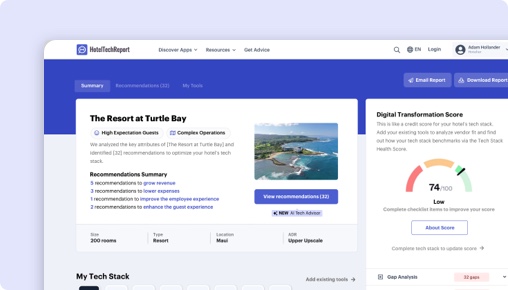
Sorry, this functionality is only available for verified hoteliers
The project dashboard is a free tool that is only available to verified hoteliers to make adopting new technology easier by streamlining their research and simplifying their communication workflow.

Deputy vs. Unifocus:
¿Cuál es el adecuado para ti?

Resumen
Analizamos 40 reseñas verificadas de hoteleros, comparamos funcionalidades, precios y casos de estudio reales para desglosar dónde destaca cada plataforma. La elección correcta depende de tu tipo de propiedad y prioridades:
Deputy destaca .
Unifocus destaca en ease of use and customer support — especialmente para propiedades brand (4.3/5) , con funcionalidades exclusivas como Labor Standards and Tip Pooling.
¿Cómo se compara Deputy con Unifocus?
Calificaciones comparadas basadas en 40 reseñas verificadas de hoteleros en HTR.
| HTScore |
|
|
| Probabilidad de recomendar |
|
|
| Facilidad de uso |
|
|
| Soporte al cliente |
|
|
| Relación calidad-precio |
|
|
| Precio inicial | Contact sales | Contact sales |
| Reseñas verificadas | 0 | 40 |
¿Cuáles son los pros y contras de Deputy vs Unifocus?
Tras analizar 40 reseñas verificadas, los usuarios de Deputy valoran más su , mientras que los usuarios de Unifocus destacan gestión laboral, interfaz fácil de usar, capacitación y soporte. Haz clic en cualquier tema para ver qué dicen los evaluadores.
|
Deputy
|
Unifocus
|
|---|---|
| Pros | |
|
+
Gestión laboral
▾
|
|
|
+
Interfaz fácil de usar
▾
|
|
|
+
Capacitación y soporte
▾
|
|
|
+
Integración perfecta
▾
|
|
| Contras | |
|
−
Necesidades de personalización
▾
|
|
|
−
Velocidad y capacidad de respuesta
▾
|
|
|
−
Críticas a la nueva versión
▾
|
|
Deputy vs Unifocus: Rankings por segmento hotelero
Cómo se posiciona cada producto entre los proveedores de Planificación y gestión de la fuerza laboral para diferentes tamaños de propiedad, tipos y regiones, basado en reseñas verificadas de hoteleros en cada segmento.
Por tamaño de hotel
| Segmento |
Deputy
|
Unifocus
|
|---|---|---|
| Pequeño (10-24 habitaciones) | — | #4 2 reseñas |
| Mediano (25-74 habitaciones) ▾ | — | #5 10 reseñas |
| Grande (75-199 habitaciones) ▾ | — | #4 17 reseñas |
| Extra grande (200+ habitaciones) ▾ | — | #4 7 reseñas |
Por tipo de propiedad
| Segmento |
Deputy
|
Unifocus
|
|---|---|---|
| Boutique ▾ | — | #5 6 reseñas |
| Lujo ▾ | — | #4 19 reseñas |
| Cadena / Marca ▾ | — | #4 17 reseñas |
| Estancia prolongada ▾ | — | #4 5 reseñas |
Por región
| Segmento |
Deputy
|
Unifocus
|
|---|---|---|
| Norteamérica ▾ | — | #4 34 reseñas |
| Europa | — | #2 3 reseñas |
| Asia Pacífico | — | #1 0 reseñas |
The Decision
When choosing workforce management software for your hotel, you need tools that streamline scheduling, improve team communication, and optimize labor costs. Deputy and Unifocus both address these core needs but diverge significantly in their features, user experience, and market presence. Deputy has a limited feature set and fewer recent reviews but is widely used globally. Unifocus boasts a broader feature suite, more recent user feedback, and a stronger reputation among hospitality operators. How do these differences impact your decision?
Is Deputy or Unifocus Better for Hotels?
Deputy offers a straightforward scheduling solution designed primarily for ease of use and basic workforce management. Its strengths lie in simple availability tracking and timesheets, enabling quick staff scheduling from any device. Conversely, Unifocus provides an extensive set of features like labor standards, tip pooling, benefit accruals, and benchmarking, making it suitable for hotels seeking detailed operational insights.
However, Deputy’s limited feature count and lack of recent reviews (none in the past six months) suggest a less dynamic platform. Meanwhile, Unifocus, with 37 recent reviews and a high NPS score of 7.97/5, indicates ongoing user engagement and satisfaction. Are you comfortable with a basic scheduling tool, or do you need a comprehensive system with broad functionality?
Deputy vs Unifocus: Which Should Your Hotel Choose?
If your hotel needs an easy-to-implement, cost-effective scheduling system with minimal training requirements, Deputy is a logical choice. It’s favored for its simplicity and basic time tracking, especially if your team prioritizes quick onboarding. On the other hand, if your hotel requires advanced labor forecasting, detailed reporting, and integration with multiple systems, Unifocus is the better pick. Its broader feature set and recent positive reviews make it suitable for larger, more complex operations.
For independent hotels or small properties, Deputy’s streamlined approach suffices. Larger hotels or resort chains aiming for operational insights and detailed labor standards will find Unifocus’s capabilities more aligned with their needs. Which profile best matches your hotel’s size and complexity?
Is Deputy or Unifocus Easier to Use?
Deputy’s usability is hampered by a lack of recent reviews and no current ratings, making it hard to assess with confidence. In contrast, Unifocus scores a 4.01/5 for ease of use, supported by 37 recent reviews that praise its intuitive interface, especially for labor forecasting and reporting. Reviewers note that Unifocus’s user-friendly design simplifies management tasks despite some slow system response times.
Additionally, Unifocus’s onboarding process earns a 4/5 rating, with users emphasizing its effectiveness. Deputy’s ease of use cannot be confidently assessed based on available data, but the absence of recent feedback suggests it might lack the ongoing refinement Unifocus benefits from. Edge: Unifocus.
Which Has Better Features: Deputy or Unifocus?
Unifocus offers 14 features, including labor standards, tip pooling, benefit accruals, benchmarking, and detailed labor forecasting—features Deputy does not have. Deputy’s feature set is limited to core scheduling and timesheet management, focusing on ease rather than depth. Users appreciate Unifocus’s ability to forecast labor needs considering variables like weather and traffic, which helps in fine-tuning staffing levels.
Deputy’s primary advantage is its simplicity, which might suit smaller properties or teams seeking basic scheduling. But for hotels wanting advanced operational tools, Unifocus’s expanded features deliver more control and insights. Which set of features aligns better with your operational goals?
Which Has Better Customer Support: Deputy or Unifocus?
Unifocus’s support ratings are higher, with a 4.19/5 and recent reviews praising its on-site training and support responsiveness. Review quotes highlight that Unifocus’s support team is effective and engaging, often guiding users through complex features. Deputy, with a 0/5 rating (likely due to no recent reviews), offers no current support feedback, making it difficult to evaluate.
The consistency and recency of Unifocus’s support reviews suggest a more reliable experience for your team. If ongoing support and training are priorities, Unifocus clearly holds the edge. Edge: Unifocus.
Which Has More Integrations: Deputy or Unifocus?
Unifocus integrates with 32 verified partners, including systems like WorkRecords, Kronos, and Otelier, offering seamless data flow across various platforms. Deputy’s integration count stands at just 1 verified partner, Xero, limiting its connectivity options. This extensive integration capability makes Unifocus more suitable for hotels with complex operational infrastructure.
The ability to connect with multiple labor, payroll, and property systems ensures smoother workflows and data accuracy. For hotels that rely on diverse systems, Unifocus’s broader integration options are a significant advantage. Edge: Unifocus.
Which Do Hoteliers Rate Higher: Deputy or Unifocus?
Unifocus receives a higher overall rating of 4.25/5, with recent reviews emphasizing its user-friendliness and robust features. Hotel segments like resorts and branded hotels rate Unifocus at around 4.3/5, while independent hotels and smaller properties have limited feedback on Deputy, which has no recent reviews and a 0/5 rating.
Recent reviewers of Unifocus praise its operational insights and ease of managing large teams, whereas Deputy’s ratings are unavailable or outdated. For recent performance and user satisfaction, Unifocus is the clear winner. Edge: Unifocus.
How Much Do Deputy and Unifocus Cost?
Both products do not publicly list pricing details, and neither offers a free trial, making direct comparisons difficult. Deputy’s pricing is not disclosed, but its no-trial, no-implementation model suggests a subscription-based payment. Unifocus also lacks transparent pricing but, based on industry standards, likely involves custom quotes reflecting the extensive feature set and integrations.
Expect to contact vendors directly for detailed quotes tailored to your hotel’s size and needs. Given the lack of public pricing, consider the value of features and support as part of your assessment.
What Type of Hotel Should Use Deputy?
- Hotels that need quick, straightforward scheduling solutions with minimal setup.
- Teams that prioritize ease of use and fast onboarding above detailed operational insights.
- Properties with small or less complex staffing needs, such as boutique hotels or limited-service properties.
- Hotels that want to manage seasonal staff and casual workers efficiently.
- Not ideal if your hotel requires detailed labor standards, benchmarking, or extensive system integrations.
If your hotel’s focus is on reducing administrative burden without complex forecasting, Deputy could be suitable. However, it’s less ideal for large operations demanding in-depth analytics and integrations.
What Type of Hotel Should Use Unifocus?
- Hotels that need detailed labor forecasting, including variables like weather and traffic.
- Teams seeking advanced features like tip pooling, benefit accruals, and benchmarking.
- Larger properties or resorts with complex staffing and operational needs.
- Hotels that value seamless integrations with multiple systems, such as PMS, payroll, and ticketing software.
- Not ideal if your hotel prefers a simple, lightweight scheduling solution or has a very limited tech budget.
Unifocus’s feature richness makes it ideal for hotels aiming to optimize labor costs and enhance operational efficiency through deeper data insights.
The Bottom Line for Hotels: Deputy or Unifocus?
Deputy is a simple, user-friendly scheduling tool that suits small properties or hotels with minimal operational complexity. Its limited features and outdated review data make it less suitable for larger or more sophisticated hotels seeking deeper insights. Unifocus, with a broader feature set, recent positive reviews, and extensive integrations, is better suited for hotels aiming for operational excellence and data-driven staffing.
If you need a quick, easy-to-deploy scheduling system, Deputy might serve your needs. But if your hotel is looking to refine labor management, forecast accurately, and benefit from ongoing support, Unifocus is the clear choice. It’s designed to grow with your hotel’s needs and deliver measurable operational improvements.
Comparación de funcionalidades: Deputy frente a Unifocus
Estas son las funcionalidades que cada proveedor ha configurado, organizadas por grupo de funcionalidades — los mismos datos que se muestran en el panel del proveedor. Expande un grupo para comparar las funcionalidades en paralelo.
| Funcionalidad |
Deputy
|
Unifocus
|
|---|---|---|
|
▾
Turnos y programación
|
|
|
| Cambio de turno | ||
| Programación automática | ||
| Aplicación de reloj de tiempo | ||
| Programación dinámica | ||
| Normas laborales | ||
|
▾
Seguimiento del tiempo
|
|
|
| Aplicación de reloj de tiempo | ||
|
▾
Análisis y evaluación comparativa
|
|
|
| Benchmarking | ||
| Informes y análisis | ||
| Visibilidad corporativa | ||
| Monitoreo laboral automatizado | ||
| Normas laborales | ||
| Integración de pronósticos de ocupación | ||
|
▾
Tareas y listas de verificación
|
|
|
| Tareas y listas de tareas pendientes | ||
|
▾
Mensajería y Comunicación
|
|
|
| Comunicación en equipo | ||
| Aplicación movil | ||
|
▾
Gestión de beneficios
|
|
|
| Beneficios acumulados | ||
| Pool de propinas |
Deputy vs Unifocus: Conclusión final
Lo que les encanta a los hoteleros
Los usuarios elogian el software por sus sólidas funciones de gestión laboral, que incluyen la planificación, la programación y el análisis de las nec... Los usuarios elogian el software por sus sólidas funciones de gestión laboral, que incluyen la planificación, la programación y el análisis de las necesidades de mano de obra. Es especialmente útil para la gestión de operaciones tanto pequeñas como grandes, gracias a su capacidad para extraer datos de diversos sistemas para optimizar la previsión.
Muchos usuarios valoran la interfaz intuitiva de UniFocus, destacando su interfaz intuitiva y su backend organizado. Los usuarios encuentran fácil nav... Muchos usuarios valoran la interfaz intuitiva de UniFocus, destacando su interfaz intuitiva y su backend organizado. Los usuarios encuentran fácil navegar y gestionar tareas como la programación y la gestión laboral, lo que la hace accesible para nuevos gerentes y supervisores.
Si bien el software obtiene excelentes calificaciones en cuanto a capacitación y soporte presencial, los usuarios consideran que la capacitación inici... Si bien el software obtiene excelentes calificaciones en cuanto a capacitación y soporte presencial, los usuarios consideran que la capacitación inicial en línea podría mejorarse. La capacitación presencial se destaca por su alta eficacia y atractivo.
Donde los hoteleros objetan
Algunos usuarios expresan la necesidad de más opciones de personalización en la interfaz de usuario y la capacidad de acceder a un historial de inform... Algunos usuarios expresan la necesidad de más opciones de personalización en la interfaz de usuario y la capacidad de acceder a un historial de informes extendido sin generar y guardar informes en intervalos específicos.
Varios revisores expresan su frustración por la lentitud y la falta de capacidad de respuesta del software UniFocus. Esto es especialmente problemátic... Varios revisores expresan su frustración por la lentitud y la falta de capacidad de respuesta del software UniFocus. Esto es especialmente problemático en horas punta, como la aprobación de nóminas.
Capacidades únicas
Donde más difieren las calificaciones
Preguntas frecuentes sobre Deputy vs Unifocus
¿Puede Deputy reemplazar a Unifocus?
Depende de tus requerimientos. Deputy y Unifocus comparten muchas funcionalidades principales de Scheduling & Workforce Management, pero cada uno tiene capacidades únicas. Deputy ofrece 1 socios de integración verificados, mientras que Unifocus ofrece 32. Revisa la comparativa de funcionalidades anterior para ver en qué difieren antes de cambiar.
¿Cuál es mejor para hoteles pequeños o independientes?
Los hoteles pequeños deben priorizar la facilidad de uso y una incorporación rápida. Unifocus lidera en facilidad de uso con 4.0/5 vs 0.0/5. Busca precios transparentes y una opción de prueba o demostración. Filtra las reseñas en la página de cada producto por tamaño de propiedad para conocer la opinión de hoteles como el tuyo.
¿Ofrecen Deputy o Unifocus un plan gratuito?
Deputy: No. Unifocus: No. Ninguno de los dos productos ofrece actualmente un nivel gratuito. La mayoría de los proveedores de Scheduling & Workforce Management ofrecen demostraciones o pruebas. Solicita una de cada uno para evaluar antes de comprometerte.
¿Cómo evalúa y clasifica HTR a Deputy y Unifocus?
El HT Score es un ranking compuesto que considera 4 grupos de criterios y más de una docena de variables para ayudar a los hoteleros a comparar objetivamente los productos de tecnología hotelera. Deputy tiene un HT Score de 0 y Unifocus tiene 74. Así se calcula la puntuación.
| Grupo de criterios | Peso | Qué mide |
|---|---|---|
| Calificaciones y reseñas de clientes |
|
¿Qué tanto recomiendan los usuarios este producto? Puntuación de calificaciones, Volumen de reseñas, Participación de voz, Profundidad de reseñas, Antigüedad de reseñas, Casos de éxito ▾ El factor con mayor ponderación. Analiza las calificaciones promedio de satisfacción (probabilidad de recomendar, facilidad de uso, soporte, ROI), el total de reseñas en relación con los competidores de la categoría, la antigüedad de las reseñas (al menos 20 reseñas en los últimos 6 meses) y la participación de voz entre clientes hoteleros únicos para detectar sesgo de selección. |
| Ecosistema de socios |
|
¿Qué tanto recomiendan los socios tecnológicos a esta empresa? Recomendaciones de socios, Cantidad de integraciones, Calidad de integraciones ▾ Evalúa las recomendaciones de socios como votos de confianza de expertos, la cantidad de integraciones verificadas y la calidad del ecosistema, es decir, el promedio de HT Scores de los socios de integración. Los productos con ecosistemas de integración de mayor calidad tienen más probabilidades de ofrecer un stack tecnológico conectado. |
| Enfoque en el cliente |
|
¿Qué tan centrada en el cliente es esta organización? Soporte certificado, Consistencia de reseñas, Completitud del perfil ▾ Evalúa si la empresa ha obtenido la Certificación de Soporte al Cliente de HTR, mantiene una recolección consistente de reseñas a lo largo del tiempo (un indicador de cultura orientada al feedback) y mantiene los perfiles de producto completos con capacidades, capturas de pantalla, precios y funcionalidades. |
| Alcance, solidez y recursos |
|
¿Qué tan extenso es el alcance y los recursos de esta empresa? Alcance geográfico, Solidez, Recursos de la empresa, Puntuación de tendencia ▾ Mide la presencia global (países y regiones atendidos), los años en el negocio como indicador de estabilidad, el tamaño del equipo como indicador de recursos y una puntuación de tendencia basada en consultas de compradores, reseñas, recomendaciones de socios y actividad en prensa de los últimos doce meses. |
Las calificaciones y reseñas de clientes son con diferencia el factor más importante en el algoritmo del HT Score. HTR no acepta pagos a cambio de mejores posiciones en el ranking. Todas las reseñas son verificadas: solo profesionales de la industria hotelera con afiliaciones confirmadas pueden enviar calificaciones. Ver metodología completa del HT Score →
¿Qué otras comparativas de Planificación y gestión de la fuerza laboral están leyendo los hoteleros?
Explora más comparativas directas basadas en reseñas verificadas de hoteleros.




Contenido
Obtén tu informe gratuito de analista de IA.
Recomendaciones personalizadas adaptadas a su propiedad.


