

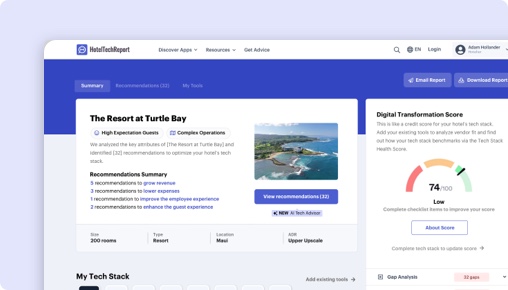
Désolé, cette fonctionnalité est réservée aux hôteliers vérifiés
Le tableau de bord des projets est un outil gratuit réservé aux hôteliers vérifiés. Il facilite l'adoption de nouvelles technologies en rationalisant leurs recherches et en simplifiant leurs échanges.

Adshotel vs. Demand Booster:
Lequel vous convient le mieux ?

TLDR
Nous avons analysé 20 avis vérifiés d'hôteliers, comparé les fonctionnalités, les tarifs et des études de cas réelles pour identifier les points forts de chaque plateforme. Le bon choix dépend de votre type d'hôtel et de vos priorités :
RateGain se distingue par des fonctionnalités exclusives comme marketing méta-moteur et Connectivité metasearch.
Comment Adshotel se compare-t-il à Demand Booster ?
Notes comparées basées sur 20 avis vérifiés d'hôteliers sur HTR.
| HTScore |
|
|
| Probabilité de recommandation |
|
|
| Facilité d'utilisation |
|
|
| Support client |
|
|
| Rapport qualité-prix |
|
|
| Prix de départ | Contacter le service commercial | Dès 1 000 $/mois |
| Avis vérifiés | 1 | 19 |
AdsHotel vs RateGain : Classement par segment hôtelier
Comment chaque produit se classe parmi les fournisseurs Logiciel de gestion de métamoteurs hôteliers pour différentes tailles d'établissement, types et régions — basé sur les avis vérifiés d'hôteliers dans chaque segment.
Par taille d'hôtel
| Segment |
AdsHotel
|
RateGain
|
|---|---|---|
| Petit (10-24 chambres) | — | #8 4 avis |
| Moyen (25-74 chambres) ▾ | — | #8 10 avis |
| Grand (75-199 chambres) ▾ | — | #7 5 avis |
| Très grand (200+ chambres) | — | #9 0 avis |
Par type d'hôtel
| Segment |
AdsHotel
|
RateGain
|
|---|---|---|
| Boutique ▾ | — | #7 9 avis |
| Luxe ▾ | #18 1 avis | #7 8 avis |
| Enseigne / Chaîne ▾ | — | #8 6 avis |
| Séjour prolongé | #13 1 avis | #5 1 avis |
Par région
| Segment |
AdsHotel
|
RateGain
|
|---|---|---|
| Amérique du Nord | — | #12 0 avis |
| Europe ▾ | — | #8 13 avis |
| Asie-Pacifique ▾ | — | #2 5 avis |
| Moyen-Orient | #7 1 avis | #1 1 avis |
Is AdsHotel or Demand Booster Better for Hotels?
AdsHotel and Demand Booster both position themselves as metasearch management solutions for hotels aiming to increase direct bookings and compete with OTAs. They diverge sharply in execution and market fit. AdsHotel is a self-managed platform with limited adoption and one unfavorable review reporting poor communication and zero results across three locations. Demand Booster is a mature, end-to-end metasearch and digital marketing platform with 19 reviews averaging 4.8/5, widely used by boutique, branded, and city hotels globally.
Both solve the problem of driving direct bookings through metasearch campaigns, but AdsHotel requires hands-on campaign management and targets smaller or self-catering properties, while Demand Booster offers comprehensive marketing automation combined with business intelligence that benefits medium to large hotels with complex distribution needs.
AdsHotel vs Demand Booster: Which Should Your Hotel Choose?
If your property is a small hostel or independent hotel with a limited marketing budget and you want to self-manage metasearch campaigns, AdsHotel might seem a low-cost choice but beware its lack of results and poor user feedback—only one review exists, warning about wasted budget and poor support. Data on AdsHotel’s performance is too thin to recommend it confidently.
If you operate a boutique, branded, or city center hotel in Europe, North America, or Asia Pacific with a desire for integrated marketing insights and comprehensive campaign management, Demand Booster’s 19 reviews averaging 4.8/5, including 4.9 ratings from boutique and branded hotels, make it the safer choice. Its ability to boost direct bookings by 30% with a 22x ROAS, plus strong support and integration breadth, suits hotels focused on sustainable growth. For luxury, airport, and resort hotels, Demand Booster also has positive reviews, though data is less dense.
Is AdsHotel or Demand Booster Easier to Use?
AdsHotel scores 1/5 for ease of use and onboarding from its single reviewer who found the interface difficult and access frustrating. Demand Booster has a 4.7/5 ease of use rating across 19 reviews, with multiple users praising its intuitive dashboard and quick campaign setup. However, some users note the outdated dashboard appearance, suggesting room for UI improvements.
Despite the stark ratings gap, the small number of AdsHotel reviews and zero recent reviews limit confidence in this data. Demand Booster’s larger review base and consistent praise for quick onboarding imply it scales well for hotel teams managing complex campaigns.
Edge: Even.
Which Has Better Features: AdsHotel or Demand Booster?
AdsHotel does not list any unique features in the data provided, focusing on self-managed bidding, budget controls, and AI-enhanced campaign optimization. Demand Booster offers six features absent on AdsHotel, including meta search marketing, connectivity, surveillance, a marketing dashboard, and e-commerce consulting. These allow hotels to monitor competitors’ pricing, analyze demand intelligence, and receive tailored marketing advice.
Operationally, Demand Booster’s marketing dashboard centralizes campaign management and performance data, reducing front desk or revenue manager workload, while AdsHotel’s self-management demands more hands-on attention. Demand Booster’s e-commerce consulting translates into actionable strategies, a service AdsHotel does not provide.
Edge: Demand Booster.
Which Has Better Customer Support: AdsHotel or Demand Booster?
AdsHotel’s sole review criticizes slow and poor communication and reports no positive outcomes. Demand Booster has a 4.9/5 customer support rating across 19 reviews. Reviewers highlight prompt, friendly, and professional responses, proactive consultation, and helpful reporting tools. One reviewer notes support availability over four years with consistent satisfaction.
Though AdsHotel’s data is minimal, its only review points to significant dissatisfaction with support, while Demand Booster’s broad and positive support feedback suggests it better serves hotel teams needing ongoing assistance.
Edge: Even.
Which Has More Integrations: AdsHotel or Demand Booster?
AdsHotel has 5 verified integrations, sharing 4 with Demand Booster: Bookassist, Simple Booking, Access Hospitality, and Cloudbeds. Demand Booster boasts 96 verified partners, including 92 not available to AdsHotel users, such as RoomRaccoon, Profitroom, Mirai, and apaleo GmbH.
Hotels using more advanced or diverse property management systems and channel managers will benefit from Demand Booster’s wider integration ecosystem, enabling seamless data flow and more accurate rate parity checks. AdsHotel’s limited integration portfolio restricts operational flexibility, especially for hotels requiring multi-channel distribution.
Edge: Demand Booster.
Which Do Hoteliers Rate Higher: AdsHotel or Demand Booster?
AdsHotel has only one review with no rating data, preventing meaningful analysis. Demand Booster averages 4.8/5 across 19 reviews, with boutique hotels rating it 4.9/5 (9 reviews), branded hotels 4.9/5 (6 reviews), and city center hotels 4.8/5 (13 reviews). Luxury and resort segments also rate Demand Booster highly (4.8–5/5). Recent review volume is zero for both but Demand Booster maintains stable average ratings over time.
The lack of data for AdsHotel means its performance is unverified, while Demand Booster’s ratings are strong, consistent, and come from varied hotel types, reinforcing its credibility.
Edge: Even.
How Much Do AdsHotel and Demand Booster Cost?
AdsHotel does not publish pricing details or offer a trial. Its fee structure is not transparent, and reviewers mention consuming budget on connectivity fees without returns.
Demand Booster has a published base price of $1,000 but no per-room or flat monthly fees. It operates on a “pay on the stay” commission model, which aligns costs directly with bookings generated, reducing upfront risk. No trial is available.
Demand Booster’s transparent pricing and commission-based model provide hotels with predictable cost structures tied to performance, whereas AdsHotel’s pricing opacity and user complaints about wasted budget caution against it.
What Type of Hotel Should Use AdsHotel?
- Hotels that want a self-managed metasearch platform and have internal marketing expertise.
- Hostels or small self-catering properties in regional markets given current user base.
- Operators seeking budget control with daily and monthly limits on campaigns.
- Teams preferring to define bidding strategies and campaign timing manually.
- Properties with limited integration needs due to the small verified partner network.
Not ideal if:
- You require assured campaign performance and ROI; reviews report zero results.
- You need responsive customer support; communication is rated poor.
- Your property demands system scalability and integration with multiple PMS or channel managers.
- You prioritize ease of use and onboarding; the interface is reported difficult.
What Type of Hotel Should Use Demand Booster?
- Boutique, branded, and city center hotels looking for proven direct booking growth (30%+ increase).
- Medium to large hotels that require comprehensive metasearch marketing with e-commerce consulting.
- Hotels needing wide integration with over 90 PMS and channel managers for operational efficiency.
- Properties seeking detailed marketing dashboards and competitive price surveillance.
- Teams valuing responsive support and ongoing strategic consultation.
Not ideal if:
- Your property is a small hostel or self-catering unit with limited budget and desire for self-management.
- You require a free trial to evaluate the product before commitment; none is offered.
- You prefer a simple, standalone metasearch tool without added marketing services.
AdsHotel vs Demand Booster: The Bottom Line for Hotels
The core difference is that AdsHotel offers a self-service platform with minimal market presence and one negative user experience, while Demand Booster delivers a comprehensive, well-integrated marketing platform with proven results across diverse hotel segments. AdsHotel demands hands-on campaign management with reported poor outcomes. Demand Booster automates campaign distribution, provides actionable business intelligence, and supports hotels with expert consulting.
Choose AdsHotel only if you run a small hostel or self-catering hotel willing to invest effort in self-managing metasearch advertising and accept risk due to limited evidence of success. Its budget control features may appeal to hotels with constrained spend but come with customer support and performance risks.
Choose Demand Booster if you operate boutique, branded, or city center hotels that want scalable, data-driven marketing with extensive integrations and expert support. Demand Booster’s 4.8/5 rating across 19 reviews, 6 unique features, and a global partner network make it the safer, more effective choice for hotels aiming to increase direct bookings and revenue sustainably.
Combien coûtent Adshotel et Demand Booster ?
La tarification des Logiciel de gestion de métamoteurs hôteliers est rarement simple. Voici ce que nous savons à partir des données tarifaires publiques de chaque fournisseur. Demandez toujours un devis personnalisé pour la taille de votre établissement.
|
AdsHotel
|
RateGain
|
|
|---|---|---|
| Prix de départ | — | Dès 1 000 $/mois |
Comparaison des fonctionnalités : Adshotel vs Demand Booster
Voici les fonctionnalités configurées par chaque fournisseur, organisées par groupe de fonctionnalités — les mêmes données que dans le tableau de bord du fournisseur. Développez un groupe pour comparer les fonctionnalités côte à côte.
| Fonctionnalité |
AdsHotel
|
RateGain
|
|---|---|---|
|
▾
Services
|
|
|
| Conseil en e-commerce | ||
| Analyse des métamoteurs de recherche | ||
| Connectivité metasearch | ||
| marketing méta-moteur | ||
|
▾
Reporting et analyses
|
|
|
| Tableau de bord marketing |
Résultats concrets : AdsHotel vs RateGain par objectif commercial
Nous avons analysé 1 études de cas vérifiées pour comparer ce que les hôtels obtiennent réellement avec chaque plateforme sur quatre objectifs commerciaux clés.
AdsHotel
Aucune étude de cas publiée pour cet objectif pour le moment.
Safir Hotels & Resorts
Moyen
"The partnership with RateGain has been transformative for Safir Hotels & Resorts, yielding 4x growth in our revenue."

AdsHotel vs RateGain : Le verdict final
Mieux classé pour
Mieux classé pour
Fonctionnalités uniques
Questions fréquentes sur Adshotel vs Demand Booster
Adshotel peut-il remplacer Demand Booster ?
Cela dépend de vos besoins. Adshotel et Demand Booster partagent de nombreuses fonctionnalités Hotel Metasearch Management Software de base, mais chacun a des capacités uniques. Adshotel propose 5 partenaires d'intégration vérifiés, tandis que Demand Booster en propose 96. Consultez la comparaison des fonctionnalités ci-dessus pour voir les différences avant de changer.
Lequel est le mieux adapté aux petits hôtels ou hôtels indépendants ?
Les petits hôtels devraient privilégier la facilité d'utilisation et une prise en main rapide. Demand Booster est en tête pour la facilité d'utilisation avec 4,7/5 contre 1,0/5. Recherchez une tarification transparente et une option d'essai ou de démonstration. Filtrez les avis sur chaque page produit par taille d'établissement pour lire les retours d'hôtels similaires au vôtre.
Adshotel ou Demand Booster proposent-ils une offre gratuite ?
Adshotel : Non. Demand Booster : Non. Aucun des deux produits ne propose actuellement d'offre gratuite. La plupart des fournisseurs Hotel Metasearch Management Software proposent des démonstrations ou des essais — demandez-en un à chacun pour évaluer avant de vous engager.
Comment HTR évalue-t-il et classe-t-il Adshotel et Demand Booster ?
Le HT Score est un classement composite qui prend en compte 4 groupes de critères et plus d'une douzaine de variables pour aider les hôteliers à comparer objectivement les produits technologiques hôteliers. AdsHotel a un HT Score de 0 et RateGain a 0. Voici comment le score est calculé.
| Groupe de critères | Pondération | Ce qu'il mesure |
|---|---|---|
| Notes et avis clients |
|
À quel point les utilisateurs recommandent-ils ce produit ? Score des notes, Volume d'avis, Part de voix, Profondeur des avis, Récence des avis, Cas de réussite ▾ Le facteur le plus fortement pondéré. Analyse les notes de satisfaction moyennes (probabilité de recommandation, facilité d'utilisation, support, ROI), le nombre total d'avis par rapport aux pairs de la catégorie, la récence des avis (au moins 20 avis sur les 6 derniers mois) et la part de voix parmi les clients hôteliers uniques pour détecter les biais de sélection. |
| Écosystème partenaire |
|
À quel point les partenaires technologiques recommandent-ils cette entreprise ? Recommandations des partenaires, Nombre d'intégrations, Qualité des intégrations ▾ Évalue les recommandations des partenaires comme des votes de confiance d'experts, le nombre d'intégrations vérifiées et la qualité de l'écosystème — la moyenne des HT Scores des partenaires d'intégration. Les produits avec des écosystèmes d'intégration de meilleure qualité sont plus susceptibles de fournir un stack technologique connecté. |
| Orientation client |
|
À quel point cette organisation est-elle orientée client ? Support certifié, Régularité des avis, Complétude du profil ▾ Évalue si l'entreprise a obtenu la certification HTR de support client, maintient une collecte d'avis régulière dans le temps (un indicateur de culture axée sur le feedback) et tient à jour les profils produits avec les fonctionnalités, captures d'écran, tarifs et caractéristiques. |
| Portée, pérennité et ressources |
|
Quelle est l'étendue de la portée et des ressources de cette entreprise ? Portée géographique, Pérennité, Ressources de l'entreprise, Score de tendance ▾ Mesure la présence mondiale (pays et régions desservis), les années d'activité comme indicateur de stabilité, les effectifs comme indicateur de ressources, et un score de tendance basé sur les demandes d'acheteurs, les avis, les recommandations de partenaires et l'activité presse des douze derniers mois. |
Les notes et avis clients sont de loin le facteur le plus important dans l'algorithme du HT Score. HTR n'accepte aucun paiement pour un meilleur classement. Tous les avis sont vérifiés — seuls les professionnels du secteur hôtelier avec des affiliations confirmées peuvent soumettre des notes. Voir la méthodologie complète du HT Score →
Quelles autres comparaisons Logiciel de gestion de métamoteurs hôteliers les hôteliers consultent-ils ?
Explorez d'autres comparaisons directes basées sur les avis vérifiés d'hôteliers.





Sommaire
Obtenez votre rapport d'analyste IA gratuit
Recommandations personnalisées adaptées à votre établissement


Cherchons les informations sur votre hôtel
Vous hésitez encore sur vos options de logiciel de gestion de métamoteurs hôteliers ?
Voici quelques systèmes populaires de notre guide sur logiciel de gestion de métamoteurs hôteliers — ou laissez notre IA les noter un par un pour votre hôtel en deux minutes environ.


