

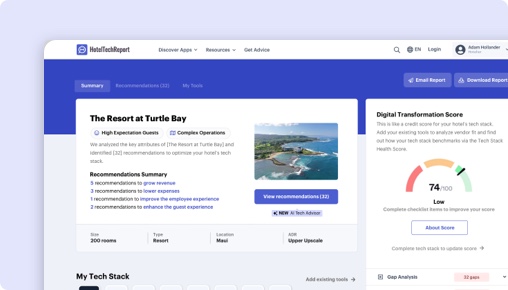
Désolé, cette fonctionnalité est réservée aux hôteliers vérifiés
Le tableau de bord des projets est un outil gratuit réservé aux hôteliers vérifiés. Il facilite l'adoption de nouvelles technologies en rationalisant leurs recherches et en simplifiant leurs échanges.

Demand Booster vs. Triptease: Metasearch:
Lequel vous convient le mieux ?

TLDR
Nous avons analysé 84 avis vérifiés d'hôteliers, comparé les fonctionnalités, les tarifs et des études de cas réelles pour identifier les points forts de chaque plateforme. Le bon choix dépend de votre type d'hôtel et de vos priorités :
RateGain excelle en Support client — en particulier pour les établissements boutique (4,9/5), avec des fonctionnalités exclusives comme Analyse des métamoteurs de recherche et Tableau de bord marketing.
Triptease excelle en performance de la métarecherche et du référencement payant — en particulier pour les établissements d'aéroport et de conférence (4,9/5).
Comment Demand Booster se compare-t-il à Triptease: Metasearch ?
Notes comparées basées sur 84 avis vérifiés d'hôteliers sur HTR.
| HTScore |
|
|
| Probabilité de recommandation |
|
|
| Facilité d'utilisation |
|
|
| Support client |
|
|
| Rapport qualité-prix |
|
|
| Prix de départ | Dès 1 000 $/mois | Dès 300 $/mois |
| Avis vérifiés | 19 | 65 |
Quels sont les avantages et inconvénients de Demand Booster vs Triptease: Metasearch ?
Après analyse de 84 avis vérifiés, les utilisateurs de RateGain apprécient surtout , tandis que ceux de Triptease mettent en avant performance de la métarecherche et du référencement payant. Cliquez sur un thème pour voir ce que disent les évaluateurs.
|
RateGain
|
Triptease
|
|---|---|
| Avantages | |
|
+
Performance de la métarecherche et du référencement payant
▾
|
|
| Inconvénients | |
|
−
Rapports et analyses
▾
|
|
|
−
Performance de la métarecherche et du référencement payant
▾
|
|
|
−
Réservations directes et croissance du chiffre d'affaires
▾
|
|
RateGain vs Triptease : Classement par segment hôtelier
Comment chaque produit se classe parmi les fournisseurs Logiciel de gestion de métamoteurs hôteliers pour différentes tailles d'établissement, types et régions — basé sur les avis vérifiés d'hôteliers dans chaque segment.
Par taille d'hôtel
| Segment |
RateGain
|
Triptease
|
|---|---|---|
| Petit (10-24 chambres) ▾ | #8 4 avis | #9 7 avis |
| Moyen (25-74 chambres) ▾ | #8 10 avis | #5 32 avis |
| Grand (75-199 chambres) ▾ | #7 5 avis | #5 16 avis |
| Très grand (200+ chambres) ▾ | #9 0 avis | #4 5 avis |
Par type d'hôtel
| Segment |
RateGain
|
Triptease
|
|---|---|---|
| Boutique ▾ | #7 9 avis | #4 31 avis |
| Luxe ▾ | #7 8 avis | #4 36 avis |
| Enseigne / Chaîne ▾ | #8 6 avis | #5 25 avis |
| Séjour prolongé ▾ | #5 1 avis | #4 5 avis |
Par région
| Segment |
RateGain
|
Triptease
|
|---|---|---|
| Amérique du Nord ▾ | #12 0 avis | #4 23 avis |
| Europe ▾ | #8 13 avis | #6 15 avis |
| Asie-Pacifique ▾ | #2 5 avis | #3 13 avis |
| Moyen-Orient | #1 1 avis | #9 1 avis |
Is Demand Booster by RateGain or Triptease: Metasearch Better for Hotels?
Demand Booster by RateGain and Triptease: Metasearch both address the challenge of increasing direct bookings through metasearch management, but they diverge in their approach and market fit. RateGain focuses on leveraging a vast travel intent database and offering an end-to-end digital marketing and distribution platform, targeting hotels that want deep control over guest journeys and data-driven campaign management. Triptease emphasizes AI-powered bidding algorithms and dynamic price parity controls to optimize direct bookings by beating OTAs on metasearch platforms, ideal for hotels seeking automated real-time rate management and cost control.
Both products solve the problem of reducing OTA commission dependence by driving more direct bookings, but RateGain offers broader consulting and marketing support with a larger integration network, while Triptease provides specialized metasearch bidding and price matching features aimed at protecting margins. This fundamental difference shapes which hotels benefit most from each solution.
Demand Booster by RateGain vs Triptease: Metasearch: Which Should Your Hotel Choose?
If you operate a boutique or branded hotel in Europe or Asia looking for a comprehensive platform that combines e-commerce consulting, marketing dashboards, and metasearch surveillance with a global reach, Demand Booster by RateGain is preferable. Its 19 reviews average 4.8/5 overall, with specialized features like marketing consulting and a pay-on-stay commission model, supported by 96 verified integrations across 25 countries. This fit is supported by 38% of RateGain’s users being boutique hotels and 26% branded hotels with consistent 4.9/5 segment ratings.
If you manage a small to medium resort or city center property in North America or Europe that requires agile metasearch bidding with automatic price parity adjustments to defend margins, Triptease is a strong choice. It has 65 reviews at 4.6/5 overall, with 6 recent reviews, indicating sustained performance. Triptease’s unique ability to remove direct prices from auctions when OTAs undercut rates and its Price Match feature are critical for hotels with tight margin control. This is substantiated by its user base, including 22% resorts and 8% city center hotels, with segment ratings between 4.7 and 4.8/5.
Limited data for small independents and bed & breakfasts (under 10 reviews) for both products advise caution in assuming fit. However, RateGain’s broader consulting may also suit hoteliers seeking strategic support beyond software.
Is Demand Booster by RateGain or Triptease: Metasearch Easier to Use?
Demand Booster by RateGain scores 4.7/5 for ease of use and 4.6/5 for onboarding, while Triptease rates 4.5/5 and 4.4/5 respectively. RateGain reviewers praise the platform’s intuitive interface and responsive support during setup, facilitating quick campaign activation and steady use even by small marketing teams. Triptease users note a clear dashboard but request improvements in navigation flow and report customization, which can affect adoption speed.
Both products have comparable ease of use backed by multiple positive comments on staff training and interface clarity, but RateGain’s slightly higher ratings and absence of recent onboarding complaints provide a modest edge. Neither product has recent onboarding issues significant enough to impact operational workflows explicitly.
Edge: Even.
Which Has Better Features: Demand Booster by RateGain or Triptease: Metasearch?
RateGain includes three exclusive features not found in Triptease: metasearch surveillance, a marketing dashboard, and e-commerce consulting. Metasearch surveillance lets revenue managers monitor competitor pricing and demand shifts, directly informing rate strategy adjustments. The marketing dashboard consolidates campaign data, enabling marketing teams and GMs to track ROI across channels without switching platforms. E-commerce consulting provides strategic guidance, enhancing campaign effectiveness and conversion rates.
Triptease does not list unique features outside the shared core metasearch functionalities but excels in automation tools like dynamic bidding and automatic price removal from auctions when OTAs undercut rates. These capabilities directly reduce wasted ad spend and protect margins, crucial for revenue managers focused on cost control.
While Triptease’s automation affects daily bidding workflows, RateGain’s additional features extend beyond metasearch into broader revenue and marketing management, impacting both strategic planning and tactical execution.
Edge: Demand Booster by RateGain.
Which Has Better Customer Support: Demand Booster by RateGain or Triptease: Metasearch?
RateGain leads with a 4.9/5 customer support rating and 4.6/5 onboarding score, compared to Triptease’s 4.6/5 and 4.4/5 respectively. RateGain reviewers frequently highlight the promptness, friendliness, and proactive nature of their support teams, citing consistent availability and expert advice that extends beyond technical issues into strategic marketing. One reviewer noted “super fast and friendly support” as a decisive factor.
Triptease reviews are more mixed; several users praise the team’s responsiveness and willingness to improve the platform, but some report poor post-trial follow-up and unresolved PMS integration issues. A 0.5/5 review detailed dissatisfaction with customer service responsiveness, affecting operational continuity in rate parity management.
This disparity in support experiences is critical for hotels relying on vendor partnership to execute complex metasearch campaigns and resolve integration challenges.
Edge: Demand Booster by RateGain.
Which Has More Integrations: Demand Booster by RateGain or Triptease: Metasearch?
RateGain has 96 verified partner integrations, more than double Triptease’s 43. Both share 23 partners, including major PMS and channel managers like Mirai, GuestCentric, ROIBACK, and SHR Group, covering core operational needs for boutique and branded hotels.
RateGain’s unique integrations include providers like Hospitality Software Development Services (HSDS), RoomRaccoon, Profitroom, and Fairmas, extending connectivity to specialized revenue and property management systems favored by European and Asian markets. Triptease integrates with digital marketing and channel management platforms such as SiteMinder, STAAH, and Hotel-Spider, more common in North American and resort segments.
For hotels requiring broad PMS and booking engine compatibility, RateGain’s larger integration ecosystem reduces operational friction and expands campaign reach. Triptease’s integrations suit those focused on metasearch and digital marketing channels.
Edge: Demand Booster by RateGain.
Which Do Hoteliers Rate Higher: Demand Booster by RateGain or Triptease: Metasearch?
RateGain and Triptease have overall ratings of 4.8/5 and 4.6/5 respectively, with RateGain’s 19 reviews versus Triptease’s 65. Neither product has enough recent reviews (RateGain has none in the last six months; Triptease has 6) to calculate a reliable current rating. RateGain’s 97% likelihood to recommend slightly exceeds Triptease’s 92%.
Segment ratings show RateGain consistently scores 4.8 to 4.9/5 across boutique (9 reviews), branded (6), and city center hotels (13), indicating strong satisfaction in these property types. Triptease holds 4.7–4.8/5 ratings in luxury (37), resorts (25), branded (28), and city center hotels (27), with more review volume but slightly lower scores.
Triptease’s larger review pool reflects broader adoption but includes some critical feedback affecting average scores. RateGain’s smaller, highly positive sample suggests strong satisfaction but limited recent review data.
Edge: Even.
How Much Do Demand Booster by RateGain and Triptease: Metasearch Cost?
Demand Booster by RateGain starts at $1,000 base price with no freemium or per-room pricing, and no trial or implementation fees disclosed. Triptease has a lower base price of $300, also without freemium or per-room charges and no trial period.
Neither product publishes detailed pricing tiers or fees for additional services, but Triptease’s lower entry price may appeal to smaller properties or those seeking to pilot metasearch bidding with less upfront investment. RateGain’s higher base price aligns with its broader platform and consulting offerings.
Both products lack a trial, increasing the importance of vendor demos and references prior to commitment.
What Type of Hotel Should Use Demand Booster by RateGain?
- Hotels that operate boutique or branded properties in Europe or Asia Pacific with 38% boutique and 26% branded user base.
- Teams looking for integrated e-commerce consulting combined with metasearch surveillance to inform pricing and marketing decisions.
- Properties that value a large integration ecosystem (96 partners) to connect with diverse PMS and booking engines.
- Hotels aiming to increase direct booking contribution by at least 30%, supported by RateGain’s proprietary travel intent data and campaign management.
- Organizations preferring a pay-on-stay commission model to align costs with actual bookings.
Not ideal if:
- Your hotel requires dynamic metasearch bidding automation and price parity controls tailored to real-time OTA undercutting.
- Your budget cannot accommodate RateGain’s $1,000 base pricing without a trial period.
- You need frequent, granular reporting with highly customizable dashboards that Triptease offers more natively through its platform.
What Type of Hotel Should Use Triptease: Metasearch?
- Resorts and luxury hotels focusing on North American and European markets, evidenced by 22% resorts and 9% luxury hotel users.
- Properties prioritizing automated metasearch bidding and price matching to protect margins against OTA undercutting.
- Teams seeking a platform with lower base pricing ($300) and flexible payment models including pay-per-stay and license fees.
- Hotels that require targeted promotion and retargeting tools to increase direct booking conversion rates, as demonstrated by case studies with 25% direct booking gains.
- Small to medium-size properties that benefit from Triptease’s metasearch-focused integrations with channel managers like SiteMinder and STAAH.
Not ideal if:
- Your operation demands extensive e-commerce consulting and a marketing dashboard integrated with metasearch surveillance.
- You need a broad integration network beyond metasearch and channel management.
- Customer support responsiveness and PMS integration stability are critical, given some reviewers’ challenges post-trial.
Demand Booster by RateGain vs Triptease: Metasearch: The Bottom Line for Hotels
The core difference between Demand Booster by RateGain and Triptease: Metasearch lies in scope and automation. RateGain offers a comprehensive platform combining metasearch surveillance, marketing dashboards, and e-commerce consulting, suited for hotels seeking strategic control over direct booking campaigns and broad system connectivity. Triptease delivers advanced AI-driven metasearch bidding and price parity automation, optimizing direct bookings by dynamically countering OTA undercutting.
Choose Demand Booster by RateGain if your hotel requires extensive consulting services, a wide range of integrations (96 verified), and a platform that supports long-term direct booking strategies through data-driven marketing. Its 4.8/5 rating across boutique and branded hotel segments and strong customer support reinforce this choice.
Choose Triptease if your hotel prioritizes real-time metasearch bidding automation with price matching to maintain rate parity, especially in resort and luxury segments with 4.7–4.8/5 ratings and a proven 25% direct booking increase. Triptease’s lower base price and pay-per-stay options also fit smaller budgets, despite some customer service concerns.
Both products have solid reputations but serve distinct operational needs; your choice should align with your hotel’s market, size, and campaign management capabilities.
Combien coûtent Demand Booster et Triptease: Metasearch ?
La tarification des Logiciel de gestion de métamoteurs hôteliers est rarement simple. Voici ce que nous savons à partir des données tarifaires publiques de chaque fournisseur. Demandez toujours un devis personnalisé pour la taille de votre établissement.
|
RateGain
|
Triptease
|
|
|---|---|---|
| Prix de départ | Dès 1 000 $/mois | Dès 300 $/mois |
Comparaison des fonctionnalités : Demand Booster vs Triptease: Metasearch
Voici les fonctionnalités configurées par chaque fournisseur, organisées par groupe de fonctionnalités — les mêmes données que dans le tableau de bord du fournisseur. Développez un groupe pour comparer les fonctionnalités côte à côte.
| Fonctionnalité |
RateGain
|
Triptease
|
|---|---|---|
|
▾
Services
|
|
|
| Conseil en e-commerce | ||
| Analyse des métamoteurs de recherche | ||
| Connectivité metasearch | ||
| marketing méta-moteur | ||
|
▾
Reporting et analyses
|
|
|
| Tableau de bord marketing |
Résultats concrets : RateGain vs Triptease par objectif commercial
Nous avons analysé 6 études de cas vérifiées pour comparer ce que les hôtels obtiennent réellement avec chaque plateforme sur quatre objectifs commerciaux clés.
RateGain
Aucune étude de cas publiée pour cet objectif pour le moment.
GCP Hospitality
Moyen
"It's been very easy for us to encourage adoption at the hotel level because the system is intuitive. Even a GM can just look and see how much business they're getting. In many ways..."
 Safir Hotels & Resorts
Moyen
"The partnership with RateGain has been transformative for Safir Hotels & Resorts, yielding 4x growth in our revenue."
 Triptease
Aucune étude de cas publiée pour cet objectif pour le moment.
RateGain
Aucune étude de cas publiée pour cet objectif pour le moment.
RIO Las Vegas
Petit
"One of the biggest KPIs I have for success is direct bookings, and direct room nights. Triptease delivers results. I get the tools and the support I need. It's a great partnership."

RateGain vs Triptease : Le verdict final
Mieux classé pour
Fonctionnalités uniques
Ce que les hôteliers apprécient
Les utilisateurs mentionnent fréquemment la gestion de la métarecherche et du référencement payant de Triptease comme un cas d'utilisation principal,... Les utilisateurs mentionnent fréquemment la gestion de la métarecherche et du référencement payant de Triptease comme un cas d'utilisation principal, certains rapportant des résultats améliorés et une bonne gestion des campagnes. D'autres décrivent un ROAS faible, aucune amélioration claire ou des problèmes d'exécution qui ont compromis la performance sur les deux canaux.
Les points de friction pour les hôteliers
Plusieurs évaluateurs apprécient la couche de rapports et d’analyse, indiquant qu’elle offre une visibilité utile sur la performance et des rapports f... Plusieurs évaluateurs apprécient la couche de rapports et d’analyse, indiquant qu’elle offre une visibilité utile sur la performance et des rapports faciles à lire. En revanche, d’autres souhaitent des rapports plus centralisés, personnalisables et mieux attribués pour prendre des décisions d’optimisation plus rapidement et avec moins de confusion.
Les utilisateurs mentionnent fréquemment la gestion de la métarecherche et du référencement payant de Triptease comme un cas d'utilisation principal,... Les utilisateurs mentionnent fréquemment la gestion de la métarecherche et du référencement payant de Triptease comme un cas d'utilisation principal, certains rapportant des résultats améliorés et une bonne gestion des campagnes. D'autres décrivent un ROAS faible, aucune amélioration claire ou des problèmes d'exécution qui ont compromis la performance sur les deux canaux.
Mieux classé pour
Où les notes divergent le plus
Questions fréquentes sur Demand Booster vs Triptease: Metasearch
Demand Booster peut-il remplacer Triptease: Metasearch ?
Cela dépend de vos besoins. Demand Booster et Triptease: Metasearch partagent de nombreuses fonctionnalités Hotel Metasearch Management Software de base, mais chacun a des capacités uniques. Demand Booster propose 96 partenaires d'intégration vérifiés, tandis que Triptease: Metasearch en propose 43. Consultez la comparaison des fonctionnalités ci-dessus pour voir les différences avant de changer.
Lequel est le mieux adapté aux petits hôtels ou hôtels indépendants ?
Les petits hôtels devraient privilégier la facilité d'utilisation et une prise en main rapide. Demand Booster est en tête pour la facilité d'utilisation avec 4,7/5 contre 4,5/5. Recherchez une tarification transparente et une option d'essai ou de démonstration. Filtrez les avis sur chaque page produit par taille d'établissement pour lire les retours d'hôtels similaires au vôtre.
Demand Booster ou Triptease: Metasearch proposent-ils une offre gratuite ?
Demand Booster : Non. Triptease: Metasearch : Non. Aucun des deux produits ne propose actuellement d'offre gratuite. La plupart des fournisseurs Hotel Metasearch Management Software proposent des démonstrations ou des essais — demandez-en un à chacun pour évaluer avant de vous engager.
Comment HTR évalue-t-il et classe-t-il Demand Booster et Triptease: Metasearch ?
Le HT Score est un classement composite qui prend en compte 4 groupes de critères et plus d'une douzaine de variables pour aider les hôteliers à comparer objectivement les produits technologiques hôteliers. RateGain a un HT Score de 0 et Triptease a 79. Voici comment le score est calculé.
| Groupe de critères | Pondération | Ce qu'il mesure |
|---|---|---|
| Notes et avis clients |
|
À quel point les utilisateurs recommandent-ils ce produit ? Score des notes, Volume d'avis, Part de voix, Profondeur des avis, Récence des avis, Cas de réussite ▾ Le facteur le plus fortement pondéré. Analyse les notes de satisfaction moyennes (probabilité de recommandation, facilité d'utilisation, support, ROI), le nombre total d'avis par rapport aux pairs de la catégorie, la récence des avis (au moins 20 avis sur les 6 derniers mois) et la part de voix parmi les clients hôteliers uniques pour détecter les biais de sélection. |
| Écosystème partenaire |
|
À quel point les partenaires technologiques recommandent-ils cette entreprise ? Recommandations des partenaires, Nombre d'intégrations, Qualité des intégrations ▾ Évalue les recommandations des partenaires comme des votes de confiance d'experts, le nombre d'intégrations vérifiées et la qualité de l'écosystème — la moyenne des HT Scores des partenaires d'intégration. Les produits avec des écosystèmes d'intégration de meilleure qualité sont plus susceptibles de fournir un stack technologique connecté. |
| Orientation client |
|
À quel point cette organisation est-elle orientée client ? Support certifié, Régularité des avis, Complétude du profil ▾ Évalue si l'entreprise a obtenu la certification HTR de support client, maintient une collecte d'avis régulière dans le temps (un indicateur de culture axée sur le feedback) et tient à jour les profils produits avec les fonctionnalités, captures d'écran, tarifs et caractéristiques. |
| Portée, pérennité et ressources |
|
Quelle est l'étendue de la portée et des ressources de cette entreprise ? Portée géographique, Pérennité, Ressources de l'entreprise, Score de tendance ▾ Mesure la présence mondiale (pays et régions desservis), les années d'activité comme indicateur de stabilité, les effectifs comme indicateur de ressources, et un score de tendance basé sur les demandes d'acheteurs, les avis, les recommandations de partenaires et l'activité presse des douze derniers mois. |
Les notes et avis clients sont de loin le facteur le plus important dans l'algorithme du HT Score. HTR n'accepte aucun paiement pour un meilleur classement. Tous les avis sont vérifiés — seuls les professionnels du secteur hôtelier avec des affiliations confirmées peuvent soumettre des notes. Voir la méthodologie complète du HT Score →
Quelles autres comparaisons Logiciel de gestion de métamoteurs hôteliers les hôteliers consultent-ils ?
Explorez d'autres comparaisons directes basées sur les avis vérifiés d'hôteliers.





Sommaire
Obtenez votre rapport d'analyste IA gratuit
Recommandations personnalisées adaptées à votre établissement


Cherchons les informations sur votre hôtel
Vous hésitez encore sur vos options de logiciel de gestion de métamoteurs hôteliers ?
Voici quelques systèmes populaires de notre guide sur logiciel de gestion de métamoteurs hôteliers — ou laissez notre IA les noter un par un pour votre hôtel en deux minutes environ.


