

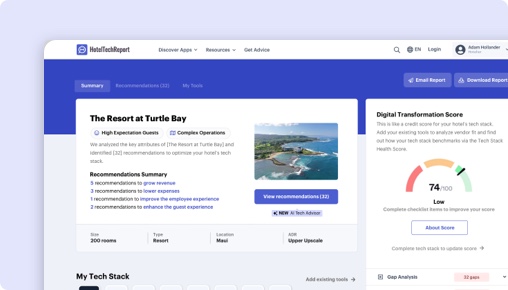
Spiacenti, questa funzionalità è disponibile solo per gli albergatori verificati
La dashboard dei progetti è uno strumento gratuito disponibile solo per gli albergatori verificati, che semplifica l'adozione di nuove tecnologie snellendo la ricerca e i flussi di comunicazione.

NewBook (PMS) vs. Prostay:
Qual è Quello Giusto per Te?

TLDR
Abbiamo analizzato 21 recensioni verificate di albergatori, confrontato funzionalità, prezzi e casi studio reali per evidenziare dove ciascuna piattaforma eccelle. La scelta giusta dipende dal tipo di hotel e dalle tue priorità:
NewBook si distingue per funzionalità esclusive come CRM ospite e Profili degli ospiti.
Prostay si distingue per funzionalità esclusive come Transactional Emails (booking, folios, etc) e Centralized Messaging.
Come si Confronta NewBook (PMS) con Prostay?
Valutazioni fianco a fianco basate su 21 recensioni verificate di albergatori su HTR.
| HTScore |
|
|
| Probabilità di Raccomandazione |
|
|
| Facilità d'Uso |
|
|
| Assistenza Clienti |
|
|
| Rapporto Qualità-Prezzo |
|
|
| Prezzo di Partenza | Da $1.000/mese | Da $600/mese |
| Recensioni Verificate | 16 | 5 |
NewBook vs Prostay: Classifiche per Segmento Alberghiero
Come si classifica ciascun prodotto tra i fornitori di Sistemi di Gestione della Struttura (PMS) per diverse dimensioni di struttura, tipologie di hotel e regioni — basato su recensioni verificate di albergatori in ogni segmento.
Per Dimensione Hotel
| Segmento |
NewBook
|
Prostay
|
|---|---|---|
| Piccolo (10-24 camere) ▾ | #43 8 recensioni | #50 5 recensioni |
| Medio (25-74 camere) ▾ | #42 7 recensioni | #71 0 recensioni |
| Grande (75-199 camere) | #50 1 recensioni | — |
Per Tipo di Hotel
| Segmento |
NewBook
|
Prostay
|
|---|---|---|
| Boutique ▾ | #47 7 recensioni | #55 3 recensioni |
| Lusso | #55 2 recensioni | — |
| Brand / Catena | #45 4 recensioni | #65 1 recensioni |
| Soggiorno Prolungato | #42 2 recensioni | — |
Per Regione
| Segmento |
NewBook
|
Prostay
|
|---|---|---|
| Nord America | #38 2 recensioni | #47 0 recensioni |
| Europa | — | #50 1 recensioni |
| Asia Pacifico | — | #16 4 recensioni |
Is NewBook or Prostay Better for Hotels?
NewBook and Prostay both serve as comprehensive Property Management Systems (PMS) with strengths that cater to different hotel types. NewBook fits properties that value extensive customization, guest communication, and integrated payment hardware. Prostay targets resorts and larger boutique hotels requiring multi-property support, advanced automation, and robust reporting, including offline capabilities.
Both platforms centralize operations such as booking management, housekeeping, and billing, solving the core challenge of running diverse hotel operations from a single platform. The choice comes down to the specific operational needs, property scale, and preferred integrations.
NewBook vs Prostay: Which Should Your Hotel Choose?
If your property is an independent boutique hotel, resort, or RV park seeking a PMS with strong guest CRM features, digital registration, and integrated payment terminals, NewBook’s 4.8 overall rating across 16 reviews—especially its 4.9 rating from boutique hotel users—makes it a strong fit. This is supported by its presence in 4 countries and 16 verified integrations, including key revenue and channel management tools.
Conversely, if you operate a resort or boutique hotel needing flexible multi-property management, real-time reporting, and advanced automation like room assignments or space optimization, Prostay’s perfect 5/5 rating across 5 reviews is compelling. Despite fewer reviews, Prostay is rated 5/5 by resorts and boutique hotels and offers unique features such as an integrated Point of Sale system and offline mode. Its smaller user base is spread over 3 countries, with 2 verified partners, indicating a newer but promising market presence.
Data on limited service and budget hotels is scant for Prostay, so NewBook's performance there (4.8/5) might influence properties in that segment. Consider NewBook if broader integration and global market presence are priorities; choose Prostay if automation and offline operation are critical.
Is NewBook or Prostay Easier to Use?
Both NewBook and Prostay score closely on ease of use: NewBook earns 4.7/5, and Prostay 4.8/5. Their onboarding ratings tie at 4.8/5. Reviewers for both highlight intuitive interfaces that reduce staff training time. Prostay users specifically praise faster staff training due to well-thought workflows, while NewBook users appreciate its ease for all staff levels, including housekeepers.
No review indicates significant usability issues in either system. Staff adoption appears smooth across property sizes with both solutions. Given these nearly identical ratings and user feedback on user-friendliness, neither platform holds a clear advantage in ease of use.
Edge: Even.
Which Has Better Features: NewBook or Prostay?
Prostay leads with 15 unique hotel-relevant features compared to NewBook’s 8. Prostay’s exclusive features include automated reminders, task management, real-time status updates, drag-n-drop tape chart, rules-based room assignments, and GDPR compliance. These features enable operational automation, reduce manual tasks, and provide dynamic room management—beneficial for resorts and properties with complex booking logistics.
NewBook offers guest CRM, guest profiles, group functionality, automated night audit, a mobile app, digital registration, SMS guest communication, and an integrated payment terminal and card reader. These features improve guest engagement, streamline check-in/out, and facilitate on-site payments, fitting for properties emphasizing guest relationship management and hands-on service.
Both share 22 features typical for PMS. The presence of integrated payment hardware and SMS messaging in NewBook contrasts with Prostay’s stronger automation and reporting tools. Operationally, NewBook enhances front desk guest interactions, while Prostay’s features optimize back-office workflows and room inventory.
Edge: Prostay.
Which Has Better Customer Support: NewBook or Prostay?
Customer support ratings tie at 5/5 for both products, with onboarding also equal at 4.8/5. NewBook reviewers emphasize prompt, knowledgeable, and friendly support with rapid resolution of issues and ongoing training updates. Prostay users describe their support as professional and responsive, with assistance during migration and training.
No negative themes dominate either product’s support reviews. Both vendors maintain high service levels, ensuring operational continuity during implementation and daily use.
Edge: Even.
Which Has More Integrations: NewBook or Prostay?
NewBook offers 16 verified integrations, including SiteMinder, Tripadvisor, Revinate, PriceLabs, and IDeaS, which are widely used for channel management, reputation, and revenue management. Prostay has only 2 verified partners, Stripe and STAAH.
For hotels relying on broad third-party integrations—especially global chains or those using established channel managers and revenue tools—NewBook provides a significantly larger ecosystem. Prostay’s limited integrations may constrain connectivity for properties with existing technology stacks.
Edge: NewBook.
Which Do Hoteliers Rate Higher: NewBook or Prostay?
Overall ratings are close: NewBook scores 4.8/5 from 16 reviews, Prostay 5/5 from 5 reviews. However, NewBook has no recent reviews in the last six months, and Prostay has none either, leaving current ratings stable but with limited recent data.
Segment-wise, NewBook’s boutique hotels rate it 4.9/5 (7 reviews), resorts 4.9/5 (8 reviews), and luxury hotels 5/5 (2 reviews). Prostay’s boutique hotels and resorts both rate it 5/5 but with fewer reviews (3 and 4 respectively). Limited service and budget hotels rate NewBook at 4.8/5 (7 reviews); Prostay has only 2 reviews here.
Given the larger sample size and broader segment coverage, NewBook’s ratings are more statistically representative. Prostay’s perfect scores indicate strong user satisfaction but from a smaller, less recent sample.
Edge: Even.
How Much Do NewBook and Prostay Cost?
NewBook’s base price is $1,000. Prostay’s base price is $600. Neither offers freemium, monthly flat, or per-room pricing, nor do they charge implementation fees or provide trials.
Prostay is the more affordable option by $400 at base level, potentially appealing to smaller properties or those with tight budgets. Both vendors require direct contact for pricing tiers or add-ons beyond the base.
What Type of Hotel Should Use NewBook?
- Hotels that prioritize integrated payment hardware for streamlined on-site transactions.
- Teams needing detailed guest CRM and SMS guest communication to personalize stays.
- Properties requiring group booking functionality and digital registration to reduce front desk workload.
- Hotels looking for broad third-party integrations like SiteMinder and Tripadvisor to expand distribution.
- Properties with a mix of boutique, resort, and RV park segments, supported by strong user ratings in these categories.
Not ideal if:
- Your property depends heavily on automation features like task management and rules-based room assignments.
- You require extensive multi-property management or offline operation.
- Integrations with emerging or niche platforms are critical beyond NewBook’s verified partners.
What Type of Hotel Should Use Prostay?
- Resorts and boutique hotels needing advanced automation for room assignments and space optimization.
- Hotels requiring a drag-n-drop tape chart and real-time reporting for dynamic inventory management.
- Properties wanting native apps with offline functionality for operation in low-connectivity environments.
- Teams looking for integrated Point of Sale and centralized guest/agent messaging platforms.
- Hotels prioritizing GDPR compliance and comprehensive task management features.
Not ideal if:
- Your property needs a wide range of third-party integrations for revenue management and online distribution.
- Integrated payment terminals and SMS guest communication are core to your guest experience.
- You operate outside Prostay’s core markets where vendor support and integrations may be limited.
NewBook vs Prostay: The Bottom Line for Hotels
NewBook and Prostay are both capable PMS solutions that centralize hotel operations but diverge in feature focus and market positioning. NewBook emphasizes guest relationship management and extensive integration capabilities, making it suitable for boutique hotels, resorts, and mixed-use properties seeking enhanced guest communication and payment processing. Prostay excels in automation, reporting, and multi-property support, fitting resorts and boutique hotels that require operational efficiency and offline readiness.
Choose NewBook if your hotel benefits from integrated payment terminals, SMS messaging, and a broad partner ecosystem including SiteMinder and Tripadvisor, as supported by its 16 verified integrations and strong segment ratings. Opt for Prostay if your property demands advanced automation features like rule-based room assignments, drag-n-drop tape charts, and native offline apps, backed by perfect 5/5 ratings in boutique and resort segments and a lower base price.
Where integration breadth and guest communication matter most, NewBook leads. Where automation, flexible workflows, and offline operation are priorities, Prostay is superior. The decision hinges on your property’s operational complexity and technology ecosystem.
Quanto Costano NewBook (PMS) e Prostay?
I prezzi di Sistemi di Gestione della Struttura (PMS) raramente sono semplici. Ecco cosa sappiamo dai dati pubblici sui prezzi di ciascun fornitore. Richiedi sempre un preventivo personalizzato per la dimensione della tua struttura.
|
NewBook
|
Prostay
|
|
|---|---|---|
| Prezzo di Partenza | Da $1.000/mese | Da $600/mese |
Confronto delle funzionalità: NewBook (PMS) vs Prostay
Queste sono le funzionalità configurate da ciascun fornitore, organizzate per gruppo di funzionalità — gli stessi dati mostrati nella dashboard del fornitore. Espandi un gruppo per confrontare le funzionalità affiancate.
| Funzionalità |
NewBook
|
Prostay
|
|---|---|---|
|
▾
Contabilità e finanza
|
|
|
| Fatturazione diretta | ||
| Rapporti RevPaR e ADR | ||
| Multivaluta | ||
| Transactional Emails (booking, folios, etc) | ||
| Audit notturno automatizzato | ||
|
▾
Marketing e commercio elettronico
|
|
|
| Comunicazione ospite (messaggi SMS) | ||
| Email marketing nativo | ||
| Profili degli ospiti | ||
| CRM ospite | ||
| buoni regalo | ||
| Gestore di canale | ||
| Motore di prenotazione | ||
| Transactional Emails (booking, folios, etc) | ||
|
▾
Amministrazione e configurazione
|
|
|
| Gestione centralizzata di utenti e ruoli | ||
| Multilingue | ||
| Basato su cloud | ||
| In sede | ||
|
▾
Gestione clienti
|
|
|
| Comunicazione ospite (messaggi SMS) | ||
| Profili degli ospiti | ||
| Centralized Messaging | ||
| Transactional Emails (booking, folios, etc) | ||
|
▾
Sportello
|
|
|
| Note e attività sui dispositivi mobili (Voice-to-Text) | ||
| App mobile | ||
| Audit notturno automatizzato | ||
| Vista calendario | ||
| Multilingue | ||
| Task Management | ||
| Automated reminders | ||
| Profili degli ospiti | ||
| Tablet/Kiosk Check-in | ||
| Payment Requests | ||
| Centralized Messaging | ||
| Automated Space Optimization | ||
|
▾
Gestione Gruppi
|
|
|
| Funzionalità di gruppo | ||
| Automated Space Optimization | ||
|
▾
Esperienza degli ospiti
|
|
|
| Scanner integrato per ID e passaporto | ||
| Registrazione digitale | ||
| Guest App | ||
| Online Check-in | ||
| Online Checkout | ||
| Guest Messaging | ||
| Transactional Emails (booking, folios, etc) | ||
| ID Scanning & Registration Pre-fill | ||
| Lobby Kiosk | ||
|
▾
Faccende domestiche
|
|
|
| Modulo per le pulizie | ||
| Housekeeping Mobile App | ||
| Real-Time Status Updates | ||
| Automated Assignments | ||
| Real Time Reporting | ||
| Shift Planning | ||
| Employee Messaging | ||
| Online Checkout | ||
|
▾
Pagamenti
|
|
|
| Terminale di pagamento e lettore di carte integrati | ||
| Fatturazione diretta | ||
| Multivaluta | ||
| Processo di pagamento | ||
| Payment Requests | ||
|
▾
Gestione delle prenotazioni
|
|
|
| Rapporti RevPaR e ADR | ||
| buoni regalo | ||
| Gestore di canale | ||
| CRS integrato | ||
| Drag-n-Drop Tapechart | ||
| Rate Management | ||
| Automated Space Optimization | ||
| Rules Based Room Assignments | ||
| Transactional Emails (booking, folios, etc) | ||
|
▾
Gestione delle entrate
|
|
|
| Rapporti RevPaR e ADR | ||
| Tariffe personalizzate | ||
| Monitoraggio delle entrate accessorie | ||
| Modulo di gestione delle entrate | ||
| Base Pricing | ||
|
▾
Tasse e conformità
|
|
|
| PCI Compliant | ||
| GDPR Compliant | ||
| SOC2 Complaint | ||
| Tax Configuration | ||
|
▾
Supporto e formazione
|
|
|
| Supporto online 24 ore su 24, 7 giorni su 7 | ||
|
▾
Prodotti alimentari e bevande
|
|
|
| EPoS | ||
|
▾
Terme
|
|
|
| Modulo Spa e Benessere |
NewBook vs Prostay: Il Verdetto Finale
Classificato più in alto per
Funzionalità uniche
Funzionalità uniche
Domande Frequenti su NewBook (PMS) vs Prostay
NewBook (PMS) può sostituire Prostay?
Dipende dalle tue esigenze. NewBook (PMS) e Prostay condividono molte funzionalità di base di Property Management Systems, ma ciascuno ha capacità uniche. NewBook (PMS) offre 16 partner di integrazione verificati, mentre Prostay ne offre 2. Consulta il confronto delle funzionalità sopra per vedere dove differiscono prima di cambiare.
Qual è migliore per hotel piccoli o indipendenti?
Gli hotel piccoli dovrebbero dare priorità alla facilità d'uso e a un onboarding rapido. Prostay è in testa per facilità d'uso con 4,8/5 vs 4,7/5. Cerca prezzi trasparenti e un'opzione di prova o demo. Filtra le recensioni su ogni pagina prodotto per dimensione della struttura per sentire le opinioni di hotel simili al tuo.
NewBook (PMS) o Prostay offrono un piano gratuito?
NewBook (PMS): No. Prostay: No. Nessuno dei due prodotti offre attualmente un livello gratuito. La maggior parte dei fornitori di Property Management Systems offre demo o prove gratuite — richiedine una a ciascuno per valutare prima di impegnarti.
Come Valuta e Classifica HTR NewBook (PMS) e Prostay?
L'HT Score è una classifica composita che considera 4 gruppi di criteri e oltre una dozzina di variabili per aiutare gli albergatori a confrontare oggettivamente i prodotti tecnologici per hotel. NewBook ha un HT Score di 0 e Prostay ha 0. Ecco come viene calcolato il punteggio.
| Gruppo di Criteri | Peso | Cosa Misura |
|---|---|---|
| Valutazioni e Recensioni dei Clienti |
|
Quanto raccomandano gli utenti questo prodotto? Punteggio Valutazioni, Volume Recensioni, Quota di Voce, Profondità Recensioni, Recenza Recensioni, Storie di Successo ▾ Il fattore con il peso maggiore. Analizza le valutazioni medie di soddisfazione (probabilità di raccomandazione, facilità d'uso, assistenza, ROI), il numero totale di recensioni rispetto ai concorrenti nella categoria, la recenza delle recensioni (almeno 20 recensioni negli ultimi 6 mesi) e la quota di voce tra clienti hotel unici per rilevare bias di selezione. |
| Ecosistema dei Partner |
|
Quanto raccomandano i partner tecnologici questa azienda? Raccomandazioni dei Partner, Quantità Integrazioni, Qualità Integrazioni ▾ Valuta le raccomandazioni dei partner come voti di fiducia degli esperti, il numero di integrazioni verificate e la qualità dell'ecosistema — la media degli HT Score dei partner di integrazione. I prodotti con ecosistemi di integrazione di qualità superiore hanno maggiori probabilità di offrire uno stack tecnologico connesso. |
| Centralità del Cliente |
|
Quanto è orientata al cliente questa organizzazione? Assistenza Certificata, Coerenza delle Recensioni, Completezza del Profilo ▾ Valuta se l'azienda ha ottenuto la Certificazione di Assistenza Clienti HTR, mantiene una raccolta di recensioni costante nel tempo (un indicatore di cultura orientata al feedback) e mantiene i profili prodotto completi con funzionalità, screenshot, prezzi e caratteristiche. |
| Portata, Solidità e Risorse |
|
Quanto sono estese la portata e le risorse di questa azienda? Portata Geografica, Solidità nel Tempo, Risorse Aziendali, Punteggio di Tendenza ▾ Misura la presenza globale (paesi e regioni servite), gli anni di attività come indicatore di stabilità, il numero di dipendenti come indicatore di risorse e un punteggio di tendenza basato su richieste degli acquirenti, recensioni, raccomandazioni dei partner e attività stampa degli ultimi dodici mesi. |
Le valutazioni e le recensioni dei clienti sono di gran lunga il fattore più importante nell'algoritmo dell'HT Score. HTR non accetta pagamenti per classifiche più alte. Tutte le recensioni sono verificate — solo i professionisti del settore alberghiero con affiliazioni confermate possono inviare valutazioni. Visualizza la metodologia completa dell'HT Score →
Quali Altri Confronti di Sistemi di Gestione della Struttura (PMS) Stanno Leggendo gli Albergatori?
Esplora altri confronti diretti basati su recensioni verificate di albergatori.






Indice
Ottieni il tuo report gratuito di analisi AI
Consigli personalizzati su misura per la tua struttura


Cerchiamo le informazioni sul tuo hotel
Stai ancora valutando le tue opzioni di sistemi di gestione della struttura (pms)?
Alcuni sistemi popolari dalla nostra guida su sistemi di gestione della struttura (pms) — oppure lascia che la nostra IA valuti ciascuno di essi in base alla tua struttura in circa due minuti.


