

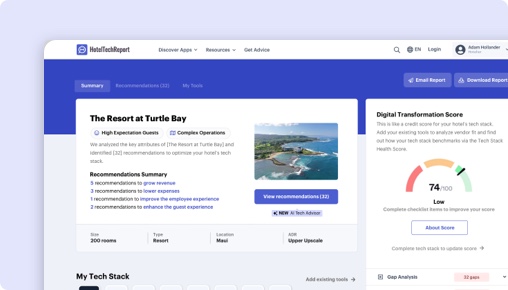
Lo sentimos, esta funcionalidad solo está disponible para hoteleros verificados
El panel de proyectos es una herramienta gratuita disponible únicamente para hoteleros verificados, que facilita la adopción de nuevas tecnologías al agilizar su investigación y simplificar sus flujos de comunicación.

Demand Calendar vs. happyhotel:
¿Cuál es el adecuado para usted?


Resumen
Analizamos 222 reseñas verificadas de hoteleros, comparamos funcionalidades, precios y casos de estudio reales para desglosar dónde destaca cada plataforma. La elección correcta depende de su tipo de hotel y de sus prioridades:
Demand Calendar AB se destaca por funcionalidades exclusivas como Market Insights Reporting.
happyhotel destaca en soporte, incorporación e implementación — especialmente para alojamientos del centro de la ciudad (4,9/5), con funciones exclusivas como Gestión de ingresos totalmente automatizada y Diseño amigable para dispositivos móviles.
¿Cómo se compara Demand Calendar con happyhotel?
Calificaciones comparadas basadas en 222 reseñas verificadas de hoteleros en HTR.
| HTScore |
|
|
| Probabilidad de recomendar |
|
|
| Facilidad de uso |
|
|
| Soporte al cliente |
|
|
| Relación calidad-precio |
|
|
| Precio inicial | Desde $600/mes | Desde $500/mes |
| Reseñas verificadas | 7 | 215 |
¿Cuáles son los pros y contras de Demand Calendar vs happyhotel?
Tras analizar 222 reseñas verificadas, los usuarios de Demand Calendar AB valoran más su , mientras que los usuarios de happyhotel destacan soporte, incorporación e implementación, informes, paneles y análisis, impacto en ingresos y ahorro de tiempo. Haga clic en cualquier tema para ver qué dicen los evaluadores.
|
Demand Calendar AB
|
happyhotel
|
|---|---|
| Pros | |
|
+
Soporte, incorporación e implementación
▾
|
|
|
+
Informes, paneles y análisis
▾
|
|
|
+
Impacto en ingresos y ahorro de tiempo
▾
|
|
|
+
Piloto automático / precios automatizados
▾
|
|
| Contras | |
Demand Calendar AB vs happyhotel: Rankings por segmento hotelero
Cómo se posiciona cada producto entre los proveedores de Sistemas de gestión de ingresos para hoteles de diferentes tamaños, tipos y regiones, basado en reseñas verificadas de hoteleros en cada segmento.
Por tamaño de hotel
| Segmento |
Demand Calendar AB
|
happyhotel
|
|---|---|---|
| Pequeño (10-24 habitaciones) ▾ | #39 2 reseñas | #4 98 reseñas |
| Mediano (25-74 habitaciones) ▾ | #34 5 reseñas | #7 83 reseñas |
| Grande (75-199 habitaciones) ▾ | — | #11 11 reseñas |
| Extra grande (200+ habitaciones) | — | #21 1 reseñas |
Por tipo de hotel
| Segmento |
Demand Calendar AB
|
happyhotel
|
|---|---|---|
| Boutique ▾ | #39 5 reseñas | #10 54 reseñas |
| Lujo ▾ | #40 2 reseñas | #16 26 reseñas |
| Marca / Cadena ▾ | #37 2 reseñas | #7 33 reseñas |
| Estancia prolongada ▾ | — | #7 23 reseñas |
Por región
| Segmento |
Demand Calendar AB
|
happyhotel
|
|---|---|---|
| Europa ▾ | #29 5 reseñas | #6 196 reseñas |
| Asia Pacífico | #13 2 reseñas | #25 1 reseñas |
Is Demand Calendar by Demand Calendar AB or happyhotel by happyhotel Better for Hotels?
Demand Calendar and happyhotel both address revenue management challenges but diverge significantly in scope and target users. Demand Calendar functions primarily as a hotel business intelligence tool, aggregating PMS, RMS, STR, and budget data to forecast total revenue and profit across rooms, F&B, meetings, and spa. It is tailored for hotel groups seeking strategic alignment across departments. In contrast, happyhotel is a cloud-based revenue management system focused on real-time dynamic pricing automation designed for hotels of all sizes, especially small to medium properties aiming to increase revenue through algorithm-driven price optimization.
Both tools solve the core problem of revenue predictability and pricing efficiency. Demand Calendar provides a consolidated forecast platform to identify budget risks and opportunities across multiple revenue streams, aiding operational coordination. happyhotel automates pricing decisions with autopilot features, competitor benchmarking, and demand signals, reducing manual intervention and improving rate agility. Hotels that want a holistic business intelligence view with manual pricing controls may lean towards Demand Calendar, while those prioritizing automated yield management and frequent rate updates will find happyhotel a more complete revenue management solution.
Demand Calendar vs happyhotel: Which Should Your Hotel Choose?
If you operate a multi-department or multi-property hotel group that requires consolidated forecasting across rooms, F&B, meetings, and spa, Demand Calendar’s integration of PMS, RMS, and market data offers a strategic advantage by aligning revenue, sales, marketing, and operations around one forecast. This insight fits properties with complex revenue streams and organizational layers, reflected in its user base with 44% boutique hotels and 14% branded hotels, predominantly in Europe and North America.
If your hotel is a small to medium-sized property or a chain seeking automated pricing to maximize occupancy and ADR, happyhotel’s dynamic pricing algorithms, autopilot function, and real-time market benchmarking provide superior operational value. Its extensive feature set (32 unique features) and integration with 25 verified partners including top PMS systems like Opera Cloud and protel support rapid adoption and ongoing revenue optimization. Review data from 215 hoteliers, including 50 recent reviews at 4.8/5, confirms its suitability for properties ranging from boutique hotels to luxury resorts.
Data for luxury hotels and boutique hotels is robust for both products, but happyhotel has broader segment coverage and more recent reviews. Demand Calendar’s limited review count (7 total, none recent) suggests its current market presence is narrower, making happyhotel the safer choice for broader hotel segments and chains requiring automated, scalable revenue management.
Is Demand Calendar or happyhotel Easier to Use?
Demand Calendar and happyhotel share nearly identical ease of use and onboarding scores: Demand Calendar with 4.7 and 4.3, happyhotel with 4.8 and 4.7 respectively. Reviewers of Demand Calendar appreciate its time-saving dashboards and centralized data views that simplify complex revenue work, though some note a slightly cluttered layout and occasional syncing issues with PMS Suite8. happyhotel users highlight its intuitive interface, rapid onboarding, and ease of use for non-revenue management specialists, enabling quick team adoption even during staff shortages.
Both products facilitate user adoption but happyhotel’s higher onboarding rating (4.7 vs 4.3) and numerous reviews praising friendly, responsive support during setup give it a modest operational edge for properties new to revenue management systems. Demand Calendar’s fewer reviews limit confidence in broad usability claims.
Edge: Even.
Which Has Better Features: Demand Calendar or happyhotel?
happyhotel offers 32 unique features not found in Demand Calendar, including dynamic pricing, fully automated revenue management, price sensitivity modeling, “what-if” scenario analysis, guided workflows, group pricing and evaluation, and AI optimization. These features enable real-time price optimization, bulk adjustments, and multi-month forward pricing (up to 24 months), directly reducing manual workload for revenue teams and increasing pricing agility. For example, happyhotel’s automated room-type pricing and controlled algorithm customization allow hoteliers to fine-tune pricing strategies without daily manual intervention, benefiting front desk and revenue managers by ensuring rates reflect current demand and market conditions.
Demand Calendar’s 4 unique features focus on business intelligence: future market demand data, lost business data, market insights reporting, and booking pattern analysis. These support strategic decision-making by revealing market trends and revenue leakage but do not automate pricing. This suits hotels needing comprehensive revenue forecasting across departments rather than dynamic pricing automation.
The extensive feature set of happyhotel translates into operational efficiency gains through automation and detailed analytics, while Demand Calendar provides broader revenue visibility without pricing automation. Given the scale and scope difference, happyhotel’s feature advantage is decisive for hotels wanting automated, dynamic revenue management.
Edge: happyhotel.
Which Has Better Customer Support: Demand Calendar or happyhotel?
Demand Calendar scores a perfect 5.0 for customer support, while happyhotel scores 4.8. Both products have onboarding ratings close to each other (4.3 vs 4.7). Demand Calendar reviewers emphasize prompt, easy communication and rapid responses to improvement suggestions, with one reviewer noting, “If you have any suggestion for improvement or any problems it is very easy to make contact and get a response.” happyhotel users commonly praise the personal, fast, and competent support that provides individualized responses instead of boilerplate answers, with some calling it “fantastic” and “excellent.” However, a minority report slower support responses and occasional technical issues with PMS integration.
With just 7 total reviews, Demand Calendar’s support ratings rest on less evidence compared to happyhotel’s 215 reviews, including 50 recent ones. The volume and recency of happyhotel’s positive feedback provide stronger operational assurance. Both vendors appear committed to support quality, but happyhotel’s scale and consistency make its support reliability more verifiable.
Edge: Even.
Which Has More Integrations: Demand Calendar or happyhotel?
Happyhotel leads with 25 verified integration partners versus Demand Calendar’s 5. Both share three common partners: Mews, Clock, and Oracle Hospitality. Demand Calendar integrates uniquely with IDeaS and HQ Revenue, focusing on revenue systems. Happyhotel’s broader partner list includes major PMS and channel managers like RoomRaccoon, apaleo GmbH, SiteMinder, protel, Access Hospitality, and others.
For hotels relying on a wide ecosystem of PMS and distribution software, happyhotel’s larger integration portfolio facilitates smoother data exchange, real-time rate updates, and reduced manual workload for front desk and revenue teams. Demand Calendar’s integrations emphasize BI data sources, aligning with its forecasting role but limiting operational connectivity.
Edge: happyhotel.
Which Do Hoteliers Rate Higher: Demand Calendar or happyhotel?
Both products share an identical overall rating of 4.8/5. However, happyhotel’s rating is based on 215 reviews with 50 in the last six months, while Demand Calendar’s 4.8 rating comes from only 7 reviews with no recent activity. happyhotel’s stable last-6-month rating of 4.8 confirms consistency in current performance, whereas Demand Calendar’s lack of recent reviews limits confidence in its present state.
By segment, Demand Calendar’s highest ratings come from small samples in boutique hotels (4.7 from 5 reviews), luxury hotels (5.0 from 2 reviews), and city center hotels (4.7 from 5 reviews). However, these counts are low. happyhotel maintains strong ratings across multiple hotel types with substantial review counts: boutique hotels (4.8/5, 58 reviews), branded hotels (4.8/5, 36), city center hotels (4.9/5, 56), airport/conference hotels (4.8/5, 70), and luxury hotels (4.9/5, 27). happyhotel also shows high ratings in limited service, hostels, resorts, and extended stay segments, reflecting broad acceptance.
The volume, recency, and segment diversity of happyhotel’s reviews give it a more reliable rating benchmark for buyers.
Edge: Even.
How Much Do Demand Calendar and happyhotel Cost?
Demand Calendar has a base price of $600.00 with no implementation fee or trial. happyhotel’s base price is $500.00, also without implementation fees or trials. Neither product publishes monthly flat or per-room pricing, and neither offers a freemium or free trial. This fixed base price model suggests a predictable upfront investment for both, with happyhotel being slightly more affordable by $100.
Without detailed pricing tiers or published volume discounts, cost comparisons rely on base price alone, where happyhotel offers a modest price advantage.
What Type of Hotel Should Use Demand Calendar?
- Hotels that operate multiple revenue streams (rooms, F&B, meetings, spa) and need consolidated forecasting to align revenue, sales, marketing, and operations within one view.
- Boutique and branded hotel groups with complex organizational structures requiring shared total revenue forecasts.
- Properties located in Europe, North America, or the Middle East where Demand Calendar has verified presence and partner integrations.
- Teams prioritizing business intelligence over automated pricing, focusing on strategic decision-making and market insights.
- Hotels currently using Suite8 PMS or Oracle Hospitality RMS, though with some reported integration limitations.
Not ideal if:
- You require automated, dynamic pricing adjustments or real-time rate optimization.
- You operate a small to medium hotel or chain seeking easy-to-use, hands-off revenue management.
- Seamless integration with a broad range of PMS and channel management systems is critical.
- You need frequent price updates and flexible rate controls for pricing agility.
- You depend on active vendor support and regular product updates, given Demand Calendar’s limited recent review activity.
What Type of Hotel Should Use happyhotel?
- Small to medium hotels and chains seeking automated revenue management with dynamic pricing algorithms.
- Hotels that value real-time price optimization, including forward pricing up to 24 months and bulk rate adjustments.
- Properties using popular PMS platforms like Opera Cloud, protel, apaleo, and RoomRaccoon benefiting from 25 verified integrations.
- Hotels requiring strong competitor benchmarking, event and holiday demand signals, and “what-if” scenario analysis.
- Teams that want fast onboarding, personal support, and a user-friendly interface for staff without extensive revenue management expertise.
Not ideal if:
- Your hotel requires deep business intelligence integration across multiple revenue streams beyond pricing.
- You operate in regions outside happyhotel’s primary European market presence.
- Advanced multi-property workflows and special group pricing controls are mission-critical but currently limited.
- You prefer a system focused primarily on strategic forecasting rather than operational pricing automation.
Demand Calendar vs happyhotel: The Bottom Line for Hotels
Demand Calendar and happyhotel serve distinctly different revenue management needs. Demand Calendar excels as a hotel business intelligence platform that aggregates multiple data sources to forecast total revenue and profit across rooms, F&B, meetings, and spa. It supports strategic alignment across hotel departments but does not automate pricing. happyhotel delivers a comprehensive, cloud-based revenue management system with advanced automation, dynamic pricing, and extensive integrations that streamline daily rate management and optimize hotel profitability.
Choose Demand Calendar if your property operates multiple revenue streams and requires consolidated forecasting and business intelligence to guide strategic decisions. Its unique features like lost business data and market insights reporting support this need. Choose happyhotel if you prioritize automated, real-time price optimization with AI-driven algorithms, autopilot pricing, and broad PMS/channel integrations that reduce manual tasks and increase revenue agility. happyhotel’s 215 reviews, including 50 recent ones at 4.8/5, demonstrate operational reliability and satisfaction across diverse hotel segments.
For most small to medium hotels and chains seeking scalable, data-driven revenue management with ease of use and automation, happyhotel represents the stronger choice. Demand Calendar suits hotel groups with complex forecasting needs who are prepared to manage pricing separately. The decision hinges on whether your hotel’s primary need is strategic revenue intelligence or automated pricing execution.
¿Cuánto cuestan Demand Calendar y happyhotel?
Los precios de Sistemas de gestión de ingresos rara vez son sencillos. Esto es lo que sabemos de los datos de precios públicos de cada proveedor. Solicite siempre un presupuesto personalizado para el tamaño de su hotel.
|
Demand Calendar AB
|
happyhotel
|
|
|---|---|---|
| Precio inicial | Desde $600/mes | Desde $500/mes |
Comparación de funcionalidades: Demand Calendar vs happyhotel
Estas son las funcionalidades que cada proveedor ha configurado, organizadas por grupo de funcionalidades — los mismos datos que se muestran en el panel del proveedor. Expanda un grupo para comparar las funcionalidades en paralelo.
| Funcionalidad |
Demand Calendar AB
|
happyhotel
|
|---|---|---|
|
▾
Optimización de Precios
|
|
|
| Explicación de precios | ||
| Directrices comerciales empresariales | ||
| Recomendaciones de fechas de estadía alternativas | ||
| Recomendaciones de propiedad alternativa | ||
| Optimización de precios en tiempo real | ||
| Control dinámico de jerarquía de precios | ||
| Precios abiertos | ||
| Flujos de trabajo guiados | ||
| Análisis de escenarios hipotéticos | ||
| Precio dinamico | ||
| Set Boundaries | ||
| Manage Exceptions | ||
| Group Pricing | ||
| Manage Restrictions | ||
| Manage Sell-Outs & Cancellations | ||
| Business Mix Optimization | ||
| Define Cycles | ||
| Yield Room Types Individually | ||
| Bulk Adjustments | ||
| Precios y previsiones a 24 meses | ||
| Precios de componentes/salas virtuales | ||
| Precios para estancias prolongadas | ||
| Precios de venta adicional | ||
| tasa de obstáculo | ||
|
▾
Inteligencia de mercado y pronóstico
|
|
|
| Pronóstico quinquenal | ||
| Precios a plazo de 365 días | ||
| STR Data | ||
| 18-Month Forward Pricing | ||
| Modelado de sensibilidad al precio | ||
| Multi-Property Dashboard | ||
| Market Intelligence Data | ||
| Interactive Customizable Dashboards | ||
| Datos de demanda del mercado futuro | ||
| Generador de pronósticos financieros | ||
| Previsión de estancias prolongadas | ||
| Previsión de canales | ||
| Explicación del pronóstico | ||
| Datos flexibles de la competencia | ||
|
▾
Tableros e informes
|
|
|
| Reportes personalizados | ||
| Informes programados | ||
| Datos comerciales perdidos | ||
| Panel de análisis | ||
| Interactive Customizable Dashboards | ||
| Market Insights Reporting | ||
| Pickup Analysis | ||
| Booking Pattern Analysis | ||
| Event Data | ||
| Price Change Logs | ||
| Customizable Notifications & Alerts | ||
| Displacement Analysis | ||
| Group Pricing & Evaluation | ||
| Multi-Property Dashboard | ||
| Medición de los beneficios del sistema | ||
|
▾
Automatización
|
|
|
| Controlled Automation/Algorithm Customization | ||
| Precios automatizados por tipo de habitación | ||
| Gestión de ingresos totalmente automatizada | ||
| Precio dinamico | ||
| AI Optimization | ||
| Automatic Pricing Updates | ||
|
▾
Funcionalidad multipropiedad
|
|
|
| La gestión del inventario | ||
| Gestión de propiedades múltiples | ||
| Multi-Property Dashboard | ||
|
▾
negocio del grupo
|
|
|
| Group Pricing & Evaluation | ||
| Análisis de escenarios hipotéticos | ||
| Displacement Analysis | ||
| Pronóstico y lavado de grupo | ||
|
▾
integraciones
|
|
|
| API abierta | ||
| Gestión de canales | ||
| Business Intelligence | ||
| STR Data | ||
| Property Management System | ||
| Autenticación multifactor | ||
|
▾
Other
|
|
|
| Precios y evaluación grupales | ||
| Aplicación movil | ||
| Tecnología de esparcimiento inteligente | ||
| Inicio de sesión único | ||
| Diseño amigable para dispositivos móviles |
Resultados reales: Demand Calendar AB vs happyhotel por objetivo de negocio
Analizamos 4 casos de estudio verificados para comparar lo que los hoteles realmente logran con cada plataforma en cuatro objetivos clave de negocio.
Demand Calendar AB
Aún no hay caso de estudio publicado para este objetivo.
Natur- & Wellnesshotels Brunner Hof 4****S (45 rooms, luxury resort, Germany)
Pequeño
"Before happyhotel, we handled prices manually and tracked everything in Excel. Now we have all key metrics in one place and save a lot of time every day."
 Demand Calendar AB
Aún no hay caso de estudio publicado para este objetivo.
Hotel Öschberghof (127 rooms, luxury resort, Germany)
Pequeño
"Before we started using happyhotel, I manually entered prices into our PMS using self-made Excel sheets. We didn’t have a flexible pricing system and worked with seasonal tables, o..."

Demand Calendar AB vs happyhotel: Conclusión final
Mejor posicionado en
Capacidades únicas
Lo que les encanta a los hoteleros
El soporte es un tema positivo principal: los revisores describen repetidamente la incorporación como personal, rápida, competente y orientada a soluc... El soporte es un tema positivo principal: los revisores describen repetidamente la incorporación como personal, rápida, competente y orientada a soluciones. Esto es importante porque el producto suele ser adoptado por equipos nuevos en RMS, y una buena implementación acorta el tiempo para obtener valor. Las principales quejas son respuestas más lentas en algunos casos, mayor necesidad de capacitación para configuraciones complejas y un deseo de mejor orientación durante la migración o configuración técnica.
Los usuarios valoran constantemente los paneles claros, los gráficos personalizables y el acceso rápido a KPIs, pronósticos, RevPAR, ADR, ocupación y... Los usuarios valoran constantemente los paneles claros, los gráficos personalizables y el acceso rápido a KPIs, pronósticos, RevPAR, ADR, ocupación y acumulados. Happyhotel se percibe como especialmente útil para convertir datos hoteleros complejos en decisiones diarias accionables. Las solicitudes de mejora suelen mencionar filtros más flexibles, comparaciones más profundas, un mejor análisis STLY y una navegación de informes más intuitiva.
Un tema constante es que Happyhotel ahorra tiempo al personal mientras aumenta el ADR, la ocupación y los ingresos totales. Los revisores lo describen... Un tema constante es que Happyhotel ahorra tiempo al personal mientras aumenta el ADR, la ocupación y los ingresos totales. Los revisores lo describen con frecuencia como una herramienta práctica para el negocio que permite a equipos pequeños competir de manera más efectiva y centrarse en otras tareas. Varios mencionan ganancias medibles, mientras que un grupo menor indica que los resultados dependen de la calidad de la configuración o que los beneficios tardaron en manifestarse.
Mejor posicionado en
Capacidades únicas
Preguntas frecuentes sobre Demand Calendar vs happyhotel
¿Puede Demand Calendar reemplazar a happyhotel?
Depende de sus requerimientos. Demand Calendar y happyhotel comparten muchas funcionalidades principales de Revenue Management Systems, pero cada uno tiene capacidades únicas. Demand Calendar ofrece 5 socios de integración verificados, mientras que happyhotel ofrece 25. Revise la comparación de funcionalidades anterior para ver en qué difieren antes de cambiar.
¿Cuál es mejor para hoteles pequeños o independientes?
Los hoteles pequeños deben priorizar la facilidad de uso y una incorporación rápida. happyhotel lidera en facilidad de uso con 4,8/5 vs 4,7/5. Busque precios transparentes y una opción de prueba o demostración. Filtre las reseñas en la página de cada producto por tamaño de hotel para conocer la opinión de hoteles como el suyo.
¿Ofrecen Demand Calendar o happyhotel un plan gratuito?
Demand Calendar: No. happyhotel: No. Ninguno de los dos productos ofrece actualmente un nivel gratuito. La mayoría de los proveedores de Revenue Management Systems ofrecen demostraciones o pruebas. Solicite una de cada uno para evaluar antes de comprometerse.
¿Cómo evalúa y clasifica HTR a Demand Calendar y happyhotel?
El HT Score es un ranking compuesto que considera 4 grupos de criterios y más de una docena de variables para ayudar a los hoteleros a comparar objetivamente los productos de tecnología hotelera. Demand Calendar AB tiene un HT Score de 0 y happyhotel tiene 95. Así se calcula la puntuación.
| Grupo de criterios | Peso | Qué mide |
|---|---|---|
| Calificaciones y reseñas de clientes |
|
¿Qué tanto recomiendan los usuarios este producto? Puntuación de calificaciones, Volumen de reseñas, Participación de voz, Profundidad de reseñas, Actualidad de reseñas, Casos de éxito ▾ El factor con mayor ponderación. Analiza las calificaciones promedio de satisfacción (probabilidad de recomendar, facilidad de uso, soporte, ROI), el total de reseñas en relación con los competidores de la categoría, la actualidad de las reseñas (al menos 20 reseñas en los últimos 6 meses) y la participación de voz entre clientes hoteleros únicos para detectar sesgo de selección. |
| Ecosistema de socios |
|
¿Qué tanto recomiendan los socios tecnológicos a esta empresa? Recomendaciones de socios, Cantidad de integraciones, Calidad de integraciones ▾ Evalúa las recomendaciones de socios como votos de confianza de expertos, la cantidad de integraciones verificadas y la calidad del ecosistema, es decir, el promedio de HT Scores de los socios de integración. Los productos con ecosistemas de integración de mayor calidad tienen más probabilidades de ofrecer un stack tecnológico conectado. |
| Enfoque en el cliente |
|
¿Qué tan centrada en el cliente es esta organización? Soporte certificado, Consistencia de reseñas, Completitud del perfil ▾ Evalúa si la empresa ha obtenido la Certificación de Soporte al Cliente de HTR, mantiene una recolección consistente de reseñas a lo largo del tiempo (un indicador de cultura orientada al feedback) y mantiene los perfiles de producto completos con capacidades, capturas de pantalla, precios y funcionalidades. |
| Alcance, solidez y recursos |
|
¿Qué tan extensos son el alcance y los recursos de esta empresa? Alcance geográfico, Solidez, Recursos de la empresa, Puntuación de tendencia ▾ Mide la presencia global (países y regiones atendidos), los años en el negocio como indicador de estabilidad, el tamaño del equipo como indicador de recursos y una puntuación de tendencia basada en consultas de compradores, reseñas, recomendaciones de socios y actividad en prensa de los últimos doce meses. |
Las calificaciones y reseñas de clientes son con diferencia el factor más importante en el algoritmo del HT Score. HTR no acepta pagos a cambio de mejores posiciones en el ranking. Todas las reseñas son verificadas: solo profesionales de la industria hotelera con afiliaciones confirmadas pueden enviar calificaciones. Ver metodología completa del HT Score →
¿Qué otras comparaciones de Sistemas de gestión de ingresos están leyendo los hoteleros?
Explore más comparaciones directas basadas en reseñas verificadas de hoteleros.





Contenido
Obtenga su informe gratuito de analista de IA.
Recomendaciones personalizadas adaptadas a su hotel


Busquemos la información de tu hotel
¿Sigues sopesando tus opciones de sistemas de gestión de ingresos?
Algunos sistemas populares de nuestra guía sobre sistemas de gestión de ingresos — o deja que nuestra IA evalúe cada uno para tu hotel concreto en unos dos minutos.


