

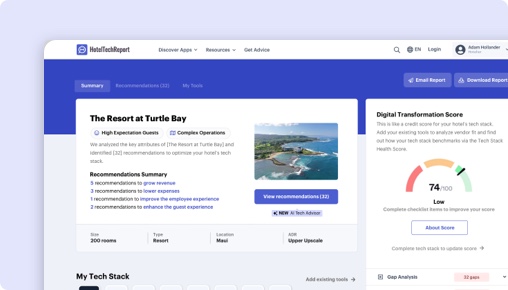
Désolé, cette fonctionnalité est réservée aux hôteliers vérifiés
Le tableau de bord des projets est un outil gratuit réservé aux hôteliers vérifiés. Il facilite l'adoption de nouvelles technologies en rationalisant leurs recherches et en simplifiant leurs échanges.

Beekeeper (Digital Workspace) vs. Hudini Staff App:
Lequel vous convient le mieux ?


TLDR
Nous avons analysé 21 avis vérifiés d'hôteliers, comparé les fonctionnalités, les tarifs et des études de cas réelles pour identifier les points forts de chaque plateforme. Le bon choix dépend de votre type d'hôtel et de vos priorités :
Beekeeper se distingue par des fonctionnalités exclusives comme Accès mobile et Messagerie SMS.
Hudini se distingue par des fonctionnalités exclusives comme Priorisation du travail et Routage des messages.
Comment Beekeeper (Digital Workspace) se compare-t-il à Hudini Staff App ?
Notes comparées basées sur 21 avis vérifiés d'hôteliers sur HTR.
| HTScore |
|
|
| Probabilité de recommandation |
|
|
| Facilité d'utilisation |
|
|
| Support client |
|
|
| Rapport qualité-prix |
|
|
| Prix de départ | Contacter le service commercial | Dès 600 $/mois |
| Avis vérifiés | 20 | 1 |
Beekeeper vs Hudini : Classement par segment hôtelier
Comment chaque produit se classe parmi les fournisseurs Outils de collaboration du personnel pour différentes tailles d'établissement, types et régions — basé sur les avis vérifiés d'hôteliers dans chaque segment.
Par taille d'hôtel
| Segment |
Beekeeper
|
Hudini
|
|---|---|---|
| Petit (10-24 chambres) | #17 1 avis | — |
| Moyen (25-74 chambres) ▾ | #13 8 avis | — |
| Grand (75-199 chambres) | #15 4 avis | #28 1 avis |
| Très grand (200+ chambres) ▾ | #7 5 avis | — |
Par type d'hôtel
| Segment |
Beekeeper
|
Hudini
|
|---|---|---|
| Boutique ▾ | #13 10 avis | — |
| Luxe ▾ | #14 11 avis | #30 1 avis |
| Enseigne / Chaîne ▾ | #10 9 avis | #32 1 avis |
| Séjour prolongé | #17 1 avis | — |
Par région
| Segment |
Beekeeper
|
Hudini
|
|---|---|---|
| Amérique du Nord ▾ | #9 18 avis | #20 1 avis |
| Europe | #19 1 avis | — |
| Asie-Pacifique | #14 0 avis | — |
| Moyen-Orient | #7 1 avis | — |
Is Beekeeper or Hudini Better for Hotels?
Beekeeper and Hudini both aim to improve hotel staff communication and collaboration but serve distinctly different operational needs. Beekeeper excels as an all-encompassing digital workspace focused on employee engagement and cross-department communication. It supports complex workflows, multilingual teams, and broad employee populations. Hudini, on the other hand, centers on operational efficiency and guest service enhancement by integrating real-time data and task management for front-line teams.
Both products address the perennial challenge of staff communication in hotels, where shifts, departments, and roles fragment information flow. They provide mobile platforms to reduce reliance on manual communication—such as printed memos or verbal handoffs—thereby reducing errors, delays, and disengagement. However, Beekeeper’s strength lies in cultural and informational connectivity across the entire workforce, while Hudini targets operational task prioritization and guest-focused service recovery.
Beekeeper vs Hudini: Which Should Your Hotel Choose?
If your hotel operates multiple departments or locations with a large, multilingual staff, Beekeeper’s extensive feature set and auto-translate capabilities make it a better choice. Its positive ratings in branded hotels (4.9/5 across 9 reviews) and luxury hotels (4.9/5 across 11 reviews) confirm its fit for complex, high-service environments. Its employee engagement tools and content management workflows suit hotels aiming to build community and reduce turnover.
Conversely, if your property needs a streamlined operational tool that enhances real-time guest service and task management, Hudini’s work prioritization, message routing, and service recovery features address those gaps. Although Hudini’s review base is limited to one, that review rates it 5/5 across several hotel types including luxury and resorts, suggesting promise for guest-centric roles. However, the limited review volume means conclusions for smaller or independent hotels remain tentative.
For hotels looking strictly at broad employee communication platforms, Beekeeper’s 20 unique features and 20 verified reviews provide a stronger data foundation. Hudini’s narrower operational feature focus and single review indicate it is best suited for properties prioritizing guest interaction workflows over internal culture building.
Is Beekeeper or Hudini Easier to Use?
Beekeeper has an ease of use rating of 4.8/5 from 20 reviews, while Hudini holds a perfect 5/5 rating based on a single review. Beekeeper reviewers highlight its intuitive user experience, noting that staff familiar with social media adapt quickly. One reviewer emphasized that both mobile and desktop versions are user-friendly, supporting diverse employee preferences. Hudini’s sole reviewer praises its clean design and user-friendly interface, also noting straightforward communication with the vendor during rollout.
Onboarding scores are 4.7/5 for Beekeeper with 20 reviews and 5/5 for Hudini with 1 review. Beekeeper customers appreciate the involvement of customer success managers to guide adoption, reflecting a structured onboarding process suitable for larger teams. Hudini’s onboarding feedback is positive but limited to the initial rollout phase.
The volume and recency of Beekeeper’s reviews provide a reliable representation of current ease of use, whereas Hudini’s rating is promising but less certain due to limited data.
Edge: Even.
Which Has Better Features: Beekeeper or Hudini?
Beekeeper offers 20 features unique to its platform, focused on employee engagement and communication. These include employee onboarding workflows, auto-translate messaging for multilingual teams, SMS text messaging, employee recognition and tagging, engagement analytics dashboards, scheduled campaigns, and in-app translation. These features transform how hotels cultivate team culture, share knowledge, and manage training—tasks critical for large or multi-lingual staff bases.
Hudini provides five unique features centered on operational task management: work prioritization, message routing for directing requests to the right staff, service recovery/escalation processes, message templates, and automated replies. These functions streamline front-line operations and improve guest service responsiveness, critical for properties emphasizing operational efficiency and guest experience.
Both share three common features centered on basic communication, but Beekeeper’s broader feature set shapes it as a digital workspace rather than a pure operational tool.
Edge: Beekeeper.
Which Has Better Customer Support: Beekeeper or Hudini?
Beekeeper’s customer support rating is 4.8/5, based on 20 reviews, with customers frequently citing helpful, human support and proactive engagement from customer success managers. One reviewer described their support contact as “like a really cool friend” who assisted with launch and adoption challenges. This ongoing support is vital for hotels implementing new technology across diverse teams.
Hudini’s single review scores support at 5/5 and emphasizes quick, straightforward communication and follow-up from the team during rollout. While positive, this single data point limits confidence in Hudini’s ongoing support capabilities compared to Beekeeper’s broader feedback.
Edge: Even.
Which Has More Integrations: Beekeeper or Hudini?
Hudini leads with 15 verified integrations, compared to Beekeeper’s 9. Both connect to major hospitality systems like Oracle Hospitality and Hapi, critical for hotels seeking integration with property management and guest service platforms.
Hudini’s unique integrations include daily point™, Signify, INTEREL, Vingcard, SALTO Systems, Book4Time, Infor, and Adyen, which support access control, guest experience management, and payment processing. These integrations align with Hudini’s operational focus on guest service and task management.
Beekeeper integrates with Kronos, SuitePad, Revinate, Quore, and Amadeus, among others, enabling workforce management, guest communication, and revenue optimization workflows that support broader employee engagement.
Hotels prioritizing operational guest-facing integrations will benefit from Hudini’s broader connectivity. Those focused on internal communication and workforce management will find Beekeeper’s integrations sufficient.
Edge: Hudini.
Which Do Hoteliers Rate Higher: Beekeeper or Hudini?
Beekeeper has an overall rating of 4.9/5 from 20 reviews, while Hudini has a perfect 5/5 rating from a single review. Beekeeper’s rating is stable with no recent reviews to suggest decline, and a 98% likelihood to recommend. Hudini’s single review reflects high satisfaction but insufficient volume for a representative sample.
Segment-specific ratings favor Beekeeper in branded hotels (4.9/5, 9 reviews), luxury hotels (4.9/5, 11 reviews), and city center hotels (4.9/5, 7 reviews). Hudini’s single review covers multiple segments with a perfect rating but lacks breadth.
Given the volume and consistency, Beekeeper’s rating is a stronger indicator of overall hotelier satisfaction.
Edge: Even.
How Much Do Beekeeper and Hudini Cost?
Beekeeper does not publish pricing information or offer freemium, monthly flat, or per-room pricing. There is no implementation fee or trial available, indicating pricing is likely custom and requires vendor engagement.
Hudini’s base price is publicly listed at $600.00, with no freemium or monthly pricing models published. It also does not offer a trial or charge an implementation fee.
Hotels seeking transparent, upfront pricing will find Hudini’s published base price advantageous, while Beekeeper’s pricing requires direct consultation.
What Type of Hotel Should Use Beekeeper?
- Hotels that operate multiple departments or locations needing unified communication across shifts and teams.
- Properties with multilingual staff requiring auto-translate messaging for inclusive communication.
- Teams prioritizing employee engagement through features like recognition, surveys, and training workflows.
- Branded and luxury hotels with complex operational needs and a focus on workforce culture.
- Hotels wanting rich mobile and desktop access with social media-like interfaces for faster adoption.
Not ideal if:
- Your property prioritizes front-line operational task management over broad employee engagement.
- You require transparent, published pricing rather than custom quotes.
- Your team size or budget is very small, as the platform’s depth suits larger workforces.
What Type of Hotel Should Use Hudini?
- Hotels focused on optimizing front-line operations, including work prioritization and task escalation.
- Properties requiring integrations with access control, payment, and guest experience platforms.
- Teams that want message routing and automated replies to streamline communication.
- Hotels seeking a straightforward, clean interface for quick deployment.
- Properties needing clear base pricing upfront.
Not ideal if:
- You require comprehensive employee engagement features like onboarding, recognition, or multilingual support.
- Your hotel workforce spans multiple departments needing broad cross-team collaboration.
- You want extensive review data to validate product performance.
Beekeeper vs Hudini: The Bottom Line for Hotels
Beekeeper and Hudini approach staff collaboration tools from different operational angles. Beekeeper is a digital workspace designed for workforce-wide engagement, multilingual communication, and cultural connectivity. Hudini focuses on front-line operational efficiency, guest service workflows, and task management. This fundamental difference defines which hotels benefit most from each.
Choose Beekeeper if your hotel needs an employee communication platform that supports training, recognition, and multilingual teams across multiple properties or departments. Its 20 unique features and 20 verified reviews demonstrate depth and reliability for complex operations. Beekeeper’s integrations with workforce and guest engagement systems further support this role.
Choose Hudini if your priority is streamlining guest-facing operations through work prioritization, message routing, and service recovery. Its integrations with access control, payment systems, and guest service platforms make it ideal for hotels focused on operational responsiveness. Hudini’s published base price also aids budgeting for properties needing cost transparency.
The choice hinges on whether your hotel aims to unify and engage the workforce broadly (Beekeeper) or optimize front-line guest service workflows specifically (Hudini).
Combien coûtent Beekeeper (Digital Workspace) et Hudini Staff App ?
La tarification des Outils de collaboration du personnel est rarement simple. Voici ce que nous savons à partir des données tarifaires publiques de chaque fournisseur. Demandez toujours un devis personnalisé pour la taille de votre établissement.
|
Beekeeper
|
Hudini
|
|
|---|---|---|
| Prix de départ | — | Dès 600 $/mois |
Comparaison des fonctionnalités : Beekeeper (Digital Workspace) vs Hudini Staff App
Voici les fonctionnalités configurées par chaque fournisseur, organisées par groupe de fonctionnalités — les mêmes données que dans le tableau de bord du fournisseur. Développez un groupe pour comparer les fonctionnalités côte à côte.
| Fonctionnalité |
Beekeeper
|
Hudini
|
|---|---|---|
|
▾
Gestion des tâches
|
|
|
| Priorisation du travail | ||
| Gestion de la bibliothèque de fichiers (images, documents et vidéos) | ||
| Suivi des actifs | ||
| Gestion des dossiers | ||
| Inspection | ||
| Nettoyage en profondeur | ||
| Module de maintenance préventive | ||
| Suivi des tâches en temps réel | ||
| Carnet de bord virtuel | ||
| Module des objets trouvés | ||
| Départs tardifs | ||
|
▾
Messagerie et collaboration
|
|
|
| Routage des messages | ||
| Définition des objectifs d'équipe (par ex. inscriptions aux récompenses, satisfaction) | ||
| Traduction dans l’application | ||
| Accès mobile sur tout appareil | ||
|
▾
Gestion des escalades et alertes
|
|
|
| Gestion de la récupération du service / Escalade | ||
|
▾
Rapports
|
|
|
| Tableau de bord analytique | ||
| Suivi de portefeuille multi-établissements | ||
| Imprimer les anciens dossiers | ||
| Relevé de compteur | ||
| Suivi des rémunérations | ||
|
▾
Automatisation
|
|
|
| Réponses automatisées | ||
| Modèles de messages | ||
| API ouverte | ||
|
▾
Modèles
|
|
|
| Modèles de messages |
Beekeeper vs Hudini : Le verdict final
Mieux classé pour
Fonctionnalités uniques
Fonctionnalités uniques
Questions fréquentes sur Beekeeper (Digital Workspace) vs Hudini Staff App
Beekeeper (Digital Workspace) peut-il remplacer Hudini Staff App ?
Cela dépend de vos besoins. Beekeeper (Digital Workspace) et Hudini Staff App partagent de nombreuses fonctionnalités Staff Collaboration Tools de base, mais chacun a des capacités uniques. Beekeeper (Digital Workspace) propose 9 partenaires d'intégration vérifiés, tandis que Hudini Staff App en propose 15. Consultez la comparaison des fonctionnalités ci-dessus pour voir les différences avant de changer.
Lequel est le mieux adapté aux petits hôtels ou hôtels indépendants ?
Les petits hôtels devraient privilégier la facilité d'utilisation et une prise en main rapide. Hudini Staff App est en tête pour la facilité d'utilisation avec 5,0/5 contre 4,8/5. Recherchez une tarification transparente et une option d'essai ou de démonstration. Filtrez les avis sur chaque page produit par taille d'établissement pour lire les retours d'hôtels similaires au vôtre.
Beekeeper (Digital Workspace) ou Hudini Staff App proposent-ils une offre gratuite ?
Beekeeper (Digital Workspace) : Non. Hudini Staff App : Non. Aucun des deux produits ne propose actuellement d'offre gratuite. La plupart des fournisseurs Staff Collaboration Tools proposent des démonstrations ou des essais — demandez-en un à chacun pour évaluer avant de vous engager.
Comment HTR évalue-t-il et classe-t-il Beekeeper (Digital Workspace) et Hudini Staff App ?
Le HT Score est un classement composite qui prend en compte 4 groupes de critères et plus d'une douzaine de variables pour aider les hôteliers à comparer objectivement les produits technologiques hôteliers. Beekeeper a un HT Score de 0 et Hudini a 0. Voici comment le score est calculé.
| Groupe de critères | Pondération | Ce qu'il mesure |
|---|---|---|
| Notes et avis clients |
|
À quel point les utilisateurs recommandent-ils ce produit ? Score des notes, Volume d'avis, Part de voix, Profondeur des avis, Récence des avis, Cas de réussite ▾ Le facteur le plus fortement pondéré. Analyse les notes de satisfaction moyennes (probabilité de recommandation, facilité d'utilisation, support, ROI), le nombre total d'avis par rapport aux pairs de la catégorie, la récence des avis (au moins 20 avis sur les 6 derniers mois) et la part de voix parmi les clients hôteliers uniques pour détecter les biais de sélection. |
| Écosystème partenaire |
|
À quel point les partenaires technologiques recommandent-ils cette entreprise ? Recommandations des partenaires, Nombre d'intégrations, Qualité des intégrations ▾ Évalue les recommandations des partenaires comme des votes de confiance d'experts, le nombre d'intégrations vérifiées et la qualité de l'écosystème — la moyenne des HT Scores des partenaires d'intégration. Les produits avec des écosystèmes d'intégration de meilleure qualité sont plus susceptibles de fournir un stack technologique connecté. |
| Orientation client |
|
À quel point cette organisation est-elle orientée client ? Support certifié, Régularité des avis, Complétude du profil ▾ Évalue si l'entreprise a obtenu la certification HTR de support client, maintient une collecte d'avis régulière dans le temps (un indicateur de culture axée sur le feedback) et tient à jour les profils produits avec les fonctionnalités, captures d'écran, tarifs et caractéristiques. |
| Portée, pérennité et ressources |
|
Quelle est l'étendue de la portée et des ressources de cette entreprise ? Portée géographique, Pérennité, Ressources de l'entreprise, Score de tendance ▾ Mesure la présence mondiale (pays et régions desservis), les années d'activité comme indicateur de stabilité, les effectifs comme indicateur de ressources, et un score de tendance basé sur les demandes d'acheteurs, les avis, les recommandations de partenaires et l'activité presse des douze derniers mois. |
Les notes et avis clients sont de loin le facteur le plus important dans l'algorithme du HT Score. HTR n'accepte aucun paiement pour un meilleur classement. Tous les avis sont vérifiés — seuls les professionnels du secteur hôtelier avec des affiliations confirmées peuvent soumettre des notes. Voir la méthodologie complète du HT Score →
Quelles autres comparaisons Outils de collaboration du personnel les hôteliers consultent-ils ?
Explorez d'autres comparaisons directes basées sur les avis vérifiés d'hôteliers.




Sommaire
Obtenez votre rapport d'analyste IA gratuit
Recommandations personnalisées adaptées à votre établissement


Cherchons les informations sur votre hôtel
Vous hésitez encore sur vos options de outils de collaboration du personnel ?
Voici quelques systèmes populaires de notre guide sur outils de collaboration du personnel — ou laissez notre IA les noter un par un pour votre hôtel en deux minutes environ.
