

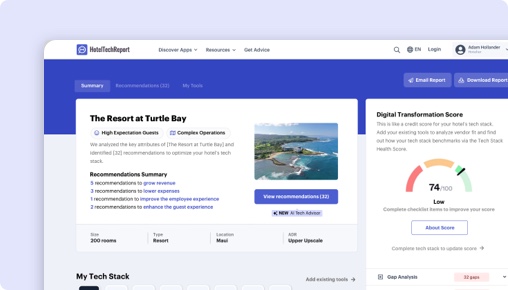
Désolé, cette fonctionnalité est réservée aux hôteliers vérifiés
Le tableau de bord des projets est un outil gratuit réservé aux hôteliers vérifiés. Il facilite l'adoption de nouvelles technologies en rationalisant leurs recherches et en simplifiant leurs échanges.

Demand Booster vs. hotjar:
Lequel vous convient le mieux ?
TLDR
Nous avons analysé 19 avis vérifiés d'hôteliers, comparé les fonctionnalités, les tarifs et des études de cas réelles pour identifier les points forts de chaque plateforme. Le bon choix dépend de votre type d'hôtel et de vos priorités :
RateGain se distingue sur ease of use and customer support , avec des fonctionnalités exclusives comme Meta search marketing and Metasearch connectivity.
hotjar se distingue .
Comment Demand Booster se compare-t-il à hotjar ?
Notes comparées basées sur 19 avis vérifiés d'hôteliers sur HTR.
| HTScore |
|
|
| Probabilité de recommandation |
|
|
| Facilité d'utilisation |
|
|
| Support client |
|
|
| Rapport qualité-prix |
|
|
| Prix de départ | Dès 1,000 $/mois | Contacter le service commercial |
| Avis vérifiés | 19 | 0 |
RateGain vs hotjar : Classement par segment hôtelier
Comment chaque produit se classe parmi les fournisseurs Logiciel de gestion de métarecherche hôtelière pour différentes tailles d'établissement, types et régions — basé sur les avis vérifiés d'hôteliers dans chaque segment.
Par taille d'hôtel
| Segment |
RateGain
|
hotjar |
|---|---|---|
| Petit (10-24 chambres) | #6 4 avis | — |
| Moyen (25-74 chambres) ▾ | #8 10 avis | — |
| Grand (75-199 chambres) ▾ | #6 4 avis | — |
| Très grand (200+ chambres) | #8 0 avis | — |
Par type d'hôtel
| Segment |
RateGain
|
hotjar |
|---|---|---|
| Boutique ▾ | #7 9 avis | — |
| Luxe ▾ | #7 8 avis | — |
| Enseigne / Chaîne ▾ | #8 6 avis | — |
| Séjour prolongé | #5 1 avis | — |
Par région
| Segment |
RateGain
|
hotjar |
|---|---|---|
| Amérique du Nord | #14 0 avis | — |
| Europe ▾ | #8 13 avis | — |
| Asie-Pacifique ▾ | #2 5 avis | — |
| Moyen-Orient | #1 1 avis | — |
The Decision
Choosing between Demand Booster by RateGain and Hotjar hinges on your hotel’s core needs. RateGain’s Demand Booster offers a targeted, data-driven approach to increasing direct bookings and optimizing distribution channels. Hotjar, in contrast, focuses on understanding visitor behavior to improve website engagement but doesn’t directly influence bookings or distribution. Which solution aligns better with your current priorities: revenue growth or website optimization?
RateGain’s Demand Booster is designed to actively boost revenue through sophisticated metasearch marketing and distribution management. Hotjar provides insights into user behavior, helping improve website engagement but not directly impacting your bottom line. Are you looking to increase revenue or refine user experience?
Is Demand Booster or Hotjar Better for Hotels?
Demand Booster is tailored for hotels seeking to grow direct revenue by managing metasearch campaigns, connecting to over 95 partners, and harnessing first-party travel intent data. It’s a comprehensive platform that combines digital marketing and distribution, with features like meta search surveillance and a marketing dashboard. Hotjar, with no verified integrations or reviews, primarily offers heatmaps, session recordings, and feedback collection—tools to analyze visitor behavior but not designed for revenue generation.
Demand Booster’s recent reviews highlight a 4.93/5 overall rating, with 19 reviews in the last six months, emphasizing its relevance and user satisfaction. Hotjar, on the other hand, has no recent reviews or ratings, making its current effectiveness uncertain. Does your hotel need proven revenue tools or behavioral insights to improve website engagement?
Demand Booster’s focus on hotel-specific distribution and marketing strategies makes it a more immediate asset for revenue growth. Hotjar’s insights are valuable for website optimization but do not directly translate into increased bookings. Which of these objectives is your current priority?
Demand Booster vs Hotjar: Which Should Your Hotel Choose?
If your hotel needs to increase direct bookings and optimize distribution channels, Demand Booster is the clear choice. Its features—metasearch marketing, connectivity, and a proven track record with over 300 brands—make it the more effective tool for revenue-related goals. Its recent reviews praise its contribution to raising direct bookings by at least 30%, backed by a 4.92/5 user rating.
If your team’s focus is understanding website visitor behavior to improve user experience, Hotjar might seem appealing. However, with no verified integrations, no recent reviews, and an absence of hotel industry-specific features, it lacks the hotel-centric focus Demand Booster offers. For tangible revenue results, Demand Booster is the definitive pick.
Is Demand Booster or Hotjar Easier to Use?
Demand Booster’s user rating of 4.71/5 reflects its intuitive interface, seamless integration with existing hotel systems, and straightforward onboarding process. User reviews mention efficient setup, friendly support, and clear reporting that helps your team act quickly. Hotjar, with no reviews or ratings, provides basic tools like heatmaps and session recordings, which are generally easy to understand but lack the hotel-specific polish.
Edge: Demand Booster. Its proven, hotel-focused interface and the presence of dedicated support make onboarding and daily use more straightforward for your team.
Which Has Better Features: Demand Booster or Hotjar?
Demand Booster offers six unique features tailored for hotels: meta search marketing, metasearch connectivity, metasearch surveillance, marketing dashboards, e-commerce consulting, and distribution automation. These tools directly support revenue growth and channel management. Hotjar, with no verified features beyond basic website analytics, lacks hotel-specific functions and lacks integration with distribution platforms.
Demand Booster’s features are designed to drive direct revenue, reduce reliance on OTAs, and provide actionable demand intelligence. Hotjar’s capabilities are limited to understanding visitor behavior, without tools for channel or revenue management. The edge goes to Demand Booster for hotel-specific features that impact your revenue.
Which Has Better Customer Support: Demand Booster or Hotjar?
RateGain’s Demand Booster boasts a support rating of 4.92/5, with recent reviews praising prompt, friendly, and professional assistance. Customers highlight proactive consultations, detailed reporting, and ongoing strategic advice, all critical for hotel teams seeking reliable support. Hotjar, with no recent reviews or explicit support ratings, offers a basic level of user assistance that’s not tailored to hotel operations.
Edge: Demand Booster. Its strong support reputation ensures your team can implement and optimize the platform effectively, minimizing downtime and maximizing results.
Which Has More Integrations: Demand Booster or Hotjar?
Demand Booster integrates with over 95 verified partners, including major hospitality software like RoomRaccoon, Profitroom, and Fairmas, as well as OTAs, booking engines, and distribution systems. These integrations streamline your operations and enhance distribution efficiency. Hotjar, lacking verified integrations, functions as a standalone website analytics tool without deep hotel industry connections.
Demand Booster’s extensive integration network makes it more adaptable to your existing hotel tech stack. Hotjar’s limited scope means it cannot support complex distribution or marketing workflows. Edge: Demand Booster.
Which Do Hoteliers Rate Higher: Demand Booster or Hotjar?
Demand Booster’s recent reviews showcase a 4.93/5 rating from 19 reviewers over the last six months, primarily from hotel and hospitality professionals. Hotels of various sizes, from boutique to branded, report significant improvements in direct bookings, with a 97% likelihood to recommend. Hotjar has no recent reviews or ratings, so its current hotel-specific reputation remains unknown.
Given the recent feedback, Demand Booster’s user satisfaction is evident and current. Hotjar’s lack of recent hotel-specific reviews leaves its effectiveness and hotel industry relevance questionable.
How Much Do Demand Booster and Hotjar Cost?
Demand Booster is priced with a base fee of $1,000 per month, with no mention of freemium options or setup fees. Its pricing model is straightforward, with no additional implementation costs or per-room charges. Hotjar’s pricing details are unavailable, which suggests it may operate on a custom or tiered model without transparent pricing for hotels.
For your hotel, Demand Booster’s clear and predictable pricing makes financial planning easier. The absence of pricing data for Hotjar limits its comparability and may indicate higher or less transparent costs.
What Type of Hotel Should Use Demand Booster?
- Hotels that want to significantly grow direct bookings through metasearch advertising and distribution management.
- Teams aiming to reduce dependence on OTAs and increase revenue contribution from direct channels.
- Hotels seeking a platform with over 95 integrations spanning booking engines, PMS, and distribution partners.
- Properties in need of actionable demand intelligence and real-time campaign insights.
- Hotels that prioritize data-driven marketing with clear ROI metrics.
Not ideal if your hotel primarily requires website visitor behavior insights without a focus on revenue or distribution management.
What Type of Hotel Should Use Hotjar?
- Hotels focusing solely on website usability and user experience improvements.
- Teams that want to visualize visitor engagement with heatmaps and session recordings.
- Hotels seeking direct feedback from website visitors via surveys and polls.
- Properties with a digital marketing team capable of translating behavioral insights into broader marketing strategies.
Not ideal if your goal is to directly increase bookings or optimize distribution channels. Hotjar’s lack of hotel-specific features limits its suitability for revenue-focused initiatives.
Demand Booster vs Hotjar: The Bottom Line for Hotels
Demand Booster is the clear choice for hotels prioritizing revenue growth through targeted distribution and metasearch marketing. Its extensive integrations, proven results, and hotel-specific features make it a robust platform for increasing direct bookings—a proven asset with a 4.93/5 rating and recent positive reviews.
Hotjar, with no recent hotel industry reviews and no verified integrations, offers insights into visitor behavior but does not support direct revenue initiatives. If your goal is to boost bookings and optimize your distribution channels, Demand Booster is the smarter, more proven investment.
For hotels aiming at direct revenue growth, Demand Booster’s comprehensive, hotel-centric tools provide the most tangible results. Hotjar is better suited for digital teams wanting to analyze website behavior but falls short of supporting revenue goals.
Summary:
Choose Demand Booster if increasing direct bookings is your top priority, leveraging its proven track record, extensive integrations, and hotel-specific features. Hotjar might help improve website experience, but it doesn’t directly impact your revenue or distribution strategies. Your hotel’s success depends on aligning your tools with your primary objectives—Demand Booster stands out as the more impactful choice for revenue-focused hotel teams.
Combien coûtent Demand Booster et hotjar ?
La tarification des Logiciel de gestion de métarecherche hôtelière est rarement simple. Voici ce que nous savons à partir des données tarifaires publiques de chaque fournisseur. Demandez toujours un devis personnalisé pour la taille de votre établissement.
|
RateGain
|
hotjar | |
|---|---|---|
| Prix de départ | Dès 1,000 $/mois | — |
Comparaison des fonctionnalités : Demand Booster vs hotjar
Voici les fonctionnalités configurées par chaque fournisseur, organisées par groupe de fonctionnalités — les mêmes données que dans le tableau de bord du fournisseur. Développez un groupe pour comparer les fonctionnalités côte à côte.
| Fonctionnalité |
RateGain
|
hotjar |
|---|---|---|
|
▾
Prestations de service
|
|
|
| Conseil en commerce électronique | ||
| Surveillance des méta-recherches | ||
| Connectivité de méta-recherche | ||
| Le marketing par méta-recherche | ||
|
▾
Rapports et analyses
|
|
|
| Tableau de bord marketing |
Résultats concrets : RateGain vs hotjar par objectif commercial
Nous avons analysé 1 études de cas vérifiées pour comparer ce que les hôtels obtiennent réellement avec chaque plateforme sur quatre objectifs commerciaux clés.
Safir Hotels & Resorts
Moyen
"The partnership with RateGain has been transformative for Safir Hotels & Resorts, yielding 4x growth in our revenue."

Aucune étude de cas publiée pour cet objectif pour le moment.
RateGain vs hotjar : Le verdict final
Fonctionnalités uniques
Où les notes divergent le plus
Questions fréquentes sur Demand Booster vs hotjar
Demand Booster peut-il remplacer hotjar ?
Cela dépend de vos besoins. Demand Booster et hotjar partagent de nombreuses fonctionnalités Hotel Metasearch Management Software de base, mais chacun a des capacités uniques. Demand Booster propose 96 partenaires d'intégration vérifiés, tandis que hotjar en propose 0. Consultez la comparaison des fonctionnalités ci-dessus pour voir les différences avant de changer.
Lequel est le mieux adapté aux petits hôtels ou hôtels indépendants ?
Les petits hôtels devraient privilégier la facilité d'utilisation et une prise en main rapide. Demand Booster est en tête pour la facilité d'utilisation avec 4.7/5 contre 0.0/5. Recherchez une tarification transparente et une option d'essai ou de démonstration. Filtrez les avis sur chaque page produit par taille d'établissement pour lire les retours d'hôtels similaires au vôtre.
Demand Booster ou hotjar proposent-ils une offre gratuite ?
Demand Booster : Non. hotjar : Non. Aucun des deux produits ne propose actuellement d'offre gratuite. La plupart des fournisseurs Hotel Metasearch Management Software proposent des démonstrations ou des essais — demandez-en un à chacun pour évaluer avant de vous engager.
Comment HTR évalue-t-il et classe-t-il Demand Booster et hotjar ?
Le HT Score est un classement composite qui prend en compte 4 groupes de critères et plus d'une douzaine de variables pour aider les hôteliers à comparer objectivement les produits technologiques hôteliers. RateGain a un HT Score de 0 et hotjar a 0. Voici comment le score est calculé.
| Groupe de critères | Pondération | Ce qu'il mesure |
|---|---|---|
| Notes et avis clients |
|
À quel point les utilisateurs recommandent-ils ce produit ? Score des notes, Volume d'avis, Part de voix, Profondeur des avis, Récence des avis, Cas de réussite ▾ Le facteur le plus fortement pondéré. Analyse les notes de satisfaction moyennes (probabilité de recommandation, facilité d'utilisation, support, ROI), le nombre total d'avis par rapport aux pairs de la catégorie, la récence des avis (au moins 20 avis sur les 6 derniers mois) et la part de voix parmi les clients hôteliers uniques pour détecter les biais de sélection. |
| Écosystème partenaire |
|
À quel point les partenaires technologiques recommandent-ils cette entreprise ? Recommandations des partenaires, Nombre d'intégrations, Qualité des intégrations ▾ Évalue les recommandations des partenaires comme des votes de confiance d'experts, le nombre d'intégrations vérifiées et la qualité de l'écosystème — la moyenne des HT Scores des partenaires d'intégration. Les produits avec des écosystèmes d'intégration de meilleure qualité sont plus susceptibles de fournir un stack technologique connecté. |
| Orientation client |
|
À quel point cette organisation est-elle orientée client ? Support certifié, Régularité des avis, Complétude du profil ▾ Évalue si l'entreprise a obtenu la certification HTR de support client, maintient une collecte d'avis régulière dans le temps (un indicateur de culture axée sur le feedback) et tient à jour les profils produits avec les fonctionnalités, captures d'écran, tarifs et caractéristiques. |
| Portée, pérennité et ressources |
|
Quelle est l'étendue de la portée et des ressources de cette entreprise ? Portée géographique, Pérennité, Ressources de l'entreprise, Score de tendance ▾ Mesure la présence mondiale (pays et régions desservis), les années d'activité comme indicateur de stabilité, les effectifs comme indicateur de ressources, et un score de tendance basé sur les demandes d'acheteurs, les avis, les recommandations de partenaires et l'activité presse des douze derniers mois. |
Les notes et avis clients sont de loin le facteur le plus important dans l'algorithme du HT Score. HTR n'accepte aucun paiement pour un meilleur classement. Tous les avis sont vérifiés — seuls les professionnels du secteur hôtelier avec des affiliations confirmées peuvent soumettre des notes. Voir la méthodologie complète du HT Score →
Quelles autres comparaisons Logiciel de gestion de métarecherche hôtelière les hôteliers consultent-ils ?
Explorez d'autres comparaisons directes basées sur les avis vérifiés d'hôteliers.




Sommaire
Obtenez votre rapport d'analyste IA gratuit
Recommandations personnalisées adaptées à votre établissement


Cherchons les informations sur votre hôtel
Vous hésitez encore sur vos options de logiciel de gestion de métarecherche hôtelière ?
Voici quelques systèmes populaires de notre guide sur logiciel de gestion de métarecherche hôtelière — ou laissez notre IA les noter un par un pour votre hôtel en deux minutes environ.


