

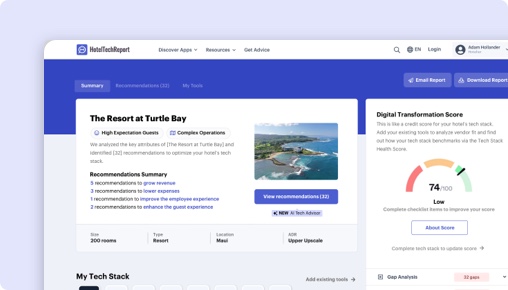
Désolé, cette fonctionnalité est réservée aux hôteliers vérifiés
Le tableau de bord des projets est un outil gratuit réservé aux hôteliers vérifiés. Il facilite l'adoption de nouvelles technologies en rationalisant leurs recherches et en simplifiant leurs échanges.

Dharma Operations Platform vs. Roommonitor:
Lequel vous convient le mieux ?


TLDR
Nous avons analysé 13 avis vérifiés d'hôteliers, comparé les fonctionnalités, les tarifs et des études de cas réelles pour identifier les points forts de chaque plateforme. Le bon choix dépend de votre type d'hôtel et de vos priorités :
Comment Dharma Operations Platform se compare-t-il à Roommonitor ?
Notes comparées basées sur 13 avis vérifiés d'hôteliers sur HTR.
| HTScore |
|
|
| Probabilité de recommandation |
|
|
| Facilité d'utilisation |
|
|
| Support client |
|
|
| Rapport qualité-prix |
|
|
| Prix de départ | Contacter le service commercial | Contacter le service commercial |
| Avis vérifiés | 13 | 0 |
Dharma vs Roomonitor : Classement par segment hôtelier
Comment chaque produit se classe parmi les fournisseurs Nettoyage et opérations pour différentes tailles d'établissement, types et régions — basé sur les avis vérifiés d'hôteliers dans chaque segment.
Par taille d'hôtel
| Segment |
Dharma
|
Roomonitor
|
|---|---|---|
| Petit (10-24 chambres) ▾ | #1 13 avis | — |
Par type d'hôtel
| Segment |
Dharma
|
Roomonitor
|
|---|---|---|
| Boutique ▾ | #1 10 avis | — |
| Luxe | #2 2 avis | — |
| Séjour prolongé | #1 3 avis | — |
Par région
| Segment |
Dharma
|
Roomonitor
|
|---|---|---|
| Amérique du Nord ▾ | #2 12 avis | — |
| Europe | #1 1 avis | — |
Is Dharma Operations Platform or Roomonitor Better for Hotels?
Dharma Operations Platform and Roomonitor target distinct operational needs in the hospitality sector. Dharma is a comprehensive operations platform focused on unifying communication, managing work orders, and centralizing property information. Its design serves vacation rentals and villas primarily, with 92% of users in that segment, and extended stays as a secondary market. Roomonitor specializes in real-time noise monitoring and energy efficiency through IoT devices, emphasizing environmental and social sustainability, primarily for short-term rentals.
Both solutions address operational challenges but from different angles: Dharma streamlines internal workflows and guest communication across multiple properties, while Roomonitor delivers data-driven insights to reduce noise disturbances and energy consumption. Hotels must choose based on whether their priority is cohesive operations management (Dharma) or environmental and neighbor-friendly monitoring (Roomonitor).
Dharma Operations Platform vs Roomonitor: Which Should Your Hotel Choose?
If your property portfolio consists mainly of vacation rentals or villas needing unified task and communication management, Dharma’s platform—with verified integrations like SiteMinder and a 4.9 overall rating from 13 reviews—fits best. This is especially true if your team is distributed or remote, as Dharma’s knowledge base and AI assistant support operational consistency. Hotels with extended-stay units also report strong satisfaction.
Conversely, if your focus is on reducing noise complaints and cutting energy usage by over 50%, and your property is a short-term rental concerned about social and environmental impacts, Roomonitor’s IoT-powered monitoring system aligns better. However, Roomonitor lacks verified reviews and published pricing, limiting confidence in current market fit and user experience. Hotels requiring concrete operational task management rather than monitoring may find Roomonitor’s offering insufficient.
Is Dharma Operations Platform or Roomonitor Easier to Use?
Dharma has an ease of use rating of 4.6/5 across 13 reviews, with users highlighting streamlined task coordination and intuitive access to property details. Reviewers note the platform helps their teams stay synchronized, even remotely, and that task management workflows are clear and accessible.
Roomonitor has no verified reviews on ease of use, making direct comparison impossible. Without user feedback, it's uncertain how intuitive its IoT device interfaces and analytics dashboards are for front desks or operations managers.
Given this, the edge on ease of use remains even, as Roomonitor’s lack of data prevents a definitive judgment.
Edge: Even.
Which Has Better Features: Dharma Operations Platform or Roomonitor?
Neither product shares features, and no evidence shows overlapping capabilities. Dharma’s feature set includes an AI assistant powered by a business data knowledge base, an issue management and work order system, unified messaging that consolidates communication across channels like WhatsApp and Booking.com, enhanced guest profiles, and housekeeping management. These features directly affect front desk and operations staff workflows by centralizing information and tasks, reducing the need for multiple apps or manual tracking.
Roomonitor’s features revolve around IoT-enabled real-time noise monitoring and smart algorithms for energy efficiency. This supports property managers and owners by delivering analytics to prevent noise disturbances and reduce energy consumption by over 50%, which can improve guest satisfaction indirectly and lower operational costs.
Since Dharma offers five explicit hotel-focused operational features not present in Roomonitor, and Roomonitor’s unique capabilities are environmental monitoring features absent in Dharma, the choice depends on operational priorities. However, as features tied to core hotel operations are broader in Dharma, it holds the feature advantage.
Edge: Dharma Operations Platform.
Which Has Better Customer Support: Dharma Operations Platform or Roomonitor?
Dharma earns a 4.9/5 in customer support and 4.7/5 in onboarding from 13 user reviews. Reviewers praise Dharma’s 24/7 support and AI chatbot that ensures guest inquiries receive prompt responses at any hour. Users describe support as efficient, responsive, and a key factor in staff adoption of the platform.
Roomonitor lacks any verified user reviews on support or onboarding, and no direct evidence is available regarding its service quality.
With substantial user feedback lauding Dharma’s support and no data on Roomonitor’s support, the edge goes to Dharma.
Edge: Dharma Operations Platform.
Which Has More Integrations: Dharma Operations Platform or Roomonitor?
Dharma has one verified integration partner: SiteMinder, a leading channel manager widely used in vacation rentals and hotel segments. This integration enables syncing availability and reservations, enhancing operational efficiency for properties managing multiple distribution channels.
Roomonitor has no verified integrations, limiting its ability to connect with other property management or booking systems.
Since Dharma offers at least one integration critical for multi-channel distribution, and Roomonitor offers none, Dharma holds the integration edge.
Edge: Dharma Operations Platform.
Which Do Hoteliers Rate Higher: Dharma Operations Platform or Roomonitor?
Dharma’s overall rating is 4.9/5 across 13 reviews. Ratings by segment show consistent satisfaction: Resorts (4.9/5, 12 reviews), Vacation Rentals & Villas (4.9/5, 12 reviews), Boutique Hotels (4.9/5, 10 reviews), Extended Stay & Serviced Apartments (5/5, 3 reviews), and Bed & Breakfast & Inns (5/5, 2 reviews). This broad coverage reflects applicability across property types, especially vacation rentals and resorts.
Roomonitor has no verified reviews, so no rating data exists to compare. This absence means its current market satisfaction and product quality are unquantified.
Given the volume and consistency of Dharma’s ratings versus the lack of data on Roomonitor, Dharma is rated higher by hoteliers.
Edge: Dharma Operations Platform.
How Much Do Dharma Operations Platform and Roomonitor Cost?
Neither Dharma nor Roomonitor publishes pricing details publicly. Both products lack freemium models, monthly flat fees, per-room pricing, implementation fees, or trial options. Without transparent pricing, hotels must contact vendors directly for quotes, which complicates budgeting and comparative cost analysis.
What Type of Hotel Should Use Dharma Operations Platform?
- Hotels that manage multiple vacation rental units or villas, benefiting from the platform’s unified operations and communication tools (92% of users).
- Teams with remote or distributed staff needing centralized access to property details and real-time task coordination.
- Properties requiring an integrated issue management and work order system to prioritize and track maintenance and guest service issues.
- Operations that value comprehensive guest profiles and unified messaging across channels like WhatsApp and OTAs for consistent guest communication.
- Hotels aiming to improve housekeeping scheduling and accountability through dedicated task management features.
Not ideal if:
- The property primarily requires IoT-based noise or energy monitoring solutions not covered by Dharma.
- Hotels preferring a platform with customizable reporting on work order data beyond current capabilities.
- Operations needing granular user-based feature configuration across all platform modules, which is currently limited according to reviews.
What Type of Hotel Should Use Roomonitor?
- Short-term rentals and small hotels focused on reducing noise complaints and improving relations with neighbors through real-time noise monitoring.
- Properties aiming to significantly decrease energy consumption (by more than 50%) via IoT-driven insights and smart algorithms.
- Hotels prioritizing social and environmental sustainability, leveraging analytics to demonstrate efficiency improvements.
- Owners and property managers seeking to monetize insights from real-time data on property usage and guest behavior.
Not ideal if:
- The property requires comprehensive operational task and communication management beyond monitoring and analytics.
- Hotels or teams needing verified user feedback or support assurances, since Roomonitor lacks public reviews.
- Operations that depend on integrations with channel managers or PMS platforms, as Roomonitor has no verified integrations.
Dharma Operations Platform vs Roomonitor: The Bottom Line for Hotels
Dharma Operations Platform and Roomonitor serve fundamentally different operational needs in hospitality. Dharma provides a unified operations system that streamlines guest communication, task management, and property data access, primarily benefiting vacation rentals and extended stay properties. Roomonitor delivers environmental monitoring through IoT devices with a focus on noise reduction and energy efficiency, especially suited for short-term rentals concerned with social and sustainability issues.
Choose Dharma Operations Platform if your hotel requires operational cohesion across teams and properties, with benefits including a verified SiteMinder integration for channel management and a 4.9 overall rating from 13 reviews praising its communication unification and AI-driven support. Its comprehensive issue management and housekeeping task features enhance daily workflows.
Choose Roomonitor if your priority is environmental stewardship and guest neighborhood relations, leveraging real-time noise monitoring and smart algorithms to reduce energy costs by over 50%. However, the absence of verified reviews and integrations means the product’s operational impact and support quality are less certain.
In summary, Dharma fits hotels seeking integrated operational management backed by positive user feedback, while Roomonitor targets properties needing IoT-based environmental control without public evidence of broader operational features or user satisfaction.
Combien coûtent Dharma Operations Platform et Roommonitor ?
La tarification des Nettoyage et opérations est rarement simple. Voici ce que nous savons à partir des données tarifaires publiques de chaque fournisseur. Demandez toujours un devis personnalisé pour la taille de votre établissement.
|
Dharma
|
Roomonitor
|
|---|
Dharma vs Roomonitor : Le verdict final
Questions fréquentes sur Dharma Operations Platform vs Roommonitor
Dharma Operations Platform peut-il remplacer Roommonitor ?
Cela dépend de vos besoins. Dharma Operations Platform et Roommonitor partagent de nombreuses fonctionnalités Cleaning & Operations de base, mais chacun a des capacités uniques. Dharma Operations Platform propose 1 partenaires d'intégration vérifiés, tandis que Roommonitor en propose 0. Consultez la comparaison des fonctionnalités ci-dessus pour voir les différences avant de changer.
Dharma Operations Platform ou Roommonitor proposent-ils une offre gratuite ?
Dharma Operations Platform : Non. Roommonitor : Non. Aucun des deux produits ne propose actuellement d'offre gratuite. La plupart des fournisseurs Cleaning & Operations proposent des démonstrations ou des essais — demandez-en un à chacun pour évaluer avant de vous engager.
Comment HTR évalue-t-il et classe-t-il Dharma Operations Platform et Roommonitor ?
Le HT Score est un classement composite qui prend en compte 4 groupes de critères et plus d'une douzaine de variables pour aider les hôteliers à comparer objectivement les produits technologiques hôteliers. Dharma a un HT Score de 0 et Roomonitor a 0. Voici comment le score est calculé.
| Groupe de critères | Pondération | Ce qu'il mesure |
|---|---|---|
| Notes et avis clients |
|
À quel point les utilisateurs recommandent-ils ce produit ? Score des notes, Volume d'avis, Part de voix, Profondeur des avis, Récence des avis, Cas de réussite ▾ Le facteur le plus fortement pondéré. Analyse les notes de satisfaction moyennes (probabilité de recommandation, facilité d'utilisation, support, ROI), le nombre total d'avis par rapport aux pairs de la catégorie, la récence des avis (au moins 20 avis sur les 6 derniers mois) et la part de voix parmi les clients hôteliers uniques pour détecter les biais de sélection. |
| Écosystème partenaire |
|
À quel point les partenaires technologiques recommandent-ils cette entreprise ? Recommandations des partenaires, Nombre d'intégrations, Qualité des intégrations ▾ Évalue les recommandations des partenaires comme des votes de confiance d'experts, le nombre d'intégrations vérifiées et la qualité de l'écosystème — la moyenne des HT Scores des partenaires d'intégration. Les produits avec des écosystèmes d'intégration de meilleure qualité sont plus susceptibles de fournir un stack technologique connecté. |
| Orientation client |
|
À quel point cette organisation est-elle orientée client ? Support certifié, Régularité des avis, Complétude du profil ▾ Évalue si l'entreprise a obtenu la certification HTR de support client, maintient une collecte d'avis régulière dans le temps (un indicateur de culture axée sur le feedback) et tient à jour les profils produits avec les fonctionnalités, captures d'écran, tarifs et caractéristiques. |
| Portée, pérennité et ressources |
|
Quelle est l'étendue de la portée et des ressources de cette entreprise ? Portée géographique, Pérennité, Ressources de l'entreprise, Score de tendance ▾ Mesure la présence mondiale (pays et régions desservis), les années d'activité comme indicateur de stabilité, les effectifs comme indicateur de ressources, et un score de tendance basé sur les demandes d'acheteurs, les avis, les recommandations de partenaires et l'activité presse des douze derniers mois. |
Les notes et avis clients sont de loin le facteur le plus important dans l'algorithme du HT Score. HTR n'accepte aucun paiement pour un meilleur classement. Tous les avis sont vérifiés — seuls les professionnels du secteur hôtelier avec des affiliations confirmées peuvent soumettre des notes. Voir la méthodologie complète du HT Score →
Sommaire
Obtenez votre rapport d'analyste IA gratuit
Recommandations personnalisées adaptées à votre établissement


