

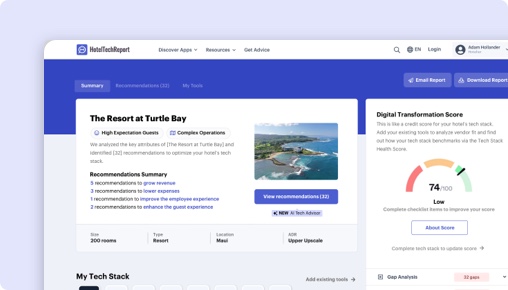
Spiacenti, questa funzionalità è disponibile solo per gli albergatori verificati
La dashboard dei progetti è uno strumento gratuito disponibile solo per gli albergatori verificati, che semplifica l'adozione di nuove tecnologie snellendo la ricerca e i flussi di comunicazione.

Demand Calendar vs. happyhotel:
Qual è Quello Giusto per Te?


TLDR
Abbiamo analizzato 222 recensioni verificate di albergatori, confrontato funzionalità, prezzi e casi studio reali per evidenziare dove ciascuna piattaforma eccelle. La scelta giusta dipende dal tipo di hotel e dalle tue priorità:
Demand Calendar AB si distingue per funzionalità esclusive come Market Insights Reporting.
happyhotel eccelle in supporto, onboarding e implementazione — soprattutto per le strutture in centro città (4,9/5), con funzionalità esclusive come Gestione delle entrate completamente automatizzata e Design ottimizzato per dispositivi mobili.
Come si Confronta Demand Calendar con happyhotel?
Valutazioni fianco a fianco basate su 222 recensioni verificate di albergatori su HTR.
| HTScore |
|
|
| Probabilità di Raccomandazione |
|
|
| Facilità d'Uso |
|
|
| Assistenza Clienti |
|
|
| Rapporto Qualità-Prezzo |
|
|
| Prezzo di Partenza | Da $600/mese | Da $500/mese |
| Recensioni Verificate | 7 | 215 |
Quali Sono i Pro e i Contro di Demand Calendar vs happyhotel?
Dopo aver analizzato 222 recensioni verificate, gli utenti di Demand Calendar AB apprezzano maggiormente , mentre gli utenti di happyhotel evidenziano supporto, onboarding e implementazione, reporting, dashboard e analisi, impatto sui ricavi e risparmio di tempo. Clicca su qualsiasi tema per vedere cosa dicono i recensori.
|
Demand Calendar AB
|
happyhotel
|
|---|---|
| Pro | |
|
+
Supporto, onboarding e implementazione
▾
|
|
|
+
Reporting, dashboard e analisi
▾
|
|
|
+
Impatto sui ricavi e risparmio di tempo
▾
|
|
|
+
Autopilota / tariffe automatizzate
▾
|
|
| Contro | |
Demand Calendar AB vs happyhotel: Classifiche per Segmento Alberghiero
Come si classifica ciascun prodotto tra i fornitori di Sistemi di gestione delle entrate per diverse dimensioni di struttura, tipologie di hotel e regioni — basato su recensioni verificate di albergatori in ogni segmento.
Per Dimensione Hotel
| Segmento |
Demand Calendar AB
|
happyhotel
|
|---|---|---|
| Piccolo (10-24 camere) ▾ | #39 2 recensioni | #4 98 recensioni |
| Medio (25-74 camere) ▾ | #34 5 recensioni | #7 83 recensioni |
| Grande (75-199 camere) ▾ | — | #11 11 recensioni |
| Extra-Grande (200+ camere) | — | #21 1 recensioni |
Per Tipo di Hotel
| Segmento |
Demand Calendar AB
|
happyhotel
|
|---|---|---|
| Boutique ▾ | #39 5 recensioni | #10 54 recensioni |
| Lusso ▾ | #40 2 recensioni | #16 26 recensioni |
| Brand / Catena ▾ | #37 2 recensioni | #7 33 recensioni |
| Soggiorno Prolungato ▾ | — | #7 23 recensioni |
Per Regione
| Segmento |
Demand Calendar AB
|
happyhotel
|
|---|---|---|
| Europa ▾ | #29 5 recensioni | #6 196 recensioni |
| Asia Pacifico | #13 2 recensioni | #25 1 recensioni |
Is Demand Calendar by Demand Calendar AB or happyhotel by happyhotel Better for Hotels?
Demand Calendar and happyhotel both address revenue management challenges but diverge significantly in scope and target users. Demand Calendar functions primarily as a hotel business intelligence tool, aggregating PMS, RMS, STR, and budget data to forecast total revenue and profit across rooms, F&B, meetings, and spa. It is tailored for hotel groups seeking strategic alignment across departments. In contrast, happyhotel is a cloud-based revenue management system focused on real-time dynamic pricing automation designed for hotels of all sizes, especially small to medium properties aiming to increase revenue through algorithm-driven price optimization.
Both tools solve the core problem of revenue predictability and pricing efficiency. Demand Calendar provides a consolidated forecast platform to identify budget risks and opportunities across multiple revenue streams, aiding operational coordination. happyhotel automates pricing decisions with autopilot features, competitor benchmarking, and demand signals, reducing manual intervention and improving rate agility. Hotels that want a holistic business intelligence view with manual pricing controls may lean towards Demand Calendar, while those prioritizing automated yield management and frequent rate updates will find happyhotel a more complete revenue management solution.
Demand Calendar vs happyhotel: Which Should Your Hotel Choose?
If you operate a multi-department or multi-property hotel group that requires consolidated forecasting across rooms, F&B, meetings, and spa, Demand Calendar’s integration of PMS, RMS, and market data offers a strategic advantage by aligning revenue, sales, marketing, and operations around one forecast. This insight fits properties with complex revenue streams and organizational layers, reflected in its user base with 44% boutique hotels and 14% branded hotels, predominantly in Europe and North America.
If your hotel is a small to medium-sized property or a chain seeking automated pricing to maximize occupancy and ADR, happyhotel’s dynamic pricing algorithms, autopilot function, and real-time market benchmarking provide superior operational value. Its extensive feature set (32 unique features) and integration with 25 verified partners including top PMS systems like Opera Cloud and protel support rapid adoption and ongoing revenue optimization. Review data from 215 hoteliers, including 50 recent reviews at 4.8/5, confirms its suitability for properties ranging from boutique hotels to luxury resorts.
Data for luxury hotels and boutique hotels is robust for both products, but happyhotel has broader segment coverage and more recent reviews. Demand Calendar’s limited review count (7 total, none recent) suggests its current market presence is narrower, making happyhotel the safer choice for broader hotel segments and chains requiring automated, scalable revenue management.
Is Demand Calendar or happyhotel Easier to Use?
Demand Calendar and happyhotel share nearly identical ease of use and onboarding scores: Demand Calendar with 4.7 and 4.3, happyhotel with 4.8 and 4.7 respectively. Reviewers of Demand Calendar appreciate its time-saving dashboards and centralized data views that simplify complex revenue work, though some note a slightly cluttered layout and occasional syncing issues with PMS Suite8. happyhotel users highlight its intuitive interface, rapid onboarding, and ease of use for non-revenue management specialists, enabling quick team adoption even during staff shortages.
Both products facilitate user adoption but happyhotel’s higher onboarding rating (4.7 vs 4.3) and numerous reviews praising friendly, responsive support during setup give it a modest operational edge for properties new to revenue management systems. Demand Calendar’s fewer reviews limit confidence in broad usability claims.
Edge: Even.
Which Has Better Features: Demand Calendar or happyhotel?
happyhotel offers 32 unique features not found in Demand Calendar, including dynamic pricing, fully automated revenue management, price sensitivity modeling, “what-if” scenario analysis, guided workflows, group pricing and evaluation, and AI optimization. These features enable real-time price optimization, bulk adjustments, and multi-month forward pricing (up to 24 months), directly reducing manual workload for revenue teams and increasing pricing agility. For example, happyhotel’s automated room-type pricing and controlled algorithm customization allow hoteliers to fine-tune pricing strategies without daily manual intervention, benefiting front desk and revenue managers by ensuring rates reflect current demand and market conditions.
Demand Calendar’s 4 unique features focus on business intelligence: future market demand data, lost business data, market insights reporting, and booking pattern analysis. These support strategic decision-making by revealing market trends and revenue leakage but do not automate pricing. This suits hotels needing comprehensive revenue forecasting across departments rather than dynamic pricing automation.
The extensive feature set of happyhotel translates into operational efficiency gains through automation and detailed analytics, while Demand Calendar provides broader revenue visibility without pricing automation. Given the scale and scope difference, happyhotel’s feature advantage is decisive for hotels wanting automated, dynamic revenue management.
Edge: happyhotel.
Which Has Better Customer Support: Demand Calendar or happyhotel?
Demand Calendar scores a perfect 5.0 for customer support, while happyhotel scores 4.8. Both products have onboarding ratings close to each other (4.3 vs 4.7). Demand Calendar reviewers emphasize prompt, easy communication and rapid responses to improvement suggestions, with one reviewer noting, “If you have any suggestion for improvement or any problems it is very easy to make contact and get a response.” happyhotel users commonly praise the personal, fast, and competent support that provides individualized responses instead of boilerplate answers, with some calling it “fantastic” and “excellent.” However, a minority report slower support responses and occasional technical issues with PMS integration.
With just 7 total reviews, Demand Calendar’s support ratings rest on less evidence compared to happyhotel’s 215 reviews, including 50 recent ones. The volume and recency of happyhotel’s positive feedback provide stronger operational assurance. Both vendors appear committed to support quality, but happyhotel’s scale and consistency make its support reliability more verifiable.
Edge: Even.
Which Has More Integrations: Demand Calendar or happyhotel?
Happyhotel leads with 25 verified integration partners versus Demand Calendar’s 5. Both share three common partners: Mews, Clock, and Oracle Hospitality. Demand Calendar integrates uniquely with IDeaS and HQ Revenue, focusing on revenue systems. Happyhotel’s broader partner list includes major PMS and channel managers like RoomRaccoon, apaleo GmbH, SiteMinder, protel, Access Hospitality, and others.
For hotels relying on a wide ecosystem of PMS and distribution software, happyhotel’s larger integration portfolio facilitates smoother data exchange, real-time rate updates, and reduced manual workload for front desk and revenue teams. Demand Calendar’s integrations emphasize BI data sources, aligning with its forecasting role but limiting operational connectivity.
Edge: happyhotel.
Which Do Hoteliers Rate Higher: Demand Calendar or happyhotel?
Both products share an identical overall rating of 4.8/5. However, happyhotel’s rating is based on 215 reviews with 50 in the last six months, while Demand Calendar’s 4.8 rating comes from only 7 reviews with no recent activity. happyhotel’s stable last-6-month rating of 4.8 confirms consistency in current performance, whereas Demand Calendar’s lack of recent reviews limits confidence in its present state.
By segment, Demand Calendar’s highest ratings come from small samples in boutique hotels (4.7 from 5 reviews), luxury hotels (5.0 from 2 reviews), and city center hotels (4.7 from 5 reviews). However, these counts are low. happyhotel maintains strong ratings across multiple hotel types with substantial review counts: boutique hotels (4.8/5, 58 reviews), branded hotels (4.8/5, 36), city center hotels (4.9/5, 56), airport/conference hotels (4.8/5, 70), and luxury hotels (4.9/5, 27). happyhotel also shows high ratings in limited service, hostels, resorts, and extended stay segments, reflecting broad acceptance.
The volume, recency, and segment diversity of happyhotel’s reviews give it a more reliable rating benchmark for buyers.
Edge: Even.
How Much Do Demand Calendar and happyhotel Cost?
Demand Calendar has a base price of $600.00 with no implementation fee or trial. happyhotel’s base price is $500.00, also without implementation fees or trials. Neither product publishes monthly flat or per-room pricing, and neither offers a freemium or free trial. This fixed base price model suggests a predictable upfront investment for both, with happyhotel being slightly more affordable by $100.
Without detailed pricing tiers or published volume discounts, cost comparisons rely on base price alone, where happyhotel offers a modest price advantage.
What Type of Hotel Should Use Demand Calendar?
- Hotels that operate multiple revenue streams (rooms, F&B, meetings, spa) and need consolidated forecasting to align revenue, sales, marketing, and operations within one view.
- Boutique and branded hotel groups with complex organizational structures requiring shared total revenue forecasts.
- Properties located in Europe, North America, or the Middle East where Demand Calendar has verified presence and partner integrations.
- Teams prioritizing business intelligence over automated pricing, focusing on strategic decision-making and market insights.
- Hotels currently using Suite8 PMS or Oracle Hospitality RMS, though with some reported integration limitations.
Not ideal if:
- You require automated, dynamic pricing adjustments or real-time rate optimization.
- You operate a small to medium hotel or chain seeking easy-to-use, hands-off revenue management.
- Seamless integration with a broad range of PMS and channel management systems is critical.
- You need frequent price updates and flexible rate controls for pricing agility.
- You depend on active vendor support and regular product updates, given Demand Calendar’s limited recent review activity.
What Type of Hotel Should Use happyhotel?
- Small to medium hotels and chains seeking automated revenue management with dynamic pricing algorithms.
- Hotels that value real-time price optimization, including forward pricing up to 24 months and bulk rate adjustments.
- Properties using popular PMS platforms like Opera Cloud, protel, apaleo, and RoomRaccoon benefiting from 25 verified integrations.
- Hotels requiring strong competitor benchmarking, event and holiday demand signals, and “what-if” scenario analysis.
- Teams that want fast onboarding, personal support, and a user-friendly interface for staff without extensive revenue management expertise.
Not ideal if:
- Your hotel requires deep business intelligence integration across multiple revenue streams beyond pricing.
- You operate in regions outside happyhotel’s primary European market presence.
- Advanced multi-property workflows and special group pricing controls are mission-critical but currently limited.
- You prefer a system focused primarily on strategic forecasting rather than operational pricing automation.
Demand Calendar vs happyhotel: The Bottom Line for Hotels
Demand Calendar and happyhotel serve distinctly different revenue management needs. Demand Calendar excels as a hotel business intelligence platform that aggregates multiple data sources to forecast total revenue and profit across rooms, F&B, meetings, and spa. It supports strategic alignment across hotel departments but does not automate pricing. happyhotel delivers a comprehensive, cloud-based revenue management system with advanced automation, dynamic pricing, and extensive integrations that streamline daily rate management and optimize hotel profitability.
Choose Demand Calendar if your property operates multiple revenue streams and requires consolidated forecasting and business intelligence to guide strategic decisions. Its unique features like lost business data and market insights reporting support this need. Choose happyhotel if you prioritize automated, real-time price optimization with AI-driven algorithms, autopilot pricing, and broad PMS/channel integrations that reduce manual tasks and increase revenue agility. happyhotel’s 215 reviews, including 50 recent ones at 4.8/5, demonstrate operational reliability and satisfaction across diverse hotel segments.
For most small to medium hotels and chains seeking scalable, data-driven revenue management with ease of use and automation, happyhotel represents the stronger choice. Demand Calendar suits hotel groups with complex forecasting needs who are prepared to manage pricing separately. The decision hinges on whether your hotel’s primary need is strategic revenue intelligence or automated pricing execution.
Quanto Costano Demand Calendar e happyhotel?
I prezzi di Sistemi di gestione delle entrate raramente sono semplici. Ecco cosa sappiamo dai dati pubblici sui prezzi di ciascun fornitore. Richiedi sempre un preventivo personalizzato per la dimensione della tua struttura.
|
Demand Calendar AB
|
happyhotel
|
|
|---|---|---|
| Prezzo di Partenza | Da $600/mese | Da $500/mese |
Confronto delle funzionalità: Demand Calendar vs happyhotel
Queste sono le funzionalità configurate da ciascun fornitore, organizzate per gruppo di funzionalità — gli stessi dati mostrati nella dashboard del fornitore. Espandi un gruppo per confrontare le funzionalità affiancate.
| Funzionalità |
Demand Calendar AB
|
happyhotel
|
|---|---|---|
|
▾
Ottimizzazione dei prezzi
|
|
|
| Spiegazione del prezzo | ||
| Linee guida per le imprese aziendali | ||
| Raccomandazioni su date di soggiorno alternative | ||
| Raccomandazioni di proprietà alternative | ||
| Ottimizzazione dei prezzi in tempo reale | ||
| Controllo dinamico della gerarchia dei prezzi | ||
| Prezzi aperti | ||
| Flussi di lavoro guidati | ||
| Analisi dello scenario "What-if" | ||
| Prezzi dinamici | ||
| Set Boundaries | ||
| Manage Exceptions | ||
| Group Pricing | ||
| Manage Restrictions | ||
| Manage Sell-Outs & Cancellations | ||
| Business Mix Optimization | ||
| Define Cycles | ||
| Yield Room Types Individually | ||
| Bulk Adjustments | ||
| Prezzi e previsioni a 24 mesi | ||
| Prezzi dei componenti/stanze virtuali | ||
| Prezzi per soggiorni prolungati | ||
| Prezzi di upsell | ||
| Tasso di ostacolo | ||
|
▾
Informazioni e previsioni di mercato
|
|
|
| Previsioni quinquennali | ||
| Prezzi a termine di 365 giorni | ||
| STR Data | ||
| 18-Month Forward Pricing | ||
| Modellazione della sensibilità al prezzo | ||
| Multi-Property Dashboard | ||
| Market Intelligence Data | ||
| Interactive Customizable Dashboards | ||
| Dati sulla domanda futura del mercato | ||
| Costruttore di previsioni finanziarie | ||
| Previsione di soggiorno prolungato | ||
| Previsione del canale | ||
| Spiegazione delle previsioni | ||
| Dati flessibili sui concorrenti | ||
|
▾
Dashboard e reportistica
|
|
|
| Rapporti personalizzati | ||
| Rapporti programmati | ||
| Dati aziendali persi | ||
| Dashboard di analisi | ||
| Interactive Customizable Dashboards | ||
| Market Insights Reporting | ||
| Pickup Analysis | ||
| Booking Pattern Analysis | ||
| Event Data | ||
| Price Change Logs | ||
| Customizable Notifications & Alerts | ||
| Displacement Analysis | ||
| Group Pricing & Evaluation | ||
| Multi-Property Dashboard | ||
| Misurazione dei benefici del sistema | ||
|
▾
Automazione
|
|
|
| Controlled Automation/Algorithm Customization | ||
| Prezzi automatizzati per tipo di camera | ||
| Gestione delle entrate completamente automatizzata | ||
| Prezzi dinamici | ||
| AI Optimization | ||
| Automatic Pricing Updates | ||
|
▾
Funzionalità multiproprietà
|
|
|
| Gestione delle scorte | ||
| Gestione multiproprietà | ||
| Multi-Property Dashboard | ||
|
▾
Affari di gruppo
|
|
|
| Group Pricing & Evaluation | ||
| Analisi dello scenario "What-if" | ||
| Displacement Analysis | ||
| Previsione e lavaggio del gruppo | ||
|
▾
Integrazioni
|
|
|
| Apri API | ||
| Gestione del canale | ||
| Business Intelligence | ||
| STR Data | ||
| Property Management System | ||
| Autenticazione multifattoriale | ||
|
▾
Other
|
|
|
| Prezzi e valutazione di gruppo | ||
| App per dispositivi mobili | ||
| Tecnologia di diffusione intelligente | ||
| Single Sign-On | ||
| Design ottimizzato per dispositivi mobili |
Risultati Reali: Demand Calendar AB vs happyhotel per Obiettivo di Business
Abbiamo analizzato 4 casi studio verificati per confrontare cosa gli hotel ottengono realmente con ciascuna piattaforma su quattro obiettivi di business chiave.
Demand Calendar AB
Nessun caso studio ancora pubblicato per questo obiettivo.
Natur- & Wellnesshotels Brunner Hof 4****S (45 rooms, luxury resort, Germany)
Piccolo
"Before happyhotel, we handled prices manually and tracked everything in Excel. Now we have all key metrics in one place and save a lot of time every day."
 Demand Calendar AB
Nessun caso studio ancora pubblicato per questo obiettivo.
Hotel Öschberghof (127 rooms, luxury resort, Germany)
Piccolo
"Before we started using happyhotel, I manually entered prices into our PMS using self-made Excel sheets. We didn’t have a flexible pricing system and worked with seasonal tables, o..."

Demand Calendar AB vs happyhotel: Il Verdetto Finale
Classificato più in alto per
Funzionalità uniche
Cosa amano gli albergatori
Il supporto è un tema positivo importante: i recensori descrivono ripetutamente l'onboarding come personale, rapido, competente e orientato alla soluz... Il supporto è un tema positivo importante: i recensori descrivono ripetutamente l'onboarding come personale, rapido, competente e orientato alla soluzione. Questo è rilevante perché il prodotto viene spesso adottato da team nuovi a RMS, e una buona implementazione riduce il tempo per ottenere il valore. Le principali critiche riguardano risposte più lente in alcuni casi, la necessità di formazione aggiuntiva per configurazioni complesse e il desiderio di una guida migliore durante la migrazione o la configurazione tecnica.
Gli utenti apprezzano ripetutamente i dashboard chiari, i grafici personalizzabili e l'accesso rapido a KPI, previsioni, RevPAR, ADR, occupazione e pi... Gli utenti apprezzano ripetutamente i dashboard chiari, i grafici personalizzabili e l'accesso rapido a KPI, previsioni, RevPAR, ADR, occupazione e pickup. Happyhotel è considerato particolarmente utile per trasformare dati complessi dell'hotel in decisioni quotidiane pratiche. Le richieste di miglioramento spesso menzionano filtri più flessibili, confronti più approfonditi, analisi STLY più accurate e una navigazione dei report più intuitiva.
Un tema ricorrente è che Happyhotel permette di risparmiare tempo al personale aumentando ADR, occupazione e ricavi complessivi. I recensori lo descri... Un tema ricorrente è che Happyhotel permette di risparmiare tempo al personale aumentando ADR, occupazione e ricavi complessivi. I recensori lo descrivono spesso come uno strumento pratico per le aziende, che consente a team ridotti di competere più efficacemente e di concentrarsi su altre attività. Diversi segnalano miglioramenti misurabili, mentre un gruppo più piccolo afferma che i risultati dipendono dalla qualità dell’implementazione o che i benefici si sono manifestati nel tempo.
Classificato più in alto per
Funzionalità uniche
Domande Frequenti su Demand Calendar vs happyhotel
Demand Calendar può sostituire happyhotel?
Dipende dalle tue esigenze. Demand Calendar e happyhotel condividono molte funzionalità di base di Revenue Management Systems, ma ciascuno ha capacità uniche. Demand Calendar offre 5 partner di integrazione verificati, mentre happyhotel ne offre 25. Consulta il confronto delle funzionalità sopra per vedere dove differiscono prima di cambiare.
Qual è migliore per hotel piccoli o indipendenti?
Gli hotel piccoli dovrebbero dare priorità alla facilità d'uso e a un onboarding rapido. happyhotel è in testa per facilità d'uso con 4,8/5 vs 4,7/5. Cerca prezzi trasparenti e un'opzione di prova o demo. Filtra le recensioni su ogni pagina prodotto per dimensione della struttura per sentire le opinioni di hotel simili al tuo.
Demand Calendar o happyhotel offrono un piano gratuito?
Demand Calendar: No. happyhotel: No. Nessuno dei due prodotti offre attualmente un livello gratuito. La maggior parte dei fornitori di Revenue Management Systems offre demo o prove gratuite — richiedine una a ciascuno per valutare prima di impegnarti.
Come Valuta e Classifica HTR Demand Calendar e happyhotel?
L'HT Score è una classifica composita che considera 4 gruppi di criteri e oltre una dozzina di variabili per aiutare gli albergatori a confrontare oggettivamente i prodotti tecnologici per hotel. Demand Calendar AB ha un HT Score di 0 e happyhotel ha 95. Ecco come viene calcolato il punteggio.
| Gruppo di Criteri | Peso | Cosa Misura |
|---|---|---|
| Valutazioni e Recensioni dei Clienti |
|
Quanto raccomandano gli utenti questo prodotto? Punteggio Valutazioni, Volume Recensioni, Quota di Voce, Profondità Recensioni, Recenza Recensioni, Storie di Successo ▾ Il fattore con il peso maggiore. Analizza le valutazioni medie di soddisfazione (probabilità di raccomandazione, facilità d'uso, assistenza, ROI), il numero totale di recensioni rispetto ai concorrenti nella categoria, la recenza delle recensioni (almeno 20 recensioni negli ultimi 6 mesi) e la quota di voce tra clienti hotel unici per rilevare bias di selezione. |
| Ecosistema dei Partner |
|
Quanto raccomandano i partner tecnologici questa azienda? Raccomandazioni dei Partner, Quantità Integrazioni, Qualità Integrazioni ▾ Valuta le raccomandazioni dei partner come voti di fiducia degli esperti, il numero di integrazioni verificate e la qualità dell'ecosistema — la media degli HT Score dei partner di integrazione. I prodotti con ecosistemi di integrazione di qualità superiore hanno maggiori probabilità di offrire uno stack tecnologico connesso. |
| Centralità del Cliente |
|
Quanto è orientata al cliente questa organizzazione? Assistenza Certificata, Coerenza delle Recensioni, Completezza del Profilo ▾ Valuta se l'azienda ha ottenuto la Certificazione di Assistenza Clienti HTR, mantiene una raccolta di recensioni costante nel tempo (un indicatore di cultura orientata al feedback) e mantiene i profili prodotto completi con funzionalità, screenshot, prezzi e caratteristiche. |
| Portata, Solidità e Risorse |
|
Quanto sono estese la portata e le risorse di questa azienda? Portata Geografica, Solidità nel Tempo, Risorse Aziendali, Punteggio di Tendenza ▾ Misura la presenza globale (paesi e regioni servite), gli anni di attività come indicatore di stabilità, il numero di dipendenti come indicatore di risorse e un punteggio di tendenza basato su richieste degli acquirenti, recensioni, raccomandazioni dei partner e attività stampa degli ultimi dodici mesi. |
Le valutazioni e le recensioni dei clienti sono di gran lunga il fattore più importante nell'algoritmo dell'HT Score. HTR non accetta pagamenti per classifiche più alte. Tutte le recensioni sono verificate — solo i professionisti del settore alberghiero con affiliazioni confermate possono inviare valutazioni. Visualizza la metodologia completa dell'HT Score →
Quali Altri Confronti di Sistemi di gestione delle entrate Stanno Leggendo gli Albergatori?
Esplora altri confronti diretti basati su recensioni verificate di albergatori.





Ottieni il tuo report gratuito di analisi AI
Consigli personalizzati su misura per la tua struttura


Cerchiamo le informazioni sul tuo hotel
Stai ancora valutando le tue opzioni di sistemi di gestione delle entrate?
Alcuni sistemi popolari dalla nostra guida su sistemi di gestione delle entrate — oppure lascia che la nostra IA valuti ciascuno di essi in base alla tua struttura in circa due minuti.


