

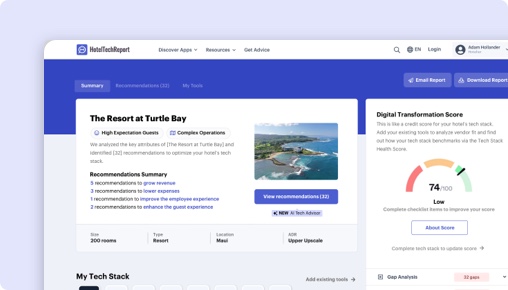
Désolé, cette fonctionnalité est réservée aux hôteliers vérifiés
Le tableau de bord des projets est un outil gratuit réservé aux hôteliers vérifiés. Il facilite l'adoption de nouvelles technologies en rationalisant leurs recherches et en simplifiant leurs échanges.

Demand Calendar vs. happyhotel:
Lequel vous convient le mieux ?


TLDR
Nous avons analysé 222 avis vérifiés d'hôteliers, comparé les fonctionnalités, les tarifs et des études de cas réelles pour identifier les points forts de chaque plateforme. Le bon choix dépend de votre type d'hôtel et de vos priorités :
Demand Calendar AB se distingue par des fonctionnalités exclusives comme Market Insights Reporting.
happyhotel excelle en support, onboarding et mise en œuvre — en particulier pour les établissements de centre-ville (4,9/5), avec des fonctionnalités exclusives comme Gestion des revenus entièrement automatisée et Conception adaptée aux mobiles.
Comment Demand Calendar se compare-t-il à happyhotel ?
Notes comparées basées sur 222 avis vérifiés d'hôteliers sur HTR.
| HTScore |
|
|
| Probabilité de recommandation |
|
|
| Facilité d'utilisation |
|
|
| Support client |
|
|
| Rapport qualité-prix |
|
|
| Prix de départ | Dès 600 $/mois | Dès 500 $/mois |
| Avis vérifiés | 7 | 215 |
Quels sont les avantages et inconvénients de Demand Calendar vs happyhotel ?
Après analyse de 222 avis vérifiés, les utilisateurs de Demand Calendar AB apprécient surtout , tandis que ceux de happyhotel mettent en avant support, onboarding et mise en œuvre, rapports, tableaux de bord et analyses, impact sur le chiffre d'affaires et gains de temps. Cliquez sur un thème pour voir ce que disent les évaluateurs.
|
Demand Calendar AB
|
happyhotel
|
|---|---|
| Avantages | |
|
+
Support, onboarding et mise en œuvre
▾
|
|
|
+
Rapports, tableaux de bord et analyses
▾
|
|
|
+
Impact sur le chiffre d'affaires et gains de temps
▾
|
|
|
+
Pilote automatique / tarification automatisée
▾
|
|
| Inconvénients | |
Demand Calendar AB vs happyhotel : Classement par segment hôtelier
Comment chaque produit se classe parmi les fournisseurs Systèmes de gestion des revenus pour différentes tailles d'établissement, types et régions — basé sur les avis vérifiés d'hôteliers dans chaque segment.
Par taille d'hôtel
| Segment |
Demand Calendar AB
|
happyhotel
|
|---|---|---|
| Petit (10-24 chambres) ▾ | #39 2 avis | #4 98 avis |
| Moyen (25-74 chambres) ▾ | #34 5 avis | #7 83 avis |
| Grand (75-199 chambres) ▾ | — | #11 11 avis |
| Très grand (200+ chambres) | — | #21 1 avis |
Par type d'hôtel
| Segment |
Demand Calendar AB
|
happyhotel
|
|---|---|---|
| Boutique ▾ | #39 5 avis | #10 54 avis |
| Luxe ▾ | #40 2 avis | #16 26 avis |
| Enseigne / Chaîne ▾ | #37 2 avis | #7 33 avis |
| Séjour prolongé ▾ | — | #7 23 avis |
Par région
| Segment |
Demand Calendar AB
|
happyhotel
|
|---|---|---|
| Europe ▾ | #29 5 avis | #6 196 avis |
| Asie-Pacifique | #13 2 avis | #25 1 avis |
Is Demand Calendar by Demand Calendar AB or happyhotel by happyhotel Better for Hotels?
Demand Calendar and happyhotel both address revenue management challenges but diverge significantly in scope and target users. Demand Calendar functions primarily as a hotel business intelligence tool, aggregating PMS, RMS, STR, and budget data to forecast total revenue and profit across rooms, F&B, meetings, and spa. It is tailored for hotel groups seeking strategic alignment across departments. In contrast, happyhotel is a cloud-based revenue management system focused on real-time dynamic pricing automation designed for hotels of all sizes, especially small to medium properties aiming to increase revenue through algorithm-driven price optimization.
Both tools solve the core problem of revenue predictability and pricing efficiency. Demand Calendar provides a consolidated forecast platform to identify budget risks and opportunities across multiple revenue streams, aiding operational coordination. happyhotel automates pricing decisions with autopilot features, competitor benchmarking, and demand signals, reducing manual intervention and improving rate agility. Hotels that want a holistic business intelligence view with manual pricing controls may lean towards Demand Calendar, while those prioritizing automated yield management and frequent rate updates will find happyhotel a more complete revenue management solution.
Demand Calendar vs happyhotel: Which Should Your Hotel Choose?
If you operate a multi-department or multi-property hotel group that requires consolidated forecasting across rooms, F&B, meetings, and spa, Demand Calendar’s integration of PMS, RMS, and market data offers a strategic advantage by aligning revenue, sales, marketing, and operations around one forecast. This insight fits properties with complex revenue streams and organizational layers, reflected in its user base with 44% boutique hotels and 14% branded hotels, predominantly in Europe and North America.
If your hotel is a small to medium-sized property or a chain seeking automated pricing to maximize occupancy and ADR, happyhotel’s dynamic pricing algorithms, autopilot function, and real-time market benchmarking provide superior operational value. Its extensive feature set (32 unique features) and integration with 25 verified partners including top PMS systems like Opera Cloud and protel support rapid adoption and ongoing revenue optimization. Review data from 215 hoteliers, including 50 recent reviews at 4.8/5, confirms its suitability for properties ranging from boutique hotels to luxury resorts.
Data for luxury hotels and boutique hotels is robust for both products, but happyhotel has broader segment coverage and more recent reviews. Demand Calendar’s limited review count (7 total, none recent) suggests its current market presence is narrower, making happyhotel the safer choice for broader hotel segments and chains requiring automated, scalable revenue management.
Is Demand Calendar or happyhotel Easier to Use?
Demand Calendar and happyhotel share nearly identical ease of use and onboarding scores: Demand Calendar with 4.7 and 4.3, happyhotel with 4.8 and 4.7 respectively. Reviewers of Demand Calendar appreciate its time-saving dashboards and centralized data views that simplify complex revenue work, though some note a slightly cluttered layout and occasional syncing issues with PMS Suite8. happyhotel users highlight its intuitive interface, rapid onboarding, and ease of use for non-revenue management specialists, enabling quick team adoption even during staff shortages.
Both products facilitate user adoption but happyhotel’s higher onboarding rating (4.7 vs 4.3) and numerous reviews praising friendly, responsive support during setup give it a modest operational edge for properties new to revenue management systems. Demand Calendar’s fewer reviews limit confidence in broad usability claims.
Edge: Even.
Which Has Better Features: Demand Calendar or happyhotel?
happyhotel offers 32 unique features not found in Demand Calendar, including dynamic pricing, fully automated revenue management, price sensitivity modeling, “what-if” scenario analysis, guided workflows, group pricing and evaluation, and AI optimization. These features enable real-time price optimization, bulk adjustments, and multi-month forward pricing (up to 24 months), directly reducing manual workload for revenue teams and increasing pricing agility. For example, happyhotel’s automated room-type pricing and controlled algorithm customization allow hoteliers to fine-tune pricing strategies without daily manual intervention, benefiting front desk and revenue managers by ensuring rates reflect current demand and market conditions.
Demand Calendar’s 4 unique features focus on business intelligence: future market demand data, lost business data, market insights reporting, and booking pattern analysis. These support strategic decision-making by revealing market trends and revenue leakage but do not automate pricing. This suits hotels needing comprehensive revenue forecasting across departments rather than dynamic pricing automation.
The extensive feature set of happyhotel translates into operational efficiency gains through automation and detailed analytics, while Demand Calendar provides broader revenue visibility without pricing automation. Given the scale and scope difference, happyhotel’s feature advantage is decisive for hotels wanting automated, dynamic revenue management.
Edge: happyhotel.
Which Has Better Customer Support: Demand Calendar or happyhotel?
Demand Calendar scores a perfect 5.0 for customer support, while happyhotel scores 4.8. Both products have onboarding ratings close to each other (4.3 vs 4.7). Demand Calendar reviewers emphasize prompt, easy communication and rapid responses to improvement suggestions, with one reviewer noting, “If you have any suggestion for improvement or any problems it is very easy to make contact and get a response.” happyhotel users commonly praise the personal, fast, and competent support that provides individualized responses instead of boilerplate answers, with some calling it “fantastic” and “excellent.” However, a minority report slower support responses and occasional technical issues with PMS integration.
With just 7 total reviews, Demand Calendar’s support ratings rest on less evidence compared to happyhotel’s 215 reviews, including 50 recent ones. The volume and recency of happyhotel’s positive feedback provide stronger operational assurance. Both vendors appear committed to support quality, but happyhotel’s scale and consistency make its support reliability more verifiable.
Edge: Even.
Which Has More Integrations: Demand Calendar or happyhotel?
Happyhotel leads with 25 verified integration partners versus Demand Calendar’s 5. Both share three common partners: Mews, Clock, and Oracle Hospitality. Demand Calendar integrates uniquely with IDeaS and HQ Revenue, focusing on revenue systems. Happyhotel’s broader partner list includes major PMS and channel managers like RoomRaccoon, apaleo GmbH, SiteMinder, protel, Access Hospitality, and others.
For hotels relying on a wide ecosystem of PMS and distribution software, happyhotel’s larger integration portfolio facilitates smoother data exchange, real-time rate updates, and reduced manual workload for front desk and revenue teams. Demand Calendar’s integrations emphasize BI data sources, aligning with its forecasting role but limiting operational connectivity.
Edge: happyhotel.
Which Do Hoteliers Rate Higher: Demand Calendar or happyhotel?
Both products share an identical overall rating of 4.8/5. However, happyhotel’s rating is based on 215 reviews with 50 in the last six months, while Demand Calendar’s 4.8 rating comes from only 7 reviews with no recent activity. happyhotel’s stable last-6-month rating of 4.8 confirms consistency in current performance, whereas Demand Calendar’s lack of recent reviews limits confidence in its present state.
By segment, Demand Calendar’s highest ratings come from small samples in boutique hotels (4.7 from 5 reviews), luxury hotels (5.0 from 2 reviews), and city center hotels (4.7 from 5 reviews). However, these counts are low. happyhotel maintains strong ratings across multiple hotel types with substantial review counts: boutique hotels (4.8/5, 58 reviews), branded hotels (4.8/5, 36), city center hotels (4.9/5, 56), airport/conference hotels (4.8/5, 70), and luxury hotels (4.9/5, 27). happyhotel also shows high ratings in limited service, hostels, resorts, and extended stay segments, reflecting broad acceptance.
The volume, recency, and segment diversity of happyhotel’s reviews give it a more reliable rating benchmark for buyers.
Edge: Even.
How Much Do Demand Calendar and happyhotel Cost?
Demand Calendar has a base price of $600.00 with no implementation fee or trial. happyhotel’s base price is $500.00, also without implementation fees or trials. Neither product publishes monthly flat or per-room pricing, and neither offers a freemium or free trial. This fixed base price model suggests a predictable upfront investment for both, with happyhotel being slightly more affordable by $100.
Without detailed pricing tiers or published volume discounts, cost comparisons rely on base price alone, where happyhotel offers a modest price advantage.
What Type of Hotel Should Use Demand Calendar?
- Hotels that operate multiple revenue streams (rooms, F&B, meetings, spa) and need consolidated forecasting to align revenue, sales, marketing, and operations within one view.
- Boutique and branded hotel groups with complex organizational structures requiring shared total revenue forecasts.
- Properties located in Europe, North America, or the Middle East where Demand Calendar has verified presence and partner integrations.
- Teams prioritizing business intelligence over automated pricing, focusing on strategic decision-making and market insights.
- Hotels currently using Suite8 PMS or Oracle Hospitality RMS, though with some reported integration limitations.
Not ideal if:
- You require automated, dynamic pricing adjustments or real-time rate optimization.
- You operate a small to medium hotel or chain seeking easy-to-use, hands-off revenue management.
- Seamless integration with a broad range of PMS and channel management systems is critical.
- You need frequent price updates and flexible rate controls for pricing agility.
- You depend on active vendor support and regular product updates, given Demand Calendar’s limited recent review activity.
What Type of Hotel Should Use happyhotel?
- Small to medium hotels and chains seeking automated revenue management with dynamic pricing algorithms.
- Hotels that value real-time price optimization, including forward pricing up to 24 months and bulk rate adjustments.
- Properties using popular PMS platforms like Opera Cloud, protel, apaleo, and RoomRaccoon benefiting from 25 verified integrations.
- Hotels requiring strong competitor benchmarking, event and holiday demand signals, and “what-if” scenario analysis.
- Teams that want fast onboarding, personal support, and a user-friendly interface for staff without extensive revenue management expertise.
Not ideal if:
- Your hotel requires deep business intelligence integration across multiple revenue streams beyond pricing.
- You operate in regions outside happyhotel’s primary European market presence.
- Advanced multi-property workflows and special group pricing controls are mission-critical but currently limited.
- You prefer a system focused primarily on strategic forecasting rather than operational pricing automation.
Demand Calendar vs happyhotel: The Bottom Line for Hotels
Demand Calendar and happyhotel serve distinctly different revenue management needs. Demand Calendar excels as a hotel business intelligence platform that aggregates multiple data sources to forecast total revenue and profit across rooms, F&B, meetings, and spa. It supports strategic alignment across hotel departments but does not automate pricing. happyhotel delivers a comprehensive, cloud-based revenue management system with advanced automation, dynamic pricing, and extensive integrations that streamline daily rate management and optimize hotel profitability.
Choose Demand Calendar if your property operates multiple revenue streams and requires consolidated forecasting and business intelligence to guide strategic decisions. Its unique features like lost business data and market insights reporting support this need. Choose happyhotel if you prioritize automated, real-time price optimization with AI-driven algorithms, autopilot pricing, and broad PMS/channel integrations that reduce manual tasks and increase revenue agility. happyhotel’s 215 reviews, including 50 recent ones at 4.8/5, demonstrate operational reliability and satisfaction across diverse hotel segments.
For most small to medium hotels and chains seeking scalable, data-driven revenue management with ease of use and automation, happyhotel represents the stronger choice. Demand Calendar suits hotel groups with complex forecasting needs who are prepared to manage pricing separately. The decision hinges on whether your hotel’s primary need is strategic revenue intelligence or automated pricing execution.
Combien coûtent Demand Calendar et happyhotel ?
La tarification des Systèmes de gestion des revenus est rarement simple. Voici ce que nous savons à partir des données tarifaires publiques de chaque fournisseur. Demandez toujours un devis personnalisé pour la taille de votre établissement.
|
Demand Calendar AB
|
happyhotel
|
|
|---|---|---|
| Prix de départ | Dès 600 $/mois | Dès 500 $/mois |
Comparaison des fonctionnalités : Demand Calendar vs happyhotel
Voici les fonctionnalités configurées par chaque fournisseur, organisées par groupe de fonctionnalités — les mêmes données que dans le tableau de bord du fournisseur. Développez un groupe pour comparer les fonctionnalités côte à côte.
| Fonctionnalité |
Demand Calendar AB
|
happyhotel
|
|---|---|---|
|
▾
Optimisation des prix
|
|
|
| Explication du prix | ||
| Directives commerciales d'entreprise | ||
| Autres recommandations de dates de séjour | ||
| Autres recommandations de propriétés | ||
| Optimisation des prix en temps réel | ||
| Contrôle dynamique de la hiérarchie des prix | ||
| Prix ouvert | ||
| Flux de travail guidés | ||
| Analyse de scénarios « et si » | ||
| Tarification dynamique | ||
| Set Boundaries | ||
| Manage Exceptions | ||
| Group Pricing | ||
| Manage Restrictions | ||
| Manage Sell-Outs & Cancellations | ||
| Business Mix Optimization | ||
| Define Cycles | ||
| Yield Room Types Individually | ||
| Bulk Adjustments | ||
| Tarification et prévisions sur 24 mois | ||
| Tarification des composants/salles virtuelles | ||
| Tarifs pour séjours prolongés | ||
| Tarification des ventes incitatives | ||
| Taux de réussite | ||
|
▾
Intelligence de marché et prévisions
|
|
|
| Prévisions quinquennales | ||
| Tarification à terme sur 365 jours | ||
| STR Data | ||
| 18-Month Forward Pricing | ||
| Modélisation de la sensibilité au prix | ||
| Multi-Property Dashboard | ||
| Market Intelligence Data | ||
| Interactive Customizable Dashboards | ||
| Données sur la demande future du marché | ||
| Générateur de prévisions financières | ||
| Prévision des séjours prolongés | ||
| Prévisions de canal | ||
| Explication des prévisions | ||
| Données flexibles sur les concurrents | ||
|
▾
Tableaux de bord et rapports
|
|
|
| Rapports personnalisés | ||
| Rapports programmés | ||
| Données d'entreprise perdues | ||
| Tableau de bord analytique | ||
| Interactive Customizable Dashboards | ||
| Market Insights Reporting | ||
| Pickup Analysis | ||
| Booking Pattern Analysis | ||
| Event Data | ||
| Price Change Logs | ||
| Customizable Notifications & Alerts | ||
| Displacement Analysis | ||
| Group Pricing & Evaluation | ||
| Multi-Property Dashboard | ||
| Mesure des avantages du système | ||
|
▾
Automatisation
|
|
|
| Controlled Automation/Algorithm Customization | ||
| Tarification automatisée par type de chambre | ||
| Gestion des revenus entièrement automatisée | ||
| Tarification dynamique | ||
| AI Optimization | ||
| Automatic Pricing Updates | ||
|
▾
Fonctionnalité multi-propriétés
|
|
|
| Gestion de l'inventaire | ||
| Gestion multi-propriétés | ||
| Multi-Property Dashboard | ||
|
▾
Entreprise de groupe
|
|
|
| Group Pricing & Evaluation | ||
| Analyse de scénarios « et si » | ||
| Displacement Analysis | ||
| Prévisions et lavages de groupe | ||
|
▾
Intégrations
|
|
|
| API ouverte | ||
| La gestion des canaux | ||
| Business Intelligence | ||
| STR Data | ||
| Property Management System | ||
| Authentification multifacteur | ||
|
▾
Other
|
|
|
| Tarification et évaluation de groupe | ||
| Application mobile | ||
| Technologie d'épandage intelligent | ||
| Authentification unique | ||
| Conception adaptée aux mobiles |
Résultats concrets : Demand Calendar AB vs happyhotel par objectif commercial
Nous avons analysé 4 études de cas vérifiées pour comparer ce que les hôtels obtiennent réellement avec chaque plateforme sur quatre objectifs commerciaux clés.
Demand Calendar AB
Aucune étude de cas publiée pour cet objectif pour le moment.
Natur- & Wellnesshotels Brunner Hof 4****S (45 rooms, luxury resort, Germany)
Petit
"Before happyhotel, we handled prices manually and tracked everything in Excel. Now we have all key metrics in one place and save a lot of time every day."
 Demand Calendar AB
Aucune étude de cas publiée pour cet objectif pour le moment.
Hotel Öschberghof (127 rooms, luxury resort, Germany)
Petit
"Before we started using happyhotel, I manually entered prices into our PMS using self-made Excel sheets. We didn’t have a flexible pricing system and worked with seasonal tables, o..."

Demand Calendar AB vs happyhotel : Le verdict final
Mieux classé pour
Fonctionnalités uniques
Ce que les hôteliers apprécient
Le support est un point positif majeur : les évaluateurs décrivent à plusieurs reprises l’onboarding comme personnalisé, rapide, compétent et axé sur... Le support est un point positif majeur : les évaluateurs décrivent à plusieurs reprises l’onboarding comme personnalisé, rapide, compétent et axé sur la solution. Cela importe car le produit est souvent adopté par des équipes novices en RMS, et une bonne mise en œuvre réduit le délai avant la réalisation de la valeur. Les principales critiques concernent des réponses plus lentes dans certains cas, un besoin accru de formation pour les configurations complexes, et une demande de meilleures orientations lors de la migration ou de la configuration technique.
Les utilisateurs apprécient régulièrement la clarté des tableaux de bord, la personnalisation des graphiques et l’accès rapide aux KPI, prévisions, Re... Les utilisateurs apprécient régulièrement la clarté des tableaux de bord, la personnalisation des graphiques et l’accès rapide aux KPI, prévisions, RevPAR, ADR, taux d’occupation et pickups. Happyhotel est considéré comme particulièrement utile pour transformer des données hôtelières complexes en décisions quotidiennes exploitables. Les demandes d’amélioration évoquent souvent des filtres plus flexibles, des comparaisons plus approfondies, une meilleure analyse STLY et une navigation dans les rapports plus intuitive.
Un thème récurrent est que Happyhotel permet de gagner du temps pour le personnel tout en augmentant l'ADR, le taux d'occupation et le chiffre d'affai... Un thème récurrent est que Happyhotel permet de gagner du temps pour le personnel tout en augmentant l'ADR, le taux d'occupation et le chiffre d'affaires global. Les utilisateurs le décrivent souvent comme un outil pratique pour la gestion, permettant à de petites équipes de mieux rivaliser et de se concentrer sur d'autres tâches. Plusieurs mentionnent des gains mesurables, tandis qu'un groupe plus restreint indique que les résultats dépendent de la qualité de la configuration ou que les bénéfices ont mis du temps à apparaître.
Mieux classé pour
Fonctionnalités uniques
Questions fréquentes sur Demand Calendar vs happyhotel
Demand Calendar peut-il remplacer happyhotel ?
Cela dépend de vos besoins. Demand Calendar et happyhotel partagent de nombreuses fonctionnalités Revenue Management Systems de base, mais chacun a des capacités uniques. Demand Calendar propose 5 partenaires d'intégration vérifiés, tandis que happyhotel en propose 25. Consultez la comparaison des fonctionnalités ci-dessus pour voir les différences avant de changer.
Lequel est le mieux adapté aux petits hôtels ou hôtels indépendants ?
Les petits hôtels devraient privilégier la facilité d'utilisation et une prise en main rapide. happyhotel est en tête pour la facilité d'utilisation avec 4,8/5 contre 4,7/5. Recherchez une tarification transparente et une option d'essai ou de démonstration. Filtrez les avis sur chaque page produit par taille d'établissement pour lire les retours d'hôtels similaires au vôtre.
Demand Calendar ou happyhotel proposent-ils une offre gratuite ?
Demand Calendar : Non. happyhotel : Non. Aucun des deux produits ne propose actuellement d'offre gratuite. La plupart des fournisseurs Revenue Management Systems proposent des démonstrations ou des essais — demandez-en un à chacun pour évaluer avant de vous engager.
Comment HTR évalue-t-il et classe-t-il Demand Calendar et happyhotel ?
Le HT Score est un classement composite qui prend en compte 4 groupes de critères et plus d'une douzaine de variables pour aider les hôteliers à comparer objectivement les produits technologiques hôteliers. Demand Calendar AB a un HT Score de 0 et happyhotel a 95. Voici comment le score est calculé.
| Groupe de critères | Pondération | Ce qu'il mesure |
|---|---|---|
| Notes et avis clients |
|
À quel point les utilisateurs recommandent-ils ce produit ? Score des notes, Volume d'avis, Part de voix, Profondeur des avis, Récence des avis, Cas de réussite ▾ Le facteur le plus fortement pondéré. Analyse les notes de satisfaction moyennes (probabilité de recommandation, facilité d'utilisation, support, ROI), le nombre total d'avis par rapport aux pairs de la catégorie, la récence des avis (au moins 20 avis sur les 6 derniers mois) et la part de voix parmi les clients hôteliers uniques pour détecter les biais de sélection. |
| Écosystème partenaire |
|
À quel point les partenaires technologiques recommandent-ils cette entreprise ? Recommandations des partenaires, Nombre d'intégrations, Qualité des intégrations ▾ Évalue les recommandations des partenaires comme des votes de confiance d'experts, le nombre d'intégrations vérifiées et la qualité de l'écosystème — la moyenne des HT Scores des partenaires d'intégration. Les produits avec des écosystèmes d'intégration de meilleure qualité sont plus susceptibles de fournir un stack technologique connecté. |
| Orientation client |
|
À quel point cette organisation est-elle orientée client ? Support certifié, Régularité des avis, Complétude du profil ▾ Évalue si l'entreprise a obtenu la certification HTR de support client, maintient une collecte d'avis régulière dans le temps (un indicateur de culture axée sur le feedback) et tient à jour les profils produits avec les fonctionnalités, captures d'écran, tarifs et caractéristiques. |
| Portée, pérennité et ressources |
|
Quelle est l'étendue de la portée et des ressources de cette entreprise ? Portée géographique, Pérennité, Ressources de l'entreprise, Score de tendance ▾ Mesure la présence mondiale (pays et régions desservis), les années d'activité comme indicateur de stabilité, les effectifs comme indicateur de ressources, et un score de tendance basé sur les demandes d'acheteurs, les avis, les recommandations de partenaires et l'activité presse des douze derniers mois. |
Les notes et avis clients sont de loin le facteur le plus important dans l'algorithme du HT Score. HTR n'accepte aucun paiement pour un meilleur classement. Tous les avis sont vérifiés — seuls les professionnels du secteur hôtelier avec des affiliations confirmées peuvent soumettre des notes. Voir la méthodologie complète du HT Score →
Quelles autres comparaisons Systèmes de gestion des revenus les hôteliers consultent-ils ?
Explorez d'autres comparaisons directes basées sur les avis vérifiés d'hôteliers.





Sommaire
Obtenez votre rapport d'analyste IA gratuit
Recommandations personnalisées adaptées à votre établissement


Cherchons les informations sur votre hôtel
Vous hésitez encore sur vos options de systèmes de gestion des revenus ?
Voici quelques systèmes populaires de notre guide sur systèmes de gestion des revenus — ou laissez notre IA les noter un par un pour votre hôtel en deux minutes environ.


