
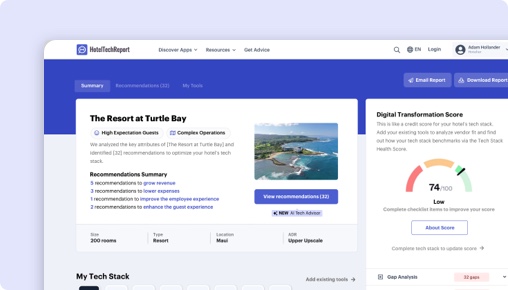
Sorry, this functionality is only available for verified hoteliers
The project dashboard is a free tool that is only available to verified hoteliers to make adopting new technology easier by streamlining their research and simplifying their communication workflow.

Clock PMS vs. Theova UHS:
Which Is Right for You?
TLDR
We analyzed 328 verified hotelier reviews, compared feature sets, pricing, and real-world case studies to break down where each platform delivers. The right choice depends on your property type and priorities:
Clock shines in ease of use and customer support — especially for independent properties (4.8/5) , with exclusive features like Payment processing and Revenue management module.
theova UHS shines .
How Does Clock PMS Compare to Theova UHS?
Side-by-side ratings based on 328 verified hotelier reviews on HTR.
| HTScore |
|
|
| Likelihood to Recommend |
|
|
| Ease of Use |
|
|
| Customer Support |
|
|
| Value for Money |
|
|
| Starting Price | From $600/mo | Contact sales |
| Verified Reviews | 328 | 0 |
What Are the Pros and Cons of Clock PMS vs Theova UHS?
After analyzing 328 verified reviews, Clock users most value its feature richness, operational efficiency, responsive support and regular updates, while theova UHS users highlight . Click any theme to see what reviewers say.
|
Clock
|
theova UHS |
|---|---|
| Pros | |
|
+
Feature Richness
▾
|
|
|
+
Operational Efficiency
▾
|
|
|
+
Responsive Support and Regular Updates
▾
|
|
|
+
Ease of Use for Training
▾
|
|
| Cons | |
|
−
Error Messages
▾
|
|
|
−
Reporting Feature
▾
|
|
Clock vs theova UHS: Rankings by Hotel Segment
How each product ranks among Property Management Systems vendors for different property sizes, types, and regions — based on verified reviews from hoteliers in each segment.
By Hotel Size
| Segment |
Clock
|
theova UHS |
|---|---|---|
| Small (10-24 rooms) ▾ | #11 117 reviews | — |
| Mid-Size (25-74 rooms) ▾ | #7 157 reviews | — |
| Large (75-199 rooms) ▾ | #17 9 reviews | — |
| X-Large (200+ rooms) ▾ | #11 5 reviews | — |
By Property Type
| Segment |
Clock
|
theova UHS |
|---|---|---|
| Boutique ▾ | #8 165 reviews | — |
| Luxury ▾ | #11 80 reviews | — |
| Branded / Chain ▾ | #8 62 reviews | — |
| Extended Stay ▾ | #9 27 reviews | — |
By Region
| Segment |
Clock
|
theova UHS |
|---|---|---|
| North America ▾ | #17 30 reviews | — |
| Europe ▾ | #3 228 reviews | — |
| Asia Pacific ▾ | #11 13 reviews | — |
| Middle East | #17 2 reviews | — |
The Decision
Choosing between Clock PMS and Theova UHS hinges on what your hotel needs most. Both aim to streamline operations, but Clock PMS offers a comprehensive property management system, while Theova UHS focuses on guest engagement and feedback analysis.
Clock PMS is a full-fledged PMS with features covering reservations, rates, invoicing, channel management, and more. Theova UHS, by contrast, is primarily an AI-driven feedback and review platform, lacking the extensive operational tools of Clock.
Which solution aligns best with your hotel’s priorities — operational efficiency or guest insights? The answer depends on your current pain points and growth goals.
Is Clock PMS or Theova UHS Better for Hotels?
Clock PMS is clearly designed to cover nearly every aspect of hotel management, from booking to billing to housekeeping, offering a unified platform that simplifies daily tasks. Theova UHS, however, does not provide core operational tools but specializes in aggregating and analyzing customer reviews for strategic insights.
Review data shows Clock has over 250 recent reviews with a high overall rating of 4.8/5, indicating strong user satisfaction and ongoing support. Theova UHS, with no reviews or ratings, provides no current user feedback or evidence of effectiveness.
Are you seeking a robust operational system or a feedback analytics partner? The choice largely depends on whether your focus is on day-to-day management or guest review optimization.
Clock PMS vs Theova UHS: Which Should Your Hotel Choose?
If your hotel needs an all-in-one property management system that handles reservations, rates, invoicing, channel management, and automation, go with Clock PMS. Its extensive feature set, including booking engine, payment processing, housekeeping, and revenue management, makes it suitable for hotels striving for operational efficiency.
If your team focuses on understanding customer sentiment, managing reviews, and improving guest satisfaction through insights, Theova UHS could be relevant. However, given the lack of reviews and features, Clock PMS is the clearly stronger choice for comprehensive hotel management.
For hoteliers wanting a proven, feature-rich system that supports daily operations, Clock PMS is the way to go. Theova UHS might be useful if your primary goal is customer feedback analysis, but it currently lacks the depth and validation needed to recommend strongly.
Is Clock PMS or Theova UHS Easier to Use?
Clock PMS boasts a high ease-of-use rating of 4.78/5, with a user-friendly interface that simplifies training new staff and daily operations. Its onboarding process is rated 4.71/5, and users frequently mention how intuitive and quick to learn the system is.
Theova UHS, with no available ratings or user feedback, provides no data on ease of use. Its focus on AI-driven review summaries indicates it’s designed for analytical tasks rather than operational management.
Edge: Clock PMS.
Which Has Better Features: Clock PMS or Theova UHS?
Clock PMS offers 58 unique features, including payment processing, booking engine, channel management, revenue tracking, guest profiles, online check-in, and automated workflows. These functionalities cater directly to managing hotel operations, revenue, and guest experiences.
Theova UHS, by contrast, provides no specific features or functionalities related to hotel management; it’s centered on review aggregation and AI-driven feedback insights.
The extensive feature set of Clock PMS clearly surpasses Theova UHS’s capabilities for hotel management. Edge: Clock PMS.
Which Has Better Customer Support: Clock PMS or Theova UHS?
Clock PMS is rated 4.75/5 for customer support, with frequent praise for its responsiveness and helpfulness. Review quotes mention timely assistance and proactive support, critical when managing complex hotel operations.
Theova UHS, lacking any publicly available reviews or ratings, offers no data on support quality or responsiveness.
Edge: Clock PMS.
Which Has More Integrations: Clock PMS or Theova UHS?
Clock PMS integrates with 111 verified partners, including popular hotel technology providers like Curacity, Profitroom, and Clock itself, allowing for extensive customization and operational connectivity. It also offers no connection fees on integrations.
Theova UHS has no verified integrations, limiting its ability to connect with existing hotel systems or third-party tools.
Edge: Clock PMS.
Which Do Hoteliers Rate Higher: Clock PMS or Theova UHS?
Clock PMS’s reviews reflect a high level of satisfaction across diverse hotel segments, especially independent (4.83/5), boutique, and city center hotels. Recent reviews highlight its ease of use, operational efficiency, and responsive support, reinforcing its strong reputation.
Theova UHS has no reviews or ratings, so it cannot be rated by hoteliers. Its market presence and user feedback are nonexistent.
Edge: Clock PMS.
How Much Do Clock PMS and Theova UHS Cost?
Clock PMS charges a base price of $600/month without any implementation or usage fees. Pricing details for Theova UHS are unavailable, indicating it may operate on a different model or lacks transparency.
Given the lack of pricing info for Theova UHS, Clock PMS’s transparent flat fee makes budgeting straightforward.
What Type of Hotel Should Use Clock PMS?
- Hotels that need a full management system covering reservations, rates, invoicing, and channel management.
- Properties seeking automation for daily operations, housekeeping, and guest communication.
- Hotels with a focus on revenue management or ancillary revenue tracking.
- Teams that want a cloud-based system accessible from anywhere.
- Hotels requiring extensive integrations with other tech providers.
Not ideal if your hotel only needs review management or guest feedback tools.
What Type of Hotel Should Use Theova UHS?
- Hotels or brands that prioritize guest feedback and review management.
- Teams looking to analyze customer sentiment via AI summaries.
- Hotels with a dedicated focus on reputation management and online reviews.
- Properties that want to gather actionable insights from customer comments.
Not ideal if you need a comprehensive property management system or operational features.
The Bottom Line for Hotels
Clock PMS offers an all-in-one platform with a proven track record, extensive features, and high customer satisfaction. Its broad integration network and support make it suitable for hotels aiming to streamline operations and enhance guest experiences.
Theova UHS lacks product reviews, features, or proven hotel management capabilities, making it unsuitable as a comprehensive PMS at this time. Its focus on guest review analysis might appeal to brands primarily interested in reputation management but falls short as a standalone hotel management solution.
If operational efficiency, integration, and proven support matter most, choose Clock PMS. For now, Theova UHS remains a niche tool with no current validation for hotel management needs.
How Much Do Clock PMS and Theova UHS Cost?
Property Management Systems pricing is rarely straightforward. Here is what we know from each vendor's public pricing data. Always request a custom quote for your property size.
|
Clock
|
theova UHS | |
|---|---|---|
| Starting Price | From $600/mo | — |
Which Features Does Clock PMS Have That Theova UHS Doesn't (and Vice Versa)?
According to HTR's product database, Clock PMS and Theova UHS share 0 features. Here are the key differences — features one has that the other lacks.
| Feature |
Clock
|
theova UHS |
|---|---|---|
| Booking Engine | ||
| Channel Manager | ||
| EPoS | ||
| Integrated CRS | ||
| Payment processing | ||
| Revenue management module |
Showing top differences. 46 more features differ between these products.
Real-World Results: Clock vs theova UHS by Business Goal
We analyzed 6 verified case studies to compare what hotels actually achieve with each platform across four key business objectives.
Events Hotels WICC
Large
"Clock is best all-in-one platform for managing hotel and event operations in one connected environment. It makes it easy to track bookings, organize group reservations, and handle..."
No published case study for this goal yet.
Elegancia Hotels Paris
Mid-Size
"Elegancia selected Clock for its flexibility, strong integration capabilities, and robust multi-property management—an essential requirement for a growing hotel group. The ability..."
No published case study for this goal yet.
Hotel Mitland
Small
"Quicker service, reduced request errors, and more consistent operations, resulting in higher guest satisfaction"
No published case study for this goal yet.
Clock vs theova UHS: The Bottom Line
What hoteliers love
Clock PMS+ offers a wide array of features that are beneficial for managing hotel operations and events. However, some users find the plethora of feat... Clock PMS+ offers a wide array of features that are beneficial for managing hotel operations and events. However, some users find the plethora of features overwhelming and suggest improved organization.
The software significantly enhances operational efficiency by saving time and streamlining communication and coordination among departments, contribut... The software significantly enhances operational efficiency by saving time and streamlining communication and coordination among departments, contributing to a smoother experience for both staff and guests.
Users appreciate the responsive support service and the regular updates that introduce new features and improvements, ensuring the system's reliabilit... Users appreciate the responsive support service and the regular updates that introduce new features and improvements, ensuring the system's reliability and relevance to user needs.
Where hoteliers push back
Users occasionally encounter error messages that are displayed in code, making it difficult to resolve issues quickly. Direct navigation from the erro... Users occasionally encounter error messages that are displayed in code, making it difficult to resolve issues quickly. Direct navigation from the error message to the problem would improve user experience.
While comprehensive, the reporting feature can be slow, which limits its current effectiveness. Users suggest optimization could unlock more powerful... While comprehensive, the reporting feature can be slow, which limits its current effectiveness. Users suggest optimization could unlock more powerful capabilities.
Unique capabilities
Where the ratings diverge most
Frequently Asked Questions About Clock PMS vs Theova UHS
Can Clock PMS replace Theova UHS?
It depends on your requirements. Clock PMS and Theova UHS share many core Property Management Systems features, but each has unique capabilities. Clock PMS offers 111 verified integration partners, while Theova UHS offers 0. Review the feature comparison above to see where they differ before switching.
Which is better for small or independent hotels?
Small hotels should prioritize ease of use and fast onboarding. Clock PMS leads in ease of use at 4.8/5 vs 0.0/5. Look for transparent pricing and a trial or demo option. Filter reviews on each product page by property size to hear from hotels like yours.
Do Clock PMS or Theova UHS offer a free plan?
Clock PMS: No. Theova UHS: No. Neither product currently offers a free tier. Most Property Management Systems vendors offer demos or trials — request one from each to evaluate before committing.
How Does HTR Evaluate and Rank Clock PMS and Theova UHS?
The HT Score is a composite ranking that considers 4 criteria groups and over a dozen variables to help hoteliers objectively compare hotel technology products. Clock has an HT Score of 86 and theova UHS has 0. Here is how the score is calculated.
| Criteria Group | Weight | What It Measures |
|---|---|---|
| Customer Ratings & Reviews |
|
How highly do users recommend this product? Ratings Score, Review Volume, Share of Voice, Review Depth, Review Recency, Success Stories ▾ The most heavily weighted factor. Analyzes average satisfaction ratings (likelihood to recommend, ease of use, support, ROI), total review count relative to category peers, review recency (at least 20 reviews in the trailing 6 months), and share of voice across unique hotel clients to detect selection bias. |
| Partner Ecosystem |
|
How highly do tech partners recommend this company? Partner Recommendations, Integration Quantity, Integration Quality ▾ Evaluates partner recommendations as expert votes of confidence, the number of verified integrations, and ecosystem quality — the average HT Scores of integration partners. Products with higher-quality integration ecosystems are more likely to deliver a connected tech stack. |
| Customer Centricity |
|
How customer-centric is this organization? Certified Support, Review Consistency, Profile Completeness ▾ Assesses whether the company has earned HTR Customer Support Certification, maintains consistent review collection over time (an indicator of feedback-driven culture), and keeps product profiles complete with capabilities, screenshots, pricing, and features. |
| Reach, Staying Power & Resources |
|
How extensive is this company's reach and resourcing? Geographic Reach, Staying Power, Company Resources, Trending Score ▾ Measures global presence (countries and regions served), years in business as a stability proxy, team headcount as a resource proxy, and a trending score based on trailing-twelve-month buyer inquiries, reviews, partner recommendations, and press activity. |
Customer ratings and reviews are by far the most important factor in the HT Score algorithm. HTR does not accept payment for higher rankings. All reviews are verified — only hotel industry practitioners with confirmed affiliations can submit ratings. View full HT Score methodology →
What Other Property Management Systems Comparisons Are Hoteliers Reading?
Explore more head-to-head comparisons based on verified hotelier reviews.


Contents
Get Your Free AI Analyst Report
Custom recommendations tailored to your property


Let´s lookup your hotel information
Still weighing your property management systems options?
A few popular systems from our property management systems guide — or let our AI score each one against your specific property in about two minutes.