
Sorry, this functionality is only available for verified hoteliers
The project dashboard is a free tool that is only available to verified hoteliers to make adopting new technology easier by streamlining their research and simplifying their communication workflow.

Top Hospitality TV & Casting Solutions 2026

By Jordan Hollander
Last updated on March 17, 2026

Jordan Hollander
CEO @ Hotel Tech Report
Jordan is the co-founder of HotelTechReport, the hotel industry's app store where millions of professionals discover tech tools to transform their businesses. He was previously on the Global Partnerships team at Starwood Hotels & Resorts. Prior to his work with SPG, Jordan was Director of Business Development at MWT Hospitality and an equity analyst at Wells Capital Management. Jordan received his MBA from Northwestern’s Kellogg School of Management where he was a Zell Global Entrepreneurship Scholar and a Pritzker Group Venture Fellow.
-
517
articles contributed
Our reviewers evaluate software independently. Learn how we stay transparent, read our review methodology, and tell us about any tools we missed.
This list is based on research we’ve conducted since 2017, analyzing dozens of Hospitality TV & Casting Solutions using verified hotelier reviews, product deep dives, and our proprietary HTScore.
Hospitality TV Providers Shortlist
Here are a few of the top Hospitality TV solutions providers covered in this in-depth guide:
- 1.
- 2.
- 3.
- 4.
- 5.
- 6.
- 7.
- 8.
- 9.
- 10.
Over 2M+ Leading Hotel Professionals Trust Our Advice




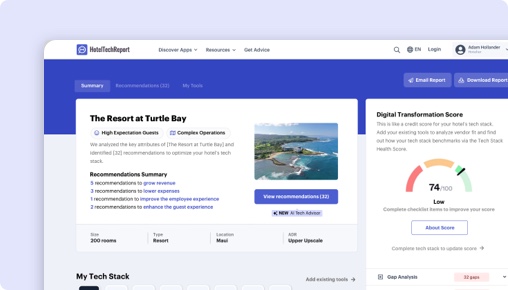
Get Your Custom Hospitality TV Analyst Report
- Ranked recommendations for your property
- Real operator reviews & pricing data
- Tailored to your size, market & integrations
Trusted by thousands of hoteliers worldwide
Takes 2 min · No credit card needed
LAST UPDATED
APPS TESTED



CONTRIBUTING EXPERTS


How to Choose the Right Hospitality TV & Casting Solutions Provider
This list is already personalized based on your hotel’s size, type, and operational profile. Because infrastructure requirements, guest expectations, and budget constraints vary widely by segment, the rankings you see reflect what performs best for properties most similar to yours.
Want to go deeper? Use the filters to refine your shortlist by country, region, property type, and even your current PMS or network environment to see which Hospitality TV & Casting Solutions are the strongest fit for your specific setup.
The goal isn’t just to show you the most popular vendors—it’s to help you quickly identify the solutions that align with your infrastructure, guest experience goals, and budget reality.
Best Hospitality TV & Casting Solutions by Property Type
These rankings are powered by data—not opinions. By analyzing thousands of verified hotelier reviews, implementation signals, and segment-specific performance data, we’re able to identify the Hospitality TV & Casting Solutions that consistently deliver the strongest results within each property type.
Because a casting platform that excels in a 500-room resort may not be the right fit for a 20-room boutique hotel, our rankings are filtered by operational segment—not just overall popularity.
The result: smarter, segment-aware recommendations based on what actually works for hotels most similar to yours—so you can shortlist vendors with confidence and move faster toward the right decision.
Q2 2026 Hospitality TV Survey Rankings
Based on HTR's Q2 2026 quarterly Hospitality TV survey insights, these are the products that are currently most recommended by each size of hotel.
Q2 2026 Hospitality TV Survey Rankings
Based on HTR's Q2 2026 quarterly Hospitality TV survey insights, these are the products that are currently most recommended by each size of hotel.
| Best for | Hoteliers | Recommended | |
|---|---|---|---|
Best Hospitality TV for Mid-sized Hotels (50-99 rooms)
Mid-sized
50-99 rooms
|
59 Hoteliers |
1 products recommended
|
|
|
|
|||
Best Hospitality TV for Large Hotels (100-499 rooms)
Large
100-499 rooms
|
153 Hoteliers | ||
|
|
|||
Best Hospitality TV for Mid-sized Hotels (50-99 rooms)
Best Hospitality TV for Large Hotels (100-499 rooms)
Create Free Account
Join 1.5M+ hoteliers making data-driven decisions



By proceeding you agree to our Terms of Service and Privacy Policy
What you'll get




Best Hospitality TV Reviews
Hospitality TV & Casting Solutions Features & Comparison


Discover popular comparisons
How We Evaluate Hospitality TV & Casting Solutions
In-room entertainment isn’t just an amenity—it’s a performance lever. When Hospitality TV systems fail, you get guest complaints, front desk friction, privacy risks, and network headaches; when they work, they boost satisfaction, reinforce your brand, and drive incremental revenue through secure streaming and PMS-driven upsells.
To cut through vendor noise and reduce risk, we surveyed 437 hoteliers across 38 countries and combined verified reviews with hands-on demos to evaluate real-world reliability, integration depth, and segment fit.
The purpose of this guide is to help you quickly and confidently find the right solution—whether you’re moving from pay-per-view to streaming or enabling BYOD. This guide breaks down how to define, evaluate, and compare Hospitality TV platforms so you can choose the system that actually works for your operation.
Hospitality TV & Casting Solutions are in-room entertainment platforms designed specifically for hotels, resorts, serviced apartments, and other lodging providers. Unlike consumer smart TVs, these systems are built to operate securely at scale, integrate with hotel systems, and deliver a branded, guest-centric experience.
Modern hospitality TV solutions typically include:
Secure guest casting (BYOD streaming from personal devices)
Branded interactive TV interfaces
Integration with PMS and guest messaging platforms
Upsell modules (room service, spa, late checkout, upgrades)
Digital compendiums and hotel information hubs
Remote device management and analytics
These systems replace outdated pay-per-view models with streaming-first experiences that align with guest expectations shaped by platforms like Netflix, YouTube, and Spotify—while maintaining enterprise-grade security and manageability.
In short: Hospitality TV & Casting Solutions transform the in-room TV from a passive entertainment device into a connected guest engagement platform.
Our evaluation methodology blends real hotelier feedback with hands-on product analysis to assess solutions across the dimensions that matter most in daily operations.
1. Guest Experience & Ease of Use
We assess how intuitive the interface is for guests, how easy casting is to initiate, and whether the system mirrors the seamless experience guests expect at home. This includes login flows, device pairing, language options, and accessibility.
2. Security & Network Architecture
Guest casting must be secure and isolated to prevent cross-room streaming issues. We evaluate network requirements, VLAN configuration, data privacy compliance, and how well the system protects guest information.
3. Integrations & Ecosystem Connectivity
A strong hospitality TV solution should integrate with:
PMS systems
Guest messaging platforms
Upselling software
Digital signage tools
Hotel apps
We analyze API flexibility, middleware requirements, and how easily the system connects to your broader tech stack.
4. Monetization & Revenue Impact
Can the system drive incremental revenue? We evaluate built-in upsell capabilities, promotional banners, targeted messaging, and reporting tools that measure conversion rates from in-room campaigns.
5. Operational Efficiency
From remote device management to firmware updates and content control, we look at how much workload the solution adds—or removes—from your IT and operations teams.
6. Hardware Flexibility & Scalability
We examine compatibility with leading TV manufacturers, casting devices, and whether the solution supports both retrofit installations and new builds. Scalability across multi-property portfolios is also considered.
7. Pricing Transparency & ROI
We benchmark pricing models (per room per month, hardware costs, licensing, installation fees) and evaluate long-term ROI based on guest satisfaction, labor savings, and upsell revenue potential.
Not all hotels need the same type of Hospitality TV & Casting Solution. A 500-room luxury resort has very different requirements than a 12-room boutique hotel or a high-turnover hostel. Below, we break down what matters most by segment so you can identify the right fit for your property type.
1. Large Hotels & Resorts
If you’re managing a large hotel or resort, your in-room TV system isn’t just entertainment—it’s a brand touchpoint, revenue channel, and operational platform. With high guest volume, multiple revenue centers, and strong brand standards, your solution must be secure, deeply integrated, and scalable across departments and properties.
Defining Characteristics:
Multi-department operations including spa, golf, F&B, and events. High guest expectations for seamless streaming and personalization. Enterprise IT involvement in procurement decisions. Complex network infrastructure and often multi-property oversight requirements.
Common Needs & Preferences:
Enterprise-grade reliability and uptime. Secure casting architecture with strong data protection. PMS and CRM integrations for personalization. Centralized content control across properties. Proven vendors with large-scale deployment experience.
Key Features and Needs
Feature Title | Description | Why It’s Critical |
|---|---|---|
Enterprise Casting Architecture | VLAN-based secure casting with room-level isolation | Prevents cross-room streaming and protects guest data |
PMS & CRM Integration | Personalized welcome screens and targeted promotions | Enables branded, data-driven guest experiences |
Multi-Property Dashboard | Centralized control across multiple hotels | Ensures brand consistency and operational efficiency |
Advanced Analytics | Usage reports, campaign tracking, and engagement metrics | Measures ROI and supports revenue optimization |
24/7 Enterprise Support | SLA-backed technical support | Minimizes downtime risk across large portfolios |
2. Boutique & Independent Hotels
Boutique hotels are design-driven and experience-focused. The TV system must feel like a seamless extension of the brand—visually polished, easy to use, and capable of enhancing the guest journey without adding operational complexity.
Defining Characteristics:
Strong emphasis on aesthetics and brand identity. Lean teams with limited IT resources. High sensitivity to guest reviews and reputation. Heavy focus on direct bookings and experiential branding.
Common Needs & Preferences:
Branded, customizable interfaces. Simple casting flows such as QR-based pairing. Upsell modules for F&B, experiences, and late checkout. Easy installation with minimal hardware disruption.
Key Features and Needs
Feature Title | Description | Why It’s Critical |
|---|---|---|
Branded UI Customization | Custom themes, welcome messaging, and visuals | Reinforces brand identity and design standards |
One-Tap Casting | QR-based or auto-pair casting | Reduces guest frustration and front desk calls |
Upsell & Promo Modules | On-screen offers for services and upgrades | Drives incremental revenue per stay |
Cloud-Based Management | Remote content updates and control | Reduces need for onsite IT |
Flexible Hardware Options | Compatible with existing TVs | Keeps upgrade costs manageable |
3. Small Hotels & B&Bs
For owner-operated properties, simplicity is everything. The right TV solution should be plug-and-play, affordable, and easy to manage—without requiring complex network upgrades or ongoing IT oversight.
Defining Characteristics:
Owner/operator wearing multiple hats. Limited IT support and infrastructure. Budget-sensitive purchasing decisions. Focus on guest comfort and reviews.
Common Needs & Preferences:
Affordable monthly pricing. Minimal setup and installation complexity. Clear guest instructions. Reliable casting without technical headaches.
Key Features and Needs
Feature Title | Description | Why It’s Critical |
|---|---|---|
Plug-and-Play Setup | Minimal hardware and easy network configuration | Avoids costly IT projects |
Simple Casting Interface | Clear on-screen pairing instructions | Reduces guest confusion |
Basic Content Customization | Add logo, WiFi info, and property details | Enhances professionalism without complexity |
Transparent Pricing | Flat monthly or per-room fee | Protects tight operating margins |
Remote Support | Quick troubleshooting without onsite visits | Saves time and operational disruption |
4. Budget Hotels, Motels & Hostels
For economy properties, the focus is operational efficiency and cost control. Guests expect reliable streaming—but margins are tight. The ideal solution is lightweight, affordable, and built for high-turnover environments.
Defining Characteristics:
High turnover and OTA-heavy bookings. Price-sensitive guests. Limited front desk staffing. Minimal appetite for complex installations.
Common Needs & Preferences:
Low-cost hardware and licensing. Easy session reset between guests. Stable casting connections. Minimal maintenance requirements.
Key Features and Needs
Feature Title | Description | Why It’s Critical |
|---|---|---|
Automated Guest Session Reset | Clears casting sessions at checkout | Protects privacy and reduces manual resets |
OTA-Friendly Network Stability | Handles frequent short stays and new device connections | Prevents guest complaints |
Lightweight Interface | Core casting and limited branding | Keeps system simple and affordable |
Fast Deployment Kits | Pre-configured hardware packages | Speeds installation and reduces setup costs |
Low Per-Room Cost | Budget-aligned pricing model | Essential in low-margin environments |
If you’ve ever tried comparing Hospitality TV & Casting vendors side-by-side and ended up more confused than when you started, you’re not alone.
On the surface, most platforms promise the same thing: seamless casting, branded interfaces, simple installation, and secure streaming. But just like hotel properties themselves, what works perfectly in a 15-room boutique hotel might completely fall apart in a 600-room resort with complex network segmentation and enterprise IT oversight.
And that’s exactly the problem.
Hospitality TV & Casting Solutions may look similar in marketing brochures—but the differences underneath the surface can dramatically impact guest satisfaction, operational efficiency, and long-term ROI.
Here’s why the comparison process is more complicated than it seems:
1. Hospitality TV Solutions Are Built for Different Property Types
A casting solution designed for a lean, limited-service hotel prioritizing simplicity and low cost will look nothing like one built for a luxury resort offering personalized welcome screens, upsell modules, and multi-property dashboards.
Some vendors optimize for:
Plug-and-play installation
Minimal network configuration
Low monthly cost per room
Others are built for:
Complex VLAN network architecture
PMS-driven personalization
Multi-outlet promotional campaigns
Enterprise-level reporting and analytics
Comparing them without considering your segment is like comparing a Chromecast to a broadcast studio system. Both stream content—but they’re designed for completely different environments.
2. “Secure Casting” Means Different Things to Different Vendors
Nearly every vendor claims to offer “secure casting.” But what does that actually mean?
For some, it’s a basic device pairing flow that resets at checkout. For others, it’s true room-level network isolation with enterprise-grade encryption and automated device disconnection tied to PMS status changes.
The difference matters—especially in high-volume environments where privacy and reliability are non-negotiable.
Without understanding the depth of the underlying network architecture, you won’t know whether the solution scales—or cracks under pressure.
3. Pricing Models Are All Over the Map
Flat monthly per-room fees. Hardware leasing. One-time CapEx installations. Revenue-share upsell models. Tiered feature bundles. Add-on integrations.
Hospitality TV pricing is rarely apples-to-apples.
One vendor may look affordable upfront but require expensive network upgrades. Another may cost more monthly but include advanced branding, analytics, and upsell tools that drive measurable ROI.
Comparing price without context—especially infrastructure requirements—is a recipe for budget surprises.
4. Integration Depth Is Often Vague
Yes, the vendor says they “integrate with your PMS.”
But does that mean:
Real-time personalization of welcome screens?
Automatic guest session resets at checkout?
Revenue tracking tied to in-room upsells?
Or does it simply mean a one-way data sync?
The quality and depth of integrations—with PMS, guest messaging, upselling software, and CRM—can dramatically change the value of the system. And this information is often buried beneath high-level marketing claims.
5. Demos Don’t Reveal Operational Reality
A casting demo in a controlled environment is easy.
What’s harder is testing:
200 guests trying to stream simultaneously on a sold-out weekend
Device reset accuracy during back-to-back checkouts
Performance across older TVs and mixed hardware environments
Staff troubleshooting in real-world conditions
The friction rarely appears in the demo—it appears during peak occupancy.
6. Guest Expectations Vary by Segment
A lifestyle boutique hotel may prioritize:
Visual branding
Curated local content
On-screen upsells for experiences
A resort may prioritize:
Personalized welcome messaging
Loyalty integration
Departmental revenue tracking
A budget hotel may prioritize:
Reliability
Speed
Minimal support calls
If you don’t filter vendors based on your segment’s operational DNA, every solution will look “good enough”—until it doesn’t align with your actual workflow.
The Bottom Line
Comparing Hospitality TV & Casting platforms is difficult because the category blends hardware, software, networking, branding, and revenue strategy into one decision.
It’s not just about streaming Netflix in-room.
It’s about:
Protecting guest privacy
Supporting your network infrastructure
Reinforcing your brand
Driving incremental revenue
Reducing front desk friction
Choosing the wrong system can create guest frustration and operational headaches. Choosing the right one can elevate your entire in-room experience.
How Our Framework Simplifies the Decision
Choosing a Hospitality TV & Casting Solution isn’t about picking the platform with the flashiest interface—it’s about selecting the one that fits how your hotel actually operates.
That’s why we built our vendor selection framework around one simple principle:
Technology decisions should reflect operational reality.
Not just star ratings. Not just marketing promises. But your actual:
Property type
Team structure
Network capabilities
Guest expectations
Budget model
Our methodology groups hotels into four core segments:
Large Hotels & Resorts
Boutique & Independent Hotels
Small Hotels & B&Bs
Budget Hotels, Motels & Hostels
Each segment has distinct infrastructure needs, guest behavior patterns, and revenue goals. By filtering vendors through this lens, we eliminate one-size-fits-all rankings and surface the solutions that consistently perform best for hotels like yours.
This segment-aware approach helps you:
Identify features that actually matter in your environment
Compare vendors with similar operational use cases
Avoid overbuying enterprise complexity you don’t need
Prevent underinvesting in infrastructure that could harm guest satisfaction
And because our framework is backed by thousands of verified hotel tech reviews, real-world case studies, and continuously updated integration data, you’re not just getting opinions—you’re getting evidence-based recommendations grounded in operational outcomes.
In a crowded category where every vendor claims to offer “secure streaming” and “easy casting,” our framework helps you find the solution that truly aligns with your property’s technical reality and guest experience goals.
Because the best Hospitality TV & Casting Solution isn’t the one with the longest feature list.
It’s the one that fits your hotel.
Everything You Need to Know About Hospitality TV & Casting Solutions
Not sure where to start with Hospitality TV & Casting Solutions? This section is your crash course.
We’ll walk you through what a hospitality TV system actually is (and how it differs from consumer smart TVs), what features to expect—from secure guest casting and branded interfaces to PMS-driven personalization—how pricing models typically work, and what infrastructure requirements you need to plan for.
We’ll also break down key integrations (hint: PMS, guest messaging, upselling software, and network architecture), implementation considerations, hardware decisions, and the real operational impact these systems can have on guest satisfaction and staff workload.
Along the way, we’ll cover the benefits, common pitfalls to avoid, and the major trends shaping the future of in-room entertainment—from BYOD streaming to fully connected guest engagement platforms.
It’s everything you need to get oriented—grounded in real-world insights from thousands of hoteliers who’ve already gone through the decision process.
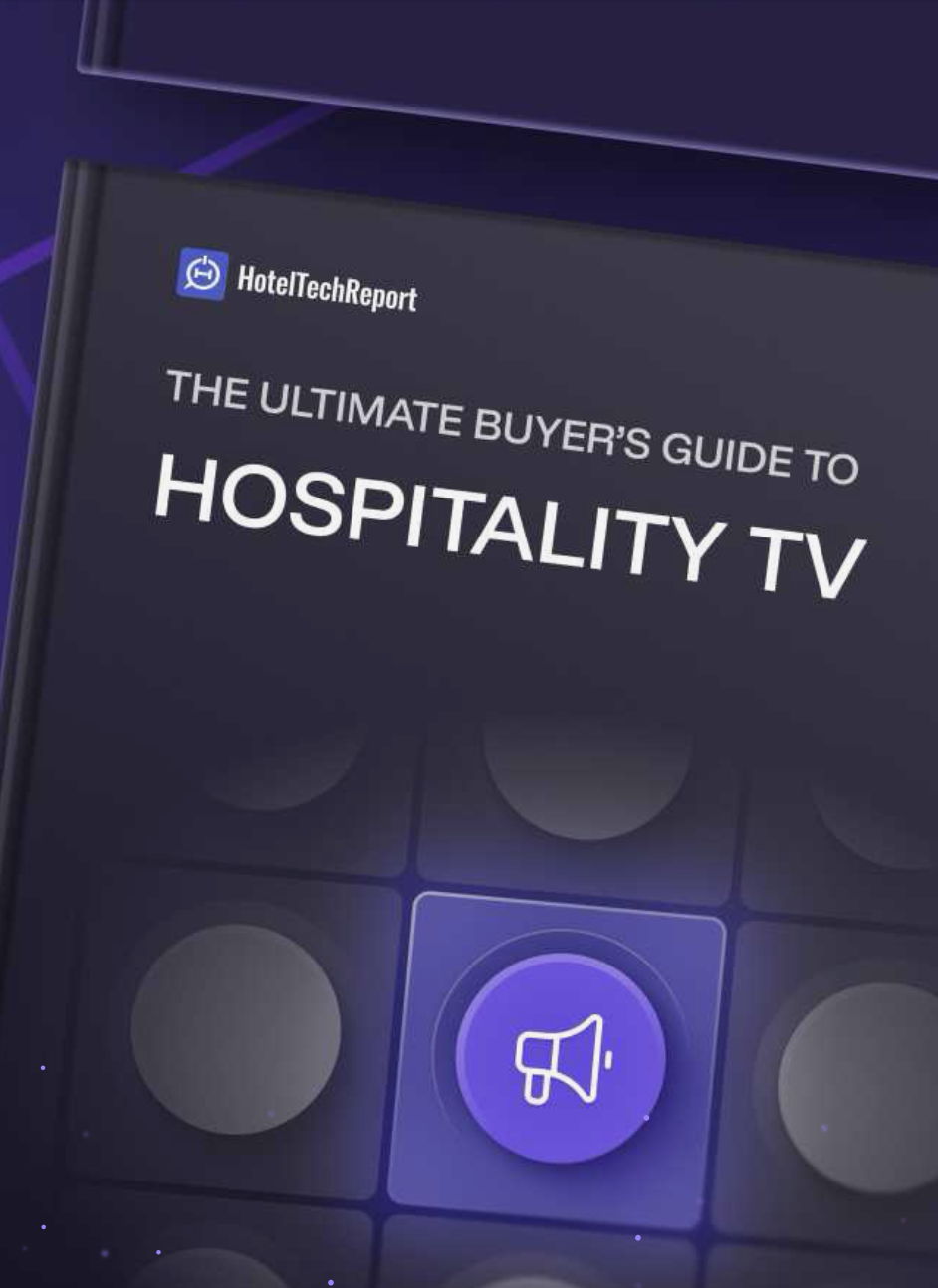
2026 Hospitality TV & Casting Solutions Buyer's Guide


Download the Free Guide
Your guide was sent!
Your guide was successfully sent to .
This email may be incorrect
Our check detected that this address may have been entered incorrectly. Please confirm or correct it before we continue:
This looks like it may contain a typo.
What is a Hospitality Casting Solution?
What features should I look for in a hospitality casting solution?
-
TV channels: At a minimum, your hospitality TV service will provide local TV channels, like ABC, NBC, and PBS, with a few different packages to choose from.
-
Streaming apps: A hospitality TV service gives your guests access to a catalog of apps, like Netflix, Hulu, Prime Video, and more.
-
On-demand video: The modern version of pay-per-view: access to early release movies from Disney, Lionsgate, Paramount, and the like.
-
Other media: Besides shows and movies, hospitality TV can include other types of content, like the weather forecast, flight tracking, music and soundscapes, and photos and videos about your hotel or brand.
-
Digital directory: Transform your printed directory into an interactive digital version where you can display information about your amenities, policies, outlets, and local area.
-
Branding: Extend your brand image to the digital realm by adding your logo, colors, taglines, and other brand collateral to the digital TV interface.
-
Promotions and upsells: Build a menu of items or services that guests can purchase and advertise special offers for your restaurant or spa.
-
Management portal: Manage the entertainment options available to guests, customize your content, and track usage from one interface.
-
Integrations: Connect your hospitality TV system to your property management system (PMS), customer relationship management system (CRM), restaurant management system, and other on-site technology to enable seamless communication between databases.
- Customizable Branded Interface
- On-screen hotel services
- Customizable Branded Interface
- On-screen hotel services
- Device Streaming (Android Compatible)
- Device Streaming (iOS Compatible)
- Interactive Channel Guide
- Device Streaming
- Pandora
- YouTube
- Hulu
- Netflix
- Device Streaming (Android Compatible)
- Device Streaming (iOS Compatible)
- Interactive Channel Guide
- Device Streaming
- Pandora
- YouTube
- Hulu
- Netflix
- Housekeeping Module
- Guest Messages & Notifications
- Wake Up Calls
- Folio Review & Checkout
- Welcome page
- Housekeeping Module
- Guest Messages & Notifications
- Wake Up Calls
- Folio Review & Checkout
- Welcome page
- Guest Marketing
- On-screen Purchases & Ordering
- On-screen hotel services
- Mini-guide channel banner
- Guest Marketing
- On-screen Purchases & Ordering
- On-screen hotel services
- Mini-guide channel banner
- Usage Analytics
- Usage Analytics
- Secure Guest Authentication
- Secure Guest Authentication
What are the Benefits of a Hotel Casting Solution?
-
Powers in-room TV entertainment: A hospitality TV system gives guests a slew of entertainment options, local and cable TV channels, streaming apps (Netflix, Hulu, etc.), on-demand movies, music, fitness videos, and more
-
Customizes the TV experience: You can control what guests see when they turn on the TV, complete with branding like your logo and imagery and a personal welcome message that uses the guest’s name, for example.
-
Hosts interactive content: Most hospitality TV providers include a digital hotel directory and tools for you to highlight promotions and upsell opportunities to guests
-
Provides tech support resources: Representatives from the hospitality TV provider can help your guests and staff troubleshoot TV issues.
-
Adds touchpoints for you to engage with guests and build brand recognition. Use the big, beautiful TV screens in your guestrooms to your advantage by showcasing your brand, your outlets, and promotional opportunities that will increase your top line. You can reinforce your hotel’s brand with a fully customized welcome screen, and you can strengthen relationships with guests by personalizing the TV experience with the guest’s name.
-
Increases guest satisfaction by allowing guests to enjoy the entertainment options they truly want. Many of today’s guests aren’t interested in the local TV channels or in pay-per-view movies; instead, they want to stream their favorite Netflix show or do an on-demand fitness class. Guests will appreciate being able to seamlessly stream their show on the guestroom TV or cast media from their own device to the TV.
-
Offloads tech support tasks from your front desk staff or on-site IT department. Your staff can do their jobs more efficiently if they can shift the responsibility of resolving guests’ TV troubles to the customer support representatives who work for your TV vendor.
Critical Integrations for Hospitality TV & Casting Solutions
When you're evaluating a Hospitality TV & Casting Solution, it’s easy to get distracted by sleek interfaces and flashy demo screens. But here’s the thing: the real power of a hospitality TV platform isn’t just what guests see on the screen—it’s how deeply the system connects to the rest of your hotel’s tech stack.
At a minimum, your Hospitality TV solution should include:
✅ Secure, room-level guest casting with automatic session reset at checkout
✅ Centralized content management for branding, messaging, and promotions
✅ Remote device monitoring and management tools
✅ Network architecture designed specifically for hospitality environments
These shouldn’t be fragile workarounds or consumer-grade adaptations. They should be purpose-built for hotel operations—with enterprise-grade security, scalability, and support.
That said, some vendors rely heavily on third-party middleware, external casting hardware, or loosely connected management portals. It’s worth asking what’s truly native, what’s white-labeled, and what depends on additional vendors. If core components aren’t deeply integrated, you may run into sync issues, guest privacy risks, or support finger-pointing when something breaks.
Once those core capabilities are covered, here are the external integrations that actually matter—the ones that transform your in-room TV from a streaming device into a connected guest engagement platform:
Property Management System (PMS): Enables automatic guest authentication, personalized welcome screens, and session resets tied to check-in/check-out status.
Guest Messaging Platforms: Sync in-room promotions and service messaging with pre-arrival and in-stay communications.
Upselling Software: Drive incremental revenue through targeted on-screen offers for room upgrades, F&B, spa, and experiences.
CRM & Loyalty Platforms: Personalize content and offers based on guest history and loyalty tier.
Digital Signage & Content Management Systems: Ensure consistent branding and promotional campaigns across public spaces and in-room screens.
Network & IT Infrastructure Tools: Proper VLAN configuration, firewall compatibility, and bandwidth optimization are critical for casting reliability at scale.
The bottom line: your Hospitality TV & Casting Solution doesn’t operate in isolation. The value multiplies when it’s tightly integrated into your operational, marketing, and revenue ecosystem.
If the integrations are shallow, you’re buying a screen.
If they’re deep, you’re investing in a guest engagement platform.
Pricing for hospitality TV services varies widely depending on your desired features, location, and property size. Contracts generally include a monthly fee per room, and sometimes an implementation fee is charged. For a basic hospitality TV package that only includes some local and cable channels, you can expect to pay roughly $5 to $10 per room per month. A more sophisticated system that includes streaming services, custom content, widgets like weather and flight tracking, and a management portal can cost double or triple the price of basic channels - or higher. Hospitality TV vendors can provide personalized quotes based on your hotel’s characteristics upon request.
If your hospitality TV project includes purchasing and installing new TVs, then your first step is to procure the devices. Depending on how many you order and where they’re coming from, it could take weeks or months for the TVs to arrive. Many hoteliers choose to hire a professional installation team to unbox, mount, and program the TVs. TV installation doesn’t take too long per room, so you might not need to block rooms for longer than a day or two once the hardware has arrived.
Once your TVs are ready to go, you will need to implement your TV service. Your vendor will give you access to a management portal where you can set up any custom content you want to display, like a personalized welcome screen and images or videos about your property. You can also integrate your TV system with other hotel technology, such as your PMS or CRM, so guest profile details can flow through to the TV (like the guest’s name, so you can display a personal welcome message). You’ll have plenty of support throughout this process from your hospitality TV vendor - either a centralized onboarding team or a dedicated account representative.
After completing the main setup steps, you’ll want to test each TV to make sure everything works properly. Turn on the TV, make sure your hotel content looks correct, and check that you can access TV channels, on-demand media, and apps. It’s also prudent to train your staff on common questions they might receive from guests. While the technical troubleshooting can be handled by your vendor’s customer support team, your front desk staff should be able to handle basic questions, like how to access Netflix or how to set parental controls. Lastly, to prevent unnecessary inquiries to your staff, it’s a best practice to place a brief TV instruction guide in each guestroom so guests know how to turn on the TV and access content.
The Future of Hospitality TV & Casting Solutions
Traditional pay-per-view models are rapidly disappearing. Today’s guests expect to log into their own streaming services—Netflix, YouTube, Disney+, Spotify—just like they do at home.
Modern Hospitality TV platforms are built around secure BYOD (Bring Your Own Device) casting, allowing guests to stream directly from their personal smartphones, tablets, or laptops to the in-room TV.
Here’s what this means for your hotel:
Higher guest satisfaction scores. Guests don’t want unfamiliar cable interfaces—they want their own content instantly.
Reduced content licensing complexity. BYOD streaming eliminates the need for expensive, outdated content contracts.
Fewer front desk calls. Simplified QR-based pairing reduces friction and tech support requests.
Future-proof infrastructure. Streaming-first systems adapt as consumer behavior evolves.
The in-room TV is no longer a closed ecosystem—it’s a secure extension of the guest’s digital life.
Hospitality TV systems are increasingly integrating with PMS and CRM platforms to deliver personalized, data-driven experiences.
Instead of a generic welcome screen, guests may see:
Personalized greetings using their name
Loyalty-tier recognition
Targeted upsell offers
Relevant property promotions
Here’s what this means for your hotel:
Dynamic personalization across the stay. PMS integrations allow the TV to reflect real-time guest status—from check-in to checkout—while CRM data can tailor promotions based on guest history and preferences.
Revenue-generating screen space. Targeted on-screen offers for spa treatments, dining, room upgrades, or late checkout transform the TV into an incremental revenue driver.
Automated guest session management. Casting sessions automatically reset at checkout, protecting privacy without manual intervention.
The in-room TV is becoming part of the connected guest journey—not a standalone device.
Hospitality TV systems are increasingly integrated into broader smart room ecosystems—connecting with IoT devices, voice assistants, lighting controls, and guest apps.
The TV is evolving into a central control hub.
Here’s what this means for your hotel:
Unified in-room control centers. Guests can adjust lighting, temperature, request services, or browse hotel amenities directly from the TV interface.
Operational efficiency gains. Integration with housekeeping and maintenance systems can automate room status updates or service requests.
Real-time responsiveness. Systems can adapt based on occupancy, guest profile, or time of day—displaying relevant content or promotions dynamically.
As smart room technology becomes more accessible, the TV will increasingly serve as the visual command center of the guest room experience.
Hoteliers Also Ask
A hotel TV might look identical to a standard consumer TV, but it’s what you see on the screen when you turn it on that sets a hotel TV apart. A hospitality TV includes not only local and cable channels, but also content related to the hotel and perhaps the ability to book restaurant reservations or purchase add-on amenities through the TV.
Engagement: How many guests are interacting with the content on your TVs? If you’re switching from a basic TV provider to a more sophisticated hospitality TV system, then you can compare engagement metrics pre- and post-implementation.
Upsell revenue: Revenue generated via guestroom TVs from promotions and upsells is a great way to calculate a return on your hospitality TV investment.
Guest review scores: Guest satisfaction metrics, like review scores, can tell you if your hospitality TV system enhances or detracts from the stay experience. If you notice scores increasing, and guest reviews mention positive experiences with the in-room entertainment, then you can be confident that guests like the amenity. But if scores drop, coupled with review comments that mention negative experience with guestroom TVs, then you’ll want to revisit your configuration and troubleshoot any issues surfaced in reviews.
Hospitality TV offers many features that standard TV service does not provide. For instance, hospitality TV can host curated content about the hotel and display information specific to each guest’s reservation.
Hotels generally purchase TVs in large quantities and at wholesale prices, so the price per device is often cheaper than what an individual consumer might find at a big-box electronic store. Hotel TVs can cost around $100 to over $1000 depending on the device specifications.
Hotel TVs are designed for use in hotels, not private homes. Although you might be able to find the same TV model at your local electronics store, the interface and entertainment options available in a hotel will be different from the TV service available through a company like Comcast.
Many modern hospitality TVs have smart TV functionality, such as the ability to log into streaming apps and watch movies and shows on-demand. In addition, some hospitality TVs allow guests to cast content from their own devices, which is a popular feature of smart TVs.
LAST UPDATED
APPS TESTED
CONTRIBUTING EXPERTS
Get Your Custom Hospitality TV Analyst Report
- Ranked recommendations for your property
- Real operator reviews & pricing data
- Tailored to your size, market & integrations
Trusted by thousands of hoteliers worldwide
Takes 2 min · No credit card needed
Get Your Free AI Analyst Report
Custom recommendations tailored to your property


