

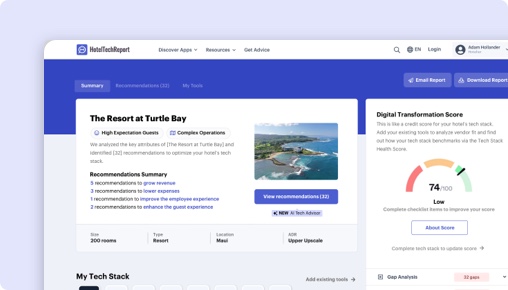
Sorry, this functionality is only available for verified hoteliers
The project dashboard is a free tool that is only available to verified hoteliers to make adopting new technology easier by streamlining their research and simplifying their communication workflow.

Duve - Online Check-in vs. Samotech eREG:
Which Is Right for You?


TLDR
We analyzed 608 verified hotelier reviews, compared feature sets, pricing, and real-world case studies to break down where each platform delivers. The right choice depends on your property type and priorities:
Duve shines in ease of use and customer support — especially for brand properties (0.0/5) , with exclusive features like Mobile Friendly and SMS text messaging.
Samsotech International shines .
How Does Duve - Online Check-in Compare to Samotech eREG?
Side-by-side ratings based on 608 verified hotelier reviews on HTR.
| HTScore |
|
|
| Likelihood to Recommend |
|
|
| Ease of Use |
|
|
| Customer Support |
|
|
| Value for Money |
|
|
| Starting Price | From $900/mo | From $400/mo |
| Verified Reviews | 608 | 0 |
What Are the Pros and Cons of Duve - Online Check-in vs Samotech eREG?
After analyzing 608 verified reviews, Duve users most value its guest messaging and continuous communication, contactless check-in and pre-arrival registration, operational efficiency and staff time savings, while Samsotech International users highlight . Click any theme to see what reviewers say.
|
Duve
|
Samsotech International
|
|---|---|
| Pros | |
|
+
Guest messaging and continuous communication
▾
|
|
|
+
Contactless check-in and pre-arrival registration
▾
|
|
|
+
Operational efficiency and staff time savings
▾
|
|
|
+
Customization, workflow flexibility, and language handling
▾
|
|
| Cons | |
|
−
PMS synchronization and integration issues
▾
|
|
|
−
Message delivery and platform reliability
▾
|
|
|
−
Guest data capture and follow-up reuse
▾
|
|
Duve vs Samsotech International: Rankings by Hotel Segment
How each product ranks among Contactless Check-in vendors for different property sizes, types, and regions — based on verified reviews from hoteliers in each segment.
By Hotel Size
| Segment |
Duve
|
Samsotech International
|
|---|---|---|
| Small (10-24 rooms) ▾ | #1 127 reviews | — |
| Mid-Size (25-74 rooms) ▾ | #2 204 reviews | — |
| Large (75-199 rooms) ▾ | #2 126 reviews | — |
| X-Large (200+ rooms) ▾ | #2 47 reviews | — |
By Property Type
| Segment |
Duve
|
Samsotech International
|
|---|---|---|
| Boutique ▾ | #2 216 reviews | — |
| Luxury ▾ | #2 237 reviews | — |
| Branded / Chain ▾ | #2 177 reviews | — |
| Extended Stay ▾ | #2 87 reviews | — |
By Region
| Segment |
Duve
|
Samsotech International
|
|---|---|---|
| North America ▾ | #3 51 reviews | — |
| Europe ▾ | #1 219 reviews | — |
| Asia Pacific ▾ | #3 19 reviews | — |
| Middle East ▾ | #1 230 reviews | — |
The Decision
Choosing the right contactless check-in solution is crucial for your hotel's operational flow and guest satisfaction. Both Duve and Samotech eREG address the core challenge of streamlining check-in, but they do so differently. Duve offers a comprehensive, guest-centric platform that automates the entire guest journey from pre-arrival to post-stay, while Samotech eREG focuses primarily on digitalizing registration and document management at check-in. Which one aligns better with your hotel's specific needs and technical infrastructure?
Is Duve or Samotech eREG Better for Hotels?
Duve and Samotech eREG serve the same fundamental purpose—making contactless check-in easier—but their approaches differ significantly. Duve’s platform is designed to automate multiple guest interactions, including pre-arrival communication, upselling, and guest engagement, with a broad feature set and high customization. In contrast, Samotech eREG concentrates on digitalizing registration, document management, and compliance, emphasizing operational efficiency at the front desk.
Duve boasts a high user rating and over 468 reviews, with recent feedback from the last six months confirming its active use and ongoing improvements. Conversely, Samotech eREG has no publicly available review scores or recent feedback, making Duve's reputation more data-backed and current. Given the importance of ongoing support, review recency becomes a critical factor—so, which platform is genuinely more reliable today?
Duve vs Samotech eREG: Which Should Your Hotel Choose?
If your hotel needs a feature-rich platform that automates the guest journey, enhances revenue through upselling, and integrates with multiple third-party systems, Duve is the clear choice. Its extensive feature set—including mobile check-in, messaging, guest profiling, and multi-channel communication—serves mid to large hotels seeking operational automation and guest engagement.
If your primary goal is to digitize registration paperwork, streamline front desk operations, and ensure compliance with local regulations—especially with a focus on document management—Samotech eREG might be suitable. However, its lack of recent reviews and broader functionality limits its appeal for hotels looking for a full guest experience solution. For most hotels today, Duve’s proven track record and extensive capabilities make it the more compelling option.
Is Duve or Samotech eREG Easier to Use?
Duve has a user rating of 4.74 out of 5 for ease of use, with many reviewers praising its intuitive interface, quick onboarding, and minimal staff training requirements. Users mention that Duve’s platform is "super slick" and "very straightforward" after initial setup, with a dedicated onboarding process that reduces learning curves.
Samotech eREG, on the other hand, lacks publicly available usability ratings or recent user feedback, making it difficult to assess its ease of adoption. Its focus on digital registration and document management suggests a more technical setup, possibly requiring staff familiar with regulatory compliance and digital documentation.
Edge: Duve.
Which Has Better Features: Duve or Samotech eREG?
Duve offers 17 shared features with Samotech eREG and 31 exclusive features—covering everything from PMS integration, mobile-friendly check-in, WhatsApp messaging, automated replies, analytics dashboards, guest profiles, and multi-channel communication, to payment processing and guest segmentation. Its feature depth supports a broad range of guest engagement and operational automation needs.
Samotech eREG’s core features are centered on digital registration, document management, secure storage, and compliance-related functionalities, with no additional features beyond these essentials. While efficient at streamlining check-in paperwork, it does not provide upselling, messaging, or guest experience modules.
Edge: Duve.
Which Has Better Customer Support: Duve or Samotech eREG?
Duve maintains an overall customer support rating of 4.65 out of 5, with reviews specifically praising its responsive and helpful support team. One reviewer highlights that Duve’s support is "quick to resolve issues" and "always there when needed," contributing to smoother implementation and ongoing use.
Samotech eREG, lacking recent reviews or detailed support ratings, offers no clear indicator of support quality. Its smaller international presence and absence of recent feedback suggest that Duve’s support infrastructure and user satisfaction are more proven today.
Edge: Duve.
Which Has More Integrations: Duve or Samotech eREG?
Duve boasts a verified partner network of 65 integrations, including PMS systems like HotelTime, apaleo, Oracle Hospitality, and other third-party tools such as RoomRaccoon, Guesty, and property management APIs. This extensive integration network allows for seamless automation across operations, guest communication, and revenue management.
Samotech eREG has only five verified partners, with limited integration options focused mainly on core registration and compliance tools. Its narrower scope reduces flexibility for hotels that rely on multiple tech solutions and want a unified system.
Edge: Duve.
Which Do Hoteliers Rate Higher: Duve or Samotech eREG?
Duve’s latest reviews reflect an average rating of 4.83 out of 5, with 468 reviews and a recent six-month review count of 25. Hoteliers across segments—from luxury hotels to hostels—highlight Duve’s ease of use, support, and revenue uplift, with a 95% likelihood to recommend.
Samotech eREG has no available ratings or reviews, making it impossible to gauge user satisfaction or compare it directly. Given the data, hoteliers favor Duve’s proven reputation and recent positive feedback.
Edge: Duve.
How Much Do Duve and Samotech eREG Cost?
Duve’s pricing starts at $900 per month, with no free tier or trial available. This reflects its enterprise-level features, integrations, and ongoing support, often justified by the ROI it delivers.
Samotech eREG’s cost is listed at $400, but details about what’s included—such as features, support, or customization—are unclear. The lack of transparency and the absence of recent reviews or success stories make it difficult to assess value.
What Type of Hotel Should Use Duve?
- Hotels that want to automate pre-arrival communication, check-in, and upselling.
- Properties seeking to enhance guest profiles for personalized service.
- Hotels with multiple locations needing extensive integrations.
- Hotels aiming to reduce front desk labor costs and manual paperwork.
- Teams that value detailed analytics and multi-channel messaging.
- Not ideal if your hotel has limited internet access or prefers a simple, low-cost solution.
What Type of Hotel Should Use Samotech eREG?
- Hotels that primarily focus on digitizing registration paperwork.
- Properties with high compliance requirements needing digital police or registration forms.
- Small hotels or hostels with limited operational complexity.
- Hotels seeking a straightforward, document-centric check-in tool.
- Hotels with staff comfortable managing regulatory compliance via digital forms.
- Not ideal if you require guest engagement, upselling, or extensive automation.
Duve vs Samotech eREG: The Bottom Line for Hotels
Duve and Samotech eREG aim to improve contactless check-in, but Duve’s broad feature set, recent reviews, and high ratings position it as the more versatile and proven platform. Duve excels at automating the entire guest journey, integrating with many systems, and delivering measurable revenue benefits.
If your hotel needs a comprehensive guest experience platform that supports automation, upselling, and multi-channel communication, Duve is the clearer choice. Its extensive reviews and recent positive feedback confirm it as the stronger, more reliable solution.
Conversely, if your focus is solely on digitizing registration and document management, and your operational scope is simple, Samotech eREG might meet your basic compliance needs. Still, with no recent performance data or reviews, it’s less advisable for hotels aiming for modern, guest-centric automation.
In conclusion, for most hotels today, Duve offers a more complete, supported, and user-rated solution, especially considering recent reviews and ongoing updates.
How Much Do Duve - Online Check-in and Samotech eREG Cost?
Contactless Check-in pricing is rarely straightforward. Here is what we know from each vendor's public pricing data. Always request a custom quote for your property size.
|
Duve
|
Samsotech International
|
|
|---|---|---|
| Starting Price | From $900/mo | From $400/mo |
Feature Comparison: Duve - Online Check-in vs Samotech eREG
These are the features each vendor has configured, organized by feature group — the same data shown in the vendor dashboard. Expand a group to compare features side by side.
| Feature |
Duve
|
Samsotech International
|
|---|---|---|
|
▾
Pre-Arrival & Check-in
|
|
|
| Hotel Website Check-in Portal | ||
| Lobby Kiosk | ||
| Self Service Checkout | ||
| Self Service Checkin | ||
| Device Agnostic | ||
| Easy Room Selection | ||
|
▾
Information Collection
|
|
|
| Custom Questions | ||
| Terms & Conditions Signing | ||
| Marketing Communications Opt-in | ||
| Pre-regisration info collection | ||
| Document & Passport Scanning | ||
| ID Verification | ||
|
▾
Translations
|
|
|
| Automatic Translations | ||
| Multi-lingual | ||
|
▾
Payments & Authorization
|
|
|
| Registration Card E-signature | ||
| Collect Deposits | ||
| Payment & Authorizations | ||
| ID Verification | ||
| PCI Compliant | ||
|
▾
Mobile Key
|
|
|
| Door Lock Integration | ||
|
▾
Upgrades & Upselling
|
|
|
| Pre-arrival Upselling & Upgrades | ||
| Easy Room Selection | ||
|
▾
Other
|
|
|
| PMS Integration |
Real-World Results: Duve vs Samsotech International by Business Goal
We analyzed 8 verified case studies to compare what hotels actually achieve with each platform across four key business objectives.
סטאי תל אביב - The Setai, Tel Aviv
Large
"Duve was a game changer for our customer service. I knew the platform would help us connect with guests but I was amazed at how cleverly simple it all is, even guests who are not v..."
 Samsotech International
No published case study for this goal yet.
Brown Hotels
Large
"While scaling up and growing in terms of more hotel rooms and more hotels in different countries we found it difficult to communicate with our guests in a very personal way. Duve f..."
 Samsotech International
No published case study for this goal yet.
Duve vs Samsotech International: The Bottom Line
What hoteliers love
Users consistently describe Duve as a strong messaging hub for staying in contact before, during, and after the stay. They like being able to centrali... Users consistently describe Duve as a strong messaging hub for staying in contact before, during, and after the stay. They like being able to centralize guest communication in one place and reduce missed requests or reliance on WhatsApp and other external channels.
Reviewers frequently say Duve shortens arrival time by letting guests complete registration before they reach the hotel, reducing front-desk congestio... Reviewers frequently say Duve shortens arrival time by letting guests complete registration before they reach the hotel, reducing front-desk congestion and manual data entry. Hotels value it most during peak arrivals because it makes check-in faster, smoother, and less labor intensive for staff and guests.
Reviewers often note that Duve saves reception and operations teams time by reducing repetitive questions, manual verification, and front-desk workloa... Reviewers often note that Duve saves reception and operations teams time by reducing repetitive questions, manual verification, and front-desk workload. This efficiency is especially important for busy properties that want staff to spend less time on admin and more time on higher-value guest service.
Where hoteliers push back
A recurring concern is that Duve does not always sync cleanly with PMS or other hotel systems, forcing manual review or duplicate work. Reviewers want... A recurring concern is that Duve does not always sync cleanly with PMS or other hotel systems, forcing manual review or duplicate work. Reviewers want tighter, more reliable integrations so pre-check-in data, guest profiles, and operational information flow without delays or errors.
Several users report occasional faults such as messages not sending, delayed updates, browser refresh needs, or inconsistent behavior across devices.... Several users report occasional faults such as messages not sending, delayed updates, browser refresh needs, or inconsistent behavior across devices. While the product is generally valued, these reliability issues are seen as operational risks because they can interrupt guest communication and create extra manual follow-up.
Unique capabilities
Where the ratings diverge most
Frequently Asked Questions About Duve - Online Check-in vs Samotech eREG
Can Duve - Online Check-in replace Samotech eREG?
It depends on your requirements. Duve - Online Check-in and Samotech eREG share many core Contactless Check-in features, but each has unique capabilities. Duve - Online Check-in offers 72 verified integration partners, while Samotech eREG offers 5. Review the feature comparison above to see where they differ before switching.
Which is better for small or independent hotels?
Small hotels should prioritize ease of use and fast onboarding. Duve - Online Check-in leads in ease of use at 4.7/5 vs 0.0/5. Look for transparent pricing and a trial or demo option. Filter reviews on each product page by property size to hear from hotels like yours.
Do Duve - Online Check-in or Samotech eREG offer a free plan?
Duve - Online Check-in: No. Samotech eREG: No. Neither product currently offers a free tier. Most Contactless Check-in vendors offer demos or trials — request one from each to evaluate before committing.
How Does HTR Evaluate and Rank Duve - Online Check-in and Samotech eREG?
The HT Score is a composite ranking that considers 4 criteria groups and over a dozen variables to help hoteliers objectively compare hotel technology products. Duve has an HT Score of 95 and Samsotech International has 0. Here is how the score is calculated.
| Criteria Group | Weight | What It Measures |
|---|---|---|
| Customer Ratings & Reviews |
|
How highly do users recommend this product? Ratings Score, Review Volume, Share of Voice, Review Depth, Review Recency, Success Stories ▾ The most heavily weighted factor. Analyzes average satisfaction ratings (likelihood to recommend, ease of use, support, ROI), total review count relative to category peers, review recency (at least 20 reviews in the trailing 6 months), and share of voice across unique hotel clients to detect selection bias. |
| Partner Ecosystem |
|
How highly do tech partners recommend this company? Partner Recommendations, Integration Quantity, Integration Quality ▾ Evaluates partner recommendations as expert votes of confidence, the number of verified integrations, and ecosystem quality — the average HT Scores of integration partners. Products with higher-quality integration ecosystems are more likely to deliver a connected tech stack. |
| Customer Centricity |
|
How customer-centric is this organization? Certified Support, Review Consistency, Profile Completeness ▾ Assesses whether the company has earned HTR Customer Support Certification, maintains consistent review collection over time (an indicator of feedback-driven culture), and keeps product profiles complete with capabilities, screenshots, pricing, and features. |
| Reach, Staying Power & Resources |
|
How extensive is this company's reach and resourcing? Geographic Reach, Staying Power, Company Resources, Trending Score ▾ Measures global presence (countries and regions served), years in business as a stability proxy, team headcount as a resource proxy, and a trending score based on trailing-twelve-month buyer inquiries, reviews, partner recommendations, and press activity. |
Customer ratings and reviews are by far the most important factor in the HT Score algorithm. HTR does not accept payment for higher rankings. All reviews are verified — only hotel industry practitioners with confirmed affiliations can submit ratings. View full HT Score methodology →
What Other Contactless Check-in Comparisons Are Hoteliers Reading?
Explore more head-to-head comparisons based on verified hotelier reviews.



Get Your Free AI Analyst Report
Custom recommendations tailored to your property


Let´s lookup your hotel information
Still weighing your contactless check-in options?
A few popular systems from our contactless check-in guide — or let our AI score each one against your specific property in about two minutes.


