

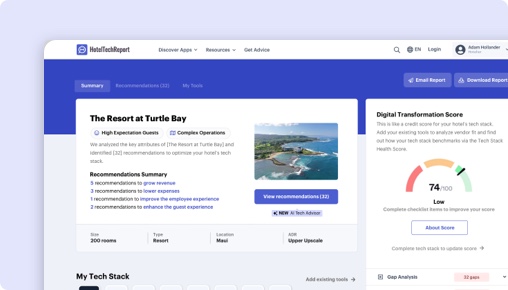
Sorry, this functionality is only available for verified hoteliers
The project dashboard is a free tool that is only available to verified hoteliers to make adopting new technology easier by streamlining their research and simplifying their communication workflow.

Adara (by RateGain) vs. Demand Booster:
Which Is Right for You?
TLDR
We analyzed 23 verified hotelier reviews, compared feature sets, pricing, and real-world case studies to break down where each platform delivers. The right choice depends on your property type and priorities:
RateGain stands out with exclusive features like Meta search marketing and Metasearch connectivity.
How Does Adara (by RateGain) Compare to Demand Booster?
Side-by-side ratings based on 23 verified hotelier reviews on HTR.
| HTScore |
|
|
| Likelihood to Recommend |
|
|
| Ease of Use |
|
|
| Customer Support |
|
|
| Value for Money |
|
|
| Starting Price | Contact sales | From $1,000/mo |
| Verified Reviews | 4 | 19 |
RateGain vs RateGain: Rankings by Hotel Segment
How each product ranks among Hotel Metasearch Management Software vendors for different property sizes, types, and regions — based on verified reviews from hoteliers in each segment.
By Hotel Size
| Segment |
RateGain
|
RateGain
|
|---|---|---|
| Small (10-24 rooms) | #10 2 reviews | #8 4 reviews |
| Mid-Size (25-74 rooms) ▾ | #9 2 reviews | #8 10 reviews |
| Large (75-199 rooms) ▾ | #10 0 reviews | #7 5 reviews |
| X-Large (200+ rooms) | #10 0 reviews | #9 0 reviews |
By Property Type
| Segment |
RateGain
|
RateGain
|
|---|---|---|
| Boutique ▾ | #10 2 reviews | #7 9 reviews |
| Luxury ▾ | #9 2 reviews | #7 8 reviews |
| Branded / Chain ▾ | #9 2 reviews | #8 6 reviews |
| Extended Stay | #7 1 reviews | #5 1 reviews |
By Region
| Segment |
RateGain
|
RateGain
|
|---|---|---|
| North America | #19 0 reviews | #12 0 reviews |
| Europe ▾ | #17 0 reviews | #8 13 reviews |
| Asia Pacific ▾ | #16 3 reviews | #2 5 reviews |
| Middle East | #12 1 reviews | #1 1 reviews |
Is Adara (by RateGain) or Demand Booster Better for Hotels?
Adara and Demand Booster both help hotels optimize metasearch marketing and direct booking performance, but they serve different operational priorities. Adara excels at transforming massive travel data sets into actionable marketing insights across multiple global brands, targeting loyalty and booking behavior with precision. Demand Booster focuses on boosting direct bookings through travel intent data and a unified distribution platform that integrates OTAs, metasearch, and booking engines.
Hotels seeking deep market intelligence and cross-platform audience targeting will find Adara’s data-driven marketing capabilities valuable. In contrast, properties aiming to increase direct booking share with a more hands-on demand management solution benefit more from Demand Booster’s end-to-end distribution and retargeting features. Both solve the metasearch challenge of driving profitable direct bookings but do so from complementary angles: Adara through insight and audience reach, Demand Booster through execution and conversion.
Adara vs Demand Booster: Which Should Your Hotel Choose?
If you run a boutique or branded hotel looking for comprehensive competitive pricing intelligence and cross-device audience targeting, Adara fits the profile, especially with its access to over 450 million monthly unique travel users and 9 billion travel searches annually. This is supported by perfect 5/5 ratings from boutique and branded hotel reviewers, though the review volume is limited (2 reviews per segment). Demand Booster, with 19 reviews and strong ratings across boutique (4.9/5 from 9 reviews), branded (4.9/5 from 6 reviews), and city center hotels (4.8/5 from 13 reviews), suits operators prioritizing direct booking growth through campaign management and retargeting.
For luxury hotels, both platforms perform well, but Adara’s luxury segment ratings are just slightly higher (5/5 from 2 reviews vs. Demand Booster’s 4.8/5 from 8 reviews). Demand Booster’s higher review volume across multiple segments, including bed & breakfasts and resorts, indicates broader adoption and trust among diverse property types.
Limited recent reviews (none in the last 6 months for either) constrain confidence in how current each product’s ratings are. However, Demand Booster’s 19 total reviews provide a more stable data set than Adara’s 4. Hotels heavily focused on direct conversion and campaign agility should lean toward Demand Booster based on review volume and integrated marketing features. Adara suits hotels emphasizing market intelligence and audience insights from global travel data.
Is Adara (by RateGain) or Demand Booster Easier to Use?
Demand Booster has an ease of use rating of 4.7/5 with onboarding at 4.6/5 across 19 reviews. Reviewers specifically praise its user-friendly interface and efficient campaign management workflows. Adara scores slightly lower with a 4.5/5 ease of use and 4.5/5 onboarding rating based on just 4 reviews. Reviewers mention a need for faster system refresh rates and some language support improvements, indicating room to streamline the user experience.
Both products receive positive feedback on staff adoption, with Demand Booster users highlighting motivated and patient support during onboarding, while Adara users confirm effective integration with PMS and channel managers but desire speed improvements.
Edge: Even.
Which Has Better Features: Adara (by RateGain) or Demand Booster?
Demand Booster offers six distinct features relevant to hotel metasearch management that Adara does not list: metasearch marketing, metasearch connectivity, metasearch surveillance, marketing dashboard, e-commerce consulting, and marketing dashboard (listed twice, likely emphasizing comprehensive dashboard functionality). These features enable hotels to monitor OTA parity, manage campaigns in a single interface, and receive expert consulting for optimizing online sales efforts.
Adara does not list unique features in the data provided, focusing instead on data-driven marketing and audience targeting powered by first-party travel data from over 100 global brands. This translates operationally into broader reach and precision targeting but lacks the direct campaign management tools found in Demand Booster.
The absence of shared features suggests different architectural focuses: Adara on data insights, Demand Booster on actionable marketing execution. For front desk and revenue teams, Demand Booster’s marketing dashboard and parity surveillance simplify daily rate checks and campaign adjustments, while Adara’s strength lies in informing strategic marketing decisions with rich data sets.
Edge: Demand Booster.
Which Has Better Customer Support: Adara (by RateGain) or Demand Booster?
Customer support ratings are 5/5 for Adara (4 reviews) and 4.9/5 for Demand Booster (19 reviews), with onboarding scores of 4.5/5 and 4.6/5 respectively. Both platforms receive praise for responsive and professional support.
Demand Booster reviewers highlight "super fast and friendly support," consistent availability, and proactive consultation that extends beyond campaign management. One user credits Demand Booster’s support for a 30% increase in direct bookings without increased marketing spend.
Adara users appreciate a committed support team that resolves issues promptly and helps ensure smooth booking integration but mention language support as an area to expand.
Given the larger sample size and consistent high marks for Demand Booster’s support responsiveness and consultation, both provide excellent support, but Demand Booster’s volume of positive feedback is more robust.
Edge: Even.
Which Has More Integrations: Adara (by RateGain) or Demand Booster?
Both products list 96 verified partner integrations with identical common partners including Hospitality Software Development Services (HSDS), RoomRaccoon, Profitroom, Mirai, BookLogic, Fairmas, VISIT, HOTELTIME, and apaleo GmbH. This parity means hotels can expect equal compatibility with major PMS, channel managers, and booking engines from either solution.
Demand Booster’s marketing claims reach to over 140 connected booking engines, which appears higher than Adara’s stated partners but the verified integration counts are the same. This may reflect differences in marketing partner counts versus verified technical integrations.
For hotels requiring broad connectivity to OTAs, metasearch, and channel managers, both products offer sufficient integration depth. Demand Booster’s unified distribution capability to OTAs, Meta platforms, and IBEs in under two minutes is operationally significant for rapid campaign adjustments.
Edge: Even.
Which Do Hoteliers Rate Higher: Adara (by RateGain) or Demand Booster?
Adara holds a slight overall rating edge at 4.9/5 (4 reviews) compared to Demand Booster’s 4.8/5 (19 reviews). The difference is marginal and review counts limit confidence for Adara.
Segment ratings reveal Adara scores perfect 5/5 in boutique, branded, luxury, resorts, and extended stay segments, though each from only 1-2 reviews. Demand Booster demonstrates high ratings from a larger sample across boutique (4.9/5, 9 reviews), branded (4.9/5, 6 reviews), city center (4.8/5, 13 reviews), luxury (4.8/5, 8 reviews), and bed & breakfast (4.7/5, 6 reviews).
No reviews have been posted in the last six months for either product, which means the current ratings reflect older versions. Demand Booster’s broader and more recent review base makes its 4.8 rating more representative of ongoing customer satisfaction.
Edge: Even.
How Much Do Adara (by RateGain) and Demand Booster Cost?
Adara does not publish pricing publicly. Demand Booster has a base price of $1,000 but no monthly flat fee or per-room pricing. Neither offers a trial period.
Demand Booster’s pricing model includes a "pay on the stay" commission option, which aligns costs directly to bookings and reduces upfront risk, an advantage for hotels wary of fixed fees. Adara’s pricing transparency is limited, which complicates cost comparisons.
For hotels prioritizing predictable budgeting and performance-based fees, Demand Booster’s model is clearer and potentially more cost-effective, especially for smaller properties.
What Type of Hotel Should Use Adara (by RateGain)?
- Hotels that need to leverage broad, cross-platform travel data to inform competitive pricing and marketing strategies.
- Teams focused on global brand awareness and audience targeting across multiple devices and channels.
- Properties with established marketing departments capable of interpreting complex data insights.
- City center and luxury hotels that value access to insights from over 100 global travel brands.
- Hotels aiming to complement existing channel management with advanced market intelligence.
Not ideal if...
- Your hotel requires direct campaign management and rapid distribution across multiple booking platforms.
- You need more frequent system refreshes or local language support, as some users cite these as limitations.
- You prefer transparent, consumption-based pricing models.
What Type of Hotel Should Use Demand Booster?
- Hotels with a focus on increasing direct bookings through targeted metasearch and unified distribution.
- Properties seeking a single system to manage campaigns across OTAs, metasearch, and booking engines in under two minutes.
- Teams that want parity and demand intelligence tools to monitor competitor pricing and optimize rate strategies.
- Hotels valuing responsive, consultative customer support with proven ROI like 30%+ direct booking increases.
- Boutique, branded, and city center hotels with diverse guest profiles and need for agile marketing campaigns.
Not ideal if...
- Your property primarily requires market intelligence and broad audience insights rather than campaign execution.
- You prefer solutions with publicly published pricing that includes freemium or flat monthly rates.
- You operate in segments with minimal review representation for Demand Booster, such as extended stay.
Adara (by RateGain) vs Demand Booster: The Bottom Line for Hotels
Adara and Demand Booster address hotel metasearch marketing from different but complementary angles. Adara’s strength lies in its vast proprietary travel data and audience targeting capabilities, offering hotels deep intelligence to shape pricing and marketing strategies. Demand Booster emphasizes direct booking growth through unified distribution, campaign management, and parity monitoring, backed by a larger base of hotel reviews and demonstrated ROI.
Choose Adara if your property prioritizes competitive pricing insights, global travel data access, and audience engagement through sophisticated data-driven marketing. Its perfect segment ratings in boutique and luxury hotels reflect its fit for hotels with mature marketing functions.
Choose Demand Booster if your hotel seeks a hands-on, operational tool that integrates campaign management across OTAs, metasearch, and booking engines quickly, with a transparent pricing model and strong customer support. Its broad adoption and positive feedback across segments support its role in driving direct booking performance.
The data supports a clear distinction: Adara is the platform for insight and reach; Demand Booster is the platform for execution and conversion. Your choice should align with whether your team wants to leverage data-driven marketing intelligence or boost direct revenue with integrated campaign tools.
Feature Comparison: Adara (by RateGain) vs Demand Booster
These are the features each vendor has configured, organized by feature group — the same data shown in the vendor dashboard. Expand a group to compare features side by side.
| Feature |
RateGain
|
RateGain
|
|---|---|---|
|
▾
Services
|
|
|
| E-commerce consulting | ||
| Metasearch Survelliance | ||
| Metasearch connectivity | ||
| Meta search marketing | ||
|
▾
Reporting & Analytics
|
|
|
| Marketing dashboard |
Real-World Results: RateGain vs RateGain by Business Goal
We analyzed 1 verified case studies to compare what hotels actually achieve with each platform across four key business objectives.
RateGain
No published case study for this goal yet.
Safir Hotels & Resorts
Mid-Size
"The partnership with RateGain has been transformative for Safir Hotels & Resorts, yielding 4x growth in our revenue."

RateGain vs RateGain: The Bottom Line
Ranks higher for
Unique capabilities
Frequently Asked Questions About Adara (by RateGain) vs Demand Booster
Can Adara (by RateGain) replace Demand Booster?
It depends on your requirements. Adara (by RateGain) and Demand Booster share many core Hotel Metasearch Management Software features, but each has unique capabilities. Adara (by RateGain) offers 96 verified integration partners, while Demand Booster offers 96. Review the feature comparison above to see where they differ before switching.
Which is better for small or independent hotels?
Small hotels should prioritize ease of use and fast onboarding. Demand Booster leads in ease of use at 4.7/5 vs 4.5/5. Look for transparent pricing and a trial or demo option. Filter reviews on each product page by property size to hear from hotels like yours.
Do Adara (by RateGain) or Demand Booster offer a free plan?
Adara (by RateGain): No. Demand Booster: No. Neither product currently offers a free tier. Most Hotel Metasearch Management Software vendors offer demos or trials — request one from each to evaluate before committing.
How Does HTR Evaluate and Rank Adara (by RateGain) and Demand Booster?
The HT Score is a composite ranking that considers 4 criteria groups and over a dozen variables to help hoteliers objectively compare hotel technology products. RateGain has an HT Score of 0 and RateGain has 0. Here is how the score is calculated.
| Criteria Group | Weight | What It Measures |
|---|---|---|
| Customer Ratings & Reviews |
|
How highly do users recommend this product? Ratings Score, Review Volume, Share of Voice, Review Depth, Review Recency, Success Stories ▾ The most heavily weighted factor. Analyzes average satisfaction ratings (likelihood to recommend, ease of use, support, ROI), total review count relative to category peers, review recency (at least 20 reviews in the trailing 6 months), and share of voice across unique hotel clients to detect selection bias. |
| Partner Ecosystem |
|
How highly do tech partners recommend this company? Partner Recommendations, Integration Quantity, Integration Quality ▾ Evaluates partner recommendations as expert votes of confidence, the number of verified integrations, and ecosystem quality — the average HT Scores of integration partners. Products with higher-quality integration ecosystems are more likely to deliver a connected tech stack. |
| Customer Centricity |
|
How customer-centric is this organization? Certified Support, Review Consistency, Profile Completeness ▾ Assesses whether the company has earned HTR Customer Support Certification, maintains consistent review collection over time (an indicator of feedback-driven culture), and keeps product profiles complete with capabilities, screenshots, pricing, and features. |
| Reach, Staying Power & Resources |
|
How extensive is this company's reach and resourcing? Geographic Reach, Staying Power, Company Resources, Trending Score ▾ Measures global presence (countries and regions served), years in business as a stability proxy, team headcount as a resource proxy, and a trending score based on trailing-twelve-month buyer inquiries, reviews, partner recommendations, and press activity. |
Customer ratings and reviews are by far the most important factor in the HT Score algorithm. HTR does not accept payment for higher rankings. All reviews are verified — only hotel industry practitioners with confirmed affiliations can submit ratings. View full HT Score methodology →
What Other Hotel Metasearch Management Software Comparisons Are Hoteliers Reading?
Explore more head-to-head comparisons based on verified hotelier reviews.






Contents
Get Your Free AI Analyst Report
Custom recommendations tailored to your property


Let´s lookup your hotel information
Still weighing your hotel metasearch management software options?
A few popular systems from our hotel metasearch management software guide — or let our AI score each one against your specific property in about two minutes.


