

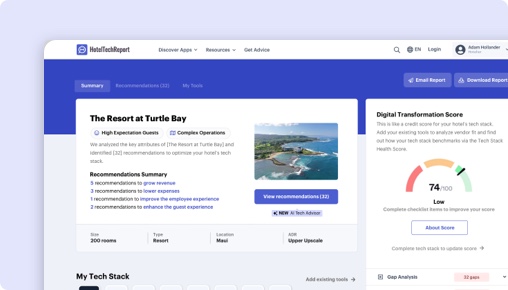
Sorry, this functionality is only available for verified hoteliers
The project dashboard is a free tool that is only available to verified hoteliers to make adopting new technology easier by streamlining their research and simplifying their communication workflow.

Bonomi vs. Duve - Communication Hub:
Which Is Right for You?

TLDR
We analyzed 853 verified hotelier reviews, compared feature sets, pricing, and real-world case studies to break down where each platform delivers. The right choice depends on your property type and priorities:
Bonomi stands out with exclusive features like Email to Chatbot Automation.
Duve shines in guest messaging / centralized communication — especially for motel properties (5.0/5), with exclusive features like Mobile Checkin and Guest Profiles.
How Does Bonomi Compare to Duve - Communication Hub?
Side-by-side ratings based on 853 verified hotelier reviews on HTR.
| HTScore |
|
|
| Likelihood to Recommend |
|
|
| Ease of Use |
|
|
| Customer Support |
|
|
| Value for Money |
|
|
| Starting Price | Contact sales | From $900/mo |
| Verified Reviews | 0 | 853 |
What Are the Pros and Cons of Bonomi vs Duve - Communication Hub?
After analyzing 853 verified reviews, Bonomi users most value its , while Duve users highlight guest messaging / centralized communication, guest app / digital guest journey personalization, upselling / ancillary revenue. Click any theme to see what reviewers say.
|
Bonomi
|
Duve
|
|---|---|
| Pros | |
|
+
Guest messaging / centralized communication
▾
|
|
|
+
Guest app / digital guest journey personalization
▾
|
|
|
+
Upselling / ancillary revenue
▾
|
|
|
+
Support / account management / implementation help
▾
|
|
| Cons | |
|
−
Usability / onboarding / configuration complexity
▾
|
|
|
−
PMS / system integrations and synchronization
▾
|
|
|
−
AI replies / AI agent / translation
▾
|
|
Bonomi vs Duve: Rankings by Hotel Segment
How each product ranks among Guest Messaging Software vendors for different property sizes, types, and regions — based on verified reviews from hoteliers in each segment.
By Hotel Size
| Segment |
Bonomi
|
Duve
|
|---|---|---|
| Small (10-24 rooms) ▾ | — | #1 168 reviews |
| Mid-Size (25-74 rooms) ▾ | — | #2 264 reviews |
| Large (75-199 rooms) ▾ | — | #2 201 reviews |
| X-Large (200+ rooms) ▾ | — | #2 76 reviews |
By Property Type
| Segment |
Bonomi
|
Duve
|
|---|---|---|
| Boutique ▾ | — | #2 303 reviews |
| Luxury ▾ | — | #2 344 reviews |
| Branded / Chain ▾ | — | #2 244 reviews |
| Extended Stay ▾ | — | #2 104 reviews |
By Region
| Segment |
Bonomi
|
Duve
|
|---|---|---|
| North America ▾ | — | #6 65 reviews |
| Europe ▾ | — | #1 308 reviews |
| Asia Pacific ▾ | — | #2 25 reviews |
| Middle East ▾ | — | #1 286 reviews |
Is Bonomi or Duve Better for Hotels?
Bonomi and Duve address guest messaging automation but diverge sharply in maturity, feature depth, and market presence. Duve suits properties seeking a comprehensive, multi-channel communication hub with extensive integration and upselling tools. Bonomi, newer and less proven, focuses on AI-driven automated messaging across many social platforms, ideal for hotels aiming for cutting-edge AI chat automation without deep operational integrations.
Both platforms solve the core problem of centralizing guest communication to reduce front desk workload and enhance guest experience. Duve achieves this with a broad, integrated toolset including mobile check-in and upsell management. Bonomi leans on AI conversational capabilities to automate inquiries across over 150 languages and channels, raising guest engagement and direct bookings.
Bonomi vs Duve: Which Should Your Hotel Choose?
If you operate a 20-room independent hotel seeking a readily deployable AI-first guest messaging solution that connects to popular social messaging apps like WhatsApp and Messenger but have limited PMS integration needs, Bonomi offers a novel approach—though its absence of verified reviews and integrations limits confidence. This applies especially if your focus is on multilingual automated conversations leveraging ChatGPT-4 technology.
If you run a medium to large hotel or chain with 50+ rooms, or need a fully integrated communication hub that consolidates email, SMS, WhatsApp, and in-app chat while enabling mobile check-in/out, upselling, and operational task management, Duve is the proven choice. Its 853 reviews averaging 4.7 overall and 188 recent reviews at 4.5 show strong current satisfaction. Its 72 verified partners and deep PMS integrations support scalability and operational efficiency.
Due to Bonomi’s lack of review data, recommendations for large or branded properties cannot be made confidently, whereas Duve’s extensive segment coverage and review volume establish it as a reliable choice for most hotel types.
Is Bonomi or Duve Easier to Use?
Duve’s ease of use rating is 4.7/5 with onboarding at 4.6/5, supported by 853 reviews including 188 in the last six months. Reviewers consistently cite convenience for guests and staff, but note initial configuration complexity due to feature richness. Bonomi has no recorded reviews to assess ease of use or onboarding, making its usability unknown in operational settings.
Front desk and guest service teams appreciate Duve’s centralized inbox and scheduled messaging workflows, which reduce manual effort while maintaining personalization. Bonomi’s AI-driven automation promises workload reduction but lacks user feedback to verify staff adoption or learning curve.
Edge: Even.
Which Has Better Features: Bonomi or Duve?
Duve offers 39 unique features beyond the 30 shared with Bonomi, transforming guest communication into an end-to-end experience platform. These include PMS integration, mobile check-in/out, payments, room service ordering, door lock integration, ID verification, upsell marketplace, charge to folio, and digital keys. This coverage enables operational workflows from pre-arrival to post-stay, crucial for front desk efficiency and guest autonomy.
Bonomi’s 11 exclusive features emphasize AI sophistication: self-learning NLP, customer profiling, customizable working hours, booking recovery campaigns, email-to-chatbot automation, and team KPI dashboards. These augment conversational AI responsiveness and allow personalized guest interactions 24/7 across many messaging apps, but do not extend to operational tools like payment capture or digital check-in.
For properties prioritizing operational breadth over AI chat automation, Duve’s feature set supports multiple departments including front desk, housekeeping, and revenue management. For hotels focused on AI-first message automation across social platforms with some custom routing and escalation, Bonomi’s features have potential but remain untested in user reviews.
Edge: Duve.
Which Has Better Customer Support: Bonomi or Duve?
Duve’s customer support scores 4.6/5 with onboarding also at 4.6/5 across 853 reviews. Positive feedback highlights responsive, professional assistance with implementation and ongoing issues. Some reviewers mention occasional slow responses and limited expertise on complex integrations, but the majority praise the support team’s dedication.
Bonomi has no reviews or ratings for support or onboarding, so no evidence exists about responsiveness or quality. This absence limits confidence in support reliability for hotels considering adoption.
Edge: Even.
Which Has More Integrations: Bonomi or Duve?
Duve has 72 verified integrations spanning PMS vendors like RoomRaccoon, apaleo, eviivo, Sirvoy, and property management and lock system providers. Shared partners with Bonomi are zero. Duve’s integrations enable data flow for reservations, payments, digital keys, and guest profiles, crucial for hotels wanting seamless backend operations.
Bonomi currently lists only one verified partner, SabeeApp, limiting its operational ecosystem significantly. Without broad PMS or channel manager integrations, Bonomi may require manual data handling or custom solutions, impeding scale and workflow automation.
Hotels with existing technology stacks that demand fast, reliable integrations should choose Duve. Smaller properties with simple setups might find Bonomi’s AI messaging useful but integration limitations are a serious consideration.
Edge: Duve.
Which Do Hoteliers Rate Higher: Bonomi or Duve?
Duve holds an overall rating of 4.7/5 from 853 reviews and 4.5/5 in the last six months from 188 reviews, indicating consistent satisfaction. It scores well across all hotel segments, with luxury, branded, resorts, and boutique hotels rating it 4.7 to 4.8 on 100+ reviews each. Even limited service and budget hotels rate it at 4.7/5 over 122 reviews.
Bonomi has no reviews or ratings, so no comparison can be drawn on guest or staff satisfaction.
Given the volume and recency of Duve’s ratings, hoteliers can rely on its proven performance and user satisfaction. Bonomi’s lack of data means its effectiveness remains unvalidated in real-world operations.
Edge: Even.
How Much Do Bonomi and Duve Cost?
Duve’s base price is published at $900 with no freemium, per-room, or implementation fees disclosed. This pricing reflects a significant investment aligned with its comprehensive feature set and enterprise-scale capabilities.
Bonomi does not publish any pricing information, including base, per-room, or implementation fees, nor offers a trial. This opacity complicates budgeting and comparison for prospective buyers.
Hotels seeking transparent cost frameworks will find Duve’s published pricing more actionable. Bonomi’s pricing model remains unknown.
What Type of Hotel Should Use Bonomi?
- Hotels that want to automate guest communications across multiple messaging apps including WhatsApp, Messenger, Viber, and Telegram.
- Teams aiming to leverage ChatGPT-4 AI to reduce repetitive inquiries and provide 24/7 personalized guest messaging in over 150 languages.
- Properties with minimal PMS integration needs or that use SabeeApp, Bonomi’s sole verified partner.
- Hotels focused on boosting direct reservations through AI-driven engagement rather than operational automation.
Not ideal if:
- Your property requires deep PMS integrations, digital check-in/out, or direct payment capture.
- You need proven customer support, onboarding, or operational reliability validated by user reviews.
- You require extensive upselling or task management capabilities integrated with guest messaging.
What Type of Hotel Should Use Duve?
- Medium and large hotels or chains seeking a unified communication hub across email, SMS, WhatsApp, and in-app chat.
- Hotels that want to automate and personalize pre-arrival, in-stay, and post-stay messaging, including upselling and guest segmentation.
- Properties needing strong PMS and third-party integrations to synchronize guest data, payments, and door lock systems.
- Teams that value mobile check-in/out, digital keys, and guest apps to reduce front desk workload and enhance guest experience.
Not ideal if:
- Your budget is limited, as Duve’s base price starts at $900 without published lower tiers.
- You operate a very small property without complex operational needs, where Duve’s extensive features might be underutilized.
- You prefer an AI-first chat automation platform focused solely on messaging over full guest experience management.
Bonomi vs Duve: The Bottom Line for Hotels
The core difference between Bonomi and Duve lies in their approach and maturity. Bonomi is an AI-first guest messaging platform emphasizing automated, multilingual chat across many social messaging channels using ChatGPT-4. Duve offers a mature, integrated communication hub that centralizes multi-channel messaging, mobile check-in/out, payments, and upselling, backed by extensive system integrations.
Choose Bonomi if your priority is AI-driven conversational automation on popular social messaging apps, and your property has limited integration requirements. This suits small to mid-sized hotels seeking to reduce staff workload via chatbots without proven full operational automation, though the lack of review data means unproven reliability.
Choose Duve if your hotel needs a comprehensive guest communication center that streamlines front desk operations, integrates deeply with PMS and door locks, and supports upselling and guest apps. Its strong ratings across hotel segments, large integration ecosystem, and documented case studies demonstrate value for mid-size to large properties aiming for operational efficiency and increased ancillary revenue.
Feature Comparison: Bonomi vs Duve - Communication Hub
These are the features each vendor has configured, organized by feature group — the same data shown in the vendor dashboard. Expand a group to compare features side by side.
| Feature |
Bonomi
|
Duve
|
|---|---|---|
|
▾
Unified Inbox
|
|
|
| Team Messaging | ||
| Broadcast Messaging | ||
| Desktop App (non-web based) | ||
| Photo Sharing | ||
| Mobile App | ||
| Mobile Friendly | ||
| Live Translations | ||
| Website Livechat | ||
|
▾
Multi-Channel
|
|
|
| Whatsapp Integration | ||
| Facebook Messenger Integration | ||
| SMS text messaging | ||
| Website Livechat | ||
|
▾
Automation
|
|
|
| Message Routing | ||
| Automated Replies | ||
| Chatbot Booking Agent | ||
| Broadcast Messaging | ||
| Upsell Fulfillment Tracking | ||
| Open API | ||
| Automated Workflows | ||
|
▾
Upselling & Ancillaries
|
|
|
| Upsell Marketplace | ||
| Offer Campaigns | ||
| Upsell Fulfillment Tracking | ||
| Purchase Links | ||
| Charge to Folio | ||
| Room Upgrades Campaigns | ||
| Upselling Campaigns | ||
|
▾
Task & Request Management
|
|
|
| Ticketing System | ||
| Tasks & Checklists | ||
| Inspections | ||
| Recurring Tasks | ||
| Upsell Fulfillment Tracking | ||
|
▾
Surveys & Feedback
|
|
|
| Messaging Guest Surveys | ||
| TripAdvisor Review Partner | ||
| Guest Reviews Campaigns | ||
|
▾
Reporting & Analytics
|
|
|
| Analytics dashboard | ||
| Guest History | ||
| Upsell Fulfillment Tracking | ||
| Team KPIs Dashboard | ||
| Custom Goal Setting | ||
|
▾
Compliance & Privacy
|
|
|
| Automated Opt-In/Consent Collection | ||
| Secured Data Protection | ||
| Open API | ||
|
▾
Digital Registration & Check-in
|
|
|
| Document & Passport Scanning | ||
| Credit Card Authorization | ||
| Mobile Keys | ||
| Custom Fields | ||
|
▾
Pre-Stay
|
|
|
| Chatbot Booking Agent | ||
| Booking Recovery Campaigns | ||
| Behavioral Marketing Campaigns | ||
| Email to Chatbot Automation | ||
| Smooth Handover to Human Agents | ||
| Click to Call | ||
| Lead Qualification | ||
| OTA Price Comparison | ||
| Interface Personalization | ||
|
▾
In-Stay & Post Stay
|
|
|
| Digital Check-in | ||
| Room Upgrades Campaigns | ||
| Upselling Campaigns | ||
| Automated Workflows | ||
| Custom Routing and Escalations | ||
| Pre-programmed Guest Notifications | ||
| Guest Reviews Campaigns | ||
| Retention Campaigns | ||
|
▾
Back-Office
|
|
|
| Unified Omnichannel Inbox | ||
| Status Tabs in Inbox Navigation | ||
| Assigning Agents | ||
| Canned Responses | ||
| User Profile Customizations | ||
| Multi Property Management | ||
| Customizable Working Hours | ||
| Unlimited Users | ||
|
▾
Artificial Intelligence
|
|
|
| Chatbot Booking Agent | ||
| Sentiment Analysis | ||
| Self-Learning NLP | ||
| Syntax & Semantic Analysis | ||
| Behavioral Analysis | ||
| Customer Profiling | ||
| Prediction & Forecasting |
Real-World Results: Bonomi vs Duve by Business Goal
We analyzed 8 verified case studies to compare what hotels actually achieve with each platform across four key business objectives.
Bonomi
No published case study for this goal yet.
סטאי תל אביב - The Setai, Tel Aviv
Large
"Duve was a game changer for our customer service. I knew the platform would help us connect with guests but I was amazed at how cleverly simple it all is, even guests who are not v..."
 Bonomi
No published case study for this goal yet.
Brown Hotels
Large
"While scaling up and growing in terms of more hotel rooms and more hotels in different countries we found it difficult to communicate with our guests in a very personal way. Duve f..."

Bonomi vs Duve: The Bottom Line
Unique capabilities
What hoteliers love
Reviewers most often say Duve centralizes guest communication in one hub, making it easier to handle questions, requests, and follow-ups across the st... Reviewers most often say Duve centralizes guest communication in one hub, making it easier to handle questions, requests, and follow-ups across the stay. Hotels value the speed and convenience of replying through multiple channels like WhatsApp, SMS, email, and in-app chat without juggling separate tools.
The guest app is valued as a branded, self-service touchpoint where guests can view hotel services, order items, and manage parts of their stay from o... The guest app is valued as a branded, self-service touchpoint where guests can view hotel services, order items, and manage parts of their stay from one place. Reviewers also want more flexibility in branding, layouts, category management, and content organization, especially for multi-property groups.
Upselling is one of Duve's biggest commercial use cases, with many hotels saying it helps convert room upgrades, late checkout, amenities, and service... Upselling is one of Duve's biggest commercial use cases, with many hotels saying it helps convert room upgrades, late checkout, amenities, and service offers into extra revenue. Reviewers like that Duve surfaces these offers before arrival and during the stay, making upsell more natural and less labor-intensive for staff.
Where hoteliers push back
While many reviewers find Duve easy to use, others say setup and ongoing configuration can be confusing, especially for new users or multi-property te... While many reviewers find Duve easy to use, others say setup and ongoing configuration can be confusing, especially for new users or multi-property teams. The most common friction points are unclear workflows, too many settings, and a need for better guidance when customizing the system for hotel-specific operations.
Integration with PMS and other hotel systems is a major theme: when it works, it removes manual entry and keeps guest details flowing into operations.... Integration with PMS and other hotel systems is a major theme: when it works, it removes manual entry and keeps guest details flowing into operations. But many reviewers report sync delays, compatibility issues, limited editability from PMS data, or difficulty connecting to systems like Opera, Mews, Cloudbeds, Protel, and other tools.
Unique capabilities
Frequently Asked Questions About Bonomi vs Duve - Communication Hub
Can Bonomi replace Duve - Communication Hub?
It depends on your requirements. Bonomi and Duve - Communication Hub share many core Guest Messaging Software features, but each has unique capabilities. Bonomi offers 1 verified integration partners, while Duve - Communication Hub offers 72. Review the feature comparison above to see where they differ before switching.
Do Bonomi or Duve - Communication Hub offer a free plan?
Bonomi: No. Duve - Communication Hub: No. Neither product currently offers a free tier. Most Guest Messaging Software vendors offer demos or trials — request one from each to evaluate before committing.
How Does HTR Evaluate and Rank Bonomi and Duve - Communication Hub?
The HT Score is a composite ranking that considers 4 criteria groups and over a dozen variables to help hoteliers objectively compare hotel technology products. Bonomi has an HT Score of 0 and Duve has 98. Here is how the score is calculated.
| Criteria Group | Weight | What It Measures |
|---|---|---|
| Customer Ratings & Reviews |
|
How highly do users recommend this product? Ratings Score, Review Volume, Share of Voice, Review Depth, Review Recency, Success Stories ▾ The most heavily weighted factor. Analyzes average satisfaction ratings (likelihood to recommend, ease of use, support, ROI), total review count relative to category peers, review recency (at least 20 reviews in the trailing 6 months), and share of voice across unique hotel clients to detect selection bias. |
| Partner Ecosystem |
|
How highly do tech partners recommend this company? Partner Recommendations, Integration Quantity, Integration Quality ▾ Evaluates partner recommendations as expert votes of confidence, the number of verified integrations, and ecosystem quality — the average HT Scores of integration partners. Products with higher-quality integration ecosystems are more likely to deliver a connected tech stack. |
| Customer Centricity |
|
How customer-centric is this organization? Certified Support, Review Consistency, Profile Completeness ▾ Assesses whether the company has earned HTR Customer Support Certification, maintains consistent review collection over time (an indicator of feedback-driven culture), and keeps product profiles complete with capabilities, screenshots, pricing, and features. |
| Reach, Staying Power & Resources |
|
How extensive is this company's reach and resourcing? Geographic Reach, Staying Power, Company Resources, Trending Score ▾ Measures global presence (countries and regions served), years in business as a stability proxy, team headcount as a resource proxy, and a trending score based on trailing-twelve-month buyer inquiries, reviews, partner recommendations, and press activity. |
Customer ratings and reviews are by far the most important factor in the HT Score algorithm. HTR does not accept payment for higher rankings. All reviews are verified — only hotel industry practitioners with confirmed affiliations can submit ratings. View full HT Score methodology →
What Other Guest Messaging Software Comparisons Are Hoteliers Reading?
Explore more head-to-head comparisons based on verified hotelier reviews.






Contents
Get Your Free AI Analyst Report
Custom recommendations tailored to your property


Let´s lookup your hotel information
Still weighing your guest messaging software options?
A few popular systems from our guest messaging software guide — or let our AI score each one against your specific property in about two minutes.


