

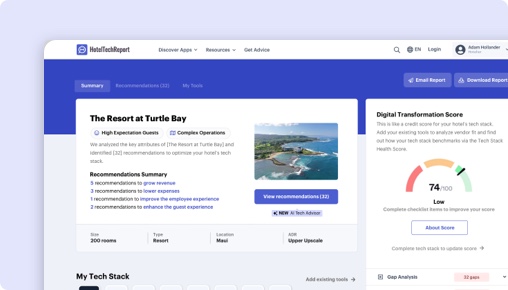
Sorry, this functionality is only available for verified hoteliers
The project dashboard is a free tool that is only available to verified hoteliers to make adopting new technology easier by streamlining their research and simplifying their communication workflow.

Cloudbeds Channel Manager vs. D-EDGE - Smart Channel Manager:
Which Is Right for You?


TLDR
We analyzed 1,668 verified hotelier reviews, compared feature sets, pricing, and real-world case studies to break down where each platform delivers. The right choice depends on your property type and priorities:
Cloudbeds shines in calendar and reservation management — especially for bed & breakfast properties (4.6/5), with exclusive features like Centralized user & role management and Unlimited Channels (no additional cost).
D-Edge shines in support and training — especially for vacation rental properties (4.8/5), with exclusive features like Meta search marketing and Metasearch connectivity.
How Does Cloudbeds Channel Manager Compare to D-EDGE - Smart Channel Manager?
Side-by-side ratings based on 1,668 verified hotelier reviews on HTR.
| HTScore |
|
|
| Likelihood to Recommend |
|
|
| Ease of Use |
|
|
| Customer Support |
|
|
| Value for Money |
|
|
| Starting Price | From $200/mo | Contact sales |
| Verified Reviews | 1,447 | 221 |
What Are the Pros and Cons of Cloudbeds Channel Manager vs D-EDGE - Smart Channel Manager?
After analyzing 1,668 verified reviews, Cloudbeds users most value its calendar and reservation management, channel distribution and ota synchronization, reporting, analytics, and dashboards, while D-Edge users highlight support and training, channel manager, rate and availability management. Click any theme to see what reviewers say.
|
Cloudbeds
|
D-Edge
|
|---|---|
| Pros | |
|
+
Calendar and reservation management
▾
|
+
Support and Training
▾
|
|
+
Channel distribution and OTA synchronization
▾
|
+
Channel Manager
▾
|
|
+
Reporting, analytics, and dashboards
▾
|
+
Rate and Availability Management
▾
|
|
+
Direct booking engine and website/digital guest engagement
▾
|
+
Booking Engine
▾
|
| Cons | |
|
−
Support responsiveness and access to humans
▾
|
−
Self-Mapping
▾
|
|
−
Payments, deposits, and billing/invoicing
▾
|
−
Little Yielder
▾
|
|
−
Mobile app limitations
▾
|
|
Cloudbeds vs D-Edge: Rankings by Hotel Segment
How each product ranks among Channel Managers vendors for different property sizes, types, and regions — based on verified reviews from hoteliers in each segment.
By Hotel Size
| Segment |
Cloudbeds
|
D-Edge
|
|---|---|---|
| Small (10-24 rooms) ▾ | #2 675 reviews | #8 84 reviews |
| Mid-Size (25-74 rooms) ▾ | #5 179 reviews | #7 91 reviews |
| Large (75-199 rooms) ▾ | #4 48 reviews | #7 28 reviews |
| X-Large (200+ rooms) ▾ | #11 4 reviews | #9 5 reviews |
By Property Type
| Segment |
Cloudbeds
|
D-Edge
|
|---|---|---|
| Boutique ▾ | #2 566 reviews | #7 77 reviews |
| Luxury ▾ | #4 230 reviews | #6 64 reviews |
| Branded / Chain ▾ | #4 117 reviews | #7 39 reviews |
| Extended Stay ▾ | #2 99 reviews | #7 21 reviews |
By Region
| Segment |
Cloudbeds
|
D-Edge
|
|---|---|---|
| North America ▾ | #1 441 reviews | #30 3 reviews |
| Europe ▾ | #4 188 reviews | #5 181 reviews |
| Asia Pacific ▾ | #4 342 reviews | #9 27 reviews |
| Middle East ▾ | #7 15 reviews | #20 3 reviews |
Is Cloudbeds Channel Manager or D-EDGE - Smart Channel Manager Better for Hotels?
Cloudbeds and D-EDGE both serve hotels by centralizing distribution across OTAs, syncing rates and availability, and reducing overbookings. Cloudbeds stands out for its extensive user base of 1,428 reviews, recent active feedback, and a broad global presence covering 109 countries. Its platform integrates property management, booking engines, and AI-powered revenue tools into a unified system. D-EDGE, with 221 reviews and no new reviews in the last six months, focuses heavily on channel distribution and data analytics but lacks recent user feedback reflecting its current state.
Cloudbeds fits properties prioritizing scalability, multi-property management, and integration depth, supporting mostly boutique hotels, hostels, and B&Bs worldwide. D-EDGE targets hotels emphasizing metasearch marketing and data-driven rate optimization, with a user base concentrated in Europe, Asia Pacific, and Africa. Both solve the core problem of OTA inventory synchronization to prevent double bookings and manual rate updates, but Cloudbeds delivers a more comprehensive operational ecosystem beyond channel management.
Cloudbeds Channel Manager vs D-EDGE - Smart Channel Manager: Which Should Your Hotel Choose?
If you operate a small to mid-sized independent hotel or hostel anywhere globally, especially outside Europe, Cloudbeds is the better choice based on 1,428 reviews reflecting its performance in 109 countries and across diverse hotel segments. Its ease of use, multi-property tools, unlimited channels without added fees, and integrated PMS make it ideal for properties seeking operational simplicity and growth flexibility.
If your property is a branded or resort hotel in Europe or Asia Pacific, and metasearch marketing or advanced data analytics are priorities, D-EDGE’s specialized features like metasearch surveillance and marketing dashboards could add value. However, with only 221 reviews and no recent feedback, the evidence for current user satisfaction is limited. Small properties should note D-EDGE’s pricing concerns raised in reviews, making Cloudbeds generally more cost-transparent.
For luxury hotels and airport/conference hotels, both have comparable ratings, but Cloudbeds has a more substantial review volume (230 luxury hotel reviews vs. 64 for D-EDGE), offering greater confidence in its fit. Hotels focused on maximizing direct bookings and integrating PMS with channel management benefit more from Cloudbeds’ unified platform.
Is Cloudbeds Channel Manager or D-EDGE - Smart Channel Manager Easier to Use?
Both platforms score equally on ease of use and onboarding, each rated 4.6 and 4.5 out of 5 respectively. Cloudbeds’ 1,428 reviews include numerous mentions of an intuitive interface and straightforward reservation management, with front desk teams appreciating drag-and-drop booking adjustments and quick editing capabilities. However, some staff training challenges arise around advanced features and mobile app limitations.
D-EDGE users find the interface generally intuitive and appreciate fast reservation processing, but critiques appear regarding the clutter in rate and inventory updates and the complexity of self-mapping new channels. Reviewers also suggest the need for more online training resources and a cleaner UI to reduce onboarding friction.
Given the volume and detail of positive Cloudbeds feedback on usability and the equal ease-of-use ratings, the operational experience slightly favors Cloudbeds for hotels with multi-role front desk teams needing quick, reliable daily workflows.
Edge: Even.
Which Has Better Features: Cloudbeds Channel Manager or D-EDGE - Smart Channel Manager?
Cloudbeds offers 3 unique features not found in D-EDGE: centralized user and role management, unlimited channels with no additional cost, and derived rates allowing for automated rate hierarchies. These features improve operational control for managers, simplify multi-user environments, and enable sophisticated rate strategies that front desk and revenue teams can manage without switching systems.
D-EDGE includes 5 distinct features: metasearch marketing, metasearch connectivity, metasearch surveillance, e-commerce consulting, and a marketing dashboard. These tools provide marketing teams and revenue managers with data-driven insights and direct control over metasearch campaigns, which can drive higher visibility on Google Hotel Ads and similar platforms.
Both share 14 core channel management features like two-way OTA connectivity and rate synchronization, but Cloudbeds’ unlimited channel support reduces cost friction for properties adding new distribution partners. D-EDGE’s metasearch tools are valuable if your hotel aggressively invests in that channel segment.
Edge: Cloudbeds.
Which Has Better Customer Support: Cloudbeds Channel Manager or D-EDGE - Smart Channel Manager?
Cloudbeds holds a 4.4 rating for customer support and 4.5 for onboarding from 1,428 reviews, while D-EDGE scores 4.6 and 4.5 respectively with 221 reviews. Both platforms enjoy strong overall support ratings, but Cloudbeds reviews reveal mixed experiences: many praise fast, knowledgeable chat help and onboarding resources, while a subset criticize slow email responses and the lack of immediate phone support during critical outages.
D-EDGE users commend account management and quick support but highlight occasional unclear communication and slower responses during peak seasons. Some note the need for more training materials to handle complex features independently.
Given the comparable scores and volume, both vendors provide solid support, though Cloudbeds’ larger client base suggests a more extensive support infrastructure. However, neither clearly outperforms the other.
Edge: Even.
Which Has More Integrations: Cloudbeds Channel Manager or D-EDGE - Smart Channel Manager?
Cloudbeds integrates with 208 verified partners, nearly double D-EDGE’s 117, with 45 shared integrations including key industry players like HOTELTIME, HiJiffy, and Bookassist. Cloudbeds’ exclusive integrations include specialized tools like FLEXIPASS Keyless Mobile Access, ManCloud, and WebRezPro PMS, supporting hoteliers who prioritize operational breadth across access control, event management, and property management.
D-EDGE’s unique partners focus more on revenue analytics, e-commerce, guest experience platforms like Customer Alliance, and digital marketing specialists such as ROIBACK and Mirai, aligning with hotels emphasizing marketing and revenue optimization.
Hotels seeking a broader ecosystem for operational, booking, and revenue tools will benefit from Cloudbeds’ deeper integration network, especially multi-property and boutique operators. Those focused on marketing and metasearch may find D-EDGE’s integrations more targeted.
Edge: Cloudbeds.
Which Do Hoteliers Rate Higher: Cloudbeds Channel Manager or D-EDGE - Smart Channel Manager?
Both products share an overall rating of 4.6/5. However, Cloudbeds’ 1,428 reviews with 175 in the last six months reflect a recent rating increase to 4.8/5, indicating growing user satisfaction. D-EDGE’s 221 reviews lack recent activity, and therefore its overall rating may not reflect current product performance.
Segment ratings favor Cloudbeds for bed & breakfasts, boutique hotels, hostels, and resorts, with 4.6+ across hundreds of reviews. D-EDGE scores similarly high for luxury hotels (4.7/5 from 64 reviews) and airport/conference hotels (4.7/5 from 37 reviews), but these segments have fewer reviews, reducing confidence.
Cloudbeds’ extensive and recent review volume provides stronger evidence of consistent satisfaction across diverse hotel types, whereas D-EDGE’s ratings, while positive, rest on less recent and fewer reviews.
Edge: Cloudbeds.
How Much Do Cloudbeds Channel Manager and D-EDGE - Smart Channel Manager Cost?
Cloudbeds publishes a clear base price of $200 without additional fees for implementation, monthly flat charges, or per-room fees. There is no freemium or trial period. This transparent pricing model allows hotels to budget predictably without hidden costs.
D-EDGE does not publicly disclose pricing details, offering no clear base price or fee structure. Reviews mention concerns regarding high pricing and extra fees for new channel mappings, which could increase costs unpredictably, especially for smaller hotels.
Without published pricing from D-EDGE, Cloudbeds’ transparent $200 base fee positions it as the more straightforward and potentially cost-effective choice for budget-conscious properties.
What Type of Hotel Should Use Cloudbeds Channel Manager?
- Hotels that operate across multiple properties and require centralized user and role management.
- Properties aiming to grow direct bookings while managing OTA distribution with unlimited channels at no extra cost.
- Boutique hotels, hostels, and bed & breakfasts with diverse operational needs and a preference for an all-in-one PMS, booking engine, and channel manager.
- Hotels prioritizing AI-driven revenue management tools and dynamic pricing integrated within their distribution platform.
- Teams seeking strong global support and a large integration marketplace for property management, keyless entry, and event solutions.
Not ideal if:
- Your property frequently experiences internet outages and needs offline functionality, as Cloudbeds is fully cloud-based without local backup modes.
- You require advanced metasearch marketing and surveillance tools natively integrated into the channel manager.
- You want a mobile app with full operational parity for front desk and revenue management tasks.
What Type of Hotel Should Use D-EDGE - Smart Channel Manager?
- Hotels with a primary focus on metasearch marketing and campaign management, benefiting from features like metasearch connectivity and surveillance.
- Properties located mainly in Europe, Asia Pacific, or Africa that want a channel manager with strong regional OTA coverage.
- Hotels looking for detailed data analytics and marketing dashboards to support revenue teams in dynamic pricing and distribution strategy.
- Branded, resort, and airport/conference hotels that need integration with specialized marketing and e-commerce consulting services.
- Teams comfortable managing integrations and mappings but seeking enhanced automation in rate management.
Not ideal if:
- You run a small independent hotel concerned about pricing transparency and extra fees for new channel connections.
- You need frequent and recent software updates backed by active user communities and reviews.
- Your team requires a highly intuitive, streamlined interface with extensive onboarding and training resources.
Cloudbeds Channel Manager vs D-EDGE - Smart Channel Manager: The Bottom Line for Hotels
Cloudbeds and D-EDGE both centralize channel management and rate synchronization but diverge sharply in scope and operational depth. Cloudbeds offers a unified platform combining PMS, channel management, booking engine, and AI-powered revenue tools, supporting hotels worldwide with scalable, easy-to-use features and broad integrations. D-EDGE specializes in metasearch marketing and data analytics, focusing on European and Asia Pacific markets with tools aimed at marketing and revenue teams.
Choose Cloudbeds if you want a comprehensive all-in-one system that supports unlimited channels without extra fees, centralized user management, and a proven record with 1,428 recent reviews confirming ease of use and satisfaction. Cloudbeds suits small to medium independent hotels, hostels, and boutique properties aiming to grow direct bookings and improve operational efficiency.
Opt for D-EDGE if your hotel prioritizes metasearch marketing, advanced data analytics, and marketing consultancy services, particularly in Europe or Asia Pacific, and you have resources to manage the less transparent pricing and occasional interface complexity. D-EDGE fits hotels focused on maximizing visibility through metasearch and leveraging specialized marketing dashboards.
The volume and recency of Cloudbeds’ reviews, its feature set, and integration ecosystem provide stronger evidence for its operational advantages and user satisfaction. D-EDGE remains a viable choice where metasearch marketing is a strategic priority and regional presence is critical.
Feature Comparison: Cloudbeds Channel Manager vs D-EDGE - Smart Channel Manager
These are the features each vendor has configured, organized by feature group — the same data shown in the vendor dashboard. Expand a group to compare features side by side.
| Feature |
Cloudbeds
|
D-Edge
|
|---|---|---|
|
▾
Rate Management
|
|
|
| Support for Weekly & Monthly Rates | ||
| Yield Rules | ||
| Derived Rates | ||
| Inventory Management | ||
| Inventory grid | ||
|
▾
Room Type Mapping
|
|
|
| Channel Self-Mapping | ||
|
▾
Automation & Syncing
|
|
|
| Bulk Updates & Multiple Restrictions | ||
| 2-way real time integrations | ||
| PMS connectivity | ||
|
▾
Administration & Settings
|
|
|
| Multi-lingual | ||
| Centralized user & role management | ||
| Multi-Currency Support | ||
| Inventory grid | ||
| Integrated Payment Processing | ||
|
▾
Analytics & Reporting
|
|
|
| Analytics dashboard | ||
| Booking Performance and Pace Reporting | ||
|
▾
Other
|
|
|
| Unlimited Channels (no additional cost) |
Real-World Results: Cloudbeds vs D-Edge by Business Goal
We analyzed 8 verified case studies to compare what hotels actually achieve with each platform across four key business objectives.
Himmapana Villas
Mid-Size
"I have not worked with a company that has such good customer service as Cloudbeds has. It's miles ahead."
 D-Edge
No published case study for this goal yet.
Flor Parks
Small
"The biggest benefit of Cloudbeds' platform is its flexibility. I can access reporting online from anywhere. Everything is smoother with Cloudbeds."
D-Edge
No published case study for this goal yet.
The Pad Silverthorne
Small
"Cloudbeds is like if Apple made a property management system. The ease of use is super simple and straightforward for guests and our staff. It’s very intuitive and just makes sense..."
 D-Edge
No published case study for this goal yet.
Cloudbeds vs D-Edge: The Bottom Line
What hoteliers love
The calendar is repeatedly described as the core daily-work tool for front desk teams because it makes it easy to see room status, move bookings, adju... The calendar is repeatedly described as the core daily-work tool for front desk teams because it makes it easy to see room status, move bookings, adjust dates, and manage check-in/check-out. Users like that it simplifies reservation handling and room blocking, though some want split stays, room changes, notes, and editing to be smoother and less error-prone.
Reviewers most often praise Cloudbeds for keeping rates, availability, and reservations synced across OTAs from one place. This reduces manual updates... Reviewers most often praise Cloudbeds for keeping rates, availability, and reservations synced across OTAs from one place. This reduces manual updates, lowers overbooking risk, and saves staff time spent jumping between extranets. A few reviews note occasional sync delays or visibility issues when updates are pending.
Many reviewers value Cloudbeds’ reporting because it helps them track occupancy, revenue, KPIs, and performance across channels. However, users consis... Many reviewers value Cloudbeds’ reporting because it helps them track occupancy, revenue, KPIs, and performance across channels. However, users consistently ask for more customizable, interactive, and faster reports, especially for revenue management, financial analysis, and property-specific views. Several mention that the current reports are useful but can feel hard to search, slow to download, or too spreadsheet-like.
Where hoteliers push back
Support is a major concern in the reviews: some users praise fast chat help, onboarding, and knowledge resources, while others strongly criticize dela... Support is a major concern in the reviews: some users praise fast chat help, onboarding, and knowledge resources, while others strongly criticize delayed email responses and chatbot-first workflows. The most common complaint is the lack of immediate phone support for urgent operational issues, which hotels feel directly affects guest service and revenue when systems break. A smaller group appreciates responsive, knowledgeable agents and solid implementation help.
Cloudbeds is valued for integrated payments, deposit collection, and the ability to handle charges directly in the workflow. This helps hotels secure... Cloudbeds is valued for integrated payments, deposit collection, and the ability to handle charges directly in the workflow. This helps hotels secure bookings, speed up check-in, and keep payment data connected to reservations. But several reviewers want stronger local billing/tax support, better invoice handling, more payment processor options, and smoother payment setup.
Ranks higher for
Unique capabilities
What hoteliers love
While D-Edge generally receives positive feedback on account management and support services, some users have pointed out delays in response times, pa... While D-Edge generally receives positive feedback on account management and support services, some users have pointed out delays in response times, particularly during peak seasons. There are suggestions to offer more online training resources and videos to help users navigate complex features more effectively.
The Channel Manager is praised for its simplicity, real-time synchronization, and broad connectivity with many OTAs. The platform enables users to man... The Channel Manager is praised for its simplicity, real-time synchronization, and broad connectivity with many OTAs. The platform enables users to manage multiple properties effortlessly from a single interface. However, some have noted the need for improved self-mapping capabilities and quicker updates on rate changes.
Users appreciate D-Edge's efficient handling of rates and inventory, making it easy to update and manage pricing strategies. This feature significantl... Users appreciate D-Edge's efficient handling of rates and inventory, making it easy to update and manage pricing strategies. This feature significantly reduces the time spent on manual updates and helps avoid overbooking, making the platform suitable for real-time rate adjustments and minimizing errors.
Where hoteliers push back
Self-mapping is highlighted as an area needing enhancement. Several users note difficulties with mapping new channels and recommend making this proces... Self-mapping is highlighted as an area needing enhancement. Several users note difficulties with mapping new channels and recommend making this process more user-friendly and error-resistant. Increased autonomy in managing self-mapping without requiring support intervention is a common request.
Users mention that while the Little Yielder tool is innovative and helps manage room rates automatically, it still has room for improvement. Suggestio... Users mention that while the Little Yielder tool is innovative and helps manage room rates automatically, it still has room for improvement. Suggestions include adding more functionalities like reopening rates when availability increases and integrating more dynamic pricing options.
Ranks higher for
Unique capabilities
Frequently Asked Questions About Cloudbeds Channel Manager vs D-EDGE - Smart Channel Manager
Can Cloudbeds Channel Manager replace D-EDGE - Smart Channel Manager?
It depends on your requirements. Cloudbeds Channel Manager and D-EDGE - Smart Channel Manager share many core Channel Managers features, but each has unique capabilities. Cloudbeds Channel Manager offers 208 verified integration partners, while D-EDGE - Smart Channel Manager offers 117. Review the feature comparison above to see where they differ before switching.
Which is better for small or independent hotels?
Small hotels should prioritize ease of use and fast onboarding. Cloudbeds Channel Manager leads in ease of use at 4.6/5 vs 4.6/5. Look for transparent pricing and a trial or demo option. Filter reviews on each product page by property size to hear from hotels like yours.
Do Cloudbeds Channel Manager or D-EDGE - Smart Channel Manager offer a free plan?
Cloudbeds Channel Manager: No. D-EDGE - Smart Channel Manager: No. Neither product currently offers a free tier. Most Channel Managers vendors offer demos or trials — request one from each to evaluate before committing.
How Does HTR Evaluate and Rank Cloudbeds Channel Manager and D-EDGE - Smart Channel Manager?
The HT Score is a composite ranking that considers 4 criteria groups and over a dozen variables to help hoteliers objectively compare hotel technology products. Cloudbeds has an HT Score of 98 and D-Edge has 71. Here is how the score is calculated.
| Criteria Group | Weight | What It Measures |
|---|---|---|
| Customer Ratings & Reviews |
|
How highly do users recommend this product? Ratings Score, Review Volume, Share of Voice, Review Depth, Review Recency, Success Stories ▾ The most heavily weighted factor. Analyzes average satisfaction ratings (likelihood to recommend, ease of use, support, ROI), total review count relative to category peers, review recency (at least 20 reviews in the trailing 6 months), and share of voice across unique hotel clients to detect selection bias. |
| Partner Ecosystem |
|
How highly do tech partners recommend this company? Partner Recommendations, Integration Quantity, Integration Quality ▾ Evaluates partner recommendations as expert votes of confidence, the number of verified integrations, and ecosystem quality — the average HT Scores of integration partners. Products with higher-quality integration ecosystems are more likely to deliver a connected tech stack. |
| Customer Centricity |
|
How customer-centric is this organization? Certified Support, Review Consistency, Profile Completeness ▾ Assesses whether the company has earned HTR Customer Support Certification, maintains consistent review collection over time (an indicator of feedback-driven culture), and keeps product profiles complete with capabilities, screenshots, pricing, and features. |
| Reach, Staying Power & Resources |
|
How extensive is this company's reach and resourcing? Geographic Reach, Staying Power, Company Resources, Trending Score ▾ Measures global presence (countries and regions served), years in business as a stability proxy, team headcount as a resource proxy, and a trending score based on trailing-twelve-month buyer inquiries, reviews, partner recommendations, and press activity. |
Customer ratings and reviews are by far the most important factor in the HT Score algorithm. HTR does not accept payment for higher rankings. All reviews are verified — only hotel industry practitioners with confirmed affiliations can submit ratings. View full HT Score methodology →
What Other Channel Managers Comparisons Are Hoteliers Reading?
Explore more head-to-head comparisons based on verified hotelier reviews.


Get Your Free AI Analyst Report
Custom recommendations tailored to your property


Let´s lookup your hotel information
Still weighing your channel managers options?
A few popular systems from our channel managers guide — or let our AI score each one against your specific property in about two minutes.


