

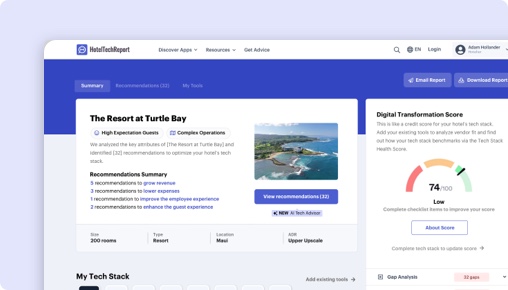
Sorry, this functionality is only available for verified hoteliers
The project dashboard is a free tool that is only available to verified hoteliers to make adopting new technology easier by streamlining their research and simplifying their communication workflow.

HIA ERP & Accounting by Hotel Investor Apps vs. Quickbooks (by Intuit):
Which Is Right for You?

TLDR
We analyzed 236 verified hotelier reviews, compared feature sets, pricing, and real-world case studies to break down where each platform delivers. The right choice depends on your property type and priorities:
Hotel Investor Apps shines in Ease of Use and Customer Support — especially for bed & breakfast properties (0.0/5), with exclusive features like Daily Reporting and Financial Reporting.
How Does HIA ERP & Accounting by Hotel Investor Apps Compare to Quickbooks (by Intuit)?
Side-by-side ratings based on 236 verified hotelier reviews on HTR.
| HTScore |
|
|
| Likelihood to Recommend |
|
|
| Ease of Use |
|
|
| Customer Support |
|
|
| Value for Money |
|
|
| Starting Price | From $700/mo | Contact sales |
| Verified Reviews | 236 | 0 |
What Are the Pros and Cons of HIA ERP & Accounting by Hotel Investor Apps vs Quickbooks (by Intuit)?
After analyzing 236 verified reviews, Hotel Investor Apps users most value its ease of use and navigation, daily reporting and financial visibility, training and onboarding, while Quickbooks (by Intuit) users highlight . Click any theme to see what reviewers say.
|
Hotel Investor Apps
|
Quickbooks (by Intuit)
|
|---|---|
| Pros | |
|
+
Ease of use and navigation
▾
|
|
|
+
Daily reporting and financial visibility
▾
|
|
|
+
Training and onboarding
▾
|
|
|
+
Customization and flexible reporting
▾
|
|
| Cons | |
|
−
AP, invoices, and payments processing
▾
|
|
|
−
Search and page navigation
▾
|
|
|
−
Editing, corrections, and reversals
▾
|
|
Hotel Investor Apps vs Quickbooks (by Intuit): Rankings by Hotel Segment
How each product ranks among Hotel Accounting Software vendors for different property sizes, types, and regions — based on verified reviews from hoteliers in each segment.
By Hotel Size
| Segment |
Hotel Investor Apps
|
Quickbooks (by Intuit)
|
|---|---|---|
| Small (10-24 rooms) ▾ | #2 22 reviews | — |
| Mid-Size (25-74 rooms) ▾ | #3 142 reviews | — |
| Large (75-199 rooms) ▾ | #4 41 reviews | — |
| X-Large (200+ rooms) ▾ | #3 25 reviews | — |
By Property Type
| Segment |
Hotel Investor Apps
|
Quickbooks (by Intuit)
|
|---|---|---|
| Boutique ▾ | #4 98 reviews | — |
| Luxury ▾ | #5 38 reviews | — |
| Branded / Chain ▾ | #3 173 reviews | — |
| Extended Stay ▾ | #3 20 reviews | — |
By Region
| Segment |
Hotel Investor Apps
|
Quickbooks (by Intuit)
|
|---|---|---|
| North America ▾ | #3 226 reviews | — |
| Asia Pacific | #3 4 reviews | — |
The Decision
Choosing between Hotel Investor Apps’ HIA ERP & Accounting and QuickBooks (by Intuit) hinges on your hotel’s specific needs and operational scope. Both aim to manage financial data efficiently, but they cater to very different user profiles. HIA is built explicitly for multi-property hotel management, offering tailored features and regional support, whereas QuickBooks is a general accounting tool designed for small to medium-sized businesses across industries. Your team must evaluate whether a specialized hospitality platform or a versatile accounting system fits your strategic goals.
While QuickBooks’s global brand recognition and extensive third-party integrations make it widely accessible, HIA’s high ratings in customer support and ease of use, along with recent reviews, solidify its relevance in the hospitality space. Do you need a purpose-built solution or a flexible, generalist platform? This question will guide your decision.
Is HIA ERP & Accounting or QuickBooks Better for Hotels?
HIA ERP & Accounting by Hotel Investor Apps specializes in hotel-specific financial management, integrating features like PMS mapping, multi-currency accounting, and detailed construction and project tracking. It’s designed to handle complex multi-property operations, providing real-time dashboards and automation tailored to hospitality needs.
QuickBooks, by contrast, is a broad accounting solution with a focus on ease of setup and use, suited for smaller hotels or single-property operations. It automates core accounting tasks like invoicing, expense tracking, and payroll but lacks the specialized features and hotel-centric integrations that HIA offers.
Both solve the core problem of financial management, but HIA’s focus on hospitality makes it more suitable for larger or multi-property hotel groups. Are your operations complex enough to require hotel-specific features, or would a straightforward accounting system suffice?
HotelTechReport’s review data shows HIA’s strong presence, with a 95.01 HT Score and 185 reviews, mostly recent, indicating active and current user engagement. QuickBooks has no available reviews in this context, suggesting it’s less tailored or less evaluated within the hotel industry. The clarity and recency of reviews for HIA emphasize its trusted standing among hoteliers.
In contrast, QuickBooks’s lack of hotel-specific reviews makes it harder to assess its suitability, reliability, or user satisfaction in a hotel setting. Given the recent reviews and high ratings for HIA, it’s clear that HIA’s hotel-focused approach resonates better with your industry’s unique needs.
Which Should Your Hotel Choose: HIA or QuickBooks?
If your hotel operates multiple properties, requires detailed financial reporting, and needs features like PMS integration, multicurrency support, and project tracking, then HIA is the clear choice. Its comprehensive set of 23 exclusive features directly address complex hospitality accounting needs, simplifying multi-property management.
If your hotel is small, single-location, or primarily needs basic accounting functions like invoicing and expense tracking, QuickBooks may suffice. However, for hotels with growth ambitions or multi-venue portfolios, HIA’s industry-specific capabilities and recent positive reviews make it a more strategic investment.
Is HIA or QuickBooks Easier to Use?
HIA’s ease of use is reflected in its 4.69/5 rating, with users highlighting its intuitive interface and quick onboarding processes. Many praise its role-based dashboards and customizable reports, which streamline daily operations and decision-making.
QuickBooks is known for its straightforward setup and user-friendly design, especially for small business owners unfamiliar with complex accounting. However, its lack of hotel-centric features means some users may need extra customization or third-party apps to fit hotel operations.
Edge: HIA.
Which Has Better Features: HIA or QuickBooks?
HIA offers 23 hotel-specific features, including daily reporting, PMS mapping, document imaging, general ledger, accounts payable, cash management, forecasting, budgeting, and multicurrency accounting. These are tailored for hotel operations and property management, facilitating detailed financial oversight across multiple sites.
QuickBooks, in comparison, provides core accounting functions but lacks dedicated hospitality features. It does not include hotel-specific modules like PMS integration, multicurrency hotel reporting, or construction project tracking.
Edge: HIA.
Which Has Better Customer Support: HIA or QuickBooks?
HIA’s customer support scores a solid 4.47/5, with reviews emphasizing responsive, knowledgeable support staff and effective onboarding. Users frequently mention that HIA’s support team helps resolve issues swiftly, especially during implementation.
QuickBooks, despite its popularity, does not have available customer support ratings in this context. However, industry feedback often notes that QuickBooks support can be inconsistent, especially for niche hotel needs, and less specialized.
Edge: HIA.
Which Has More Integrations: HIA or QuickBooks?
HIA boasts 15 verified partner integrations, including major PMS systems like Visual Matrix, RoomKey, Oracle Hospitality, and Mews, as well as payroll and HR platforms. This extensive integration ecosystem is designed specifically for hotel management workflows.
QuickBooks has only 4 verified integrations, mainly with general business tools like innRoad, and lacks hotel-specific PMS or property management integrations. Its broader focus limits its direct application for multi-property hotel accounting.
Edge: HIA.
Which Do Hoteliers Rate Higher: HIA or QuickBooks?
HIA’s reviews are mainly from hotel industry users, with a high overall satisfaction rate of 93% likelihood to recommend, and recent reviews praise its user-friendliness and comprehensive features. Hotels in varied segments, including luxury and branded properties, rate it highly, especially for multi-property management.
QuickBooks has no hotel-specific reviews available, making it impossible to gauge hoteliers’ satisfaction directly. Given HIA’s clear industry focus and recent positive feedback, hoteliers clearly favor HIA for their needs.
Edge: HIA.
How Much Do HIA and QuickBooks Cost?
HIA costs a flat $700 monthly fee, with no freemium or trial options reported. This price reflects its specialized features for multi-property hotel management.
QuickBooks does not specify a price in this context, but generally, it offers tiered plans starting at around $15/month for basic packages, which may not include the advanced hotel-specific features you need. Additional modules or integrations can increase costs.
Given the detailed features and support, HIA’s flat rate may represent better value for multi-property hotel operators.
What Type of Hotel Should Use HIA?
- Hotels that manage multiple properties across regions or countries, requiring consolidated financial reporting.
- Hotel ownership groups looking for detailed project and construction cost tracking.
- Teams that want integrated multicurrency accounting and advanced financial dashboards.
- Hotels needing PMS integration for real-time data synchronization.
- Hotels that prioritize automation in billing, invoicing, and reporting.
Not ideal if:
- Your hotel operates a single property with simple financial needs.
- You lack technical staff for onboarding and ongoing system management.
- Your budget prefers monthly subscription plans rather than flat pricing.
What Type of Hotel Should Use QuickBooks?
- Small hotels or boutique properties with straightforward accounting processes.
- Hotels with limited or no multiple location management requirements.
- Teams that require a quick setup, minimal training, and basic financial oversight.
- Hotels that already use QuickBooks for other business functions and want a unified financial system.
- Hotels with a tight budget and no need for hotel-specific features.
Not ideal if:
- Your hotel manages multiple properties and needs detailed, multi-location reporting.
- You require integrations with PMS or property management systems.
- You seek advanced hospitality-specific features like multicurrency or construction tracking.
HIA vs QuickBooks: The Bottom Line for Hotels
HIA is a purpose-built hotel ERP and accounting platform designed specifically for multi-property management, offering 23 unique features tailored to hospitality. Its high ratings, recent reviews, and extensive integrations demonstrate its industry relevance and reliability.
Choose HIA if your hotel operates multiple properties, needs detailed financial oversight, and values industry-specific automation and support. Its regional presence and active user base make it an ideal choice for large or growing hotel groups.
QuickBooks, on the other hand, remains a solid general accounting tool for small, single-property hotels seeking basic financial management. Its lack of hotel-specific features and integrations makes it less suitable for complex or multi-property operations but potentially enough for small-scale hotels with simple needs.
For most multi-property hotels looking for a dedicated hospitality solution, HIA offers more comprehensive features, better support, and a proven track record. It’s the recommended choice to streamline your financial operations and support future growth.
How Much Do HIA ERP & Accounting by Hotel Investor Apps and Quickbooks (by Intuit) Cost?
Hotel Accounting Software pricing is rarely straightforward. Here is what we know from each vendor's public pricing data. Always request a custom quote for your property size.
|
Hotel Investor Apps
|
Quickbooks (by Intuit)
|
|
|---|---|---|
| Starting Price | From $700/mo | — |
Feature Comparison: HIA ERP & Accounting by Hotel Investor Apps vs Quickbooks (by Intuit)
These are the features each vendor has configured, organized by feature group — the same data shown in the vendor dashboard. Expand a group to compare features side by side.
| Feature |
Hotel Investor Apps
|
Quickbooks (by Intuit)
|
|---|---|---|
|
▾
Accounting
|
|
|
| Import/Export | ||
| Check Writer | ||
| Cash Management | ||
| Accounts Payable | ||
| General Ledger | ||
| Accounts Receivable | ||
| Multicurrency Accounting | ||
|
▾
Forecasting & Budgeting
|
|
|
| Construction Cost Tracking | ||
| Forecasting | ||
| Budgeting | ||
| Construction & Projects | ||
|
▾
Reporting
|
|
|
| 1096 | ||
| 1099 | ||
| Report Writer | ||
| Financial Reporting | ||
| Document Imaging | ||
| Daily Reporting | ||
| Multicurrency Reporting | ||
| Scheduled Reporting | ||
|
▾
Compliance & Tax
|
|
|
| Use Tax | ||
| User Security | ||
| Document Imaging | ||
|
▾
Data Management & Integration
|
|
|
| Document Imaging | ||
| PMS Mapping | ||
| Audit Trail |
Real-World Results: Hotel Investor Apps vs Quickbooks (by Intuit) by Business Goal
We analyzed 5 verified case studies to compare what hotels actually achieve with each platform across four key business objectives.
Lark
Large
"I just found HIA to be super easy to figure out and it also allows us to clean things up easily. Being able to make changes quickly is tremendous. Something that could have been ho..."
 Quickbooks (by Intuit)
No published case study for this goal yet.
Hotel Investor Apps vs Quickbooks (by Intuit): The Bottom Line
What hoteliers love
Many reviewers describe HIA as intuitive, easy to learn, and simple to navigate, especially for staff with limited training. This ease of use helps ho... Many reviewers describe HIA as intuitive, easy to learn, and simple to navigate, especially for staff with limited training. This ease of use helps hotels onboard teams faster and keep daily accounting work moving without much friction.
Users frequently say HIA makes daily reports, revenue tracking, balances, and close-of-day review easier by putting key hotel financial data in one pl... Users frequently say HIA makes daily reports, revenue tracking, balances, and close-of-day review easier by putting key hotel financial data in one place. The system is valued for real-time visibility into operations, helping managers and accounting teams spot issues faster and make better decisions.
Training webinars, onboarding resources, and self-learning tools are a recurring topic, with users valuing ongoing education and role-based learning.... Training webinars, onboarding resources, and self-learning tools are a recurring topic, with users valuing ongoing education and role-based learning. The main criticism is that training is often too generic or not updated enough, and several reviewers want more property- or brand-specific guidance and clearer best practices.
Where hoteliers push back
Accounts payable is one of the most discussed use cases, with users highlighting invoice entry, batch payments, payable uploads, bill attachments, and... Accounts payable is one of the most discussed use cases, with users highlighting invoice entry, batch payments, payable uploads, bill attachments, and payment tracking. At the same time, many note workflow gaps such as slow ACH processing, limited editability after posting, clunky duplicate detection, and the desire for check numbers or better payment detail.
Several users call out search as a practical workflow issue, asking for better filtering, find-next/find-all behavior, page jumps in long reports, and... Several users call out search as a practical workflow issue, asking for better filtering, find-next/find-all behavior, page jumps in long reports, and less scrolling. The concern is less about core functionality and more about making the product faster for daily power users who need to get to specific records quickly.
Unique capabilities
Where the ratings diverge most
Frequently Asked Questions About HIA ERP & Accounting by Hotel Investor Apps vs Quickbooks (by Intuit)
Can HIA ERP & Accounting by Hotel Investor Apps replace Quickbooks (by Intuit)?
It depends on your requirements. HIA ERP & Accounting by Hotel Investor Apps and Quickbooks (by Intuit) share many core Hotel Accounting Software features, but each has unique capabilities. HIA ERP & Accounting by Hotel Investor Apps offers 17 verified integration partners, while Quickbooks (by Intuit) offers 4. Review the feature comparison above to see where they differ before switching.
Which is better for small or independent hotels?
Small hotels should prioritize ease of use and fast onboarding. HIA ERP & Accounting by Hotel Investor Apps leads in ease of use at 4.7/5 vs 0.0/5. Look for transparent pricing and a trial or demo option. Filter reviews on each product page by property size to hear from hotels like yours.
Do HIA ERP & Accounting by Hotel Investor Apps or Quickbooks (by Intuit) offer a free plan?
HIA ERP & Accounting by Hotel Investor Apps: No. Quickbooks (by Intuit): No. Neither product currently offers a free tier. Most Hotel Accounting Software vendors offer demos or trials — request one from each to evaluate before committing.
How Does HTR Evaluate and Rank HIA ERP & Accounting by Hotel Investor Apps and Quickbooks (by Intuit)?
The HT Score is a composite ranking that considers 4 criteria groups and over a dozen variables to help hoteliers objectively compare hotel technology products. Hotel Investor Apps has an HT Score of 97 and Quickbooks (by Intuit) has 0. Here is how the score is calculated.
| Criteria Group | Weight | What It Measures |
|---|---|---|
| Customer Ratings & Reviews |
|
How highly do users recommend this product? Ratings Score, Review Volume, Share of Voice, Review Depth, Review Recency, Success Stories ▾ The most heavily weighted factor. Analyzes average satisfaction ratings (likelihood to recommend, ease of use, support, ROI), total review count relative to category peers, review recency (at least 20 reviews in the trailing 6 months), and share of voice across unique hotel clients to detect selection bias. |
| Partner Ecosystem |
|
How highly do tech partners recommend this company? Partner Recommendations, Integration Quantity, Integration Quality ▾ Evaluates partner recommendations as expert votes of confidence, the number of verified integrations, and ecosystem quality — the average HT Scores of integration partners. Products with higher-quality integration ecosystems are more likely to deliver a connected tech stack. |
| Customer Centricity |
|
How customer-centric is this organization? Certified Support, Review Consistency, Profile Completeness ▾ Assesses whether the company has earned HTR Customer Support Certification, maintains consistent review collection over time (an indicator of feedback-driven culture), and keeps product profiles complete with capabilities, screenshots, pricing, and features. |
| Reach, Staying Power & Resources |
|
How extensive is this company's reach and resourcing? Geographic Reach, Staying Power, Company Resources, Trending Score ▾ Measures global presence (countries and regions served), years in business as a stability proxy, team headcount as a resource proxy, and a trending score based on trailing-twelve-month buyer inquiries, reviews, partner recommendations, and press activity. |
Customer ratings and reviews are by far the most important factor in the HT Score algorithm. HTR does not accept payment for higher rankings. All reviews are verified — only hotel industry practitioners with confirmed affiliations can submit ratings. View full HT Score methodology →
What Other Hotel Accounting Software Comparisons Are Hoteliers Reading?
Explore more head-to-head comparisons based on verified hotelier reviews.





Get Your Free AI Analyst Report
Custom recommendations tailored to your property


