

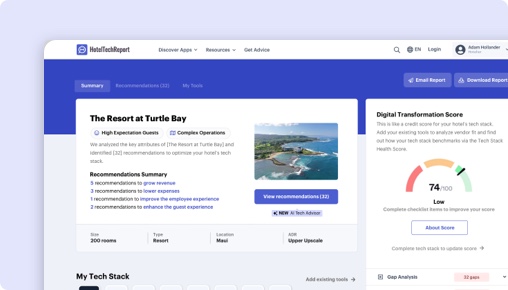
Sorry, this functionality is only available for verified hoteliers
The project dashboard is a free tool that is only available to verified hoteliers to make adopting new technology easier by streamlining their research and simplifying their communication workflow.

Hotel Cloud Analytics vs. Juyo:
Which Is Right for You?


TLDR
We analyzed 86 verified hotelier reviews, compared feature sets, pricing, and real-world case studies to break down where each platform delivers. The right choice depends on your property type and priorities:
Hotel Cloud shines in Ease of Use and Value for Money — especially for boutique properties (5.0/5).
Juyo shines in forecasting and revenue management — especially for luxury properties (4.9/5), with exclusive features like Forecast Locking & Workflows.
How Does Hotel Cloud Analytics Compare to Juyo?
Side-by-side ratings based on 86 verified hotelier reviews on HTR.
| HTScore |
|
|
| Likelihood to Recommend |
|
|
| Ease of Use |
|
|
| Customer Support |
|
|
| Value for Money |
|
|
| Starting Price | From $100/mo | From $200/mo |
| Verified Reviews | 52 | 34 |
What Are the Pros and Cons of Hotel Cloud Analytics vs Juyo?
After analyzing 86 verified reviews, Hotel Cloud users most value its feature requests & improvements, reporting & forecasting, real-time analytics, while Juyo users highlight forecasting and revenue management, data integration and dashboard, user-friendliness. Click any theme to see what reviewers say.
|
Hotel Cloud
|
Juyo
|
|---|---|
| Pros | |
|
+
Feature requests & improvements
▾
|
+
Forecasting and Revenue Management
▾
|
|
+
Reporting & forecasting
▾
|
+
Data Integration and Dashboard
▾
|
|
+
Real-time analytics
▾
|
+
User-Friendliness
▾
|
|
+
User interface & usability
▾
|
+
Ongoing Development and Improvements
▾
|
| Cons | |
|
−
Critical Modules and Areas for Improvement
▾
|
|
|
−
Setup and Initial Configuration
▾
|
|
Hotel Cloud vs Juyo: Rankings by Hotel Segment
How each product ranks among Business Intelligence vendors for different property sizes, types, and regions — based on verified reviews from hoteliers in each segment.
By Hotel Size
| Segment |
Hotel Cloud
|
Juyo
|
|---|---|---|
| Small (10-24 rooms) ▾ | #10 9 reviews | #21 1 reviews |
| Mid-Size (25-74 rooms) ▾ | #5 37 reviews | #17 13 reviews |
| Large (75-199 rooms) ▾ | — | #11 13 reviews |
| X-Large (200+ rooms) ▾ | #22 1 reviews | #7 7 reviews |
By Property Type
| Segment |
Hotel Cloud
|
Juyo
|
|---|---|---|
| Boutique ▾ | #14 20 reviews | #16 19 reviews |
| Luxury ▾ | #23 2 reviews | #17 10 reviews |
| Branded / Chain ▾ | #6 37 reviews | #13 20 reviews |
| Extended Stay | #13 3 reviews | — |
By Region
| Segment |
Hotel Cloud
|
Juyo
|
|---|---|---|
| North America | #19 1 reviews | #11 4 reviews |
| Europe ▾ | #4 51 reviews | #8 30 reviews |
Is Hotel Cloud Analytics or Juyo Better for Hotels?
Hotel Cloud Analytics and Juyo address hotel business intelligence by consolidating operational, revenue, and market data, but they diverge significantly in focus and fit. Hotel Cloud excels in delivering real-time analytics and streamlined multi-property management, making it well suited for hotel groups and branded chains that value automation and quick insights across portfolios. Juyo, with its AI-powered reasoning layer and advanced distribution cost tracking, targets hotels requiring in-depth cost analysis and forecasting capabilities, particularly those with complex financial and revenue needs.
Both products solve the challenge of scattered hotel data by aggregating multiple sources into dashboards that support timely, data-driven decision-making. They reduce manual report preparation and offer tools to optimize pricing, revenue, and marketing strategies, though each approaches these goals with differing strengths that impact how teams work and which properties benefit most.
Hotel Cloud Analytics vs Juyo: Which Should Your Hotel Choose?
If your hotel operates multiple branded properties or a small chain with 30 to 40 rooms or more, Hotel Cloud’s platform suits you due to its strong multi-property management features, affordable pricing at $100/month, and real-time data integration praised for ease of use and quick decision-making (52 reviews, 5/5 overall). Its ability to automate campaigns and centralize reports helps revenue managers save time and standardize insights across portfolios.
Conversely, if your hotel requires detailed distribution cost analysis, advanced forecasting workflows, and you operate a mid-sized or larger property demanding granular financial visibility, Juyo is preferable. Its unique forecast locking feature aids tighter control over budgeting, and integration of commercial and market data supports strategic decisions. Although Juyo’s setup can be time-intensive, users value its comprehensive dashboards and cost-tracking (34 reviews, 4.6/5 overall).
Data for very small independents or budget hotels is limited for both platforms, but Hotel Cloud’s straightforward interface and pricing might be easier for smaller teams to adopt. Properties prioritizing exhaustive forecasting and cost management should lean toward Juyo despite its higher base price of $200/month.
Is Hotel Cloud Analytics or Juyo Easier to Use?
Hotel Cloud leads on ease of use, scoring 5/5 for both ease of use and onboarding across 52 reviews, with users highlighting its intuitive navigation between properties and straightforward dashboards that reduce training time and enable rapid insight extraction. Reviewers describe it as accessible to teams with varying technical skill levels, facilitating quick adoption by revenue and front desk staff alike.
Juyo’s ease of use rating of 4.6/5 from 34 reviews reflects a generally positive experience but notes some complexity in its interface and forecasting modules. Users report a learning curve related to system setup and navigating advanced features, which may require more initial training and ongoing support.
Edge: Hotel Cloud.
Which Has Better Features: Hotel Cloud Analytics or Juyo?
Both platforms share 29 core business intelligence features, including revenue tracking, market benchmarking, and integration with major PMS systems. Juyo offers one unique feature—Forecast Locking & Workflows—that enables hotels to lock budget and forecast figures during planning cycles, enhancing control and collaboration among finance and revenue teams. This feature supports more disciplined forecasting processes, critical for hotels with complex budgeting needs.
Hotel Cloud lacks unique features beyond the shared set but distinguishes itself operationally by automating multi-property marketing campaigns, integrating event calendars for revenue managers, and offering pick-up reports in clean CSV formats that reduce manual spreadsheet work.
Edge: Juyo.
Which Has Better Customer Support: Hotel Cloud Analytics or Juyo?
Hotel Cloud scores 4.9/5 on customer support and onboarding, with reviewers praising their responsiveness, willingness to incorporate feedback, and consistent updates that add new features and improve existing ones. Users emphasize the vendor’s attentiveness to client needs and the smooth onboarding experience.
Juyo closely follows with 4.8/5 support ratings. Customers commend Juyo’s professional and open-minded support team and their quick implementation of user requests. The main critique is the initial setup time rather than ongoing support quality.
Edge: Hotel Cloud.
Which Has More Integrations: Hotel Cloud Analytics or Juyo?
Juyo supports 16 verified integrations versus Hotel Cloud’s 11, surpassing the 25% threshold for integration edge. Both platforms connect with core hotel systems such as Stayntouch, Oracle Hospitality, and Mews. Hotel Cloud’s unique integrations include regional and niche PMS systems like RoomRaccoon, Sirvoy, and Little Hotelier, reflecting strength in small and medium property ecosystems.
Juyo integrates with widely used systems like Fairmas, STR benchmarking, TravelClick, Revinate CRM, protel PMS, and Amadeus central reservations, better serving hotels requiring extensive financial, distribution, and market data connectivity, especially in Europe and global chains.
Edge: Juyo.
Which Do Hoteliers Rate Higher: Hotel Cloud Analytics or Juyo?
Hotel Cloud holds a perfect 5/5 overall rating from 52 reviews, with strong scores across segments—5/5 in boutique (20 reviews), branded hotels (37 reviews), and city center hotels (26 reviews). Juyo’s 4.6/5 across 34 reviews is solid, with its highest ratings in luxury hotels (4.9/5, 10 reviews) and bed & breakfasts (4.9/5, 7 reviews). Both products have no new reviews in the last six months, so current ratings may not reflect recent changes.
Hotel Cloud’s higher volume and perfect rating indicate broader user satisfaction and reliability, particularly in branded and boutique segments. Juyo appeals to luxury and niche segments but with slightly lower overall scores.
Edge: Hotel Cloud.
How Much Do Hotel Cloud Analytics and Juyo Cost?
Hotel Cloud’s base price is $100 per month with no implementation or trial fees, making it accessible for smaller or budget-conscious hotels. Pricing is transparent and straightforward.
Juyo’s base price is $200 per month, double that of Hotel Cloud, also without implementation fees or trial offers. This higher cost may reflect its advanced financial modules and integration depth.
Neither product charges per room or offers freemium models.
What Type of Hotel Should Use Hotel Cloud Analytics?
- Hotels that manage multiple branded or independent properties and need real-time, consolidated analytics across portfolios.
- Teams seeking automated marketing campaign management integrated with revenue analytics.
- Properties prioritizing ease of use and fast onboarding to enable quick staff adoption.
- Hotels looking for affordable business intelligence solutions with strong reporting and forecasting.
- Revenue managers wanting flexible, clean data exports and pick-up reports for detailed analysis.
Not ideal if…
- Your hotel requires advanced forecast locking and complex budgeting workflows.
- You need integrations with niche financial or distribution systems outside Hotel Cloud’s verified partners.
- Your forecast or reporting needs demand highly customizable dashboards beyond current capabilities.
What Type of Hotel Should Use Juyo?
- Hotels with complex distribution cost tracking and a need for automated cost and revenue reconciliation.
- Teams that require advanced forecasting workflows like forecast locking to better coordinate budgeting cycles.
- Properties that benefit from integrating broad financial, revenue, and commercial data, especially in Europe.
- Hotels prioritizing detailed cost analysis and Net RevPAR calculations to optimize profitability.
- Users willing to invest time in setup and training to leverage Juyo’s advanced features fully.
Not ideal if…
- You operate a smaller property with limited technical staff or prefer rapid onboarding.
- You need a lower-cost solution or more straightforward pricing.
- Your team requires a highly intuitive user interface with minimal learning curve.
Hotel Cloud Analytics vs Juyo: The Bottom Line for Hotels
Hotel Cloud Analytics and Juyo both unify hotel data to improve decision-making but differ in execution and target users. Hotel Cloud emphasizes ease of use, multi-property management, and marketing integration, delivering real-time insights and automated reporting ideal for branded hotel groups and smaller chains. Juyo targets hotels needing granular cost tracking and advanced forecasting workflows with its unique forecast locking feature and broader financial integrations.
Choose Hotel Cloud if your focus is on quick adoption, affordable pricing at $100/month, and managing multiple properties with straightforward analytics and marketing automation. Its 5/5 rating across 52 reviews, especially from branded and boutique hotels, confirms strong user satisfaction and operational efficiency.
Opt for Juyo if your hotel requires detailed distribution cost modules, complex budgeting controls, and integration with an extensive array of financial and market data systems. Its 16 integrations and unique forecast locking enhance strategic financial management, suitable for hotels with sophisticated forecasting needs despite a higher $200/month price point.
How Much Do Hotel Cloud Analytics and Juyo Cost?
Business Intelligence pricing is rarely straightforward. Here is what we know from each vendor's public pricing data. Always request a custom quote for your property size.
|
Hotel Cloud
|
Juyo
|
|
|---|---|---|
| Starting Price | From $100/mo | From $200/mo |
Feature Comparison: Hotel Cloud Analytics vs Juyo
These are the features each vendor has configured, organized by feature group — the same data shown in the vendor dashboard. Expand a group to compare features side by side.
| Feature |
Hotel Cloud
|
Juyo
|
|---|---|---|
|
▾
Analytics
|
|
|
| Custom Reports & Templates | ||
| Net Revenue KPIs | ||
| Other Income Forecasting, Reporting & Analysis | ||
| Food & Beverage Reporting, Analysis & Forecasting | ||
| Corporate & Travel Agency Account Tracking | ||
| Analytics dashboard | ||
| Sales team productivity tracking | ||
| Revenue pacing | ||
| Dashboarding & data visualization | ||
| Distribution Cost Analytics | ||
| Scheduled Reports | ||
| Multi-Property & Portfolio Level Tracking | ||
| Pricing Decision Impact Tracking | ||
| Profitability Contribution by Customer | ||
| Shared Demand Calendar | ||
| Flexible Portfolio Grouping | ||
| Artificial Intelligence | ||
|
▾
Forecasting, Budgeting & Planning
|
|
|
| Revenue pacing | ||
| Forecast Locking & Workflows | ||
| Driver Based Models | ||
| Food & Beverage Reporting, Analysis & Forecasting | ||
| Other Income Forecasting, Reporting & Analysis | ||
| Business & marketing plans | ||
| Version Control | ||
| Web Based | ||
| Pricing Decision Impact Tracking | ||
| Shared Demand Calendar | ||
| Flexible Portfolio Grouping | ||
|
▾
Data Management
|
|
|
| Multi-property management | ||
| Centralized user & role management | ||
| Open API | ||
| Automated data gathering & integration | ||
| Customizable Data Hierarchies | ||
| In-App Data Management | ||
| Flexible Portfolio Grouping | ||
|
▾
Collaboration
|
|
|
| Collaboration & Commenting | ||
| Shareable Templates & Plans | ||
| File Attachments | ||
| Web Based | ||
| Alerts Feed |
Hotel Cloud vs Juyo: The Bottom Line
What hoteliers love
Several reviews mention a desire for more features and improvements, such as PDF export options, customized dashboards, and additional AI-driven funct... Several reviews mention a desire for more features and improvements, such as PDF export options, customized dashboards, and additional AI-driven functionalities. Users are keen to see new developments that will make the system even more beneficial and versatile for their unique needs.
Many reviews point to the impressive reporting and forecasting capabilities of Hotel Cloud. The insights provided help users make better strategic dec... Many reviews point to the impressive reporting and forecasting capabilities of Hotel Cloud. The insights provided help users make better strategic decisions and track performance metrics. However, there are calls for even more detailed and customizable reports, forecast updates, and additional forecasting modules to further aid in strategy development.
Users highly value the real-time analytics provided by Hotel Cloud. They find it beneficial for tracking rates and pickup across multiple properties,... Users highly value the real-time analytics provided by Hotel Cloud. They find it beneficial for tracking rates and pickup across multiple properties, making quick decisions, and enhancing operational efficiency. The fast updates from PMS and clean insights enable hoteliers to make timely decisions and improve overall property performance.
Ranks higher for
What hoteliers love
Users highlight Juyo's effective forecasting capabilities and its help in revenue optimization through detailed analytics and strategy formulation. So... Users highlight Juyo's effective forecasting capabilities and its help in revenue optimization through detailed analytics and strategy formulation. Some also suggest improvements for more sophisticated forecasting functionalities.
Reviewers appreciate Juyo’s capacity to integrate various data sources, such as PMS, rate shopping, and CRM data, into a comprehensive dashboard that... Reviewers appreciate Juyo’s capacity to integrate various data sources, such as PMS, rate shopping, and CRM data, into a comprehensive dashboard that facilitates strategic decision-making and simplifies daily operations.
The intuitive and user-friendly interface of Juyo is a significant strength highlighted by hoteliers, making it easy to navigate and utilize different... The intuitive and user-friendly interface of Juyo is a significant strength highlighted by hoteliers, making it easy to navigate and utilize different modules effectively.
Where hoteliers push back
Despite the positive feedback, some users point out specific areas for improvement, such as more detailed forecasting modules, a better overview for c... Despite the positive feedback, some users point out specific areas for improvement, such as more detailed forecasting modules, a better overview for certain data, and enhancements in user-friendly design.
Some users mention that although the setup process can be time-consuming, they find the effort worthwhile due to the extensive capabilities and benefi... Some users mention that although the setup process can be time-consuming, they find the effort worthwhile due to the extensive capabilities and benefits Juyo offers once fully configured.
Ranks higher for
Unique capabilities
Where the ratings diverge most
Frequently Asked Questions About Hotel Cloud Analytics vs Juyo
Can Hotel Cloud Analytics replace Juyo?
It depends on your requirements. Hotel Cloud Analytics and Juyo share many core Business Intelligence features, but each has unique capabilities. Hotel Cloud Analytics offers 11 verified integration partners, while Juyo offers 16. Review the feature comparison above to see where they differ before switching.
Which is better for small or independent hotels?
Small hotels should prioritize ease of use and fast onboarding. Hotel Cloud Analytics leads in ease of use at 5.0/5 vs 4.6/5. Look for transparent pricing and a trial or demo option. Filter reviews on each product page by property size to hear from hotels like yours.
Do Hotel Cloud Analytics or Juyo offer a free plan?
Hotel Cloud Analytics: No. Juyo: No. Neither product currently offers a free tier. Most Business Intelligence vendors offer demos or trials — request one from each to evaluate before committing.
How Does HTR Evaluate and Rank Hotel Cloud Analytics and Juyo?
The HT Score is a composite ranking that considers 4 criteria groups and over a dozen variables to help hoteliers objectively compare hotel technology products. Hotel Cloud has an HT Score of 14 and Juyo has 24. Here is how the score is calculated.
| Criteria Group | Weight | What It Measures |
|---|---|---|
| Customer Ratings & Reviews |
|
How highly do users recommend this product? Ratings Score, Review Volume, Share of Voice, Review Depth, Review Recency, Success Stories ▾ The most heavily weighted factor. Analyzes average satisfaction ratings (likelihood to recommend, ease of use, support, ROI), total review count relative to category peers, review recency (at least 20 reviews in the trailing 6 months), and share of voice across unique hotel clients to detect selection bias. |
| Partner Ecosystem |
|
How highly do tech partners recommend this company? Partner Recommendations, Integration Quantity, Integration Quality ▾ Evaluates partner recommendations as expert votes of confidence, the number of verified integrations, and ecosystem quality — the average HT Scores of integration partners. Products with higher-quality integration ecosystems are more likely to deliver a connected tech stack. |
| Customer Centricity |
|
How customer-centric is this organization? Certified Support, Review Consistency, Profile Completeness ▾ Assesses whether the company has earned HTR Customer Support Certification, maintains consistent review collection over time (an indicator of feedback-driven culture), and keeps product profiles complete with capabilities, screenshots, pricing, and features. |
| Reach, Staying Power & Resources |
|
How extensive is this company's reach and resourcing? Geographic Reach, Staying Power, Company Resources, Trending Score ▾ Measures global presence (countries and regions served), years in business as a stability proxy, team headcount as a resource proxy, and a trending score based on trailing-twelve-month buyer inquiries, reviews, partner recommendations, and press activity. |
Customer ratings and reviews are by far the most important factor in the HT Score algorithm. HTR does not accept payment for higher rankings. All reviews are verified — only hotel industry practitioners with confirmed affiliations can submit ratings. View full HT Score methodology →
What Other Business Intelligence Comparisons Are Hoteliers Reading?
Explore more head-to-head comparisons based on verified hotelier reviews.





Contents
Get Your Free AI Analyst Report
Custom recommendations tailored to your property


