

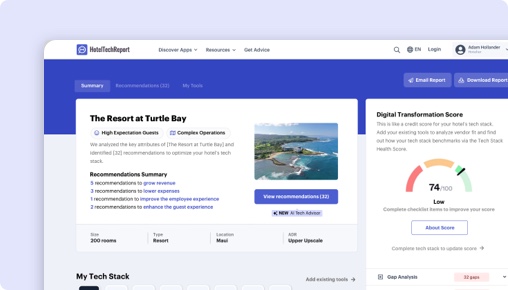
Sorry, this functionality is only available for verified hoteliers
The project dashboard is a free tool that is only available to verified hoteliers to make adopting new technology easier by streamlining their research and simplifying their communication workflow.

hotellab vs. Pricing Coach Dynamic Pricing:
Which Is Right for You?


TLDR
We analyzed 123 verified hotelier reviews, compared feature sets, pricing, and real-world case studies to break down where each platform delivers. The right choice depends on your property type and priorities:
hotellab shines when it comes to adr, occupancy, & revenue impact , with exclusive features like Fully automated revenue management and Mobile Friendly Design.
Pricing Coach shines when it comes to forecasting and market insight , with exclusive features like Alternate Property Reccomendations and Upsell pricing.
How Does hotellab Compare to Pricing Coach Dynamic Pricing?
Side-by-side ratings based on 123 verified hotelier reviews on HTR.
| HTScore |
|
|
| Likelihood to Recommend |
|
|
| Ease of Use |
|
|
| Customer Support |
|
|
| Value for Money |
|
|
| Starting Price | From $500/mo | From $400/mo |
| Verified Reviews | 95 | 28 |
What Are the Pros and Cons of hotellab vs Pricing Coach Dynamic Pricing?
After analyzing 123 verified reviews, hotellab users most value its adr, occupancy, & revenue impact, customization needs for small properties, automation & autopilot, while Pricing Coach users highlight forecasting and market insight, revenue optimization, dynamic pricing. Click any theme to see what reviewers say.
|
hotellab
|
Pricing Coach
|
|---|---|
| Pros | |
|
+
ADR, Occupancy, & Revenue Impact
▾
|
+
Forecasting and Market Insight
▾
|
|
+
Customization Needs for Small Properties
▾
|
+
Revenue Optimization
▾
|
|
+
Automation & Autopilot
▾
|
+
Dynamic Pricing
▾
|
|
+
Business Intelligence
▾
|
+
Reporting and Analytics Enhancements
▾
|
| Cons | |
|
−
Integration with Hotel Systems
▾
|
|
|
−
Flexible Filtering and Customization
▾
|
|
hotellab vs Pricing Coach: Rankings by Hotel Segment
How each product ranks among Revenue Management Systems vendors for different property sizes, types, and regions — based on verified reviews from hoteliers in each segment.
By Hotel Size
| Segment |
hotellab
|
Pricing Coach
|
|---|---|---|
| Small (10-24 rooms) ▾ | #19 20 reviews | #25 9 reviews |
| Mid-Size (25-74 rooms) ▾ | #16 18 reviews | #30 6 reviews |
| Large (75-199 rooms) ▾ | #9 9 reviews | #13 6 reviews |
| X-Large (200+ rooms) | — | #18 1 reviews |
By Property Type
| Segment |
hotellab
|
Pricing Coach
|
|---|---|---|
| Boutique ▾ | #14 30 reviews | #41 2 reviews |
| Luxury ▾ | #16 21 reviews | #35 3 reviews |
| Branded / Chain ▾ | #21 7 reviews | #32 2 reviews |
| Extended Stay ▾ | #11 11 reviews | #34 1 reviews |
By Region
| Segment |
hotellab
|
Pricing Coach
|
|---|---|---|
| North America | #31 1 reviews | — |
| Europe ▾ | #14 44 reviews | — |
| Asia Pacific | #24 0 reviews | — |
| Middle East ▾ | #6 6 reviews | #4 7 reviews |
The Decision
Choosing between Hotellab by Hotellab and Pricing Coach Dynamic Pricing hinges on your hotel’s specific revenue management needs and operational focus. Both systems aim to optimize your rates and boost revenue, but they approach it differently. Hotellab offers a comprehensive, customizable platform with advanced forecasting and operational features, while Pricing Coach emphasizes real-time automation and simplicity. Which one aligns better with your hotel’s size, complexity, and strategy?
Hotellab’s more extensive feature set and higher user ratings suggest it may be better suited for hotels seeking a tailored, in-depth revenue management system. Conversely, Pricing Coach’s recent reviews and straightforward AI-driven automation might appeal if you prioritize ease of use and rapid deployment. Do you want a deeply customizable system or a more streamlined, automated approach?
Is Hotellab or Pricing Coach Better for Hotels?
Both Hotellab and Pricing Coach serve the core function of revenue optimization through dynamic pricing, yet they differ markedly in scope and sophistication. Hotellab’s platform is built for mid-sized hotels and clusters, offering advanced forecasting, group pricing, and extensive integrations. Pricing Coach, however, is designed for hotels that want AI-driven rate adjustments with minimal fuss, focusing on simplicity and automation.
Hotellab’s 80+ features, including five-year forecasting and open API, provide detailed control and customization, appealing to hotels with complex pricing needs. Pricing Coach’s strength lies in its ease of use, delivering quick, actionable recommendations with fewer configuration requirements. Which approach matches your hotel’s operational capacity and strategic depth?
Hotellab vs Pricing Coach: Which Should Your Hotel Choose?
If your hotel needs a highly customizable revenue management system with advanced forecasting, group pricing, and extensive integrations, Hotellab is the clear choice. It’s best for hotels with 15-150 rooms or clusters over 300 rooms looking to optimize multiple revenue streams and fine-tune strategies.
If your team seeks a straightforward, AI-powered solution that automates daily rate updates and market analysis without complex setup, Pricing Coach is ideal. It suits hotels prioritizing ease of use, quick deployment, and proven automation to improve RevPAR with minimal manual intervention.
In essence, Hotellab’s extensive feature set and user ratings favor larger or more complex properties, while Pricing Coach excels in simplicity and automation for hotels that want quick results without extensive customization.
Is Hotellab or Pricing Coach Easier to Use?
Hotellab’s UI is rated 4.92/5, with users praising its intuitive design, simple onboarding, and straightforward navigation. Hoteliers appreciate its customizable dashboard, which can be tailored to display up to 60 key parameters, making complex data accessible without overwhelming.
Pricing Coach’s interface is slightly more polished at 4.96/5, emphasizing clarity and automation. Users highlight its ease of daily operation, with automatic competitor checks and transparent rate recommendations reducing manual effort.
Edge: Pricing Coach.
Which Has Better Features: Hotellab or Pricing Coach?
Hotellab’s 64 verified features include group pricing, 18-month forward pricing, open API, and a unique Custom View mode, offering deep control and comprehensive forecasting tools. It also provides advanced functionalities like manage sell-outs, business mix optimization, and five-year forecasts, making it suited for detailed revenue strategies.
Pricing Coach offers 25 features, with strengths in automatic competitor analysis, demand forecasting, and AI-driven rate adjustments. Unique features include alternate property recommendations, upsell pricing, and channel forecasting, focusing on automation and strategic flexibility.
Edge: Hotellab.
Which Has Better Customer Support: Hotellab or Pricing Coach?
Hotellab’s support team is highly rated at 4.97/5, with reviews emphasizing knowledgeable, responsive assistance and comprehensive onboarding. Clients mention that Hotellab’s support is proactive, providing tailored guidance and quick troubleshooting, which is crucial for complex setups.
Pricing Coach’s support is rated perfect at 5/5, with reviews praising its quick responses and clarity. Users often comment on the support team’s accessibility and helpfulness, noting that it feels more like a partnership than just software.
Edge: Pricing Coach.
Which Has More Integrations: Hotellab or Pricing Coach?
Hotellab boasts 14 verified integrations, including major PMS, channel managers, and technology partners like Mews, Oracle Hospitality, and Lighthouse. This broad ecosystem enables smoother data flow and operational cohesion, essential for hotels with diverse tech stacks.
Pricing Coach has only 2 verified integrations, with users requesting more to connect seamlessly with existing PMS and CRM systems. Its limited integrations may require manual data handling or custom connectors.
Edge: Hotellab.
Which Do Hoteliers Rate Higher: Hotellab or Pricing Coach?
Hotellab’s reviews, especially recent ones, reflect a high satisfaction rate—99% likelihood of recommendation and a 5/5 overall rating from 64 reviews. Hotels across segments, including boutique and city hotels, praise its ease of use, detailed reporting, and revenue impact.
Pricing Coach, despite a smaller review pool (25 reviews), has a 100% likelihood to recommend and is praised for its automation and clarity. However, fewer recent reviews mean less confidence in its current performance compared to Hotellab.
Edge: Hotellab.
How Much Do Hotellab and Pricing Coach Cost?
Hotellab’s pricing starts at $500 per month, with no free trial or freemium options. Its higher price reflects its extensive feature set and customization capabilities.
Pricing Coach charges $400 per month, with a 30-day trial, making it slightly more accessible for smaller hotels or those testing automation. Its lower price point is aligned with its simpler, more automated approach.
What Type of Hotel Should Use Hotellab?
- Hotels that require deep customization of revenue strategies based on detailed forecasts.
- Properties managing multiple revenue streams like group, retail, and extended stay.
- Clusters with over 300 rooms or hotel groups needing centralized control.
- Teams that want extensive integration with existing systems and open API access.
- Hotels seeking five-year forecasting and advanced demand analysis.
Not ideal if you prefer a simple, out-of-the-box solution without extensive setup or customization.
What Type of Hotel Should Use Pricing Coach?
- Hotels that prioritize ease of use and rapid deployment of automated rate adjustments.
- Properties seeking to reduce manual workload with AI-driven recommendations.
- Hotels with limited revenue management resources or smaller teams.
- Properties that want to enhance occupancy and RevPAR through real-time market analysis.
- Hotels that value straightforward, transparent pricing strategies.
Not ideal if you need highly detailed forecasting, extensive customization, or integrations with complex hotel systems.
The Bottom Line for Hotels
Hotellab’s comprehensive feature set and high user ratings establish it as a robust choice for hotels needing detailed control and complex revenue strategies. Its extensive integrations and advanced forecasting tools make it suitable for larger, multi-property operators or tech-savvy teams.
Pricing Coach’s strength lies in its simplicity and automation, ideal for hotels seeking quick, automated rate adjustments with minimal fuss. Its AI-driven approach can rapidly improve RevPAR for smaller to mid-sized properties prioritizing ease of use.
If your hotel values depth, customization, and extensive integrations, Hotellab is the safer choice. For straightforward, automated revenue management that requires less setup, Pricing Coach is the better fit.
In conclusion, for hotels aiming to maximize revenue with a detailed, customizable platform, Hotellab outperforms with more recent reviews and a higher overall rating. If automation and simplicity are your priorities, Pricing Coach’s recent surge in reviews and high support score make it an attractive option.
How Much Do hotellab and Pricing Coach Dynamic Pricing Cost?
Revenue Management Systems pricing is rarely straightforward. Here is what we know from each vendor's public pricing data. Always request a custom quote for your property size.
|
hotellab
|
Pricing Coach
|
|
|---|---|---|
| Starting Price | From $500/mo | From $400/mo |
Feature Comparison: hotellab vs Pricing Coach Dynamic Pricing
These are the features each vendor has configured, organized by feature group — the same data shown in the vendor dashboard. Expand a group to compare features side by side.
| Feature |
hotellab
|
Pricing Coach
|
|---|---|---|
|
▾
Pricing Optimization
|
|
|
| Price Explanation | ||
| Enterprise Business Guidelines | ||
| Alternate Stay Date Recommendations | ||
| Alternate Property Reccomendations | ||
| Real-time price optimization | ||
| Dynamic Price Hierarchy Control | ||
| Open Pricing | ||
| Guided workflows | ||
| "What-if" scenario analysis | ||
| Dynamic Pricing | ||
| Set Boundaries | ||
| Manage Exceptions | ||
| Group Pricing | ||
| Manage Restrictions | ||
| Manage Sell-Outs & Cancellations | ||
| Business Mix Optimization | ||
| Define Cycles | ||
| Yield Room Types Individually | ||
| Bulk Adjustments | ||
| 24-Months Pricing & Forecasting | ||
| Component/virtual room pricing | ||
| Extended stay pricing | ||
| Upsell pricing | ||
| Hurdle rate | ||
|
▾
Market Intelligence & Forecasting
|
|
|
| Five-Year Forecasting | ||
| 365-Day Forward Pricing | ||
| STR Data | ||
| 18-Month Forward Pricing | ||
| Price sensitivity modeling | ||
| Multi-Property Dashboard | ||
| Market Intelligence Data | ||
| Interactive Customizable Dashboards | ||
| Future Market Demand Data | ||
| Financial Forecast Builder | ||
| Extended stay forecasting | ||
| Channel forecasting | ||
| Forecast explanation | ||
| Flexible competitor data | ||
|
▾
Dashboards & Reporting
|
|
|
| Custom Reports | ||
| Scheduled Reports | ||
| Lost Business Data | ||
| Analytics dashboard | ||
| Interactive Customizable Dashboards | ||
| Market Insights Reporting | ||
| Pickup Analysis | ||
| Booking Pattern Analysis | ||
| Event Data | ||
| Price Change Logs | ||
| Customizable Notifications & Alerts | ||
| Displacement Analysis | ||
| Group Pricing & Evaluation | ||
| Multi-Property Dashboard | ||
| System benefit measurement | ||
|
▾
Automation
|
|
|
| Controlled Automation/Algorithm Customization | ||
| Automated Room-Type Pricing | ||
| Fully automated revenue management | ||
| Dynamic Pricing | ||
| AI Optimization | ||
| Automatic Pricing Updates | ||
|
▾
Multi-Property Functionality
|
|
|
| Inventory Management | ||
| Multi-property Management | ||
| Multi-Property Dashboard | ||
|
▾
Group Business
|
|
|
| Group Pricing & Evaluation | ||
| "What-if" scenario analysis | ||
| Displacement Analysis | ||
| Group forecast and wash | ||
|
▾
Integrations
|
|
|
| Open API | ||
| Channel Manager | ||
| Business Intelligence | ||
| STR Data | ||
| Property Management System | ||
| Multi-factor authentication | ||
|
▾
Other
|
|
|
| Group pricing & evaluation | ||
| Mobile App | ||
| Smart Spreading Technology | ||
| Single Sign-On | ||
| Mobile Friendly Design |
Real-World Results: hotellab vs Pricing Coach by Business Goal
We analyzed 3 verified case studies to compare what hotels actually achieve with each platform across four key business objectives.
Bella Vista
Small
"We implemented hotellab in the middle of summer - the busiest time of the year. Within weeks, I could see the difference. The system worked for me, not the other way around."
 Pricing Coach
No published case study for this goal yet.
hotellab vs Pricing Coach: The Bottom Line
What hoteliers love
Hotellab RMS is highly effective in boosting ADR, occupancy, and overall revenue. Multiple reviews confirm significant improvements in these metrics,... Hotellab RMS is highly effective in boosting ADR, occupancy, and overall revenue. Multiple reviews confirm significant improvements in these metrics, attributing this to the system's dynamic pricing and strategic forecasting capabilities.
Some users from smaller properties express a need for more tailored and simplified reporting options, suggesting that certain features cater more to l... Some users from smaller properties express a need for more tailored and simplified reporting options, suggesting that certain features cater more to larger hotels. Customized solutions could enhance usability for this segment.
Hotellab’s automation features, including the Autopilot, are lauded for reducing manual tasks and confidently managing pricing adjustments. Users note... Hotellab’s automation features, including the Autopilot, are lauded for reducing manual tasks and confidently managing pricing adjustments. Users note the tool's ability to respond to market changes quickly and efficiently.
Ranks higher for
Unique capabilities
What hoteliers love
Users appreciate the robust forecasting tools that provide insights into demand trends and market fluctuations. The feature empowers hotels to anticip... Users appreciate the robust forecasting tools that provide insights into demand trends and market fluctuations. The feature empowers hotels to anticipate high-demand periods and manage low-demand days, boosting confidence in pricing decisions.
Pricing Coach's revenue optimization strategies help hotels maximize RevPAR and occupancy by aligning pricing decisions with market insights. The syst... Pricing Coach's revenue optimization strategies help hotels maximize RevPAR and occupancy by aligning pricing decisions with market insights. The system’s data-driven approach provides measurable performance impacts, leading to improved revenue outcomes.
Several reviews highlight Pricing Coach's dynamic pricing capabilities, noting its ability to automatically adjust room rates in response to market de... Several reviews highlight Pricing Coach's dynamic pricing capabilities, noting its ability to automatically adjust room rates in response to market demand and competition. This feature facilitates real-time pricing strategies that enhance revenue management and improve occupancy rates.
Where hoteliers push back
Some users express the need for improved integration capabilities with existing hotel management systems, like PMS and CRM. Enhanced connectivity is e... Some users express the need for improved integration capabilities with existing hotel management systems, like PMS and CRM. Enhanced connectivity is expected to streamline operations and leverage data more holistically.
The desire for more flexible filtering options is noted in several reviews. Users suggest that more tailored data views and competitor comparisons wou... The desire for more flexible filtering options is noted in several reviews. Users suggest that more tailored data views and competitor comparisons would enhance the system's usability and relevancy to varied business needs.
Ranks higher for
Unique capabilities
Where the ratings diverge most
Frequently Asked Questions About hotellab vs Pricing Coach Dynamic Pricing
Can hotellab replace Pricing Coach Dynamic Pricing?
It depends on your requirements. hotellab and Pricing Coach Dynamic Pricing share many core Revenue Management Systems features, but each has unique capabilities. hotellab offers 13 verified integration partners, while Pricing Coach Dynamic Pricing offers 3. Review the feature comparison above to see where they differ before switching.
Which is better for small or independent hotels?
Small hotels should prioritize ease of use and fast onboarding. hotellab leads in ease of use at 4.9/5 vs 4.9/5. Look for transparent pricing and a trial or demo option. Filter reviews on each product page by property size to hear from hotels like yours.
Do hotellab or Pricing Coach Dynamic Pricing offer a free plan?
hotellab: No. Pricing Coach Dynamic Pricing: No. Neither product currently offers a free tier. Most Revenue Management Systems vendors offer demos or trials — request one from each to evaluate before committing.
How Does HTR Evaluate and Rank hotellab and Pricing Coach Dynamic Pricing?
The HT Score is a composite ranking that considers 4 criteria groups and over a dozen variables to help hoteliers objectively compare hotel technology products. hotellab has an HT Score of 87 and Pricing Coach has 78. Here is how the score is calculated.
| Criteria Group | Weight | What It Measures |
|---|---|---|
| Customer Ratings & Reviews |
|
How highly do users recommend this product? Ratings Score, Review Volume, Share of Voice, Review Depth, Review Recency, Success Stories ▾ The most heavily weighted factor. Analyzes average satisfaction ratings (likelihood to recommend, ease of use, support, ROI), total review count relative to category peers, review recency (at least 20 reviews in the trailing 6 months), and share of voice across unique hotel clients to detect selection bias. |
| Partner Ecosystem |
|
How highly do tech partners recommend this company? Partner Recommendations, Integration Quantity, Integration Quality ▾ Evaluates partner recommendations as expert votes of confidence, the number of verified integrations, and ecosystem quality — the average HT Scores of integration partners. Products with higher-quality integration ecosystems are more likely to deliver a connected tech stack. |
| Customer Centricity |
|
How customer-centric is this organization? Certified Support, Review Consistency, Profile Completeness ▾ Assesses whether the company has earned HTR Customer Support Certification, maintains consistent review collection over time (an indicator of feedback-driven culture), and keeps product profiles complete with capabilities, screenshots, pricing, and features. |
| Reach, Staying Power & Resources |
|
How extensive is this company's reach and resourcing? Geographic Reach, Staying Power, Company Resources, Trending Score ▾ Measures global presence (countries and regions served), years in business as a stability proxy, team headcount as a resource proxy, and a trending score based on trailing-twelve-month buyer inquiries, reviews, partner recommendations, and press activity. |
Customer ratings and reviews are by far the most important factor in the HT Score algorithm. HTR does not accept payment for higher rankings. All reviews are verified — only hotel industry practitioners with confirmed affiliations can submit ratings. View full HT Score methodology →
What Other Revenue Management Systems Comparisons Are Hoteliers Reading?
Explore more head-to-head comparisons based on verified hotelier reviews.




Get Your Free AI Analyst Report
Custom recommendations tailored to your property


Let´s lookup your hotel information
Still weighing your revenue management systems options?
A few popular systems from our revenue management systems guide — or let our AI score each one against your specific property in about two minutes.


