

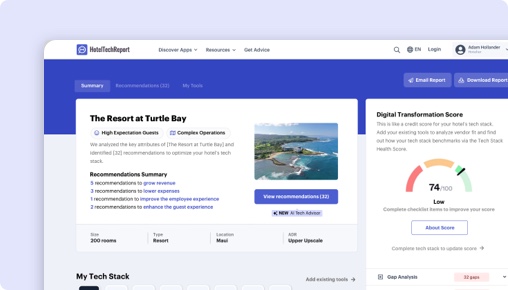
Sorry, this functionality is only available for verified hoteliers
The project dashboard is a free tool that is only available to verified hoteliers to make adopting new technology easier by streamlining their research and simplifying their communication workflow.

IBC Technology (Booking Engine) vs. SiteMinder Booking Engine:
Which Is Right for You?


TLDR
We analyzed 1,379 verified hotelier reviews, compared feature sets, pricing, and real-world case studies to break down where each platform delivers. The right choice depends on your property type and priorities:
IBC Hospitality Technologies shines .
SiteMinder shines in ease of use and customer support — especially for brand properties (4.3/5) , with exclusive features like Performance Reporting and Mobile optimized/responsive.
How Does IBC Technology (Booking Engine) Compare to SiteMinder Booking Engine?
Side-by-side ratings based on 1,379 verified hotelier reviews on HTR.
| HTScore |
|
|
| Likelihood to Recommend |
|
|
| Ease of Use |
|
|
| Customer Support |
|
|
| Value for Money |
|
|
| Starting Price | Contact sales | From $500/mo |
| Verified Reviews | 2 | 1,377 |
What Are the Pros and Cons of IBC Technology (Booking Engine) vs SiteMinder Booking Engine?
After analyzing 1,379 verified reviews, IBC Hospitality Technologies users most value its , while SiteMinder users highlight ease of use and operational efficiency, channel manager real-time sync and overbooking prevention, support responsiveness and issue resolution. Click any theme to see what reviewers say.
|
IBC Hospitality Technologies
|
SiteMinder
|
|---|---|
| Pros | |
|
+
Ease of use and operational efficiency
▾
|
|
|
+
Channel manager real-time sync and overbooking prevention
▾
|
|
|
+
Support responsiveness and issue resolution
▾
|
|
|
+
Booking engine direct bookings and guest conversion
▾
|
|
| Cons | |
|
−
Customization and branding of booking engine/website builder
▾
|
|
|
−
Rate shopping and pricing optimization
▾
|
|
|
−
Promotions, upselling, and ancillary revenue tools
▾
|
|
IBC Hospitality Technologies vs SiteMinder: Rankings by Hotel Segment
How each product ranks among Booking Engine vendors for different property sizes, types, and regions — based on verified reviews from hoteliers in each segment.
By Hotel Size
| Segment |
IBC Hospitality Technologies
|
SiteMinder
|
|---|---|---|
| Small (10-24 rooms) ▾ | #43 1 reviews | #1 470 reviews |
| Mid-Size (25-74 rooms) ▾ | #44 0 reviews | #1 527 reviews |
| Large (75-199 rooms) ▾ | #32 1 reviews | #1 96 reviews |
| X-Large (200+ rooms) ▾ | — | #1 50 reviews |
By Property Type
| Segment |
IBC Hospitality Technologies
|
SiteMinder
|
|---|---|---|
| Boutique ▾ | #39 1 reviews | #1 564 reviews |
| Luxury ▾ | #44 1 reviews | #1 411 reviews |
| Branded / Chain ▾ | #39 1 reviews | #1 230 reviews |
| Extended Stay ▾ | — | #1 174 reviews |
By Region
| Segment |
IBC Hospitality Technologies
|
SiteMinder
|
|---|---|---|
| North America ▾ | #23 1 reviews | #2 157 reviews |
| Europe ▾ | #43 0 reviews | #5 266 reviews |
| Asia Pacific ▾ | #25 1 reviews | #1 418 reviews |
| Middle East ▾ | — | #3 13 reviews |
The Decision
When choosing a booking engine for your hotel, your primary goal is to increase direct bookings while reducing reliance on OTAs. Both IBC Hospitality Technologies and SiteMinder aim to serve this purpose but differ significantly in features, user experience, and market presence. Understanding their core strengths and limitations can help you decide which aligns best with your property's needs and growth targets.
IBC offers a straightforward, easy-to-embed booking engine designed to boost direct reservations without extensive customization. SiteMinder, on the other hand, provides a feature-rich platform with extensive integrations, ideal for larger or multi-property operators seeking comprehensive distribution management. Are you prioritizing simplicity or scalability?
Is IBC Hospitality Technologies or SiteMinder Better for Hotels?
IBC's booking engine focuses on ease of integration and user-friendly operation, making it suitable for smaller hotels or properties new to direct booking technology. SiteMinder’s platform excels in extensive channel management, reporting, and automation, catering to hotels aiming for robust distribution and advanced revenue strategies.
While IBC’s interface is minimalistic and simple, SiteMinder offers a more complex dashboard with over 39 distinct features, including rate comparison and performance analytics. If your hotel needs a straightforward booking tool, IBC might suffice. But if you require detailed control over distribution and data insights, SiteMinder is the better choice.
Considering recent reviews, SiteMinder’s large user base and active development provide stronger confidence in ongoing support and feature updates. Do you want a tool focused on simplicity or one that scales with your hotel’s ambitions?
IBC Hospitality Technologies vs SiteMinder: Which Should Your Hotel Choose?
If your hotel is a small to mid-sized independent property seeking easy website integration and quick implementation, go with IBC. Its simplicity and low upfront cost make it suitable for hotels prioritizing direct bookings without complex distribution needs.
If your hotel operates multiple properties, targets high occupancy, or relies heavily on OTA partnerships, SiteMinder’s extensive features—like multi-channel management, rate intelligence, and automation—are more appropriate. Its larger review base and recent activity indicate higher reliability, especially for hotels with more complex distribution requirements.
In summary, choose IBC for ease and quick wins, and SiteMinder for comprehensive management and scalability.
Is IBC Hospitality Technologies or SiteMinder Easier to Use?
Based on ratings, SiteMinder’s user experience is notably superior with a 4.6/5 ease-of-use score from over 1,200 reviews, compared to IBC’s 3.5/5 from just 2 reviews. Recent reviews praise SiteMinder’s intuitive interface, streamlined onboarding, and straightforward navigation, making it easier for staff to adopt.
IBC’s interface has received some criticism for being less modern and more difficult for new staff to interpret, with reviews mentioning that the graphical loading bar could benefit from updates. Edge: SiteMinder.
Which Has Better Features: IBC Hospitality Technologies or SiteMinder?
SiteMinder packs in 39 features exclusive to its platform, including room & rate filtering, performance reporting, rate intelligence, API access, multi-currency support, analytics dashboards, and multi-lingual options. IBC, by comparison, offers no additional features beyond its core booking engine.
This richer feature set means SiteMinder can support complex pricing strategies, detailed analytics, and multi-channel synchronization—all critical for larger hotels or those with diverse distribution channels. Edge: SiteMinder.
Which Has Better Customer Support: IBC Hospitality Technologies or SiteMinder?
IBC’s support ratings are slightly above average, with a 4/5 rating based on limited reviews, and some users appreciate its responsive service. SiteMinder’s support, rated 4.43/5 from over 1,200 reviews, is lauded for its responsiveness, especially during onboarding.
Recent reviews highlight SiteMinder’s proactive support, with clients noting that issues like overbooking and integration challenges are addressed promptly. Given the volume of recent reviews, SiteMinder’s support is more reliable and better documented. Edge: SiteMinder.
Which Has More Integrations: IBC Hospitality Technologies or SiteMinder?
SiteMinder integrates with 245 verified partners, including major PMS, channel managers, and payment gateways, making it highly versatile. IBC connects to 16 verified partners, mainly focusing on core hospitality and booking system integrations.
While IBC’s integrations are adequate for small hotels, SiteMinder’s extensive network supports larger properties and multi-system environments. Its open API and multi-channel capabilities make it more adaptable for growth. Edge: SiteMinder.
Which Do Hoteliers Rate Higher: IBC Hospitality Technologies or SiteMinder?
SiteMinder’s recent reviews and high rating of 4.48/5 reflect strong satisfaction across various hotel segments, especially boutique and city-center hotels. Hotelier feedback highlights its ease of use, integration quality, and revenue impact.
IBC’s limited reviews have a lower rating of 3.5/5, primarily due to its simpler functionality and limited feature scope. Larger or more technologically advanced hotels tend to prefer SiteMinder’s comprehensive platform. Edge: SiteMinder.
How Much Do IBC Hospitality Technologies and SiteMinder Cost?
IBC does not publicly disclose its pricing. It appears to operate on a quote-based model, possibly with tiered packages or custom quotes.
SiteMinder charges a base fee of $500 per month, with no additional implementation fees, but prices may vary based on the number of rooms and integrations. For budget-conscious hotels, IBC might seem more flexible, but overall value depends on the scale of your operations.
What Type of Hotel Should Use IBC Hospitality Technologies?
- Hotels seeking a simple, easy-to-embed booking engine for their website.
- Small independent hotels or boutique properties with limited distribution needs.
- Hotels that want to quickly increase direct bookings without extensive setup.
- Properties with limited technical resources or staff new to online booking systems.
- Hotels aiming for a low-cost, straightforward solution.
Not ideal if your hotel plans to expand, require automation, or need advanced analytics.
What Type of Hotel Should Use SiteMinder?
- Multi-property hotel groups or large independent hotels with complex distribution needs.
- Hotels wanting detailed analytics, rate management, and revenue optimization.
- Businesses aiming to expand online presence through extensive OTA connections.
- Hotels seeking multi-lingual, multi-currency support for international guests.
- Properties that prioritize automation, real-time updates, and detailed performance insights.
Not ideal if your hotel is very small, with minimal distribution channels, or if a basic booking engine suffices.
SiteMinder & IBC Hospitality Technologies: The Bottom Line for Hotels
The core difference lies in scale and feature set: IBC offers a simple, easy-to-embed booking engine suitable for small hotels, while SiteMinder provides a comprehensive distribution and revenue management platform for larger or growth-focused properties.
If your hotel needs quick deployment with minimal complexity, IBC’s straightforward approach makes sense. Its limited features and smaller user base mean fewer updates and less support for advanced needs.
For hotels seeking a scalable, feature-rich platform that can support multi-channel distribution, detailed analytics, and automation, SiteMinder is the clear choice. Its larger review base, frequent updates, and extensive integrations make it more reliable for ambitious hotel operations.
Choose IBC if ease and affordability are your top priorities. Opt for SiteMinder if you aim for growth, automation, and the ability to manage complex distribution channels efficiently.
How Much Do IBC Technology (Booking Engine) and SiteMinder Booking Engine Cost?
Booking Engine pricing is rarely straightforward. Here is what we know from each vendor's public pricing data. Always request a custom quote for your property size.
|
IBC Hospitality Technologies
|
SiteMinder
|
|
|---|---|---|
| Starting Price | — | From $500/mo |
Feature Comparison: IBC Technology (Booking Engine) vs SiteMinder Booking Engine
These are the features each vendor has configured, organized by feature group — the same data shown in the vendor dashboard. Expand a group to compare features side by side.
| Feature |
IBC Hospitality Technologies
|
SiteMinder
|
|---|---|---|
|
▾
Merchandising & Packages
|
|
|
| Room substitutions | ||
| Multi-room bookings | ||
| Flat, floating and discounted rates | ||
| Pooled inventory | ||
| Special offers & discounts | ||
| Customizable add-ons | ||
| Meal plans | ||
| Website Integration | ||
| Social Media Integration/Bookings | ||
|
▾
Upselling & Cross Selling
|
|
|
| Multi-room bookings | ||
| Room substitutions | ||
| Gift Vouchers | ||
| Booking abandonment recapture | ||
| Customizable add-ons | ||
| Special offers & discounts | ||
| Meal plans | ||
| Alternative accommodation recommendations (when no availability) | ||
| Loyalty program integration | ||
|
▾
Conversion
|
|
|
| Mobile optimized/responsive | ||
| Special offers & discounts | ||
| Urgency messaging | ||
| Booking abandonment recapture | ||
| Multi-room bookings | ||
| Room substitutions | ||
| A/B testing & optimization | ||
| Price comparison widget | ||
| Multi-lingual | ||
| Conversion rate reports | ||
| Facebook conversion tracking | ||
| Customizable exit intent modals | ||
| Form autofill | ||
| Flexible dates | ||
| Rate plan comparisons | ||
| Google Hotel Ads Bookings | ||
| Tripadvisor Bookings | ||
|
▾
Payments
|
|
|
| Multi-currency | ||
| Apple Pay | ||
| Google Pay | ||
| Paypal | ||
| PCI Compliance | ||
| PayU | ||
| Stripe | ||
|
▾
Transactional Emails
|
|
|
| Booking abandonment recapture | ||
| Post-stay emails | ||
| Pre-stay emails | ||
| Confirmation emails | ||
|
▾
Group Bookings
|
|
|
| Wedding & corporate booking modules | ||
| Availability block | ||
|
▾
Reporting & Analytics
|
|
|
| Automated reporting | ||
| Conversion rate reports | ||
| Referral Reporting | ||
| Google Analytics tracking | ||
|
▾
Tax & Compliance
|
|
|
| PCI Compliance | ||
| ADA Compliant | ||
| Tariffs | ||
| Multi-currency | ||
| GDPR compliant |
Real-World Results: IBC Hospitality Technologies vs SiteMinder by Business Goal
We analyzed 8 verified case studies to compare what hotels actually achieve with each platform across four key business objectives.
IBC Hospitality Technologies
No published case study for this goal yet.
Olive House Apartments
Small
"As mentioned by Jacqueline, efficiency is key in the daily runnings of a property. The fast-paced nature of hospitality means that when guests have a problem, it needs to be solved..."
 IBC Hospitality Technologies
No published case study for this goal yet.
PPHE Hotel Group
Mid-Size
"The team understood our needs, and tweaked the interface to optimise performance accordingly."
 IBC Hospitality Technologies
No published case study for this goal yet.
Homa
Small
"We are a transformative business in the Southeast Asian market, in that guests can easily book stays of a varied length and be confident in the consistency of their experience. Thi..."
IBC Hospitality Technologies vs SiteMinder: The Bottom Line
What hoteliers love
A common theme is that SiteMinder simplifies daily hotel operations by centralizing reservations, rates, availability, and room controls in one place.... A common theme is that SiteMinder simplifies daily hotel operations by centralizing reservations, rates, availability, and room controls in one place. Users say this reduces training time, manual work, and errors, making it easier for staff to manage bookings efficiently across front desk and distribution tasks.
Users most often praise SiteMinder's channel manager for keeping rates and inventory synced across OTAs in real time, which reduces manual updates and... Users most often praise SiteMinder's channel manager for keeping rates and inventory synced across OTAs in real time, which reduces manual updates and helps prevent costly overbookings. Several reviews also note that this automation saves staff time and improves operational accuracy, though a few mention occasional sync delays or rare double-booking risks.
Support is frequently mentioned as a strength, with many reviewers saying issues are resolved quickly and professionally through chat, phone, or named... Support is frequently mentioned as a strength, with many reviewers saying issues are resolved quickly and professionally through chat, phone, or named agents. A smaller set of reviews criticizes slow phone response, ticket handling, or chatbot reliance, suggesting support quality is good but not always consistent across channels.
Where hoteliers push back
Many reviewers want more control over the look and behavior of the booking engine and website builder, including templates, page layout, branding, wid... Many reviewers want more control over the look and behavior of the booking engine and website builder, including templates, page layout, branding, widgets, and promotional placement. The recurring concern is that the product works well functionally but does not yet give hotels enough flexibility to match their brand or create a more conversion-focused guest experience.
Rate shopping is valued for giving hotels quick competitor visibility so they can adjust pricing and protect revenue. Users like the strategic pricing... Rate shopping is valued for giving hotels quick competitor visibility so they can adjust pricing and protect revenue. Users like the strategic pricing support, but several ask for longer lookback periods, more flexible BAR adjustments, and stronger dynamic pricing or AI-assisted pricing features.
Ranks higher for
Unique capabilities
Where the ratings diverge most
Frequently Asked Questions About IBC Technology (Booking Engine) vs SiteMinder Booking Engine
Can IBC Technology (Booking Engine) replace SiteMinder Booking Engine?
It depends on your requirements. IBC Technology (Booking Engine) and SiteMinder Booking Engine share many core Booking Engine features, but each has unique capabilities. IBC Technology (Booking Engine) offers 16 verified integration partners, while SiteMinder Booking Engine offers 248. Review the feature comparison above to see where they differ before switching.
Which is better for small or independent hotels?
Small hotels should prioritize ease of use and fast onboarding. SiteMinder Booking Engine leads in ease of use at 4.6/5 vs 3.5/5. Look for transparent pricing and a trial or demo option. Filter reviews on each product page by property size to hear from hotels like yours.
Do IBC Technology (Booking Engine) or SiteMinder Booking Engine offer a free plan?
IBC Technology (Booking Engine): No. SiteMinder Booking Engine: No. Neither product currently offers a free tier. Most Booking Engine vendors offer demos or trials — request one from each to evaluate before committing.
How Does HTR Evaluate and Rank IBC Technology (Booking Engine) and SiteMinder Booking Engine?
The HT Score is a composite ranking that considers 4 criteria groups and over a dozen variables to help hoteliers objectively compare hotel technology products. IBC Hospitality Technologies has an HT Score of 0 and SiteMinder has 100. Here is how the score is calculated.
| Criteria Group | Weight | What It Measures |
|---|---|---|
| Customer Ratings & Reviews |
|
How highly do users recommend this product? Ratings Score, Review Volume, Share of Voice, Review Depth, Review Recency, Success Stories ▾ The most heavily weighted factor. Analyzes average satisfaction ratings (likelihood to recommend, ease of use, support, ROI), total review count relative to category peers, review recency (at least 20 reviews in the trailing 6 months), and share of voice across unique hotel clients to detect selection bias. |
| Partner Ecosystem |
|
How highly do tech partners recommend this company? Partner Recommendations, Integration Quantity, Integration Quality ▾ Evaluates partner recommendations as expert votes of confidence, the number of verified integrations, and ecosystem quality — the average HT Scores of integration partners. Products with higher-quality integration ecosystems are more likely to deliver a connected tech stack. |
| Customer Centricity |
|
How customer-centric is this organization? Certified Support, Review Consistency, Profile Completeness ▾ Assesses whether the company has earned HTR Customer Support Certification, maintains consistent review collection over time (an indicator of feedback-driven culture), and keeps product profiles complete with capabilities, screenshots, pricing, and features. |
| Reach, Staying Power & Resources |
|
How extensive is this company's reach and resourcing? Geographic Reach, Staying Power, Company Resources, Trending Score ▾ Measures global presence (countries and regions served), years in business as a stability proxy, team headcount as a resource proxy, and a trending score based on trailing-twelve-month buyer inquiries, reviews, partner recommendations, and press activity. |
Customer ratings and reviews are by far the most important factor in the HT Score algorithm. HTR does not accept payment for higher rankings. All reviews are verified — only hotel industry practitioners with confirmed affiliations can submit ratings. View full HT Score methodology →
What Other Booking Engine Comparisons Are Hoteliers Reading?
Explore more head-to-head comparisons based on verified hotelier reviews.





Get Your Free AI Analyst Report
Custom recommendations tailored to your property


Let´s lookup your hotel information
Still weighing your booking engine options?
A few popular systems from our booking engine guide — or let our AI score each one against your specific property in about two minutes.


