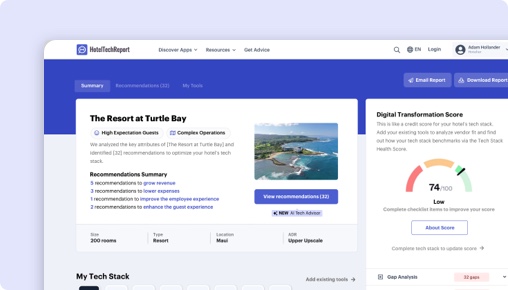
Sorry, this functionality is only available for verified hoteliers
The project dashboard is a free tool that is only available to verified hoteliers to make adopting new technology easier by streamlining their research and simplifying their communication workflow.

Cloudbeds PMS vs. SS&C TimeShareWare:
Which Is Right for You?

TLDR
We analyzed 1,255 verified hotelier reviews, compared feature sets, pricing, and real-world case studies to break down where each platform delivers. The right choice depends on your property type and priorities:
Cloudbeds shines in ease of use and customer support — especially for independent properties (4.6/5) , with exclusive features like Revenue management module and Payment processing.
SS&C shines .
How Does Cloudbeds PMS Compare to SS&C TimeShareWare?
Side-by-side ratings based on 1,255 verified hotelier reviews on HTR.
| HTScore |
|
|
| Likelihood to Recommend |
|
|
| Ease of Use |
|
|
| Customer Support |
|
|
| Value for Money |
|
|
| Starting Price | From $600/mo | From $800/mo |
| Verified Reviews | 1,255 | 0 |
What Are the Pros and Cons of Cloudbeds PMS vs SS&C TimeShareWare?
After analyzing 1,255 verified reviews, Cloudbeds users most value its user-friendly interface, implementation and support, all-in-one ecosystem, while SS&C users highlight . Click any theme to see what reviewers say.
|
Cloudbeds
|
SS&C
|
|---|---|
| Pros | |
|
+
User-Friendly Interface
▾
|
|
|
+
Implementation and Support
▾
|
|
|
+
All-in-One Ecosystem
▾
|
|
|
+
Channel Management
▾
|
|
| Cons | |
|
−
Reservation Management
▾
|
|
|
−
Report Customization
▾
|
|
|
−
System Speed
▾
|
|
Cloudbeds vs SS&C: Rankings by Hotel Segment
How each product ranks among Property Management Systems vendors for different property sizes, types, and regions — based on verified reviews from hoteliers in each segment.
By Hotel Size
| Segment |
Cloudbeds
|
SS&C
|
|---|---|---|
| Small (10-24 rooms) ▾ | #1 592 reviews | — |
| Mid-Size (25-74 rooms) ▾ | #4 212 reviews | — |
| Large (75-199 rooms) ▾ | #5 42 reviews | — |
| X-Large (200+ rooms) | #13 4 reviews | — |
By Property Type
| Segment |
Cloudbeds
|
SS&C
|
|---|---|---|
| Boutique ▾ | #2 473 reviews | — |
| Luxury ▾ | #4 228 reviews | — |
| Branded / Chain ▾ | #6 116 reviews | — |
| Extended Stay ▾ | #2 93 reviews | — |
By Region
| Segment |
Cloudbeds
|
SS&C
|
|---|---|---|
| North America ▾ | #2 435 reviews | — |
| Europe ▾ | #7 163 reviews | — |
| Asia Pacific ▾ | #3 226 reviews | — |
| Middle East ▾ | #7 11 reviews | — |
The Decision
Choosing between Cloudbeds PMS and TimeShareWare comes down to your hotel's specific needs and operational scope. Cloudbeds offers a widely adopted, user-friendly platform with a strong focus on independent hotels, boutique properties, and hostels, integrating reservations, channel management, and guest experience tools. TimeShareWare, meanwhile, specializes in timeshare, vacation club, and resort management, emphasizing detailed asset tracking and complex multi-site operations. Which system aligns best with your hotel's type and growth plans?
Cloudbeds is designed to serve a broad spectrum of hospitality properties, with a focus on scalable, simplified management. TimeShareWare caters to the niche of shared-ownership resorts and vacation clubs, with features built for multi-site, fractional, or timeshare operations. Are you seeking a flexible platform for traditional hotel management, or a specialized system for complex resort ownership models?
Is Cloudbeds or TimeShareWare Better for Hotels?
Cloudbeds and TimeShareWare solve different core problems. Cloudbeds helps hoteliers streamline daily operations, improve guest experience, and boost revenue with an all-in-one, cloud-based platform. TimeShareWare offers comprehensive asset and owner management, optimized for multi-site vacation and timeshare resorts, with deep financial tracking and detailed operational insights.
Where they diverge is in their target audience and feature focus. Cloudbeds emphasizes ease of use, real-time distribution, and guest engagement, making it ideal for independent hotels, hostels, and boutique properties. TimeShareWare concentrates on complex owner relations, multi-location asset tracking, and detailed financial reporting, suitable for large resorts with fractional ownership or multiple properties under management.
Are you looking for a straightforward, intuitive system to maximize occupancy and revenue? Or do you require a highly detailed, asset-focused platform for managing ownership and multiple resort locations?
Cloudbeds vs TimeShareWare: Which Should Your Hotel Choose?
If your hotel needs a versatile, easy-to-adopt property management system with integrated channel management, booking engine, and guest communication tools, go with Cloudbeds. Its extensive review base, recent positive feedback, and high user ratings support its suitability for independent hotels, boutique inns, hostels, and small chains.
If your hotel is part of a large resort operation, timeshare, or vacation club with complex multi-site management needs, TimeShareWare is the better choice. It is tailored for fractional ownership and resort management, offering detailed financial and owner-tracking features that Cloudbeds does not provide.
For properties prioritizing simplicity, rapid onboarding, and a strong online reputation, Cloudbeds is the clear winner. Conversely, if your operations demand granular asset management and owner services, TimeShareWare fits the bill.
Is Cloudbeds or TimeShareWare Easier to Use?
Cloudbeds scores a 4.61 out of 5 for ease of use, with over 1,000 recent reviews praising its intuitive, cloud-based interface and straightforward onboarding. Many users highlight how staff across departments can quickly adapt, with positive feedback about its mobile app and simplified reservation workflows.
TimeShareWare's user ratings are not publicly available, but its focus on complex multi-site management suggests a steeper learning curve. Its interface is likely more technical, aimed at administrators with advanced operational needs, which can be challenging for smaller teams or those unfamiliar with resort-specific software.
Edge: Cloudbeds.
Which Has Better Features: Cloudbeds or TimeShareWare?
Cloudbeds offers 64 exclusive features, including a channel manager with 190 verified partners, real-time two-way integrations, a customizable booking engine, automated night audit, guest messaging, and mobile app access. Its features cover reservations, revenue management, housekeeping, payments, marketing, and more, all designed for independent and boutique hotels.
TimeShareWare lacks publicly available feature counts but provides comprehensive asset management, owner portals, reservation automation, financial tracking, and multi-site operational tools tailored for resorts and fractional ownership. Its features focus on asset and owner relations, accounting, and complex contract management.
Edge: Cloudbeds, for its extensive, hotel-focused feature set.
Which Has Better Customer Support: Cloudbeds or TimeShareWare?
Cloudbeds has a 4.41 out of 5 support rating based on over 1,000 reviews, with many users praising its responsive, multilingual support team that helps facilitate smooth onboarding and ongoing operation. Recent reviews mention prompt assistance, helpful onboarding, and dedicated customer success resources.
TimeShareWare’s support ratings are not publicly detailed, but given its enterprise focus and 13,284 employees, it likely provides dedicated account management and professional services. However, smaller properties might find the support experience less personalized compared to Cloudbeds' reputation for quick, accessible help.
Edge: Cloudbeds.
Which Has More Integrations: Cloudbeds or TimeShareWare?
Cloudbeds boasts 190 verified partners, including major booking channels, PMS integrations, payment systems, and third-party apps like Whistle, Trevo, and HiJiffy. Its open API and extensive marketplace enable properties to customize and expand their tech stack with ease.
TimeShareWare’s integration landscape is limited by comparison, with a primary focus on key financial and operational systems for resorts and timeshare operations. Its integrations mainly serve its core functions, but with fewer third-party connections globally.
Edge: Cloudbeds.
Which Do Hoteliers Rate Higher: Cloudbeds or TimeShareWare?
Cloudbeds enjoys a 4.63 out of 5 rating with over 1,000 reviews, and recent feedback indicates 81 reviews in the last six months—highlighting its active and current user base. Hotels across segments, especially boutique and independent properties, praise its ease of use, support, and revenue tools.
TimeShareWare, lacking publicly available reviews, cannot be directly compared. Its specialized focus means it is likely rated highly by large resort and timeshare operators, but it does not have the broad hotel community endorsement Cloudbeds does.
Edge: Cloudbeds.
How Much Do Cloudbeds and TimeShareWare Cost?
Cloudbeds charges a $600 monthly fee, with no mention of implementation or hidden charges. Pricing is straightforward, targeting small to mid-sized properties seeking an all-in-one platform.
TimeShareWare’s pricing is not publicly disclosed, typical for enterprise software tailored to large resorts and management companies. Cost likely depends on property count and feature complexity, making it less transparent but potentially more expensive for multi-site operations.
What Type of Hotel Should Use Cloudbeds?
- Hotels seeking an intuitive, all-in-one PMS, channel manager, and booking engine.
- Independent, boutique, or hostel operators aiming to improve operational efficiency.
- Properties focused on direct bookings, revenue growth, and guest engagement.
- Teams that value mobile access, automation, and a broad partner network.
Not ideal if your property relies heavily on complex owner management, fractional ownership, or multi-resort financial tracking, where TimeShareWare excels.
What Type of Hotel Should Use TimeShareWare?
- Large resorts, vacation clubs, or fractional ownership properties.
- Management companies overseeing multiple properties with complex contractual arrangements.
- Teams needing detailed asset, owner, and financial management.
- Businesses that prioritize comprehensive, multi-location operational control.
Not ideal if your hotel is a small, independent property looking for simplicity, fast onboarding, and a high user rating for ease of use.
Cloudbeds vs TimeShareWare: The Bottom Line for Hotels
Cloudbeds is a straightforward, flexible property management system that serves a broad range of independent hotels, hostels, and boutique properties. Its extensive reviews, recent positive feedback, and high satisfaction ratings make it the top choice for most small and medium-sized hotels seeking operational simplicity and revenue growth.
TimeShareWare is tailored for large resorts and timeshare operators with complex multi-site management needs. Its asset-focused features and detailed financial tools are ideal for enterprise-level operations managing fractional ownership or multiple properties.
If your focus is on ease, scalability, and strong user support, go with Cloudbeds. If your operation involves complex ownership structures, multi-site management, and asset tracking, then TimeShareWare is better suited.
Note: Based on recent reviews and higher review volume, Cloudbeds currently holds a decisive advantage for most hotels considering PMS solutions.
Which Features Does Cloudbeds PMS Have That SS&C TimeShareWare Doesn't (and Vice Versa)?
According to HTR's product database, Cloudbeds PMS and SS&C TimeShareWare share 0 features. Here are the key differences — features one has that the other lacks.
| Feature |
Cloudbeds
|
SS&C
|
|---|---|---|
| 2-way real time integrations | ||
| Analytics dashboard | ||
| Centralized user & role management | ||
| Channel Manager | ||
| Inventory Management | ||
| PMS connectivity |
Showing top differences. 52 more features differ between these products.
Real-World Results: Cloudbeds vs SS&C by Business Goal
We analyzed 8 verified case studies to compare what hotels actually achieve with each platform across four key business objectives.
Himmapana Villas
Mid-Size
"I have not worked with a company that has such good customer service as Cloudbeds has. It's miles ahead."
SS&C
No published case study for this goal yet.
Flor Parks
Small
"The biggest benefit of Cloudbeds' platform is its flexibility. I can access reporting online from anywhere. Everything is smoother with Cloudbeds."
SS&C
No published case study for this goal yet.
The Pad Silverthorne
Small
"Cloudbeds is like if Apple made a property management system. The ease of use is super simple and straightforward for guests and our staff. It’s very intuitive and just makes sense..."
 SS&C
SS&C
No published case study for this goal yet.
Cloudbeds vs SS&C: The Bottom Line
What hoteliers love
Cloudbeds is praised for its intuitive and well-organized interface, making it accessible for all staff and reducing the need for extensive training.... Cloudbeds is praised for its intuitive and well-organized interface, making it accessible for all staff and reducing the need for extensive training. This ease of use is particularly beneficial for daily operations such as managing reservations and performing check-in/check-out processes.
Cloudbeds' implementation process and subsequent support receive mixed reviews. While its customer service is typically rated highly for responsivenes... Cloudbeds' implementation process and subsequent support receive mixed reviews. While its customer service is typically rated highly for responsiveness and assistance, complete feature parity on mobile and integration capabilities require more comprehensive support for a smoother transition.
Cloudbeds offers a comprehensive solution by integrating PMS, channel management, and booking engine in one platform. This reduces the need for multip... Cloudbeds offers a comprehensive solution by integrating PMS, channel management, and booking engine in one platform. This reduces the need for multiple systems, minimizing manual work and synchronizing operations in real time.
Where hoteliers push back
Reservation workflows within Cloudbeds are simple and efficient, notably for check-in and check-out processes. This feature greatly reduces administra... Reservation workflows within Cloudbeds are simple and efficient, notably for check-in and check-out processes. This feature greatly reduces administrative load, errors, and improves overall operational productivity. The system's drag-and-drop functionality is highlighted as particularly useful.
While Cloudbeds offers robust reporting features, users note a need for more flexibility in customization, as tailored management insights would be va... While Cloudbeds offers robust reporting features, users note a need for more flexibility in customization, as tailored management insights would be valuable for strategic decisions. This is a recurring theme among those seeking deeper analytics and visualization.
Unique capabilities
Where the ratings diverge most
Frequently Asked Questions About Cloudbeds PMS vs SS&C TimeShareWare
Can Cloudbeds PMS replace SS&C TimeShareWare?
It depends on your requirements. Cloudbeds PMS and SS&C TimeShareWare share many core Property Management Systems features, but each has unique capabilities. Cloudbeds PMS offers 189 verified integration partners, while SS&C TimeShareWare offers 1. Review the feature comparison above to see where they differ before switching.
Which is better for small or independent hotels?
Small hotels should prioritize ease of use and fast onboarding. Cloudbeds PMS leads in ease of use at 4.6/5 vs 0.0/5. Look for transparent pricing and a trial or demo option. Filter reviews on each product page by property size to hear from hotels like yours.
Do Cloudbeds PMS or SS&C TimeShareWare offer a free plan?
Cloudbeds PMS: No. SS&C TimeShareWare: No. Neither product currently offers a free tier. Most Property Management Systems vendors offer demos or trials — request one from each to evaluate before committing.
How Does HTR Evaluate and Rank Cloudbeds PMS and SS&C TimeShareWare?
The HT Score is a composite ranking that considers 4 criteria groups and over a dozen variables to help hoteliers objectively compare hotel technology products. Cloudbeds has an HT Score of 100 and SS&C has 0. Here is how the score is calculated.
| Criteria Group | Weight | What It Measures |
|---|---|---|
| Customer Ratings & Reviews |
|
How highly do users recommend this product? Ratings Score, Review Volume, Share of Voice, Review Depth, Review Recency, Success Stories ▾ The most heavily weighted factor. Analyzes average satisfaction ratings (likelihood to recommend, ease of use, support, ROI), total review count relative to category peers, review recency (at least 20 reviews in the trailing 6 months), and share of voice across unique hotel clients to detect selection bias. |
| Partner Ecosystem |
|
How highly do tech partners recommend this company? Partner Recommendations, Integration Quantity, Integration Quality ▾ Evaluates partner recommendations as expert votes of confidence, the number of verified integrations, and ecosystem quality — the average HT Scores of integration partners. Products with higher-quality integration ecosystems are more likely to deliver a connected tech stack. |
| Customer Centricity |
|
How customer-centric is this organization? Certified Support, Review Consistency, Profile Completeness ▾ Assesses whether the company has earned HTR Customer Support Certification, maintains consistent review collection over time (an indicator of feedback-driven culture), and keeps product profiles complete with capabilities, screenshots, pricing, and features. |
| Reach, Staying Power & Resources |
|
How extensive is this company's reach and resourcing? Geographic Reach, Staying Power, Company Resources, Trending Score ▾ Measures global presence (countries and regions served), years in business as a stability proxy, team headcount as a resource proxy, and a trending score based on trailing-twelve-month buyer inquiries, reviews, partner recommendations, and press activity. |
Customer ratings and reviews are by far the most important factor in the HT Score algorithm. HTR does not accept payment for higher rankings. All reviews are verified — only hotel industry practitioners with confirmed affiliations can submit ratings. View full HT Score methodology →
What Other Property Management Systems Comparisons Are Hoteliers Reading?
Explore more head-to-head comparisons based on verified hotelier reviews.





Contents
Get Your Free AI Analyst Report
Custom recommendations tailored to your property


Let´s lookup your hotel information
Still weighing your property management systems options?
A few popular systems from our property management systems guide — or let our AI score each one against your specific property in about two minutes.