

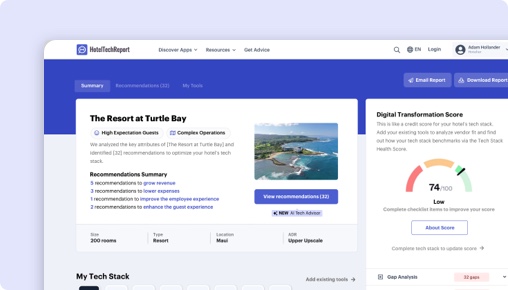
Sorry, this functionality is only available for verified hoteliers
The project dashboard is a free tool that is only available to verified hoteliers to make adopting new technology easier by streamlining their research and simplifying their communication workflow.

BEONx vs. Revenue Control Data Service:
Which Is Right for You?

TLDR
We analyzed 221 verified hotelier reviews, compared feature sets, pricing, and real-world case studies to break down where each platform delivers. The right choice depends on your property type and priorities:
BEONx shines in ease of use and customer support — especially for independent properties (5.0/5) , with exclusive features like Fully automated revenue management and Controlled Automation/Algorithm Customization.
REVENUE CONTROL DATA shines .
How Does BEONx Compare to Revenue Control Data Service?
Side-by-side ratings based on 221 verified hotelier reviews on HTR.
| HTScore |
|
|
| Likelihood to Recommend |
|
|
| Ease of Use |
|
|
| Customer Support |
|
|
| Value for Money |
|
|
| Starting Price | From $800/mo | Contact sales |
| Verified Reviews | 221 | 0 |
What Are the Pros and Cons of BEONx vs Revenue Control Data Service?
After analyzing 221 verified reviews, BEONx users most value its support and communication, user interface, forecasting accuracy, while REVENUE CONTROL DATA users highlight . Click any theme to see what reviewers say.
|
BEONx
|
REVENUE CONTROL DATA
|
|---|---|
| Pros | |
|
+
Support and communication
▾
|
|
|
+
User interface
▾
|
|
|
+
Forecasting accuracy
▾
|
|
|
+
Rate recommendations
▾
|
|
| Cons | |
|
−
Event and compset management
▾
|
|
|
−
Historical data retention
▾
|
|
BEONx vs REVENUE CONTROL DATA: Rankings by Hotel Segment
How each product ranks among Revenue Management Systems vendors for different property sizes, types, and regions — based on verified reviews from hoteliers in each segment.
By Hotel Size
| Segment |
BEONx
|
REVENUE CONTROL DATA
|
|---|---|---|
| Small (10-24 rooms) ▾ | #11 36 reviews | #46 0 reviews |
| Mid-Size (25-74 rooms) ▾ | #5 128 reviews | — |
| Large (75-199 rooms) ▾ | #3 34 reviews | — |
| X-Large (200+ rooms) ▾ | #5 16 reviews | — |
By Property Type
| Segment |
BEONx
|
REVENUE CONTROL DATA
|
|---|---|---|
| Boutique ▾ | #6 87 reviews | #50 0 reviews |
| Luxury ▾ | #5 67 reviews | — |
| Branded / Chain ▾ | #5 64 reviews | — |
| Extended Stay ▾ | #7 22 reviews | #36 0 reviews |
By Region
| Segment |
BEONx
|
REVENUE CONTROL DATA
|
|---|---|---|
| North America ▾ | #11 22 reviews | — |
| Europe ▾ | #7 138 reviews | #41 0 reviews |
| Asia Pacific | #14 2 reviews | — |
| Middle East ▾ | #5 7 reviews | — |
The Decision
Choosing between BEONx by BEONx and Revenue Control Data Service hinges on your hotel’s specific revenue management needs. BEONx offers a comprehensive, AI-driven platform with a wide range of features aimed at strategic and tactical revenue optimization. Revenue Control Data Service, on the other hand, is a simpler, data-focused tool developed by active revenue managers, primarily emphasizing data collection and quick decision-making. Both aim to increase profitability, but their core functions differ significantly.
While BEONx boasts a larger user base, extensive features, and regional presence, Revenue Control Data Service appeals to smaller teams seeking straightforward data analysis. Which solution aligns better with your hotel’s operational complexity and strategic ambitions?
Is BEONx or Revenue Control Data Service Better for Hotels?
BEONx targets hotels seeking a full-scale revenue management system with automation, advanced analytics, and channel optimization. Its AI algorithms respond dynamically to market trends, making it ideal for hotels that want to automate revenue strategies and leverage predictive insights.
Revenue Control Data Service is designed for hotels that need a centralized dashboard to analyze historical and market data quickly. It suits hotels with smaller teams or those just starting to implement revenue management, emphasizing rapid data collection and decision-making.
Both platforms aim to boost hotel profitability but diverge in sophistication. Are you looking for a deeply automated system or a straightforward, data-centric solution?
BEONx vs Revenue Control Data Service: Which Should Your Hotel Choose?
If your hotel needs a robust, AI-enabled revenue management platform that can automate pricing, forecast with high accuracy, and manage multiple properties, go with BEONx. Its extensive feature set (60+ features) and regional presence in 29 countries make it suitable for mid-to-large hotels aiming for strategic growth.
If your hotel requires a simple, active revenue management tool that consolidates data, compares market performance, and provides quick insights, Revenue Control Data Service is the better pick. It’s ideal for small teams, with a focus on ease of use, data gathering, and quick decision-making.
For hotels prioritizing automation, forecasts, and operational scalability, BEONx is the clear choice. Smaller properties or teams new to revenue management should consider Revenue Control Data Service for its simplicity and targeted functionality.
Is BEONx or Revenue Control Data Service Easier to Use?
BEONx scores a 4.72/5 for ease of use, with many reviews praising its intuitive interface and guided workflows. Its onboarding process is rated 4.59/5, and users highlight its user-friendly dashboards, customizable reports, and logical navigation.
Revenue Control Data Service, with no publicly available ratings, likely appeals to users familiar with active revenue management with minimal onboarding. Given its narrower focus and data dashboard design, it’s probably simpler but less feature-rich.
Edge: BEONx. Its high ease-of-use score and extensive support resources make it more accessible for most hotel teams.
Which Has Better Features: BEONx or Revenue Control Data Service?
BEONx offers over 60 features, including AI-driven price suggestions, automated revenue management, multi-property management, channel management, open API, dynamic pricing, revenue forecasting, and custom reports. Its features are tailored to strategic revenue optimization and operational automation.
Revenue Control Data Service focuses on core functionalities such as historical data comparison, dynamic pick-up analysis, multi-property dashboard, segmentation, and booking pace reports. Its feature set is more streamlined and aimed at quick, data-driven decisions.
The sheer breadth and depth of BEONx’s features give it an edge for hotels seeking comprehensive automation and advanced analytics.
Edge: BEONx. Its extensive, specialized feature set supports sophisticated revenue strategies.
Which Has Better Customer Support: BEONx or Revenue Control Data Service?
BEONx scores 4.77/5 for customer support, with reviews praising its helpful, responsive team that communicates effectively and guides users through implementation. The platform’s support is highlighted for professionalism and ongoing assistance.
Revenue Control Data Service, with no available review ratings, likely relies on direct, personalized support due to its smaller team size and niche focus. While support quality is probably high, it lacks the extensive user feedback that bolsters BEONx’s reputation.
Edge: BEONx. Its well-rated customer support is a key strength, especially for larger hotels needing ongoing assistance.
Which Has More Integrations: BEONx or Revenue Control Data Service?
BEONx boasts 43 verified integrations with partners like Priority Software, Omnibees, RoomRaccoon, Mirai, and others. These integrations enable seamless data flow across PMS, channel managers, and other operational systems.
Revenue Control Data Service offers no publicly listed integrations, which could limit its interoperability with other hotel systems. It primarily functions as a centralized analytics dashboard without extensive third-party connections.
Edge: BEONx. Its wide array of verified integrations supports comprehensive operational workflows.
Which Do Hoteliers Rate Higher: BEONx or Revenue Control Data Service?
BEONx has accumulated 190 reviews with a high overall rating of 4.81/5, and recent reviews (last 6 months) reinforce its current satisfaction. Hoteliers praise its ease of use, support, and impactful features, with a 94% likelihood of recommendation.
Revenue Control Data Service, lacking publicly available reviews, cannot be directly rated. Its niche focus suggests smaller-scale, specialized satisfaction, but without recent hotel feedback, its overall user sentiment remains unverified.
Given the volume and recency of reviews, BEONx clearly holds higher user ratings.
Edge: BEONx.
How Much Do BEONx and Revenue Control Data Service Cost?
BEONx charges a base price of $800/month, with no free tiers, freemium options, or trial periods. Its pricing reflects its comprehensive feature set and automation capabilities.
Revenue Control Data Service’s pricing details are not publicly disclosed, making direct comparison difficult. Likely, it follows a different pricing model suited for small teams or custom quotes.
For transparent, predictable costs aligned with advanced features, BEONx offers clearer value.
What Type of Hotel Should Use BEONx?
- Hotels seeking AI-powered automation of revenue management.
- Properties with multiple locations or complex pricing strategies.
- Hotels aiming for high forecasting accuracy and strategic insights.
- Teams that want to reduce manual work and focus on growth.
- Hotels that value integrations and customizable reporting.
Not ideal if your hotel is small, with limited staff resources, or prefers a lightweight, manual approach.
What Type of Hotel Should Use Revenue Control Data?
- Small hotels or boutique properties with minimal staff.
- Teams that need quick, consolidated data analysis.
- Hotels prioritizing simple dashboards for market comparison.
- Properties that want an active, data-driven decision support tool.
- Hotels seeking a straightforward, less automated revenue management solution.
Not ideal if your hotel operates across multiple regions or requires extensive automation and integrations.
Revenue Management Showdown: The Bottom Line for Hotels
BEONx excels as a versatile, AI-enabled platform designed for hotels looking to automate and elevate their revenue strategies. Its extensive features, integrations, and high user ratings make it suitable for mid-sized to large properties aiming for strategic growth and operational efficiency.
Revenue Control Data Service is best suited for small hotels or teams seeking a straightforward, data-focused tool that provides quick insights without the complexity of automation. Its simplicity is beneficial for hotels just starting with revenue management or with limited resources.
If your hotel values a feature-rich solution with strong support and regional reach, BEONx is the clear winner. Conversely, for smaller properties needing a leaner, cost-effective platform, Revenue Control Data Service may suffice.
In conclusion: for most hotels actively seeking a proven, well-rated revenue management system with recent growth in reviews, BEONx remains the stronger choice. Its extensive feature set and support infrastructure provide confidence in its ability to deliver measurable results.
How Much Do BEONx and Revenue Control Data Service Cost?
Revenue Management Systems pricing is rarely straightforward. Here is what we know from each vendor's public pricing data. Always request a custom quote for your property size.
|
BEONx
|
REVENUE CONTROL DATA
|
|
|---|---|---|
| Starting Price | From $800/mo | — |
Feature Comparison: BEONx vs Revenue Control Data Service
These are the features each vendor has configured, organized by feature group — the same data shown in the vendor dashboard. Expand a group to compare features side by side.
| Feature |
BEONx
|
REVENUE CONTROL DATA
|
|---|---|---|
|
▾
Pricing Optimization
|
|
|
| Price Explanation | ||
| Enterprise Business Guidelines | ||
| Alternate Stay Date Recommendations | ||
| Alternate Property Reccomendations | ||
| Real-time price optimization | ||
| Dynamic Price Hierarchy Control | ||
| Open Pricing | ||
| Guided workflows | ||
| "What-if" scenario analysis | ||
| Dynamic Pricing | ||
| Set Boundaries | ||
| Manage Exceptions | ||
| Group Pricing | ||
| Manage Restrictions | ||
| Manage Sell-Outs & Cancellations | ||
| Business Mix Optimization | ||
| Define Cycles | ||
| Yield Room Types Individually | ||
| Bulk Adjustments | ||
| 24-Months Pricing & Forecasting | ||
| Component/virtual room pricing | ||
| Extended stay pricing | ||
| Upsell pricing | ||
| Hurdle rate | ||
|
▾
Market Intelligence & Forecasting
|
|
|
| Five-Year Forecasting | ||
| 365-Day Forward Pricing | ||
| STR Data | ||
| 18-Month Forward Pricing | ||
| Price sensitivity modeling | ||
| Multi-Property Dashboard | ||
| Market Intelligence Data | ||
| Interactive Customizable Dashboards | ||
| Future Market Demand Data | ||
| Financial Forecast Builder | ||
| Extended stay forecasting | ||
| Channel forecasting | ||
| Forecast explanation | ||
| Flexible competitor data | ||
|
▾
Dashboards & Reporting
|
|
|
| Custom Reports | ||
| Scheduled Reports | ||
| Lost Business Data | ||
| Analytics dashboard | ||
| Interactive Customizable Dashboards | ||
| Market Insights Reporting | ||
| Pickup Analysis | ||
| Booking Pattern Analysis | ||
| Event Data | ||
| Price Change Logs | ||
| Customizable Notifications & Alerts | ||
| Displacement Analysis | ||
| Group Pricing & Evaluation | ||
| Multi-Property Dashboard | ||
| System benefit measurement | ||
|
▾
Automation
|
|
|
| Controlled Automation/Algorithm Customization | ||
| Automated Room-Type Pricing | ||
| Fully automated revenue management | ||
| Dynamic Pricing | ||
| AI Optimization | ||
| Automatic Pricing Updates | ||
|
▾
Multi-Property Functionality
|
|
|
| Inventory Management | ||
| Multi-property Management | ||
| Multi-Property Dashboard | ||
|
▾
Group Business
|
|
|
| Group Pricing & Evaluation | ||
| "What-if" scenario analysis | ||
| Displacement Analysis | ||
| Group forecast and wash | ||
|
▾
Integrations
|
|
|
| Open API | ||
| Channel Manager | ||
| Business Intelligence | ||
| STR Data | ||
| Property Management System | ||
| Multi-factor authentication | ||
|
▾
Other
|
|
|
| Group pricing & evaluation | ||
| Mobile App | ||
| Smart Spreading Technology | ||
| Single Sign-On | ||
| Mobile Friendly Design |
Real-World Results: BEONx vs REVENUE CONTROL DATA by Business Goal
We analyzed 6 verified case studies to compare what hotels actually achieve with each platform across four key business objectives.
HotelAtelier
Small
"Including the HQI™ in the RMS decisions combines demand patterns with quality data, marking a differential value with respect to other systems that do not include this variable in..."
 REVENUE CONTROL DATA
No published case study for this goal yet.
Grupo Sade: Transforms hotel operations with BEONx
Small
"Grupo Sade’s management highlights the “quick response from the BEONx team during incidents, personalized service, and smooth implementation process” as key elements of their satis..."
 REVENUE CONTROL DATA
No published case study for this goal yet.
BEONx vs REVENUE CONTROL DATA: The Bottom Line
What hoteliers love
BEONx's support team receives high marks for their professionalism, responsiveness, and effectiveness in resolving issues. The team’s dedication to co... BEONx's support team receives high marks for their professionalism, responsiveness, and effectiveness in resolving issues. The team’s dedication to communication and iterative improvements enhances user satisfaction.
The user interface of BEONx is widely praised for being intuitive and easy to navigate. Its modern design and ease of use allow even beginners to acce... The user interface of BEONx is widely praised for being intuitive and easy to navigate. Its modern design and ease of use allow even beginners to access its features effectively, enhancing the overall user experience.
Users frequently commend BEONx for its high forecasting accuracy, which is crucial for strategic revenue management and optimizing pricing decisions.... Users frequently commend BEONx for its high forecasting accuracy, which is crucial for strategic revenue management and optimizing pricing decisions. Several reviews mention its predictive capabilities as accurate and dynamic, assisting hotels in adapting to market fluctuations efficiently.
Where hoteliers push back
Several users express a need for improved responsiveness to special events and dynamic compset integration. Enhancements like automated event replicat... Several users express a need for improved responsiveness to special events and dynamic compset integration. Enhancements like automated event replication and AI-driven compset calculations are requested to better model demand.
There are some concerns about the deletion of pricing data after 90 days, limiting historical analysis. Users suggest retaining this data longer to en... There are some concerns about the deletion of pricing data after 90 days, limiting historical analysis. Users suggest retaining this data longer to enhance strategic insights over extended periods.
Ranks higher for
Unique capabilities
Where the ratings diverge most
Frequently Asked Questions About BEONx vs Revenue Control Data Service
Can BEONx replace Revenue Control Data Service?
It depends on your requirements. BEONx and Revenue Control Data Service share many core Revenue Management Systems features, but each has unique capabilities. BEONx offers 44 verified integration partners, while Revenue Control Data Service offers 0. Review the feature comparison above to see where they differ before switching.
Which is better for small or independent hotels?
Small hotels should prioritize ease of use and fast onboarding. BEONx leads in ease of use at 4.7/5 vs 0.0/5. Look for transparent pricing and a trial or demo option. Filter reviews on each product page by property size to hear from hotels like yours.
Do BEONx or Revenue Control Data Service offer a free plan?
BEONx: No. Revenue Control Data Service: No. Neither product currently offers a free tier. Most Revenue Management Systems vendors offer demos or trials — request one from each to evaluate before committing.
How Does HTR Evaluate and Rank BEONx and Revenue Control Data Service?
The HT Score is a composite ranking that considers 4 criteria groups and over a dozen variables to help hoteliers objectively compare hotel technology products. BEONx has an HT Score of 83 and REVENUE CONTROL DATA has 0. Here is how the score is calculated.
| Criteria Group | Weight | What It Measures |
|---|---|---|
| Customer Ratings & Reviews |
|
How highly do users recommend this product? Ratings Score, Review Volume, Share of Voice, Review Depth, Review Recency, Success Stories ▾ The most heavily weighted factor. Analyzes average satisfaction ratings (likelihood to recommend, ease of use, support, ROI), total review count relative to category peers, review recency (at least 20 reviews in the trailing 6 months), and share of voice across unique hotel clients to detect selection bias. |
| Partner Ecosystem |
|
How highly do tech partners recommend this company? Partner Recommendations, Integration Quantity, Integration Quality ▾ Evaluates partner recommendations as expert votes of confidence, the number of verified integrations, and ecosystem quality — the average HT Scores of integration partners. Products with higher-quality integration ecosystems are more likely to deliver a connected tech stack. |
| Customer Centricity |
|
How customer-centric is this organization? Certified Support, Review Consistency, Profile Completeness ▾ Assesses whether the company has earned HTR Customer Support Certification, maintains consistent review collection over time (an indicator of feedback-driven culture), and keeps product profiles complete with capabilities, screenshots, pricing, and features. |
| Reach, Staying Power & Resources |
|
How extensive is this company's reach and resourcing? Geographic Reach, Staying Power, Company Resources, Trending Score ▾ Measures global presence (countries and regions served), years in business as a stability proxy, team headcount as a resource proxy, and a trending score based on trailing-twelve-month buyer inquiries, reviews, partner recommendations, and press activity. |
Customer ratings and reviews are by far the most important factor in the HT Score algorithm. HTR does not accept payment for higher rankings. All reviews are verified — only hotel industry practitioners with confirmed affiliations can submit ratings. View full HT Score methodology →
What Other Revenue Management Systems Comparisons Are Hoteliers Reading?
Explore more head-to-head comparisons based on verified hotelier reviews.






Get Your Free AI Analyst Report
Custom recommendations tailored to your property


Let´s lookup your hotel information
Still weighing your revenue management systems options?
A few popular systems from our revenue management systems guide — or let our AI score each one against your specific property in about two minutes.


