

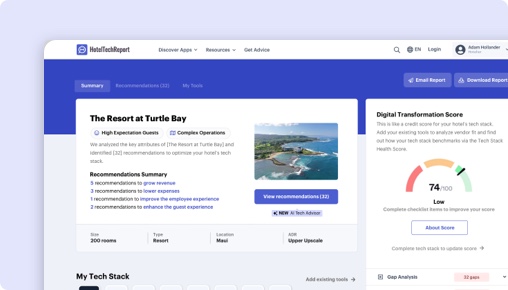
Sorry, this functionality is only available for verified hoteliers
The project dashboard is a free tool that is only available to verified hoteliers to make adopting new technology easier by streamlining their research and simplifying their communication workflow.

Blastness Revenue Management System vs. Demand Calendar:
Which Is Right for You?

TLDR
We analyzed 114 verified hotelier reviews, compared feature sets, pricing, and real-world case studies to break down where each platform delivers. The right choice depends on your property type and priorities:
Blastness shines in pricing optimization and revenue strategy — especially for boutique properties (5.0/5), with exclusive features like Controlled Automation/Algorithm Customization and Fully automated revenue management.
Demand Calendar AB stands out with exclusive features like STR Data and Five-Year Forecasting.
How Does Blastness Revenue Management System Compare to Demand Calendar?
Side-by-side ratings based on 114 verified hotelier reviews on HTR.
| HTScore |
|
|
| Likelihood to Recommend |
|
|
| Ease of Use |
|
|
| Customer Support |
|
|
| Value for Money |
|
|
| Starting Price | Contact sales | From $600/mo |
| Verified Reviews | 107 | 7 |
What Are the Pros and Cons of Blastness Revenue Management System vs Demand Calendar?
After analyzing 114 verified reviews, Blastness users most value its pricing optimization and revenue strategy, customer support and account responsiveness, ease of use and intuitive workflows, while Demand Calendar AB users highlight . Click any theme to see what reviewers say.
|
Blastness
|
Demand Calendar AB
|
|---|---|
| Pros | |
|
+
Pricing optimization and revenue strategy
▾
|
|
|
+
Customer support and account responsiveness
▾
|
|
|
+
Ease of use and intuitive workflows
▾
|
|
|
+
Reporting, forecasting, and analytics
▾
|
|
| Cons | |
|
−
Customization, flexibility, and advanced configuration
▾
|
|
Blastness vs Demand Calendar AB: Rankings by Hotel Segment
How each product ranks among Revenue Management Systems vendors for different property sizes, types, and regions — based on verified reviews from hoteliers in each segment.
By Hotel Size
| Segment |
Blastness
|
Demand Calendar AB
|
|---|---|---|
| Small (10-24 rooms) ▾ | #10 43 reviews | #39 2 reviews |
| Mid-Size (25-74 rooms) ▾ | #8 52 reviews | #34 5 reviews |
| Large (75-199 rooms) | #23 3 reviews | — |
By Property Type
| Segment |
Blastness
|
Demand Calendar AB
|
|---|---|---|
| Boutique ▾ | #11 43 reviews | #39 5 reviews |
| Luxury ▾ | #7 48 reviews | #40 2 reviews |
| Branded / Chain ▾ | #9 25 reviews | #37 2 reviews |
| Extended Stay | #20 3 reviews | — |
By Region
| Segment |
Blastness
|
Demand Calendar AB
|
|---|---|---|
| North America | #21 2 reviews | — |
| Europe ▾ | #10 99 reviews | #29 5 reviews |
| Asia Pacific | #15 1 reviews | #13 2 reviews |
Is Blastness Revenue Management System or Demand Calendar Better for Hotels?
Blastness and Demand Calendar serve distinct but complementary roles in hotel revenue strategies. Blastness is a full-service revenue management system (RMS) focused on real-time dynamic pricing and distribution control. Demand Calendar is business intelligence software designed for hotel groups to forecast total revenue and profit, integrating multiple revenue streams beyond room sales.
Blastness excels in pricing optimization, channel management, and direct booking growth across diverse properties. Demand Calendar targets multi-property operations needing centralized revenue forecasting and actionable insights across departments. Both address revenue growth but at different operational levels—Blastness optimizes rates and channel mix daily; Demand Calendar aligns teams with forward-looking budget adherence and cross-department visibility.
Blastness vs Demand Calendar: Which Should Your Hotel Choose?
If your hotel relies on daily rate adjustments, channel distribution, and direct booking growth—especially if you operate a single property or a small portfolio—choose Blastness. Its 107 reviews averaging 5/5 overall (with 44 boutique hotel reviews at 5/5) and features like AI-driven price optimization and channel management make it ideal for independent and branded hotels seeking granular pricing control.
If you manage multiple hotels and prioritize top-down revenue forecasting across rooms, F&B, meetings, and spa, Demand Calendar suits you better. Although limited to 7 reviews, its multi-property management, 5-year forecasting, and STR data integration support chains and groups needing consolidated financial oversight. Data for large portfolios is thin, so verify fit for your specific scale.
For boutique and city center hotels, Blastness holds a stronger rating base (44 and 23 reviews) than Demand Calendar (5 reviews each), supporting its suitability. Demand Calendar’s strength is in group environments with complex revenue streams beyond rooms, where Blastness’s focus narrows to room rate optimization.
Is Blastness or Demand Calendar Easier to Use?
Blastness scores 4.9/5 for ease of use and onboarding, with reviewers praising its clear interface and intuitive workflows. Users highlight simple daily rate adjustments and practical channel management, though some note occasional complexity in booking engine processes. Demand Calendar rates 4.7/5 for ease of use and 4.3/5 for onboarding, with positive feedback on time savings and streamlined data access but criticism of a cluttered dashboard and PMS connectivity issues.
Reviewers of both platforms acknowledge learning curves but appreciate how each integrates into daily revenue tasks. Blastness users emphasize straightforward pricing control; Demand Calendar users value quick access to consolidated data despite some layout frustrations.
Edge: Even.
Which Has Better Features: Blastness or Demand Calendar?
Blastness offers 30 unique features compared to Demand Calendar’s 4, reflecting its RMS specialization. Exclusive to Blastness are real-time price optimization, dynamic pricing, AI-powered automation, channel management, bulk rate adjustments, and customizable notifications. These enable front desk and revenue managers to execute granular pricing strategies, manage multiple rate levels independently across channels, and automate routine updates, reducing manual workload and improving revenue capture.
Demand Calendar uniquely provides STR data integration, five-year forecasting, multi-property management, and an open API. These features support strategic planning, portfolio-wide revenue oversight, and integration flexibility, mainly benefiting centralized revenue executives in hotel groups.
Blastness’s advanced pricing controls affect daily workflows directly, while Demand Calendar’s forecasting features influence longer-term budget alignment and interdepartmental coordination.
Edge: Blastness.
Which Has Better Customer Support: Blastness or Demand Calendar?
Blastness and Demand Calendar both score high on customer support, with Blastness at 4.9/5 and Demand Calendar at 5/5. Reviewers of Blastness consistently highlight fast, knowledgeable, and proactive support teams who maintain efficient communication over years. Demand Calendar users praise responsive support and ease of contact, noting quick resolution of issues.
Some Blastness reviewers request extended availability, such as weekend support, indicating a minor gap in coverage. Demand Calendar’s limited review volume tempers definitive conclusions but current feedback is uniformly positive.
Edge: Even.
Which Has More Integrations: Blastness or Demand Calendar?
Blastness integrates with 17 verified partners compared to Demand Calendar’s 5, providing broader connectivity. Both support major PMS platforms like Oracle Hospitality and Mews, and leading RMS systems like IDeaS. Blastness additionally integrates with Upsellguru, Asksuite, MyForecast, and Vertical Booking, enhancing capabilities in upselling, guest messaging, forecasting, and distribution.
Demand Calendar’s unique partners include Clock and HQ Revenue, which target specific BI and revenue functions. Blastness’s wider integration suite benefits hotels leveraging multiple operational tools and looking for seamless data flow between revenue, distribution, and marketing systems. Demand Calendar’s integrations align with its forecasting and multi-property focus.
Edge: Blastness.
Which Do Hoteliers Rate Higher: Blastness or Demand Calendar?
Blastness holds a 5/5 overall rating across 107 reviews, including 6 reviews in the last 6 months, while Demand Calendar has a 4.8/5 rating from 7 total reviews with no recent activity. Blastness’s recent review volume dropped 71% from its prior 2-year average, suggesting current ratings may not fully reflect recent product changes or support.
Segment-wise, Blastness rates 5/5 among boutique hotels (44 reviews) and 4.9/5 among luxury hotels (49 reviews), indicating strong operator satisfaction across property types. Demand Calendar’s boutique hotel rating is 4.7/5 from 5 reviews, and luxury hotels rate it 5/5 but with only 2 reviews, limiting confidence.
Overall, Blastness’s larger and more diverse review base supports stronger confidence in its ratings, despite the recent review decline.
Edge: Even.
How Much Do Blastness and Demand Calendar Cost?
Blastness does not publish pricing details, charges no implementation fee, and offers no trial. Pricing appears customized per property.
Demand Calendar publishes a base price of $600 monthly, also without an implementation fee or trial period. No per-room or flat monthly pricing is indicated.
This pricing transparency advantage allows Demand Calendar buyers to budget upfront, while Blastness prospects need direct quotes.
What Type of Hotel Should Use Blastness?
- Hotels that prioritize real-time, AI-driven price optimization and want flexible multi-rate management across channels.
- Independent and branded hotels seeking to increase direct bookings through integrated booking engines and channel managers.
- Properties requiring detailed forecasting and reporting within a single platform to reduce manual workload.
- Hotels with staff trained or focused on revenue strategy, benefiting from guided workflows and customizable alerts.
- Small to medium-sized luxury, boutique, and city center hotels, supported by significant review volumes and high satisfaction ratings.
Not ideal if…
- You require multi-property revenue consolidation and cross-departmental revenue forecasting.
- Your team demands 24/7 support coverage including weekends and holidays.
- You need published pricing or freemium models for initial evaluation.
What Type of Hotel Should Use Demand Calendar?
- Multi-property hotel groups seeking consolidated revenue forecasting across rooms, F&B, meetings, and spa.
- Hotels looking to align revenue, sales, marketing, and operations around one shared budget and forecast.
- Properties that prioritize long-term planning with five-year revenue forecasting and STR data integration.
- Teams requiring an open API for custom integrations with other BI or financial systems.
- Hotels with sufficient resources to manage some limitations in PMS connectivity and dashboard usability.
Not ideal if…
- You need granular daily rate optimization with automated dynamic pricing.
- Your property requires a full RMS with channel management and booking engine integration.
- You prefer vendors with extensive user reviews and a robust support track record.
Blastness Revenue Management System vs Demand Calendar: The Bottom Line for Hotels
Blastness and Demand Calendar address different revenue challenges. Blastness delivers an advanced, AI-powered RMS designed for daily price optimization and channel distribution control. Demand Calendar offers a business intelligence platform to forecast total revenue and profit across multiple properties and departments.
Choose Blastness if you want to maximize direct bookings and revenue through granular pricing, supported by extensive features like real-time price optimization, AI automation, and channel management. It suits independent, boutique, and branded hotels with dedicated revenue teams. Blastness’s strong integration portfolio and highly rated user experience reinforce its operational value.
Choose Demand Calendar if your priority is group-level revenue forecasting that consolidates rooms, F&B, and meetings into one actionable view. Its multi-property management and five-year forecasting support strategic planning for hotel groups, especially where alignment across revenue, sales, and operations is essential. Demand Calendar’s transparent pricing and open API are assets for complex environments.
Note that Blastness’s recent review volume has dropped 71% in the last six months compared to its two-year average, which may indicate evolving service or product challenges not yet reflected in its historically excellent ratings. This should be considered alongside your property’s scale and revenue management needs when making a final decision.
How Much Do Blastness Revenue Management System and Demand Calendar Cost?
Revenue Management Systems pricing is rarely straightforward. Here is what we know from each vendor's public pricing data. Always request a custom quote for your property size.
|
Blastness
|
Demand Calendar AB
|
|
|---|---|---|
| Starting Price | — | From $600/mo |
Feature Comparison: Blastness Revenue Management System vs Demand Calendar
These are the features each vendor has configured, organized by feature group — the same data shown in the vendor dashboard. Expand a group to compare features side by side.
| Feature |
Blastness
|
Demand Calendar AB
|
|---|---|---|
|
▾
Pricing Optimization
|
|
|
| Price Explanation | ||
| Enterprise Business Guidelines | ||
| Alternate Stay Date Recommendations | ||
| Alternate Property Reccomendations | ||
| Real-time price optimization | ||
| Dynamic Price Hierarchy Control | ||
| Open Pricing | ||
| Guided workflows | ||
| "What-if" scenario analysis | ||
| Dynamic Pricing | ||
| Set Boundaries | ||
| Manage Exceptions | ||
| Group Pricing | ||
| Manage Restrictions | ||
| Manage Sell-Outs & Cancellations | ||
| Business Mix Optimization | ||
| Define Cycles | ||
| Yield Room Types Individually | ||
| Bulk Adjustments | ||
| 24-Months Pricing & Forecasting | ||
| Component/virtual room pricing | ||
| Extended stay pricing | ||
| Upsell pricing | ||
| Hurdle rate | ||
|
▾
Market Intelligence & Forecasting
|
|
|
| Five-Year Forecasting | ||
| 365-Day Forward Pricing | ||
| STR Data | ||
| 18-Month Forward Pricing | ||
| Price sensitivity modeling | ||
| Multi-Property Dashboard | ||
| Market Intelligence Data | ||
| Interactive Customizable Dashboards | ||
| Future Market Demand Data | ||
| Financial Forecast Builder | ||
| Extended stay forecasting | ||
| Channel forecasting | ||
| Forecast explanation | ||
| Flexible competitor data | ||
|
▾
Dashboards & Reporting
|
|
|
| Custom Reports | ||
| Scheduled Reports | ||
| Lost Business Data | ||
| Analytics dashboard | ||
| Interactive Customizable Dashboards | ||
| Market Insights Reporting | ||
| Pickup Analysis | ||
| Booking Pattern Analysis | ||
| Event Data | ||
| Price Change Logs | ||
| Customizable Notifications & Alerts | ||
| Displacement Analysis | ||
| Group Pricing & Evaluation | ||
| Multi-Property Dashboard | ||
| System benefit measurement | ||
|
▾
Automation
|
|
|
| Controlled Automation/Algorithm Customization | ||
| Automated Room-Type Pricing | ||
| Fully automated revenue management | ||
| Dynamic Pricing | ||
| AI Optimization | ||
| Automatic Pricing Updates | ||
|
▾
Multi-Property Functionality
|
|
|
| Inventory Management | ||
| Multi-property Management | ||
| Multi-Property Dashboard | ||
|
▾
Group Business
|
|
|
| Group Pricing & Evaluation | ||
| "What-if" scenario analysis | ||
| Displacement Analysis | ||
| Group forecast and wash | ||
|
▾
Integrations
|
|
|
| Open API | ||
| Channel Manager | ||
| Business Intelligence | ||
| STR Data | ||
| Property Management System | ||
| Multi-factor authentication |
Real-World Results: Blastness vs Demand Calendar AB by Business Goal
We analyzed 4 verified case studies to compare what hotels actually achieve with each platform across four key business objectives.
Villa Cortine
Small
"The constant evolution of tools such as Business Intelligence and RMS, which my team and I use on a daily basis, has led to very interesting results."
Demand Calendar AB
No published case study for this goal yet.
Minareto
Small
"Thanks to Blastness, we not only increased our direct bookings and RevPAR, but also gained the confidence to make smarter, data-driven decisions that shape the future of our resort..."
 Demand Calendar AB
No published case study for this goal yet.
Blastness vs Demand Calendar AB: The Bottom Line
What hoteliers love
A core value theme is helping hotels set better rates and stay competitive through RMS-driven pricing, demand-based strategy, and revenue analysis. Re... A core value theme is helping hotels set better rates and stay competitive through RMS-driven pricing, demand-based strategy, and revenue analysis. Reviewers highlight daily pricing updates, stronger revenue control, and better rate decisions, though one notes the model can overemphasize market pressure and miss property-specific pickup.
Support quality is one of Blastness's strongest recurring themes, with users praising knowledgeable, fast, and proactive staff. A smaller but importan... Support quality is one of Blastness's strongest recurring themes, with users praising knowledgeable, fast, and proactive staff. A smaller but important set of comments asks for broader availability, especially 24/7 or holiday coverage, and faster helpdesk email response times.
Many reviewers describe the platform as clear, intuitive, and easy to manage, especially for daily rate and reservation tasks. At the same time, some... Many reviewers describe the platform as clear, intuitive, and easy to manage, especially for daily rate and reservation tasks. At the same time, some say certain workflows are still too cumbersome or too complex, particularly when changing prices, managing promotions, or navigating booking steps.
Where hoteliers push back
Several reviewers want more control over how the system behaves, from custom dashboards and reporting templates to pricing rules, room-type changes, a... Several reviewers want more control over how the system behaves, from custom dashboards and reporting templates to pricing rules, room-type changes, and workflow simplification. This topic appears as a recurring opportunity to make the platform better fit complex hotel operations and specialized revenue setups.
Ranks higher for
Unique capabilities
Ranks higher for
Unique capabilities
Frequently Asked Questions About Blastness Revenue Management System vs Demand Calendar
Can Blastness Revenue Management System replace Demand Calendar?
It depends on your requirements. Blastness Revenue Management System and Demand Calendar share many core Revenue Management Systems features, but each has unique capabilities. Blastness Revenue Management System offers 17 verified integration partners, while Demand Calendar offers 5. Review the feature comparison above to see where they differ before switching.
Which is better for small or independent hotels?
Small hotels should prioritize ease of use and fast onboarding. Blastness Revenue Management System leads in ease of use at 4.9/5 vs 4.7/5. Look for transparent pricing and a trial or demo option. Filter reviews on each product page by property size to hear from hotels like yours.
Do Blastness Revenue Management System or Demand Calendar offer a free plan?
Blastness Revenue Management System: No. Demand Calendar: No. Neither product currently offers a free tier. Most Revenue Management Systems vendors offer demos or trials — request one from each to evaluate before committing.
How Does HTR Evaluate and Rank Blastness Revenue Management System and Demand Calendar?
The HT Score is a composite ranking that considers 4 criteria groups and over a dozen variables to help hoteliers objectively compare hotel technology products. Blastness has an HT Score of 83 and Demand Calendar AB has 0. Here is how the score is calculated.
| Criteria Group | Weight | What It Measures |
|---|---|---|
| Customer Ratings & Reviews |
|
How highly do users recommend this product? Ratings Score, Review Volume, Share of Voice, Review Depth, Review Recency, Success Stories ▾ The most heavily weighted factor. Analyzes average satisfaction ratings (likelihood to recommend, ease of use, support, ROI), total review count relative to category peers, review recency (at least 20 reviews in the trailing 6 months), and share of voice across unique hotel clients to detect selection bias. |
| Partner Ecosystem |
|
How highly do tech partners recommend this company? Partner Recommendations, Integration Quantity, Integration Quality ▾ Evaluates partner recommendations as expert votes of confidence, the number of verified integrations, and ecosystem quality — the average HT Scores of integration partners. Products with higher-quality integration ecosystems are more likely to deliver a connected tech stack. |
| Customer Centricity |
|
How customer-centric is this organization? Certified Support, Review Consistency, Profile Completeness ▾ Assesses whether the company has earned HTR Customer Support Certification, maintains consistent review collection over time (an indicator of feedback-driven culture), and keeps product profiles complete with capabilities, screenshots, pricing, and features. |
| Reach, Staying Power & Resources |
|
How extensive is this company's reach and resourcing? Geographic Reach, Staying Power, Company Resources, Trending Score ▾ Measures global presence (countries and regions served), years in business as a stability proxy, team headcount as a resource proxy, and a trending score based on trailing-twelve-month buyer inquiries, reviews, partner recommendations, and press activity. |
Customer ratings and reviews are by far the most important factor in the HT Score algorithm. HTR does not accept payment for higher rankings. All reviews are verified — only hotel industry practitioners with confirmed affiliations can submit ratings. View full HT Score methodology →
What Other Revenue Management Systems Comparisons Are Hoteliers Reading?
Explore more head-to-head comparisons based on verified hotelier reviews.





Get Your Free AI Analyst Report
Custom recommendations tailored to your property


Let´s lookup your hotel information
Still weighing your revenue management systems options?
A few popular systems from our revenue management systems guide — or let our AI score each one against your specific property in about two minutes.


