

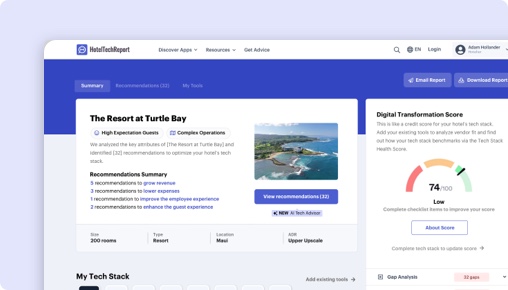
Sorry, this functionality is only available for verified hoteliers
The project dashboard is a free tool that is only available to verified hoteliers to make adopting new technology easier by streamlining their research and simplifying their communication workflow.

Busy Rooms vs. SynXis Central Reservation System:
Which Is Right for You?

TLDR
We analyzed 65 verified hotelier reviews, compared feature sets, pricing, and real-world case studies to break down where each platform delivers. The right choice depends on your property type and priorities:
Aven Hospitality shines in partner responsiveness and issue resolution — especially for extended-stay properties (4.8/5), with exclusive features like Availability Management and Booking Rules.
How Does Busy Rooms Compare to SynXis Central Reservation System?
Side-by-side ratings based on 65 verified hotelier reviews on HTR.
| HTScore |
|
|
| Likelihood to Recommend |
|
|
| Ease of Use |
|
|
| Customer Support |
|
|
| Value for Money |
|
|
| Starting Price | From $200/mo | From $400/mo |
| Verified Reviews | 5 | 60 |
What Are the Pros and Cons of Busy Rooms vs SynXis Central Reservation System?
After analyzing 65 verified reviews, Busy Rooms users most value its , while Aven Hospitality users highlight partner responsiveness and issue resolution, connectivity reliability, operational efficiency. Click any theme to see what reviewers say.
|
Busy Rooms
|
Aven Hospitality
|
|---|---|
| Pros | |
|
+
Partner responsiveness and issue resolution
▾
|
|
|
+
Connectivity reliability
▾
|
|
|
+
Operational efficiency
▾
|
|
|
+
Faster rollouts
▾
|
|
| Cons | |
|
−
Manual configuration steps
▾
|
|
|
−
Time-consuming workflows
▾
|
|
|
−
Risk of errors
▾
|
|
Busy Rooms vs Aven Hospitality: Rankings by Hotel Segment
How each product ranks among Hotel Reservations Software vendors for different property sizes, types, and regions — based on verified reviews from hoteliers in each segment.
By Hotel Size
| Segment |
Busy Rooms
|
Aven Hospitality
|
|---|---|---|
| Small (10-24 rooms) | #12 2 reviews | #11 3 reviews |
| Mid-Size (25-74 rooms) ▾ | #14 1 reviews | #5 27 reviews |
| Large (75-199 rooms) ▾ | #11 1 reviews | #2 19 reviews |
| X-Large (200+ rooms) ▾ | — | #2 5 reviews |
By Property Type
| Segment |
Busy Rooms
|
Aven Hospitality
|
|---|---|---|
| Boutique ▾ | #13 2 reviews | #6 21 reviews |
| Luxury ▾ | #13 1 reviews | #4 35 reviews |
| Branded / Chain ▾ | #16 0 reviews | #3 20 reviews |
| Extended Stay ▾ | — | #4 7 reviews |
By Region
| Segment |
Busy Rooms
|
Aven Hospitality
|
|---|---|---|
| North America ▾ | #10 1 reviews | #2 36 reviews |
| Europe ▾ | #9 2 reviews | #7 8 reviews |
| Asia Pacific ▾ | — | #3 6 reviews |
| Middle East ▾ | #8 1 reviews | #2 5 reviews |
Is Busy Rooms or SynXis Central Reservation System Better for Hotels?
Busy Rooms and SynXis Central Reservation System both serve as cloud-based central reservation platforms, but they diverge sharply in scale, feature depth, and target user base. Busy Rooms is tailored primarily for resorts and boutique hotels seeking a flexible, brandable solution that centralizes sales and marketing operations. SynXis, by contrast, targets larger, branded hotel portfolios and multi-property management with a broader feature set including availability management and booking rules.
Both platforms solve the fundamental problem of centralizing reservations, rates, and inventory to improve operational efficiency and revenue management. However, Busy Rooms emphasizes adaptability and customer service for niche and resort properties, while SynXis focuses on connectivity, scalability, and extensive OTA integration for enterprise-level hotels.
Busy Rooms vs SynXis Central Reservation System: Which Should Your Hotel Choose?
If you operate a small to mid-sized resort or boutique hotel in Europe or the Middle East, Busy Rooms is preferable based on its 4.9/5 overall rating from five reviews and strong 4.8/5 scores in ease of use and customer support. Its user base includes 40% resorts with a 4.9/5 rating, demonstrating a good fit for independent properties that value flexibility and responsive support. The limited review volume advises cautious validation for other segments.
If you manage multiple branded hotels or a large portfolio, especially in North America or across 18 countries, SynXis is a better fit due to its 123 verified integrations, advanced booking engine features like weekly/monthly rates, and robust availability management. Despite a lower overall rating of 4.3/5 from 60 reviews, SynXis’s extensive features support complex distribution needs. However, recent reviews suggest some customer service and integration delays, which may impact hotels needing rapid customization.
Is Busy Rooms or SynXis Central Reservation System Easier to Use?
Busy Rooms and SynXis both receive strong ease-of-use scores: 4.8/5 for Busy Rooms and 4.4/5 for SynXis, with onboarding ratings of 4.5/5 and 4.1/5, respectively. Busy Rooms reviewers highlight its user-friendly interface and flexibility, noting that the system rarely has issues and customer support is generally very good, albeit with occasional delays. SynXis users also praise its intuitive design and ease of managing rates and reservations, particularly for multiple properties.
Both platforms support effective staff adoption, but SynXis’s interface accommodates complex portfolios better, while Busy Rooms simplifies workflows for smaller teams. Given the rating gap is under 0.3 and both have fewer than ten recent reviews for Busy Rooms, the edge on ease of use is even.
Edge: Even.
Which Has Better Features: Busy Rooms or SynXis Central Reservation System?
SynXis offers five unique hotel-relevant features that Busy Rooms lacks: availability management, booking rules, support for weekly and monthly rates, TMC (Travel Management Company) management, and cancellation policies. These features enable SynXis users to enforce complex rate strategies, cater to corporate travel, and manage long-stay bookings—critical for branded hotels and multi-property groups.
Busy Rooms does not list any unique features beyond the shared 13 common capabilities but emphasizes integrated, modular solutions that clients can configure flexibly. However, this modularity does not compensate for the absence of advanced booking controls present in SynXis.
Edge: SynXis Central Reservation System.
Which Has Better Customer Support: Busy Rooms or SynXis Central Reservation System?
Customer support ratings are 4.8/5 for Busy Rooms and 4.1/5 for SynXis, with onboarding scores of 4.5/5 and 4.1/5, respectively. Reviewers of Busy Rooms praise the responsiveness and personalized assistance, often mentioning specific support staff by name and describing the support team as "amazing" and "a super star." The main complaint involves occasional delays in response time.
SynXis users acknowledge effective account management and proactive communication from dedicated managers but report slower issue resolution and some frustration with the support process, including language barriers and delays. Given the rating gap is below 0.3 and Busy Rooms has fewer than ten total reviews, this difference is not decisive.
Edge: Even.
Which Has More Integrations: Busy Rooms or SynXis Central Reservation System?
SynXis Central Reservation System has 123 verified integrations, almost quadruple Busy Rooms’ 31. Both platforms share 21 common partners, including industry staples like Oracle Hospitality, Mews, Maestro PMS, and RateGain. Busy Rooms integrates with niche providers such as Priority Software and Hotelchamp, while SynXis covers broader digital marketing and PMS vendors like Profitroom, Koddi, and Visual Matrix.
Hotels requiring extensive channel connectivity and third-party integrations for distribution, analytics, and marketing will benefit from SynXis’s superior ecosystem. Busy Rooms’ integrations suit properties focused on specific regional or functional needs rather than global distribution scale.
Edge: SynXis Central Reservation System.
Which Do Hoteliers Rate Higher: Busy Rooms or SynXis Central Reservation System?
Busy Rooms holds a 4.9/5 overall rating from 5 reviews, with no recent reviews in the last six months, limiting confidence about current performance. SynXis has a 4.3/5 rating from 60 reviews, including 3 recent ones, maintaining stable recent performance.
Segment ratings show Busy Rooms excels in resorts (4.9/5) and boutique hotels (4.8/5), while SynXis scores highest in branded hotels (4.4/5) and resorts (4.4/5) but lower in boutique (4.2/5) and luxury hotels (4.2/5). Busy Rooms’ user base skews heavily toward resorts and boutique properties, whereas SynXis supports larger branded portfolios and a diverse hotel mix. The limited recent reviews for Busy Rooms restrict firm conclusions on current user sentiment.
Edge: Even.
How Much Do Busy Rooms and SynXis Central Reservation System Cost?
Busy Rooms does not publicly disclose pricing, lacks trial options, and does not offer freemium or per-room pricing. SynXis requires a $400 base price, also with no trial or freemium model. Neither vendor charges implementation fees publicly.
SynXis’s published pricing provides clearer budgeting data for hotels, especially larger ones planning multi-property deployments. Busy Rooms’ pricing transparency is limited, which may present challenges for procurement teams seeking upfront cost clarity.
What Type of Hotel Should Use Busy Rooms?
- Hotels that prioritize a flexible, brandable CRS tailored for resorts or boutique properties, supported by a highly rated 4.9/5 score and positive feedback on customization.
- Teams that need integrated modules with the ability to pick and choose functionalities to suit specific operational workflows.
- Properties in Europe, Middle East, or Asia Pacific, where Busy Rooms has established regional presence and support.
- Resorts focused on personalized customer service, reflecting the platform’s strong customer support ratings and praise for responsiveness.
Not ideal if:
- Your property requires advanced availability management, booking rules, or corporate TMC functionalities, which Busy Rooms lacks.
- You operate a large branded hotel portfolio needing extensive third-party integrations and global distribution.
- Transparent and published pricing is critical for your procurement process.
What Type of Hotel Should Use SynXis Central Reservation System?
- Branded hotels and multi-property groups requiring advanced booking rules, cancellation policies, and support for weekly/monthly rates.
- Hotels seeking broad connectivity with 123 verified integrations, including global OTAs, PMS, RMS, and digital marketing platforms.
- Properties needing a centralized system to manage availability and inventory across multiple channels and geographies.
- Teams that benefit from dedicated account management and proactive communication for complex system deployments.
Not ideal if:
- Your hotel prioritizes rapid, personalized customer support and simple onboarding, as SynXis users report some delays and language barriers.
- You manage a boutique or resort property with limited need for advanced corporate travel management features.
- Your team requires a transparent freemium or trial pricing model to test software before purchase.
Busy Rooms vs SynXis Central Reservation System: The Bottom Line for Hotels
Busy Rooms and SynXis both aim to centralize hotel reservation management but serve distinctly different hotel types and operational scales. Busy Rooms excels in flexible, modular solutions for resorts and boutique hotels that prioritize personalized customer support and configuration ease. SynXis caters to branded and multi-property portfolios with a robust feature set that includes advanced booking rules and extensive integrations.
Choose Busy Rooms if your property is a resort or boutique hotel seeking a highly rated, user-friendly platform with strong customer support and modular adaptability. This choice aligns with its 4.9/5 rating, focus on resorts (40% user base), and flexible deployment model.
Choose SynXis Central Reservation System if managing a portfolio of branded hotels requiring sophisticated rate and availability controls, wide distribution reach through 123 integrations, and a centralized platform for multi-property management. This fits with SynXis's strength in corporate environments and its comprehensive feature set unique among the two products.
How Much Do Busy Rooms and SynXis Central Reservation System Cost?
Hotel Reservations Software pricing is rarely straightforward. Here is what we know from each vendor's public pricing data. Always request a custom quote for your property size.
|
Busy Rooms
|
Aven Hospitality
|
|
|---|---|---|
| Starting Price | From $200/mo | From $400/mo |
Feature Comparison: Busy Rooms vs SynXis Central Reservation System
These are the features each vendor has configured, organized by feature group — the same data shown in the vendor dashboard. Expand a group to compare features side by side.
| Feature |
Busy Rooms
|
Aven Hospitality
|
|---|---|---|
|
▾
Content Management
|
|
|
| Content management | ||
| Guest profiles | ||
|
▾
Pricing Rules
|
|
|
| Geotargeted pricing module | ||
| Support for Weekly & Monthly Rates | ||
| Dynamic Pricing | ||
| Availability Management | ||
| Booking Rules | ||
| Cancellation Policies | ||
| TMC Management | ||
| Mobile App | ||
|
▾
Distribution
|
|
|
| Metasearch connectivity | ||
| Channel management & OTA distribution | ||
| Booking engine | ||
| TMC Management | ||
|
▾
Ecommerce
|
|
|
| Booking engine | ||
| Guest profiles | ||
| Refund Vouchers | ||
|
▾
Integrations
|
|
|
| RMS connectivity | ||
| PMS connectivity | ||
| Metasearch connectivity | ||
|
▾
Reporting
|
|
|
| Multi-property management | ||
| Reporting Dashboard | ||
| Reporting Dashboard | ||
| Mobile App | ||
|
▾
Admin
|
|
|
| Centralized user & role management | ||
| Multi-property management | ||
| Mobile App | ||
|
▾
Call Center
|
|
|
| Call center functionality |
Busy Rooms vs Aven Hospitality: The Bottom Line
What hoteliers love
Reviewers praise SynXis for quick responses when connectivity or other problems arise. This support helps hotels maintain booking-channel uptime and a... Reviewers praise SynXis for quick responses when connectivity or other problems arise. This support helps hotels maintain booking-channel uptime and avoid lost reservations when issues appear.
The review reflects satisfaction with SynXis connectivity, suggesting it performs reliably in keeping systems linked. For hotels, dependable connectiv... The review reflects satisfaction with SynXis connectivity, suggesting it performs reliably in keeping systems linked. For hotels, dependable connectivity is critical to protect distribution continuity and prevent revenue leakage from channel disruptions.
The review frames SynXis as a system that could improve hotel operations if its processes were simplified. Right now, the manual burden reduces effici... The review frames SynXis as a system that could improve hotel operations if its processes were simplified. Right now, the manual burden reduces efficiency, while a more streamlined workflow would help teams manage properties faster and with less effort.
Where hoteliers push back
A major pain point is that setting up or changing configurations requires too many manual steps. Users say this creates unnecessary workload for hotel... A major pain point is that setting up or changing configurations requires too many manual steps. Users say this creates unnecessary workload for hotel teams and makes routine changes harder than they should be.
The reviewer repeatedly notes that SynXis processes take too long, especially for configuration and operational changes. This slows day-to-day hotel m... The reviewer repeatedly notes that SynXis processes take too long, especially for configuration and operational changes. This slows day-to-day hotel management and makes the platform less efficient than buyers may expect from reservations software.
Ranks higher for
Unique capabilities
Frequently Asked Questions About Busy Rooms vs SynXis Central Reservation System
Can Busy Rooms replace SynXis Central Reservation System?
It depends on your requirements. Busy Rooms and SynXis Central Reservation System share many core Hotel Reservations Software features, but each has unique capabilities. Busy Rooms offers 31 verified integration partners, while SynXis Central Reservation System offers 123. Review the feature comparison above to see where they differ before switching.
Which is better for small or independent hotels?
Small hotels should prioritize ease of use and fast onboarding. Busy Rooms leads in ease of use at 4.8/5 vs 4.4/5. Look for transparent pricing and a trial or demo option. Filter reviews on each product page by property size to hear from hotels like yours.
Do Busy Rooms or SynXis Central Reservation System offer a free plan?
Busy Rooms: No. SynXis Central Reservation System: No. Neither product currently offers a free tier. Most Hotel Reservations Software vendors offer demos or trials — request one from each to evaluate before committing.
How Does HTR Evaluate and Rank Busy Rooms and SynXis Central Reservation System?
The HT Score is a composite ranking that considers 4 criteria groups and over a dozen variables to help hoteliers objectively compare hotel technology products. Busy Rooms has an HT Score of 0 and Aven Hospitality has 84. Here is how the score is calculated.
| Criteria Group | Weight | What It Measures |
|---|---|---|
| Customer Ratings & Reviews |
|
How highly do users recommend this product? Ratings Score, Review Volume, Share of Voice, Review Depth, Review Recency, Success Stories ▾ The most heavily weighted factor. Analyzes average satisfaction ratings (likelihood to recommend, ease of use, support, ROI), total review count relative to category peers, review recency (at least 20 reviews in the trailing 6 months), and share of voice across unique hotel clients to detect selection bias. |
| Partner Ecosystem |
|
How highly do tech partners recommend this company? Partner Recommendations, Integration Quantity, Integration Quality ▾ Evaluates partner recommendations as expert votes of confidence, the number of verified integrations, and ecosystem quality — the average HT Scores of integration partners. Products with higher-quality integration ecosystems are more likely to deliver a connected tech stack. |
| Customer Centricity |
|
How customer-centric is this organization? Certified Support, Review Consistency, Profile Completeness ▾ Assesses whether the company has earned HTR Customer Support Certification, maintains consistent review collection over time (an indicator of feedback-driven culture), and keeps product profiles complete with capabilities, screenshots, pricing, and features. |
| Reach, Staying Power & Resources |
|
How extensive is this company's reach and resourcing? Geographic Reach, Staying Power, Company Resources, Trending Score ▾ Measures global presence (countries and regions served), years in business as a stability proxy, team headcount as a resource proxy, and a trending score based on trailing-twelve-month buyer inquiries, reviews, partner recommendations, and press activity. |
Customer ratings and reviews are by far the most important factor in the HT Score algorithm. HTR does not accept payment for higher rankings. All reviews are verified — only hotel industry practitioners with confirmed affiliations can submit ratings. View full HT Score methodology →
What Other Hotel Reservations Software Comparisons Are Hoteliers Reading?
Explore more head-to-head comparisons based on verified hotelier reviews.



Get Your Free AI Analyst Report
Custom recommendations tailored to your property


Let´s lookup your hotel information
Still weighing your hotel reservations software options?
A few popular systems from our hotel reservations software guide — or let our AI score each one against your specific property in about two minutes.


