
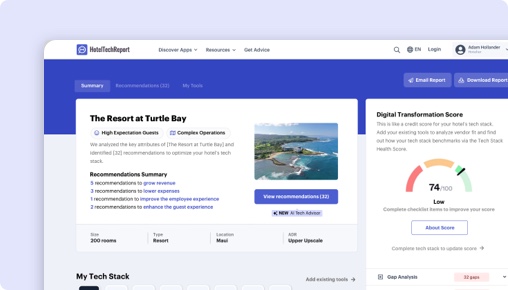
Sorry, this functionality is only available for verified hoteliers
The project dashboard is a free tool that is only available to verified hoteliers to make adopting new technology easier by streamlining their research and simplifying their communication workflow.

D-EDGE CRM (Prev. LoungeUp) vs. Experience Hotel:
Which Is Right for You?

TLDR
We analyzed 70 verified hotelier reviews, compared feature sets, pricing, and real-world case studies to break down where each platform delivers. The right choice depends on your property type and priorities:
D-Edge shines in customer support and ROI , with exclusive features like Guest Segmentation & Targeting and Multi-Channel Delivery (Email, SMS, WhatsApp, Chat).
Experience Hotel shines when it comes to support and responsiveness , with exclusive features like Guest profiles and Guest Feedback Module (comment cards/reviews).
How Does D-EDGE CRM (Prev. LoungeUp) Compare to Experience Hotel?
Side-by-side ratings based on 70 verified hotelier reviews on HTR.
| HTScore |
|
|
| Likelihood to Recommend |
|
|
| Ease of Use |
|
|
| Customer Support |
|
|
| Value for Money |
|
|
| Starting Price | From $400/mo | From $200/mo |
| Verified Reviews | 4 | 66 |
What Are the Pros and Cons of D-EDGE CRM (Prev. LoungeUp) vs Experience Hotel?
After analyzing 70 verified reviews, D-Edge users most value its , while Experience Hotel users highlight support and responsiveness, pre-stay, mid-stay, and post-stay communication, personalized guest experience. Click any theme to see what reviewers say.
|
D-Edge
|
Experience Hotel
|
|---|---|
| Pros | |
|
+
Support and Responsiveness
▾
|
|
|
+
Pre-Stay, Mid-Stay, and Post-Stay Communication
▾
|
|
|
+
Personalized Guest Experience
▾
|
|
|
+
User Interface
▾
|
|
| Cons | |
|
−
System Integration Issues
▾
|
|
|
−
Language Support
▾
|
|
D-Edge vs Experience Hotel: Rankings by Hotel Segment
How each product ranks among Hotel CRM & Email Marketing vendors for different property sizes, types, and regions — based on verified reviews from hoteliers in each segment.
By Hotel Size
| Segment |
D-Edge
|
Experience Hotel
|
|---|---|---|
| Small (10-24 rooms) ▾ | #25 1 reviews | #3 43 reviews |
| Mid-Size (25-74 rooms) ▾ | #28 1 reviews | #17 12 reviews |
| Large (75-199 rooms) | #29 1 reviews | #17 2 reviews |
By Property Type
| Segment |
D-Edge
|
Experience Hotel
|
|---|---|---|
| Boutique ▾ | — | #6 40 reviews |
| Luxury ▾ | #38 0 reviews | #15 11 reviews |
| Branded / Chain ▾ | — | #13 14 reviews |
| Extended Stay ▾ | #25 1 reviews | #6 7 reviews |
By Region
| Segment |
D-Edge
|
Experience Hotel
|
|---|---|---|
| North America | — | #15 3 reviews |
| Europe ▾ | #20 2 reviews | #5 56 reviews |
| Asia Pacific | — | #11 1 reviews |
The Decision
Choosing a hotel CRM and email marketing platform is crucial for enhancing guest relationships, streamlining operations, and increasing revenue. You are evaluating D-Edge CRM (Prev. LoungeUp) and Experience Hotel, two solutions that claim to transform your guest engagement. While both aim to improve communication and operational efficiency, they differ significantly in features, scale, and user feedback.
Your decision should hinge on which platform addresses your hotel’s unique needs for automation, personalization, and integration. Do you prioritize a more mature, feature-rich system, or a solution with stronger recent reviews and broader hotel segment coverage?
Is D-Edge CRM or Experience Hotel Better for Hotels?
D-Edge CRM and Experience Hotel both serve as comprehensive tools for managing guest communication and hotel operations. D-Edge excels in automation, segmentation, and multi-channel delivery, designed to serve larger chains and hotels seeking detailed marketing control. Experience Hotel focuses on personalized guest engagement, reputation management, and multi-stay communication, appealing to boutique and independent hotels.
The key difference lies in their core strength: D-Edge offers advanced automation and merchandising features, while Experience Hotel emphasizes relationship building and reputation enhancement. Both products aim to boost direct bookings but target different hotel types and operational focuses.
Given these distinctions, which platform aligns better with your hotel’s strategic goals and operational complexity?
D-Edge vs Experience Hotel: Which Should Your Hotel Choose?
If your hotel needs robust automation, detailed segmentation, and multi-channel marketing, D-Edge CRM is the better fit. Its 12 exclusive features—including offer experimentation, dynamic pricing, and multi-property dashboard—make it ideal for larger hotels or chains seeking granular control over marketing campaigns.
Conversely, if your hotel prioritizes personalized guest communication, reputation management, and guest feedback, Experience Hotel is preferable. Its focus on CRM functionalities, guest profiles, and automation tailored to individual guest journeys makes it suitable for boutique hotels and independents aiming to deepen guest relationships and improve online reputation.
For hotels seeking a broad feature set with extensive integration options, D-Edge's 115 verified partners may be advantageous. Smaller hotels or those with limited integration needs might find Experience Hotel's 40 partners sufficient.
Is D-Edge or Experience Hotel Easier to Use?
Both platforms are highly rated for ease of use, with D-Edge at 4.5/5 and Experience Hotel at 4.72/5. D-Edge’s interface is described as clear and simple, with onboarding rated at 4.67/5, and customer support is lauded as perfect with a 5/5 rating. Reviewers mention that D-Edge tools are practical and well-structured, facilitating staff adoption.
Experience Hotel’s interface is praised for being intuitive and user-friendly, with onboarding rated slightly lower at 4.48/5. Users highlight that the platform’s simplicity allows staff to quickly navigate features and automate tasks without extensive training.
Edge: D-Edge
Which Has Better Features: D-Edge or Experience Hotel?
D-Edge offers 12 exclusive features, including guest segmentation, room-upgrade merchandising, offer experimentation, multi-channel delivery, and a multi-property dashboard—capabilities tailored for targeted marketing and operational automation. Its open APIs and secure data handling (SOC 2 certification) add to its appeal for larger, data-driven hotels.
Experience Hotel boasts 29 unique features, such as centralized multi-hotel management, guest profiles, personalized communication, feedback modules, and comprehensive automation tools. Its focus on guest engagement, reputation management, and email marketing supports hotels aiming to deepen relationships and foster loyalty.
With more features and a broader scope, Experience Hotel provides a more versatile toolkit, but D-Edge’s specialized marketing tools have a slight edge if automation and merchandising are priorities.
Edge: Experience Hotel
Which Has Better Customer Support: D-Edge or Experience Hotel?
D-Edge support scores a perfect 5/5, with reviewers praising their dedicated, responsive team and clear communication. They describe D-Edge’s customer service as proactive and helpful, often emphasizing their ongoing improvements and support during onboarding.
Experience Hotel support is rated at 4.67/5, with users appreciating the team’s availability and responsiveness. However, some mention that support could be more accessible during off-hours or peak times. Still, users find that support generally helps resolve issues efficiently.
Edge: D-Edge
Which Has More Integrations: D-Edge or Experience Hotel?
D-Edge offers 115 verified integration partners, including major hotel management systems, channel managers, and other hospitality tech providers. Shared integrations include Cendyn, Winhotel, and Stayntouch, with D-Edge also offering numerous proprietary integrations for marketing and revenue management.
Experience Hotel has 40 verified partners, including popular systems like WebRezPro, Octorate, and WuBook. While comprehensive, its integration count is substantially lower, potentially limiting connectivity for certain properties.
Edge: D-Edge
Which Do Hoteliers Rate Higher: D-Edge or Experience Hotel?
Experience Hotel outperforms D-Edge in recent reviews, with a 4.78/5 overall rating versus D-Edge’s 4.5/5. Recent reviews from hotels of various sizes and segments emphasize Experience Hotel’s intuitive interface, comprehensive features, and strong support.
D-Edge’s ratings are slightly lower at 4.5/5, with some reviews praising the tools but noting room for aesthetic and UX improvements. Experience Hotel’s broader adoption among boutique and independent hotels, reflected in its higher recent reviews, signifies a higher current satisfaction level.
Edge: Experience Hotel
How Much Do D-Edge and Experience Hotel Cost?
D-Edge’s base price is $400 per month, with no mention of trial options or discounts. Its pricing might be a consideration for smaller hotels or those with tighter budgets, given its higher cost.
Experience Hotel’s base fee is $200 per month, offering a more affordable entry point without trial information. Its lower price makes it attractive for small to mid-sized hotels seeking strong CRM and marketing features.
Both platforms operate on subscription models without implementation fees, but D-Edge’s higher cost corresponds to its extensive feature set and integrations.
What Type of Hotel Should Use D-Edge?
Hotels that should consider D-Edge include:
- Large hotel chains seeking multi-property management.
- Hotels needing advanced marketing automation and merchandising tools.
- Properties prioritizing integrated revenue management and offer testing.
- Establishments with dedicated marketing teams wanting detailed segmentation.
- Hotels with existing integrations into D-Edge’s partner ecosystem.
Not ideal if:
- Your hotel is small or budget-conscious.
- You prefer a straightforward, less complex CRM.
- You primarily need reputation management or guest feedback features.
What Type of Hotel Should Use Experience Hotel?
Hotels best suited for Experience Hotel are:
- Boutique hotels and independent properties.
- Hotels focusing on personalized guest relationships.
- Properties seeking reputation management and feedback collection.
- Hotels aiming to boost direct bookings through targeted campaigns.
- Hotels with multiple locations wanting centralized guest data.
Not ideal if:
- Your hotel requires deep automation and merchandising features.
- You need extensive third-party integrations.
- You are a large chain or resort with complex operational needs.
The Bottom Line for Hotels
D-Edge CRM is a robust option for larger hotels and chains that need extensive automation, multi-property management, and advanced marketing tools. Its 115 verified integrations and comprehensive features make it suitable for hotels with complex operational and marketing needs.
Experience Hotel excels in personalized guest relationships, reputation management, and intuitive automation, making it ideal for boutique, independent, or smaller properties focused on direct engagement and guest satisfaction. Its recent high ratings reflect strong user satisfaction, especially among hotels prioritizing guest-centric features.
Choose D-Edge if your hotel demands detailed automation, multi-property tools, and extensive integrations. Opt for Experience Hotel if your focus is on building strong guest relationships, reputation, and personalized marketing, especially if you value user experience and recent positive reviews.
This comparison aims to guide your hotel toward the platform that aligns best with your operational size, guest engagement strategy, and budget. Prioritize what your property needs most—automation and integrations or personalization and reputation—to make an informed decision.
How Much Do D-EDGE CRM (Prev. LoungeUp) and Experience Hotel Cost?
Hotel CRM & Email Marketing pricing is rarely straightforward. Here is what we know from each vendor's public pricing data. Always request a custom quote for your property size.
|
D-Edge
|
Experience Hotel
|
|
|---|---|---|
| Starting Price | From $400/mo | From $200/mo |
Feature Comparison: D-EDGE CRM (Prev. LoungeUp) vs Experience Hotel
These are the features each vendor has configured, organized by feature group — the same data shown in the vendor dashboard. Expand a group to compare features side by side.
| Feature |
D-Edge
|
Experience Hotel
|
|---|---|---|
|
▾
Marketing Automation
|
|
|
| Personalized one-to-communication | ||
| A/B Testing | ||
| Event Based Automations | ||
| Email Newsletters | ||
| Database Health Monitoring | ||
|
▾
Template Builder
|
|
|
| Template Editor | ||
| WYSIWYG - HTML Editor | ||
| Campaign Templates | ||
| Transactional Templates | ||
| Template Importing | ||
|
▾
Guest Profiles
|
|
|
| Guest profiles | ||
| Database Health Monitoring | ||
| GDPR Compliant | ||
| CCPA Compliant | ||
| Automatic De-Duping | ||
|
▾
Segmentation
|
|
|
| Segmentation | ||
| Database Health Monitoring | ||
| Tagging | ||
| Loyalty Segmentation | ||
| Attribute Based Segmentation | ||
| Geographic Based Segmentation | ||
| Channel/Market Based Segmentation | ||
| Lead Time Based Segmentation | ||
| Room Type Based Segmentation | ||
|
▾
Privacy & Compliance
|
|
|
| GDPR Compliant | ||
| CCPA Compliant | ||
| PCI Complaint | ||
|
▾
Data Management
|
|
|
| Centralized data warehouse | ||
| Database Health Monitoring | ||
| Open API | ||
| Centralized multi-hotel/multi-brand solution | ||
|
▾
Feedback & Surveys
|
|
|
| Guest Feedback Module (comment cards/reviews) | ||
| Trip Advisor Connectivity Partner | ||
|
▾
Other
|
|
|
| Open API |
D-Edge vs Experience Hotel: The Bottom Line
Unique capabilities
What hoteliers love
While the support team is generally praised for their responsiveness and helpfulness, there are some concerns about the accessibility of support as we... While the support team is generally praised for their responsiveness and helpfulness, there are some concerns about the accessibility of support as well as the delayed responses after initial interactions.
Users frequently praise Experience for its ability to streamline communication with guests at key stages – before, during, and after their stay. This... Users frequently praise Experience for its ability to streamline communication with guests at key stages – before, during, and after their stay. This functionality allows hotels to customize guest experiences, provide assistance, and manage expectations efficiently.
Many reviews highlight the ability of Experience to gather guest information and preferences, enabling hotels to offer tailored services and create a... Many reviews highlight the ability of Experience to gather guest information and preferences, enabling hotels to offer tailored services and create a remarkable hospitality experience. This aspect significantly enhances guest satisfaction and loyalty.
Where hoteliers push back
Some users have mentioned issues with system integration, specifically with the PMS and other hotel management systems. This can cause delays and dupl... Some users have mentioned issues with system integration, specifically with the PMS and other hotel management systems. This can cause delays and duplication of work, leading to inefficiencies and user frustration.
A notable grievance is the limited language support within the Experience tool. Users have expressed a need for more languages in automated emails and... A notable grievance is the limited language support within the Experience tool. Users have expressed a need for more languages in automated emails and certain parts of the interface to cater to a broader guest demographic.
Ranks higher for
Unique capabilities
Where the ratings diverge most
Frequently Asked Questions About D-EDGE CRM (Prev. LoungeUp) vs Experience Hotel
Can D-EDGE CRM (Prev. LoungeUp) replace Experience Hotel?
It depends on your requirements. D-EDGE CRM (Prev. LoungeUp) and Experience Hotel share many core Hotel CRM & Email Marketing features, but each has unique capabilities. D-EDGE CRM (Prev. LoungeUp) offers 115 verified integration partners, while Experience Hotel offers 40. Review the feature comparison above to see where they differ before switching.
Which is better for small or independent hotels?
Small hotels should prioritize ease of use and fast onboarding. Experience Hotel leads in ease of use at 4.7/5 vs 4.5/5. Look for transparent pricing and a trial or demo option. Filter reviews on each product page by property size to hear from hotels like yours.
Do D-EDGE CRM (Prev. LoungeUp) or Experience Hotel offer a free plan?
D-EDGE CRM (Prev. LoungeUp): No. Experience Hotel: No. Neither product currently offers a free tier. Most Hotel CRM & Email Marketing vendors offer demos or trials — request one from each to evaluate before committing.
How Does HTR Evaluate and Rank D-EDGE CRM (Prev. LoungeUp) and Experience Hotel?
The HT Score is a composite ranking that considers 4 criteria groups and over a dozen variables to help hoteliers objectively compare hotel technology products. D-Edge has an HT Score of 0 and Experience Hotel has 74. Here is how the score is calculated.
| Criteria Group | Weight | What It Measures |
|---|---|---|
| Customer Ratings & Reviews |
|
How highly do users recommend this product? Ratings Score, Review Volume, Share of Voice, Review Depth, Review Recency, Success Stories ▾ The most heavily weighted factor. Analyzes average satisfaction ratings (likelihood to recommend, ease of use, support, ROI), total review count relative to category peers, review recency (at least 20 reviews in the trailing 6 months), and share of voice across unique hotel clients to detect selection bias. |
| Partner Ecosystem |
|
How highly do tech partners recommend this company? Partner Recommendations, Integration Quantity, Integration Quality ▾ Evaluates partner recommendations as expert votes of confidence, the number of verified integrations, and ecosystem quality — the average HT Scores of integration partners. Products with higher-quality integration ecosystems are more likely to deliver a connected tech stack. |
| Customer Centricity |
|
How customer-centric is this organization? Certified Support, Review Consistency, Profile Completeness ▾ Assesses whether the company has earned HTR Customer Support Certification, maintains consistent review collection over time (an indicator of feedback-driven culture), and keeps product profiles complete with capabilities, screenshots, pricing, and features. |
| Reach, Staying Power & Resources |
|
How extensive is this company's reach and resourcing? Geographic Reach, Staying Power, Company Resources, Trending Score ▾ Measures global presence (countries and regions served), years in business as a stability proxy, team headcount as a resource proxy, and a trending score based on trailing-twelve-month buyer inquiries, reviews, partner recommendations, and press activity. |
Customer ratings and reviews are by far the most important factor in the HT Score algorithm. HTR does not accept payment for higher rankings. All reviews are verified — only hotel industry practitioners with confirmed affiliations can submit ratings. View full HT Score methodology →
What Other Hotel CRM & Email Marketing Comparisons Are Hoteliers Reading?
Explore more head-to-head comparisons based on verified hotelier reviews.






Get Your Free AI Analyst Report
Custom recommendations tailored to your property


Let´s lookup your hotel information
Still weighing your hotel crm & email marketing options?
A few popular systems from our hotel crm & email marketing guide — or let our AI score each one against your specific property in about two minutes.

