
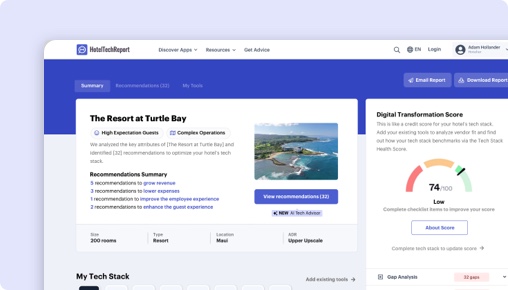
Sorry, this functionality is only available for verified hoteliers
The project dashboard is a free tool that is only available to verified hoteliers to make adopting new technology easier by streamlining their research and simplifying their communication workflow.

D-EDGE - DataCruncher vs. HotelIQ:
Which Is Right for You?


TLDR
We analyzed 112 verified hotelier reviews, compared feature sets, pricing, and real-world case studies to break down where each platform delivers. The right choice depends on your property type and priorities:
D-Edge shines when it comes to support and training , with exclusive features like Net Revenue KPIs.
HotelIQ shines when it comes to customizable and comprehensive reporting — especially for independent properties (4.9/5) , with exclusive features like Revenue pacing and Food & Beverage Reporting, Analysis & Forecasting.
How Does D-EDGE - DataCruncher Compare to HotelIQ?
Side-by-side ratings based on 112 verified hotelier reviews on HTR.
| HTScore |
|
|
| Likelihood to Recommend |
|
|
| Ease of Use |
|
|
| Customer Support |
|
|
| Value for Money |
|
|
| Starting Price | Contact sales | From $200/mo |
| Verified Reviews | 44 | 68 |
What Are the Pros and Cons of D-EDGE - DataCruncher vs HotelIQ?
After analyzing 112 verified reviews, D-Edge users most value its support and training, user-friendly interface, innovative and regularly updated solutions, while HotelIQ users highlight customizable and comprehensive reporting, advanced data analytics, user-friendly. Click any theme to see what reviewers say.
|
D-Edge
|
HotelIQ
|
|---|---|
| Pros | |
|
+
Support and Training
▾
|
+
Customizable and Comprehensive Reporting
▾
|
|
+
User-Friendly Interface
▾
|
+
Advanced Data Analytics
▾
|
|
+
Innovative and Regularly Updated Solutions
▾
|
+
User-Friendly
▾
|
|
+
Comprehensive Suite of Tools
▾
|
+
Versatility and Customization
▾
|
| Cons | |
|
−
Integration and Mapping Challenges
▾
|
−
System Performance Issues
▾
|
|
−
Cost and Value Concerns
▾
|
−
Cost Concerns
▾
|
|
−
Complexity and Too Many Options
▾
|
|
D-Edge vs HotelIQ: Rankings by Hotel Segment
How each product ranks among Business Intelligence vendors for different property sizes, types, and regions — based on verified reviews from hoteliers in each segment.
By Hotel Size
| Segment |
D-Edge
|
HotelIQ
|
|---|---|---|
| Small (10-24 rooms) ▾ | #7 16 reviews | #15 4 reviews |
| Mid-Size (25-74 rooms) ▾ | #13 22 reviews | #9 24 reviews |
| Large (75-199 rooms) ▾ | #17 4 reviews | #6 26 reviews |
| X-Large (200+ rooms) ▾ | #21 1 reviews | #13 5 reviews |
By Property Type
| Segment |
D-Edge
|
HotelIQ
|
|---|---|---|
| Boutique ▾ | #12 21 reviews | #11 23 reviews |
| Luxury ▾ | #16 10 reviews | #6 48 reviews |
| Branded / Chain ▾ | #21 7 reviews | #9 30 reviews |
| Extended Stay ▾ | #14 3 reviews | #6 7 reviews |
By Region
| Segment |
D-Edge
|
HotelIQ
|
|---|---|---|
| North America ▾ | #27 1 reviews | #9 27 reviews |
| Europe ▾ | #6 39 reviews | #10 19 reviews |
| Asia Pacific | #13 2 reviews | #9 4 reviews |
| Middle East ▾ | — | #4 12 reviews |
The Decision
Choosing between D-Edge's DataCruncher and HotelIQ hinges on your hotel's specific needs. Both promise to elevate your data analysis capabilities, but they serve different strategic purposes and cater to distinct hotel segments. DataCruncher emphasizes deep, channel-specific insights and operational metrics, while HotelIQ offers broad, visual performance dashboards and customizable reports. Which aligns better with your team’s decision-making style?
Both products aim to improve revenue management through data-driven insights, but they differ in complexity and focus. DataCruncher specializes in distribution channel KPIs and strategic analytics, while HotelIQ centers on visual dashboards, forecasting, and reporting. Are you prioritizing granular channel data or comprehensive visual insights?
Recent reviews favor DataCruncher, with 41 compared to HotelIQ's 61 reviews, and D-Edge’s ratings are consistently higher. The more recent feedback for D-Edge shows sustained satisfaction, making it the more reliable choice. Does your team want the most current, well-supported tool?
Is DataCruncher or HotelIQ Better for Hotels?
If your hotel needs detailed, distribution-focused KPIs and operational analytics, DataCruncher is your pick. Its strength lies in providing actionable insights into revenue channels, with features like distribution cost analytics and revenue impact tracking—ideal for revenue managers and operational teams. Conversely, HotelIQ suits hotels seeking visual dashboards, quick insights, and strategic planning tools, especially if your team prefers a straightforward, visual approach.
If your hotel operates across multiple regions with complex distribution channels, DataCruncher’s extensive partner integrations (115 verified partners) and in-depth KPIs make it more suitable. If your hotel prioritizes user friendliness, customizable dashboards, and quick strategic insights, HotelIQ’s intuitive interface and comprehensive reporting are better. Do you need granular distribution data or high-level visual summaries?
Is DataCruncher or HotelIQ Easier to Use?
DataCruncher scores slightly lower in ease of use with a 4.79/5 compared to HotelIQ’s 4.80/5, but both are highly rated. DataCruncher’s interface is described as intuitive, yet some users find the extensive options overwhelming, especially with complex mapping and integration challenges. HotelIQ, however, is praised for its simplicity and user-friendly dashboards, making onboarding smoother for teams unfamiliar with advanced analytics.
Support ratings are close, with DataCruncher at 4.79/5 and HotelIQ at 4.77/5, but recent reviews suggest that HotelIQ's simplified interface results in quicker adoption. If ease of onboarding and minimal training are your priorities, edge favorably to HotelIQ.
Which Has Better Features: DataCruncher or HotelIQ?
DataCruncher offers 9 shared features and 3 exclusive ones, including Net Revenue KPIs and Distribution Cost Analytics, emphasizing operational and channel-specific metrics. HotelIQ boasts 16 unique features like Revenue pacing, Sales team productivity tracking, and AI-driven analytics dashboards, focusing on strategic insights, collaboration, and automation.
HotelIQ’s extensive features for customizable reporting, group management, and AI integrations make it more versatile for broader strategic planning. If your hotel values detailed KPI tracking and channel analytics, DataCruncher’s features suffice. For advanced visualization, collaboration, and AI tools, HotelIQ leads. Which set of features aligns best with your goals?
Which Has Better Customer Support: DataCruncher or HotelIQ?
Both products enjoy high support ratings, with DataCruncher at 4.79/5 and HotelIQ at 4.77/5, and recent reviews reinforce their responsiveness. D-Edge’s dedicated account management, especially praised for support quality, makes it stand out. HotelIQ’s team is also noted for fast responses, with many users emphasizing their proactive assistance.
However, recent HotelIQ reviews mention opportunities for better training materials, while D-Edge’s support is highlighted for its consistency and personal approach. Edge: DataCruncher, for its slightly higher support score and dedicated account management.
Which Do Hoteliers Rate Higher: DataCruncher or HotelIQ?
DataCruncher leads in overall ratings at 4.86/5, compared to HotelIQ’s 4.78/5, despite fewer reviews—41 vs. 61. Recent feedback continues to favor D-Edge, with hotel segments like boutique hotels and city hotels rating it highly (average 4.87/5). HotelIQ performs well among branded hotels and resorts with perfect scores in some cases but generally receives slightly lower average scores.
If your hotel’s focus is on high ratings and recent positive feedback, DataCruncher’s superior standing makes it the safer choice. For specific segments like luxury or branded hotels, HotelIQ’s ratings are comparable, but overall, DataCruncher’s stronger recent reviews give it the edge.
How Much Do DataCruncher and HotelIQ Cost?
DataCruncher’s pricing is not publicly available, reflecting a custom quote approach typical for enterprise solutions. HotelIQ charges $200/month with no setup fees or tiers, making it more transparent and accessible for mid-sized hotels.
If your hotel prefers predictable, straightforward pricing, HotelIQ’s flat rate simplifies budgeting. For larger chains or hotels requiring tailored solutions, DataCruncher’s custom pricing may be more appropriate. Do you need a transparent, predictable price or a tailored enterprise quote?
What Type of Hotel Should Use DataCruncher?
- Hotels that operate across multiple regions with complex distribution channels.
- Teams that need detailed KPIs on channel performance and revenue impact.
- Hotels focusing on distribution costs, rate impact, and operational analytics.
- Properties aiming to optimize revenue streams through data-driven channel management.
Not ideal if your hotel prefers simple dashboards and basic reporting, or if your team lacks the capacity for extensive data analysis. Small boutique hotels with limited distribution channels or those seeking quick, visual insights may find DataCruncher overly detailed.
What Type of Hotel Should Use HotelIQ?
- Hotels prioritizing visual performance dashboards and easy-to-understand reports.
- Teams that want quick insights into revenue, ADR, and occupancy trends.
- Properties seeking customizable reports and collaborative features.
- Hotels aiming to integrate multiple data sources like STR with minimal setup.
Not ideal if your hotel requires granular, channel-specific KPIs or advanced operational analytics. Large, complex chains with detailed distribution management needs might find HotelIQ’s features insufficient.
DataCruncher vs HotelIQ: The Bottom Line for Hotels
DataCruncher excels in delivering targeted, distribution-specific insights that help optimize revenue streams. It’s best suited for hotels with complex distribution channels, regional operations, and dedicated revenue teams seeking granular KPIs.
Choose DataCruncher if you want in-depth analytics on distribution costs, channel impact, and operational metrics, especially if your hotel is looking to fine-tune revenue strategies. Its strength lies in detailed, actionable data, making it ideal for larger or multi-region properties.
HotelIQ emphasizes ease of use, visual dashboards, and strategic reporting. It’s ideal for hotels that prioritize quick insights, collaborative planning, and customizable reports without the need for deep technical analysis.
If your team prefers visual insights and straightforward reporting that facilitates quick decision-making, HotelIQ is the better fit. Its user-friendly interface and broad feature set make it suitable for properties seeking rapid adoption and strategic oversight.
In summary, DataCruncher is the choice for hotels needing detailed, operational KPIs with extensive distribution analytics. HotelIQ is better for properties that value visual dashboards, quick insights, and collaborative workflows. Both tools are excellent, but based on recent reviews and ratings, DataCruncher’s stronger support and more recent positive feedback make it the more compelling option for most hotels.
Which Features Does D-EDGE - DataCruncher Have That HotelIQ Doesn't (and Vice Versa)?
According to HTR's product database, D-EDGE - DataCruncher and HotelIQ share 9 features. Here are the key differences — features one has that the other lacks.
| Feature |
D-Edge
|
HotelIQ
|
|---|---|---|
| Analytics dashboard | ||
| Centralized user & role management | ||
| Corporate & Travel Agency Account Tracking | ||
| Distribution Cost Analytics | ||
| Net Revenue KPIs | ||
| Pricing Decision Impact Tracking | ||
| Revenue pacing | ||
| Sales team productivity tracking | ||
| Web Based |
Showing top differences. 7 more features differ between these products.
D-Edge vs HotelIQ: The Bottom Line
What hoteliers love
D-Edge provides excellent customer support which is available 24/7. However, some users feel additional training on the solutions could be beneficial.
The platform is frequently praised for its user-friendly and intuitive interface, making it easy for hotel staff to learn and manage day-to-day operat... The platform is frequently praised for its user-friendly and intuitive interface, making it easy for hotel staff to learn and manage day-to-day operations.
D-Edge is lauded for its continuous innovation and regular updates that enhance system reliability and incorporate feedback from users.
Where hoteliers push back
There are several reports of challenges related to mapping and integration, suggesting a need for more efficient self-mapping and integration with mor... There are several reports of challenges related to mapping and integration, suggesting a need for more efficient self-mapping and integration with more PMS systems.
While many appreciate D-Edge's value, some believe that the pricing, particularly for some advanced features and support, could be more competitive.
Ranks higher for
Unique capabilities
What hoteliers love
Hoteliers appreciate the extensive and customizable reporting options, including the ability to format reports to their needs and extract data in vari... Hoteliers appreciate the extensive and customizable reporting options, including the ability to format reports to their needs and extract data in various formats. This feature is emphasized for its impact on time-saving and precision in reporting.
Users frequently mention HotelIQ's robust analytical capabilities, highlighting its ability to dissect data down to rate code levels and provide compr... Users frequently mention HotelIQ's robust analytical capabilities, highlighting its ability to dissect data down to rate code levels and provide comprehensive business insights. This feature is particularly valued for making informed strategic decisions quickly.
The platform is frequently described as very user-friendly and intuitive, which allows users to navigate and utilize its features with minimal trainin... The platform is frequently described as very user-friendly and intuitive, which allows users to navigate and utilize its features with minimal training. This ease of use is often mentioned as a significant advantage.
Where hoteliers push back
Some users report occasional system slowdowns, especially when running complex reports or downloading large files. This has been identified as an area... Some users report occasional system slowdowns, especially when running complex reports or downloading large files. This has been identified as an area needing improvement for better efficiency and user experience.
A few users mention that HotelIQ can be on the expensive side for some hotels. However, they generally agree that despite the cost, the tool offers co... A few users mention that HotelIQ can be on the expensive side for some hotels. However, they generally agree that despite the cost, the tool offers considerable value by driving revenue and optimizing business operations.
Ranks higher for
Unique capabilities
Frequently Asked Questions About D-EDGE - DataCruncher vs HotelIQ
Can D-EDGE - DataCruncher replace HotelIQ?
It depends on your requirements. D-EDGE - DataCruncher and HotelIQ share many core Business Intelligence features, but each has unique capabilities. D-EDGE - DataCruncher offers 115 verified integration partners, while HotelIQ offers 8. Review the feature comparison above to see where they differ before switching.
Which is better for small or independent hotels?
Small hotels should prioritize ease of use and fast onboarding. D-EDGE - DataCruncher leads in ease of use at 4.8/5 vs 4.8/5. Look for transparent pricing and a trial or demo option. Filter reviews on each product page by property size to hear from hotels like yours.
Do D-EDGE - DataCruncher or HotelIQ offer a free plan?
D-EDGE - DataCruncher: No. HotelIQ: No. Neither product currently offers a free tier. Most Business Intelligence vendors offer demos or trials — request one from each to evaluate before committing.
How Does HTR Evaluate and Rank D-EDGE - DataCruncher and HotelIQ?
The HT Score is a composite ranking that considers 4 criteria groups and over a dozen variables to help hoteliers objectively compare hotel technology products. D-Edge has an HT Score of 28 and HotelIQ has 24. Here is how the score is calculated.
| Criteria Group | Weight | What It Measures |
|---|---|---|
| Customer Ratings & Reviews |
|
How highly do users recommend this product? Ratings Score, Review Volume, Share of Voice, Review Depth, Review Recency, Success Stories ▾ The most heavily weighted factor. Analyzes average satisfaction ratings (likelihood to recommend, ease of use, support, ROI), total review count relative to category peers, review recency (at least 20 reviews in the trailing 6 months), and share of voice across unique hotel clients to detect selection bias. |
| Partner Ecosystem |
|
How highly do tech partners recommend this company? Partner Recommendations, Integration Quantity, Integration Quality ▾ Evaluates partner recommendations as expert votes of confidence, the number of verified integrations, and ecosystem quality — the average HT Scores of integration partners. Products with higher-quality integration ecosystems are more likely to deliver a connected tech stack. |
| Customer Centricity |
|
How customer-centric is this organization? Certified Support, Review Consistency, Profile Completeness ▾ Assesses whether the company has earned HTR Customer Support Certification, maintains consistent review collection over time (an indicator of feedback-driven culture), and keeps product profiles complete with capabilities, screenshots, pricing, and features. |
| Reach, Staying Power & Resources |
|
How extensive is this company's reach and resourcing? Geographic Reach, Staying Power, Company Resources, Trending Score ▾ Measures global presence (countries and regions served), years in business as a stability proxy, team headcount as a resource proxy, and a trending score based on trailing-twelve-month buyer inquiries, reviews, partner recommendations, and press activity. |
Customer ratings and reviews are by far the most important factor in the HT Score algorithm. HTR does not accept payment for higher rankings. All reviews are verified — only hotel industry practitioners with confirmed affiliations can submit ratings. View full HT Score methodology →
What Other Business Intelligence Comparisons Are Hoteliers Reading?
Explore more head-to-head comparisons based on verified hotelier reviews.



Contents
Get Your Free AI Analyst Report
Custom recommendations tailored to your property


