
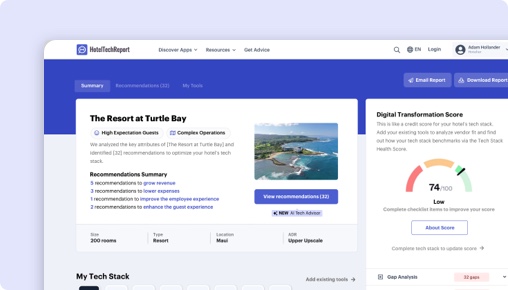
Sorry, this functionality is only available for verified hoteliers
The project dashboard is a free tool that is only available to verified hoteliers to make adopting new technology easier by streamlining their research and simplifying their communication workflow.

Duve Upselling vs. Voyyo:
Which Is Right for You?

TLDR
We analyzed 323 verified hotelier reviews, compared feature sets, pricing, and real-world case studies to break down where each platform delivers. The right choice depends on your property type and priorities:
Duve shines in ease of use and customer support — especially for brand properties (0.0/5) , with exclusive features like Mobile Friendly and SMS text messaging.
Voyyo shines .
How Does Duve Upselling Compare to Voyyo?
Side-by-side ratings based on 323 verified hotelier reviews on HTR.
| HTScore |
|
|
| Likelihood to Recommend |
|
|
| Ease of Use |
|
|
| Customer Support |
|
|
| Value for Money |
|
|
| Starting Price | From $900/mo | Contact sales |
| Verified Reviews | 323 | 0 |
What Are the Pros and Cons of Duve Upselling vs Voyyo?
After analyzing 323 verified reviews, Duve users most value its upselling features, integration with pms and other systems, guest communication, while Voyyo users highlight . Click any theme to see what reviewers say.
|
Duve
|
Voyyo
|
|---|---|
| Pros | |
|
+
Upselling Features
▾
|
|
|
+
Integration with PMS and Other Systems
▾
|
|
|
+
Guest Communication
▾
|
|
|
+
Support and Implementation
▾
|
|
| Cons | |
|
−
Potential Feature Enhancements
▾
|
|
|
−
Pricing and Value for Small Businesses
▾
|
|
Duve vs Voyyo: Rankings by Hotel Segment
How each product ranks among Upselling Software vendors for different property sizes, types, and regions — based on verified reviews from hoteliers in each segment.
By Hotel Size
| Segment |
Duve
|
Voyyo
|
|---|---|---|
| Small (10-24 rooms) ▾ | #2 69 reviews | — |
| Mid-Size (25-74 rooms) ▾ | #3 137 reviews | #29 0 reviews |
| Large (75-199 rooms) ▾ | #3 45 reviews | — |
| X-Large (200+ rooms) ▾ | #3 38 reviews | — |
By Property Type
| Segment |
Duve
|
Voyyo
|
|---|---|---|
| Boutique ▾ | #3 125 reviews | — |
| Luxury ▾ | #3 131 reviews | #26 0 reviews |
| Branded / Chain ▾ | #3 97 reviews | #27 0 reviews |
| Extended Stay ▾ | #2 45 reviews | — |
By Region
| Segment |
Duve
|
Voyyo
|
|---|---|---|
| North America ▾ | #2 37 reviews | #22 0 reviews |
| Europe ▾ | #2 132 reviews | — |
| Asia Pacific ▾ | #6 9 reviews | — |
| Middle East ▾ | #1 107 reviews | — |
The Decision
Choosing between Duve Upselling and Voyyo hinges on your hotel's specific needs. Duve aims to maximize revenue through personalized guest engagement, upselling, and contactless operations, while Voyyo concentrates on optimizing room assignments for enhanced guest satisfaction. Both platforms address distinct pain points—does your team need to boost upsells or improve room allocation? The decision depends on which challenge is more pressing for your property.
Is Duve or Voyyo Better for Hotels?
Both products serve different core functions in the hotel tech landscape. Duve is a comprehensive guest engagement platform, offering over 30 exclusive features like multi-channel messaging, personalized upselling, and digital check-in, with a solid rating of 4.79/5 based on 270 reviews—more recent reviews (21 in last 6 months) reinforce its relevance. Conversely, Voyyo is a specialized room assignment tool with no reviews or ratings available, reflecting its early market stage.
While Duve's extensive features cover multiple aspects of guest experience and revenue growth, Voyyo’s focus is solely on room personalization, which may be less appealing if your primary goal is upselling or operational automation. Do you prioritize broad guest engagement or precise room allocation?
Duve vs Voyyo: Which Should Your Hotel Choose?
If your hotel needs to increase ancillary revenue through automated, personalized upselling, Duve is the clear choice. It supports dynamic offers like late checkouts, room upgrades, in-house services, and marketplace integrations, making it ideal for properties looking to maximize revenue streams.
If your team’s main concern is optimizing room assignments to improve guest satisfaction and reduce manual effort, Voyyo’s room selection platform is the better fit. Its AI-driven personalized room choice process simplifies operations and elevates the guest experience in that specific area.
For hotels with diverse operational needs and plans to scale, Duve’s versatility makes it a more comprehensive solution. For properties solely focused on refining room allocation and guest personalization at booking, Voyyo’s streamlined approach may suffice.
Is Duve or Voyyo Easier to Use?
Duve boasts a high ease-of-use rating of 4.7/5, with many users highlighting its intuitive interface and straightforward onboarding process. Reviewers appreciate its mobile-friendly design, integrated guest app, and clear navigation, making staff adoption fairly smooth despite some initial setup complexity.
Voyyo, being a newer, less reviewed platform, offers a simplified setup process designed by its small team, but it lacks detailed user feedback or ratings. While its core functionality appears straightforward, the absence of extensive user reviews makes it difficult to assess real-world usability.
Edge: Duve.
Which Has Better Features: Duve or Voyyo?
Duve’s feature set is significantly more extensive, with 32 unique functionalities including multi-channel messaging, automated replies, guest profiles, marketplace integrations, digital check-in, room upgrade merchandising, and analytics dashboards. These features enable comprehensive guest engagement and revenue strategies.
Voyyo offers a single core feature: personalized room selection for guests, designed to enhance satisfaction and operational efficiency. It does not include other functionalities like messaging, upselling, or automation.
Edge: Duve.
Which Has Better Customer Support: Duve or Voyyo?
Duve’s support ratings are solid at 4.63/5, with reviews praising their professionalism, onboarding assistance, and responsiveness. Many users mention that Duve’s support team is quick to respond and helpful, though some note that setup can be complex.
Voyyo, with no available reviews or support ratings, offers a risk-free, white-glove setup process managed by their team, but lacks independent user feedback to evaluate ongoing support quality.
Edge: Duve.
Which Has More Integrations: Duve or Voyyo?
Duve integrates with 65 verified partners, including major PMS and channel managers like RMS, Oracle Hospitality, Mews, and others, facilitating smooth operation across diverse systems. Its open API and integrations support multi-channel communication, payments, and analytics.
Voyyo has only 3 verified partners, primarily focusing on hotel PMS and basic booking systems, which limits its integration scope. This narrower ecosystem may restrict its utility in complex hotel operations.
Edge: Duve.
Which Do Hoteliers Rate Higher: Duve or Voyyo?
Duve’s reviews, with 270 total and recent activity, reflect a 4.79/5 rating and 94% likelihood to recommend, especially among large hotels, vacation rentals, and boutique properties. Hotels like The Setai and Les Bulles De Paris praise its impact on check-in speed and guest engagement.
Voyyo, lacking reviews and ratings, cannot be directly compared. Given Duve’s extensive positive feedback, it clearly holds higher user trust and satisfaction.
Edge: Duve.
How Much Do Duve and Voyyo Cost?
Duve’s pricing starts at $900/month, with no free tier or trial, reflecting its enterprise-grade approach. The cost might be a consideration for smaller operations but is justified by its feature depth.
Voyyo’s pricing information is unavailable, but its risk-free, revenue-share model suggests it does not require upfront fees. Smaller hotels might find Voyyo more financially accessible, but without transparent pricing, comparisons are limited.
What Type of Hotel Should Use Duve?
- Hotels seeking to boost ancillary revenue through automated upselling, personalized communication, and multi-channel engagement.
- Properties aiming to reduce manual check-in, facilitate contactless experiences, and gather guest data for targeted marketing.
- Hotels with multiple locations or complex operations needing integrated analytics and management tools.
- Teams wanting to enhance guest satisfaction with tailored offers during pre-arrival, stay, and post-stay.
Not ideal if:
- Your hotel operates on a very tight budget with limited staff for onboarding.
- Your focus is solely on room assignment without plans to expand revenue channels.
What Type of Hotel Should Use Voyyo?
- Hotels prioritizing seamless, personalized room assignment at booking, especially those with a high volume of direct bookings.
- Properties seeking to improve guest satisfaction through specific room preferences and data-driven decision-making.
- Small to medium-sized hotels wanting a low-effort, AI-backed room allocation system.
- Hotels looking to reduce staff workload during room assignments without needing extensive guest communication tools.
Not ideal if:
- You require a full guest engagement platform with upselling, communication, and automation.
- Your hotel needs integrations beyond basic PMS systems or a broad feature set.
Duve vs Voyyo: The Bottom Line for Hotels
Duve offers a broad, feature-rich platform designed to improve guest engagement, streamline operations, and boost revenue through personalized upselling and contactless solutions. Its extensive integrations, high user ratings, and recent reviews position it as a trusted choice for larger or growth-oriented hotels.
Voyyo provides a targeted solution focusing solely on personalized room assignment, which can be ideal for properties prioritizing guest satisfaction in room selection and operational simplicity. Its early-stage presence and lack of reviews suggest it’s better suited for hotels with a specific focus on room personalization and minimal integration needs.
For most hotels looking for a versatile upselling and guest communication platform, Duve’s proven track record and comprehensive features make it the stronger recommendation. If your primary goal is optimizing room allocation with minimal fuss, Voyyo might serve your needs, but caution due to the limited user feedback.
Which Features Does Duve Upselling Have That Voyyo Doesn't (and Vice Versa)?
According to HTR's product database, Duve Upselling and Voyyo share 0 features. Here are the key differences — features one has that the other lacks.
| Feature |
Duve
|
Voyyo
|
|---|---|---|
| Automated Replies | ||
| Message Routing | ||
| Mobile Friendly | ||
| SMS text messaging | ||
| Secured Data Protection | ||
| Whatsapp Integration |
Showing top differences. 20 more features differ between these products.
Real-World Results: Duve vs Voyyo by Business Goal
We analyzed 8 verified case studies to compare what hotels actually achieve with each platform across four key business objectives.
סטאי תל אביב - The Setai, Tel Aviv
Large
"Duve was a game changer for our customer service. I knew the platform would help us connect with guests but I was amazed at how cleverly simple it all is, even guests who are not v..."
 Voyyo
Voyyo
No published case study for this goal yet.
Brown Hotels
Large
"While scaling up and growing in terms of more hotel rooms and more hotels in different countries we found it difficult to communicate with our guests in a very personal way. Duve f..."
 Voyyo
Voyyo
No published case study for this goal yet.
Duve vs Voyyo: The Bottom Line
What hoteliers love
Duve's upselling capabilities are frequently mentioned for effectively increasing ancillary revenue and optimizing unsold inventory. Users appreciate... Duve's upselling capabilities are frequently mentioned for effectively increasing ancillary revenue and optimizing unsold inventory. Users appreciate the automated and personalized upselling strategies; however, several reviews mention the desire for room upgrade upselling compatibility.
Duve's integration with various PMS systems like Mews is beneficial for smooth upselling processes. However, users occasionally report issues with con... Duve's integration with various PMS systems like Mews is beneficial for smooth upselling processes. However, users occasionally report issues with connection stability, indicating room for improvement in ensuring consistent integration.
The platform significantly enhances guest communication through efficient AI-driven chats and automated messaging, improving satisfaction and engageme... The platform significantly enhances guest communication through efficient AI-driven chats and automated messaging, improving satisfaction and engagement. Users commend the seamless integration with existing systems, which supports a more streamlined operation.
Where hoteliers push back
Users suggest additional features like a ticketing system for MICE sectors and expanded capabilities in the F&B segments. Room for improvement in feat... Users suggest additional features like a ticketing system for MICE sectors and expanded capabilities in the F&B segments. Room for improvement in feature expansion and the inclusion of innovative ideas is a recurring theme.
Pricing concerns are prominent among reviews, particularly for small operations like hostels. Users express dissatisfaction with premium feature prici... Pricing concerns are prominent among reviews, particularly for small operations like hostels. Users express dissatisfaction with premium feature pricing, suggesting a need for loyalty discounts and pricing models better suited for smaller establishments.
Ranks higher for
Unique capabilities
Where the ratings diverge most
Frequently Asked Questions About Duve Upselling vs Voyyo
Can Duve Upselling replace Voyyo?
It depends on your requirements. Duve Upselling and Voyyo share many core Upselling Software features, but each has unique capabilities. Duve Upselling offers 66 verified integration partners, while Voyyo offers 3. Review the feature comparison above to see where they differ before switching.
Which is better for small or independent hotels?
Small hotels should prioritize ease of use and fast onboarding. Duve Upselling leads in ease of use at 4.7/5 vs 0.0/5. Look for transparent pricing and a trial or demo option. Filter reviews on each product page by property size to hear from hotels like yours.
Do Duve Upselling or Voyyo offer a free plan?
Duve Upselling: No. Voyyo: No. Neither product currently offers a free tier. Most Upselling Software vendors offer demos or trials — request one from each to evaluate before committing.
How Does HTR Evaluate and Rank Duve Upselling and Voyyo?
The HT Score is a composite ranking that considers 4 criteria groups and over a dozen variables to help hoteliers objectively compare hotel technology products. Duve has an HT Score of 91 and Voyyo has 0. Here is how the score is calculated.
| Criteria Group | Weight | What It Measures |
|---|---|---|
| Customer Ratings & Reviews |
|
How highly do users recommend this product? Ratings Score, Review Volume, Share of Voice, Review Depth, Review Recency, Success Stories ▾ The most heavily weighted factor. Analyzes average satisfaction ratings (likelihood to recommend, ease of use, support, ROI), total review count relative to category peers, review recency (at least 20 reviews in the trailing 6 months), and share of voice across unique hotel clients to detect selection bias. |
| Partner Ecosystem |
|
How highly do tech partners recommend this company? Partner Recommendations, Integration Quantity, Integration Quality ▾ Evaluates partner recommendations as expert votes of confidence, the number of verified integrations, and ecosystem quality — the average HT Scores of integration partners. Products with higher-quality integration ecosystems are more likely to deliver a connected tech stack. |
| Customer Centricity |
|
How customer-centric is this organization? Certified Support, Review Consistency, Profile Completeness ▾ Assesses whether the company has earned HTR Customer Support Certification, maintains consistent review collection over time (an indicator of feedback-driven culture), and keeps product profiles complete with capabilities, screenshots, pricing, and features. |
| Reach, Staying Power & Resources |
|
How extensive is this company's reach and resourcing? Geographic Reach, Staying Power, Company Resources, Trending Score ▾ Measures global presence (countries and regions served), years in business as a stability proxy, team headcount as a resource proxy, and a trending score based on trailing-twelve-month buyer inquiries, reviews, partner recommendations, and press activity. |
Customer ratings and reviews are by far the most important factor in the HT Score algorithm. HTR does not accept payment for higher rankings. All reviews are verified — only hotel industry practitioners with confirmed affiliations can submit ratings. View full HT Score methodology →
What Other Upselling Software Comparisons Are Hoteliers Reading?
Explore more head-to-head comparisons based on verified hotelier reviews.




Contents
Get Your Free AI Analyst Report
Custom recommendations tailored to your property


Let´s lookup your hotel information
Still weighing your upselling software options?
A few popular systems from our upselling software guide — or let our AI score each one against your specific property in about two minutes.