

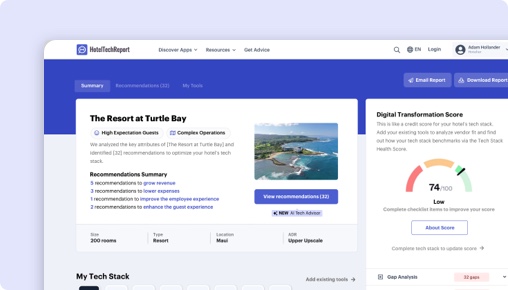
Sorry, this functionality is only available for verified hoteliers
The project dashboard is a free tool that is only available to verified hoteliers to make adopting new technology easier by streamlining their research and simplifying their communication workflow.

Duve App vs. iPortal (by Tiger TMS):
Which Is Right for You?


TLDR
We analyzed 672 verified hotelier reviews, compared feature sets, pricing, and real-world case studies to break down where each platform delivers. The right choice depends on your property type and priorities:
Duve shines in ease of use and customer support — especially for brand properties (0.0/5) , with exclusive features like Mobile Friendly and SMS text messaging.
TigerTMS shines .
How Does Duve App Compare to iPortal (by Tiger TMS)?
Side-by-side ratings based on 672 verified hotelier reviews on HTR.
| HTScore |
|
|
| Likelihood to Recommend |
|
|
| Ease of Use |
|
|
| Customer Support |
|
|
| Value for Money |
|
|
| Starting Price | From $900/mo | Contact sales |
| Verified Reviews | 672 | 0 |
What Are the Pros and Cons of Duve App vs iPortal (by Tiger TMS)?
After analyzing 672 verified reviews, Duve users most value its guest communication and omnichannel messaging, ease of use and time savings, operations workflow and hotel task management, while TigerTMS users highlight . Click any theme to see what reviewers say.
|
Duve
|
TigerTMS
|
|---|---|
| Pros | |
|
+
Guest communication and omnichannel messaging
▾
|
|
|
+
Ease of use and time savings
▾
|
|
|
+
Operations workflow and hotel task management
▾
|
|
|
+
Guest app personalization and branding
▾
|
|
| Cons | |
|
−
PMS/POS/integration and sync issues
▾
|
|
|
−
Scheduled messaging and automation
▾
|
|
Duve vs TigerTMS: Rankings by Hotel Segment
How each product ranks among Hotel Guest Apps vendors for different property sizes, types, and regions — based on verified reviews from hoteliers in each segment.
By Hotel Size
| Segment |
Duve
|
TigerTMS
|
|---|---|---|
| Small (10-24 rooms) ▾ | #1 132 reviews | — |
| Mid-Size (25-74 rooms) ▾ | #1 221 reviews | — |
| Large (75-199 rooms) ▾ | #1 130 reviews | — |
| X-Large (200+ rooms) ▾ | #1 62 reviews | — |
By Property Type
| Segment |
Duve
|
TigerTMS
|
|---|---|---|
| Boutique ▾ | #1 222 reviews | — |
| Luxury ▾ | #1 269 reviews | — |
| Branded / Chain ▾ | #1 190 reviews | — |
| Extended Stay ▾ | #1 86 reviews | — |
By Region
| Segment |
Duve
|
TigerTMS
|
|---|---|---|
| North America ▾ | #2 52 reviews | — |
| Europe ▾ | #1 224 reviews | — |
| Asia Pacific ▾ | #1 19 reviews | — |
| Middle East ▾ | #1 247 reviews | — |
The Decision
Choosing the right guest app can transform your hotel’s operations and guest experience. Duve App by Duve and iPortal by TigerTMS both aim to elevate guest engagement, but they serve different needs and offer varying levels of maturity. Duve’s extensive reviews, high ratings, and recent user feedback make it the stronger option for most hotels. Is your hotel ready to prioritize ease, features, and proven results?
Is Duve or iPortal Better for Hotels?
Both platforms aim to improve guest communication and streamline operations, but Duve’s reviews are far more recent and numerous, with 496 total reviews and a 4.75/5 rating compared to iPortal’s zero reviews. Duve’s features such as mobile-friendly interfaces, automated replies, guest profiles, and multi-lingual support are well-documented and highly praised. Conversely, iPortal provides essential services like guest chat, F&B ordering, and bill viewing, but lacks the user feedback needed to confirm its effectiveness at scale.
Duve’s strength lies in its comprehensive feature set and adaptability across various hotel types, especially upscale and boutique hotels. iPortal is more focused on a straightforward mobile experience for guests, making it suitable for properties that want a simple, PMS-integrated guest portal. Are you looking for a flexible platform with proven impact, or a more basic solution to complement your existing system?
Duve vs iPortal: Which Should Your Hotel Choose?
If your hotel needs a robust, all-in-one guest engagement platform capable of digital check-in, upselling, multilingual support, and automated messaging, Duve is the clear choice. Its extensive integrations—over 65 verified partners—support a wide range of operations, making it ideal for larger or tech-forward properties.
If your hotel primarily seeks a simple, PMS-connected guest app focusing on basic services like chat, bill viewing, and F&B ordering, iPortal can suffice. Its straightforward approach suits smaller hotels or those with minimal automation needs, but without the extensive reviews, its long-term value remains less certain.
Is Duve or iPortal Easier to Use?
Duve boasts a 4.73/5 ease of use rating based on nearly 500 reviews, reflecting a broadly user-friendly interface and smooth onboarding. Users frequently praise its intuitive design, rapid deployment, and positive staff adoption, with many noting how quickly staff and guests adapted. The onboarding process is rated 4.67/5, emphasizing ease of implementation despite the platform’s feature richness.
iPortal, by contrast, has no available review data, leaving its user experience and onboarding process unverified. Given its simpler feature set, it’s likely less complex but also less proven at scale. Edge: Duve.
Which Has Better Features: Duve or iPortal?
Duve’s 23 exclusive features include mobile check-in, WhatsApp integration, automated replies, analytics dashboards, guest profiles, secure data protection, and automated translations—covering most guest engagement needs in one platform. Its wide array of features addresses both operational automation and personalized guest interactions.
iPortal offers essential functions like guest chat, F&B order and pay, control HVAC, bill view, and auto check-out, but lacks the advanced features, integrations, and analytics found in Duve. Without additional modules, its feature count is limited, making Duve the more comprehensive choice. Edge: Duve.
Which Has Better Customer Support: Duve or iPortal?
Duve’s 4.65/5 customer support rating, based on nearly 500 reviews, indicates a highly responsive and helpful team. Reviewers frequently mention quick response times, effective problem resolution, and a supportive onboarding experience, which are vital for fast deployment and ongoing success.
iPortal offers no available review data or support ratings, leaving its customer service reputation unknown. Based on Duve’s proven track record, it’s clear that dedicated support enhances user experience significantly. Edge: Duve.
Which Has More Integrations: Duve or iPortal?
Duve integrates with over 65 verified partners, including major PMS systems like Stayntouch, protel, Oracle Hospitality, and Cloudbeds. It also supports many third-party tools, enabling extensive customization and operational integration.
iPortal integrates with PMS systems and offers features like guest chat and bill viewing but has fewer verified integrations—around 28, with less detail on partnerships. Without a comparable number, Duve’s broader ecosystem makes it the more versatile platform. Edge: Duve.
Which Do Hoteliers Rate Higher: Duve or iPortal?
Duve’s reviews are predominantly recent, with a 4.75/5 rating from 496 reviews over the last six months. Hotels across segments like luxury, boutique, and city center properties report high satisfaction, emphasizing ease of use, guest engagement, and revenue impact.
iPortal’s lack of reviews prevents any meaningful comparison, but the absence of recent, independent feedback suggests less market validation. Given Duve’s high and current ratings, it’s the preferred choice. Edge: Duve.
How Much Do Duve and iPortal Cost?
Duve costs $900 per month, a flat rate with no free tier or trial, suitable for hotels looking for a comprehensive, supported platform. Pricing for iPortal is not publicly available, but its simpler feature set suggests a potentially lower or more flexible arrangement.
While Duve’s pricing might seem high, its extensive feature set and proven ROI justify the investment for mid- to large-sized hotels. Without transparent iPortal pricing data, Duve’s value proposition is clearer. Edge: Duve.
What Type of Hotel Should Use Duve?
- Hotels that want an all-in-one guest app covering digital check-in, messaging, upselling, and multi-lingual support.
- Teams that aim to automate guest communications and reduce front desk workload.
- Properties seeking extensive PMS integrations and advanced analytics.
- Hotels that value customizable, branded guest experiences.
- Hotels prepared for a potentially complex initial setup to unlock long-term automation benefits.
Not ideal if your hotel is very small, has minimal automation needs, or prefers a simple, low-cost solution with limited features.
What Type of Hotel Should Use iPortal?
- Hotels that need a straightforward, mobile guest service app focused on guest chat, bill viewing, and F&B ordering.
- Properties with limited IT resources, seeking PMS integration without extensive customization.
- Hotels that prioritize basic guest engagement features over automation.
- Smaller properties or those new to digital guest solutions.
- Hotels that want quick deployment with minimal setup.
Not ideal if your hotel demands a rich feature set, deep integrations, or proven high-impact reviews.
The Bottom Line for Hotels
Duve and iPortal serve distinct markets, but Duve’s larger footprint, higher ratings, and recent reviews give it a clear advantage for most hotels. Its comprehensive feature set, extensive integrations, and proven impact on guest satisfaction and revenue make it the safer investment.
If your hotel seeks a scalable, all-encompassing platform capable of automating and personalizing guest interactions, Duve offers unmatched value. For properties with minimal automation needs or a tight budget, iPortal’s simpler approach might suffice, but with less confidence in its long-term performance.
In summary, choose Duve if you want a proven, versatile, and feature-rich guest app with strong support and recent success stories. Opt for iPortal only if your needs are strictly basic and you prefer a PMS-connected mobile solution without the need for extensive features or reviews.
Feature Comparison: Duve App vs iPortal (by Tiger TMS)
These are the features each vendor has configured, organized by feature group — the same data shown in the vendor dashboard. Expand a group to compare features side by side.
| Feature |
Duve
|
TigerTMS
|
|---|---|---|
|
▾
Communication & Messaging
|
|
|
| Automatic Translations (Multi-Lingual) | ||
| Request Management | ||
| Room Service Ordering | ||
| Guest Messaging | ||
| App download | ||
| Web-app | ||
|
▾
Content Management
|
|
|
| Hotel Directory | ||
| Guest Profiles | ||
| Local Recommendations | ||
| Web-app | ||
|
▾
Upselling
|
|
|
| Payments | ||
| Room Service Ordering | ||
|
▾
Request Management
|
|
|
| Request Management | ||
| Room Service Ordering | ||
| Mobile Checkout | ||
| Mobile Checkin |
Real-World Results: Duve vs TigerTMS by Business Goal
We analyzed 8 verified case studies to compare what hotels actually achieve with each platform across four key business objectives.
סטאי תל אביב - The Setai, Tel Aviv
Large
"Duve was a game changer for our customer service. I knew the platform would help us connect with guests but I was amazed at how cleverly simple it all is, even guests who are not v..."
 TigerTMS
No published case study for this goal yet.
Brown Hotels
Large
"While scaling up and growing in terms of more hotel rooms and more hotels in different countries we found it difficult to communicate with our guests in a very personal way. Duve f..."
 TigerTMS
No published case study for this goal yet.
Duve vs TigerTMS: The Bottom Line
What hoteliers love
Reviewers most often praise Duve for putting guest communication in one place across chat, WhatsApp, SMS, email, and in-app messaging. Hotels say this... Reviewers most often praise Duve for putting guest communication in one place across chat, WhatsApp, SMS, email, and in-app messaging. Hotels say this makes it easier to answer questions quickly, keep guests informed before and during the stay, and reduce repetitive front-desk work.
Many hotels say Duve reduces manual work and is easy to use once set up, helping teams respond faster and keep the guest journey organized. Still, som... Many hotels say Duve reduces manual work and is easy to use once set up, helping teams respond faster and keep the guest journey organized. Still, some reviewers describe the interface as complicated or not intuitive enough, especially for new users or when managing more advanced settings.
Beyond guest-facing features, some reviewers want Duve to support hotel operations such as maintenance, housekeeping, cleaning schedules, complaints,... Beyond guest-facing features, some reviewers want Duve to support hotel operations such as maintenance, housekeeping, cleaning schedules, complaints, and internal task routing. They see value in using the app to manage operational requests more efficiently, but several note these workflows are still limited or not yet fully developed.
Where hoteliers push back
Integration quality is a major buying consideration in the reviews, especially with PMS platforms like Opera and Mews and with POS or restaurant syste... Integration quality is a major buying consideration in the reviews, especially with PMS platforms like Opera and Mews and with POS or restaurant systems. Users appreciate real-time data flow when it works, but many report sync delays, manual updates, or missing integrations that create extra work and can affect guest data accuracy.
Reviewers frequently mention automated or scheduled messages as a way to save time, personalize outreach, and trigger the right communication at the r... Reviewers frequently mention automated or scheduled messages as a way to save time, personalize outreach, and trigger the right communication at the right moment. At the same time, they flag issues with message scheduling, previewing, translations, and the need for more flexible automation rules for different hotel workflows.
Unique capabilities
Where the ratings diverge most
Frequently Asked Questions About Duve App vs iPortal (by Tiger TMS)
Can Duve App replace iPortal (by Tiger TMS)?
It depends on your requirements. Duve App and iPortal (by Tiger TMS) share many core Hotel Guest Apps features, but each has unique capabilities. Duve App offers 71 verified integration partners, while iPortal (by Tiger TMS) offers 30. Review the feature comparison above to see where they differ before switching.
Which is better for small or independent hotels?
Small hotels should prioritize ease of use and fast onboarding. Duve App leads in ease of use at 4.7/5 vs 0.0/5. Look for transparent pricing and a trial or demo option. Filter reviews on each product page by property size to hear from hotels like yours.
Do Duve App or iPortal (by Tiger TMS) offer a free plan?
Duve App: No. iPortal (by Tiger TMS): No. Neither product currently offers a free tier. Most Hotel Guest Apps vendors offer demos or trials — request one from each to evaluate before committing.
How Does HTR Evaluate and Rank Duve App and iPortal (by Tiger TMS)?
The HT Score is a composite ranking that considers 4 criteria groups and over a dozen variables to help hoteliers objectively compare hotel technology products. Duve has an HT Score of 100 and TigerTMS has 0. Here is how the score is calculated.
| Criteria Group | Weight | What It Measures |
|---|---|---|
| Customer Ratings & Reviews |
|
How highly do users recommend this product? Ratings Score, Review Volume, Share of Voice, Review Depth, Review Recency, Success Stories ▾ The most heavily weighted factor. Analyzes average satisfaction ratings (likelihood to recommend, ease of use, support, ROI), total review count relative to category peers, review recency (at least 20 reviews in the trailing 6 months), and share of voice across unique hotel clients to detect selection bias. |
| Partner Ecosystem |
|
How highly do tech partners recommend this company? Partner Recommendations, Integration Quantity, Integration Quality ▾ Evaluates partner recommendations as expert votes of confidence, the number of verified integrations, and ecosystem quality — the average HT Scores of integration partners. Products with higher-quality integration ecosystems are more likely to deliver a connected tech stack. |
| Customer Centricity |
|
How customer-centric is this organization? Certified Support, Review Consistency, Profile Completeness ▾ Assesses whether the company has earned HTR Customer Support Certification, maintains consistent review collection over time (an indicator of feedback-driven culture), and keeps product profiles complete with capabilities, screenshots, pricing, and features. |
| Reach, Staying Power & Resources |
|
How extensive is this company's reach and resourcing? Geographic Reach, Staying Power, Company Resources, Trending Score ▾ Measures global presence (countries and regions served), years in business as a stability proxy, team headcount as a resource proxy, and a trending score based on trailing-twelve-month buyer inquiries, reviews, partner recommendations, and press activity. |
Customer ratings and reviews are by far the most important factor in the HT Score algorithm. HTR does not accept payment for higher rankings. All reviews are verified — only hotel industry practitioners with confirmed affiliations can submit ratings. View full HT Score methodology →
What Other Hotel Guest Apps Comparisons Are Hoteliers Reading?
Explore more head-to-head comparisons based on verified hotelier reviews.




Contents
Get Your Free AI Analyst Report
Custom recommendations tailored to your property


Let´s lookup your hotel information
Still weighing your hotel guest apps options?
A few popular systems from our hotel guest apps guide — or let our AI score each one against your specific property in about two minutes.


