

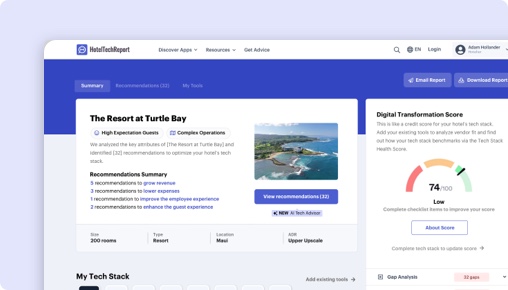
Sorry, this functionality is only available for verified hoteliers
The project dashboard is a free tool that is only available to verified hoteliers to make adopting new technology easier by streamlining their research and simplifying their communication workflow.

AI Channel Manager vs. Profitroom Channel Manager:
Which Is Right for You?


TLDR
We analyzed 440 verified hotelier reviews, compared feature sets, pricing, and real-world case studies to break down where each platform delivers. The right choice depends on your property type and priorities:
Lighthouse shines in Value for Money — especially for bed & breakfast properties (4.8/5), with exclusive features like Centralized user & role management.
Profitroom shines in support and customer success — especially for bed & breakfast properties (4.8/5), with exclusive features like Unlimited Channels (no additional cost).
How Does AI Channel Manager Compare to Profitroom Channel Manager?
Side-by-side ratings based on 440 verified hotelier reviews on HTR.
| HTScore |
|
|
| Likelihood to Recommend |
|
|
| Ease of Use |
|
|
| Customer Support |
|
|
| Value for Money |
|
|
| Starting Price | From $400/mo | From $600/mo |
| Verified Reviews | 39 | 401 |
What Are the Pros and Cons of AI Channel Manager vs Profitroom Channel Manager?
After analyzing 440 verified reviews, Lighthouse users most value its channel distribution and ota management, ease of use and setup, support and customer success responsiveness, while Profitroom users highlight support and customer success, channel management and ota distribution, ease of use and workflow efficiency. Click any theme to see what reviewers say.
|
Lighthouse
|
Profitroom
|
|---|---|
| Pros | |
|
+
Channel distribution and OTA management
▾
|
+
Support and customer success
▾
|
|
+
Ease of use and setup
▾
|
+
Channel management and OTA distribution
▾
|
|
+
Support and customer success responsiveness
▾
|
+
Ease of use and workflow efficiency
▾
|
|
+
Segmentation and drilldown reporting
▾
|
+
Booking engine and website experience
▾
|
| Cons | |
|
−
Feature availability and product gaps
▾
|
−
Flexibility and configuration limits
▾
|
|
−
Parity and rate shopping
▾
|
−
Reporting and analytics
▾
|
|
−
Integration quality and connection issues
▾
|
|
Lighthouse vs Profitroom: Rankings by Hotel Segment
How each product ranks among Channel Managers vendors for different property sizes, types, and regions — based on verified reviews from hoteliers in each segment.
By Hotel Size
| Segment |
Lighthouse
|
Profitroom
|
|---|---|---|
| Small (10-24 rooms) ▾ | #29 4 reviews | #4 128 reviews |
| Mid-Size (25-74 rooms) ▾ | #10 17 reviews | #4 186 reviews |
| Large (75-199 rooms) ▾ | #12 2 reviews | #5 43 reviews |
| X-Large (200+ rooms) ▾ | #3 4 reviews | #4 11 reviews |
By Property Type
| Segment |
Lighthouse
|
Profitroom
|
|---|---|---|
| Boutique ▾ | #17 10 reviews | #5 153 reviews |
| Luxury ▾ | #16 6 reviews | #5 142 reviews |
| Branded / Chain ▾ | #10 13 reviews | #5 82 reviews |
| Extended Stay ▾ | #19 2 reviews | #4 47 reviews |
By Region
| Segment |
Lighthouse
|
Profitroom
|
|---|---|---|
| North America ▾ | #28 14 reviews | #10 14 reviews |
| Europe ▾ | #39 8 reviews | #2 351 reviews |
| Asia Pacific ▾ | #27 3 reviews | #14 8 reviews |
| Middle East | #19 4 reviews | #12 2 reviews |
Is AI Channel Manager by Lighthouse or Profitroom Channel Manager by Profitroom Better for Hotels?
AI Channel Manager by Lighthouse and Profitroom Channel Manager by Profitroom both target hotels seeking to automate and optimize rate and availability distribution across online travel agencies (OTAs). They differ primarily in market presence and feature specialization. Lighthouse, founded in 2012 with 500 employees, is UK-based and emphasizes AI-driven revenue management and reporting insights, excelling in segmentation and market analysis. Profitroom, established in 2008 with 150 employees in Poland, focuses on omni-channel distribution, integrating marketing automation and booking engine capabilities alongside channel management.
Both products solve the core problem of reducing manual workload and overbooking risk by synchronizing rates and availability in real time. They help hotels maintain rate parity and improve revenue by consolidating channel operations into a unified interface. However, Lighthouse’s AI-powered analytics suit hotels prioritizing data-driven revenue decisions, while Profitroom’s broader toolset fits hotels seeking integrated marketing and direct booking growth alongside channel management.
AI Channel Manager by Lighthouse vs Profitroom Channel Manager by Profitroom: Which Should Your Hotel Choose?
If you operate a small to medium independent hotel or branded property in Europe or the UK, Lighthouse’s AI Channel Manager suits you best due to its advanced segmentation tools, RevPak integration (including STR reports), and interactive calendar for event management. This is supported by 37 reviews, with highly rated features for data accessibility and distribution health analysis. However, if your property depends on extensive channel diversity or operates outside Lighthouse’s 17-country footprint, Profitroom’s wider market presence across 34 countries and 401 reviews make it a reliable choice.
If your hotel prioritizes increasing direct bookings through integrated marketing automation and a high-converting booking engine, Profitroom is the better fit. It serves a diverse range of segments, including resorts (29%), boutique hotels (13%), and luxury hotels (9%), with a large user base and strong ratings in these categories. Profitroom’s unlimited channels feature (no extra cost) and seamless integration with booking engines and CRM tools enhance its appeal for operations focused on direct sales growth.
For luxury or resort hotels relying on comprehensive marketing and guest engagement tools beyond channel management, Profitroom’s ecosystem offers a more complete solution, as reflected in multiple case studies showing direct booking shares above 80%. In contrast, Lighthouse’s strength is in operational efficiency and revenue analytics, with fewer reviews in luxury segments and some integration gaps (e.g., lack of Priceline and Marriott system compatibility).
Is AI Channel Manager by Lighthouse or Profitroom Channel Manager by Profitroom Easier to Use?
Both products score identically for ease of use and onboarding, with each rated 4.7 out of 5 on Hotel Tech Report. Reviewers of Lighthouse praise the clear access to data and the intuitive interface that consolidates complex reporting, though some mention minor update delays. Profitroom users highlight the system’s clear layout and quick channel status checks, though a few note the admin environment’s complexity due to advanced features.
Onboarding experiences are similar; Lighthouse users appreciate the straightforward setup with some requests for more training options, while Profitroom clients benefit from detailed knowledge bases and user-friendly tutorials. Both products maintain a high likelihood to recommend at 94%, indicating staff adoption poses no significant barrier.
Edge: Even.
Which Has Better Features: AI Channel Manager by Lighthouse or Profitroom Channel Manager by Profitroom?
Lighthouse offers a unique feature for centralized user and role management, enabling hotel teams to assign differentiated access levels within the channel manager interface. This streamlines internal workflow by allowing revenue managers and front desk staff to operate within tailored permission sets, enhancing security and operational clarity.
Profitroom, in contrast, stands out with its unlimited channels at no additional cost, supporting hotels aiming to distribute across as many OTAs and platforms as possible without scaling fees. This benefits large or multi-property operations requiring broad channel reach.
Both share 14 core features including real-time rate and availability sync, rate parity tools, and reporting dashboards. Lighthouse’s AI-driven segmentation and distribution health reports provide deeper revenue insights, while Profitroom’s integration with booking engines and marketing automation tools extends channel management into guest acquisition and retention workflows.
Edge: Even.
Which Has Better Customer Support: AI Channel Manager by Lighthouse or Profitroom Channel Manager by Profitroom?
Both Lighthouse and Profitroom hold customer support ratings of 4.6 out of 5 with onboarding ratings close behind (4.7 for Lighthouse, 4.6 for Profitroom). Lighthouse reviewers praise support for insightful data access but mention occasional delays and glitches, especially related to Marriott system integration. Profitroom users commend fast and expert support, though some express frustration over lack of phone support and slow response times to complex requests.
Profitroom’s larger review volume (401 vs. 37) provides stronger evidence of consistent support quality. However, Lighthouse’s smaller but recent review sample also reflects positive experiences with training and assistance when available.
Edge: Even.
Which Has More Integrations: AI Channel Manager by Lighthouse or Profitroom Channel Manager by Profitroom?
Lighthouse integrates with 75 verified partners, including niche PMS systems like Visual Matrix and RoomRaccoon, and specialized analytics providers such as STR and Fairmas. These integrations enhance revenue management depth and reporting accuracy, crucial for hotels focused on data-driven decisions.
Profitroom connects to 67 verified partners, including key platforms like SiteMinder, RateGain, TrustYou, and The Hotels Network. Its ecosystem supports marketing automation and guest engagement tools, which are valuable for properties emphasizing direct bookings and brand presence.
Both share 23 common integrations covering major PMS and channel platforms. Hotels relying on Marriott systems or seeking Priceline connections currently find limitations in Lighthouse, while Profitroom lacks some revenue analytics partners but compensates with broad marketing and channel diversity.
Edge: Lighthouse.
Which Do Hoteliers Rate Higher: AI Channel Manager by Lighthouse or Profitroom Channel Manager by Profitroom?
Both products have an overall rating of 4.7 out of 5 on Hotel Tech Report. Profitroom’s rating is based on 401 reviews with 12 in the last six months (recent rating 4.5/5), while Lighthouse’s rating comes from 37 reviews with 7 recent reviews (below the 10-review threshold to assess recency rating). Profitroom’s extensive review base provides a more robust and current reflection of user satisfaction.
Segment-wise, Profitroom scores consistently high across luxury (4.8/5, 144 reviews), resorts (4.7/5, 177 reviews), and boutique hotels (4.8/5, 155 reviews). Lighthouse receives fewer reviews in luxury (4.3/5, 7 reviews) and resorts (5/5, 1 review), limiting confidence in these segments. For city center hotels and branded hotels, both products rate similarly (around 4.6 to 4.8).
Edge: Even.
How Much Do AI Channel Manager by Lighthouse and Profitroom Channel Manager by Profitroom Cost?
Lighthouse charges a base price of $400 with no implementation fee, monthly flat fee, or per-room pricing disclosed. Profitroom’s base price is $600 under similar terms. Neither product offers a freemium option or trial.
Lighthouse’s lower entry price suits hotels seeking AI-driven channel management without upfront complexity. Profitroom’s higher base price reflects its integrated platform and broader service scope, appealing to hotels valuing omni-channel marketing and booking tools alongside channel management.
What Type of Hotel Should Use AI Channel Manager by Lighthouse?
- Hotels that prioritize AI-driven revenue analytics and segmentation to optimize pricing strategies.
- Teams needing centralized user and role management for differentiated access control across reservation and revenue staff.
- Properties operating primarily in Europe and the UK, benefiting from Lighthouse’s 17-country footprint and strong integration with regional PMS like Visual Matrix.
- Hotels seeking efficient event and calendar management tools to coordinate demand spikes and market trends.
Not ideal if:
- Hotels rely extensively on Priceline or Marriott systems due to limited integration support.
- Properties requiring a broad number of OTA channels without incremental costs.
- Resorts or luxury hotels looking for extensive marketing automation and direct booking tools beyond channel management.
What Type of Hotel Should Use Profitroom Channel Manager by Profitroom?
- Hotels aiming to maximize direct bookings through integrated marketing automation and a high-converting booking engine.
- Resorts, luxury, and boutique hotels with large channel needs across 34 countries.
- Properties that require unlimited OTA channel connections without added fees.
- Hotel groups or multi-property operations benefiting from seamless product integration including CRM and website management.
Not ideal if:
- Smaller independent hotels looking for advanced AI-driven segmentation and detailed revenue analytics.
- Hotels requiring deep integration with niche revenue management partners like STR and Fairmas.
- Properties needing a highly simplified interface due to advanced feature complexity for some users.
AI Channel Manager by Lighthouse vs Profitroom Channel Manager by Profitroom: The Bottom Line for Hotels
The core difference between Lighthouse and Profitroom lies in their strategic focus and market reach. Lighthouse centers on AI-driven analytics and operational efficiency with advanced segmentation and reporting, best suited for hotels emphasizing data-driven revenue management within a UK and European footprint. Profitroom offers a broader omni-channel distribution ecosystem, combining channel management with marketing automation, booking engines, and CRM tools, targeting hotels with aggressive direct booking goals across a wider global market.
Choose AI Channel Manager by Lighthouse if your hotel values centralized user management, detailed revenue segmentation, and integration with specialized analytics providers like STR and Fairmas. Its competitive $400 base price and event management tools support operational teams focused on maximizing revenue through data insights.
Choose Profitroom Channel Manager if your hotel prioritizes unlimited channel connections, seamless integration across marketing and booking platforms, and a strong direct booking strategy backed by 400+ reviews affirming usability and support. Its presence in 34 countries and varied hotel segment success make it ideal for resorts, luxury properties, and multi-property groups seeking an all-in-one distribution solution.
How Much Do AI Channel Manager and Profitroom Channel Manager Cost?
Channel Managers pricing is rarely straightforward. Here is what we know from each vendor's public pricing data. Always request a custom quote for your property size.
|
Lighthouse
|
Profitroom
|
|
|---|---|---|
| Starting Price | From $400/mo | From $600/mo |
Feature Comparison: AI Channel Manager vs Profitroom Channel Manager
These are the features each vendor has configured, organized by feature group — the same data shown in the vendor dashboard. Expand a group to compare features side by side.
| Feature |
Lighthouse
|
Profitroom
|
|---|---|---|
|
▾
Rate Management
|
|
|
| Support for Weekly & Monthly Rates | ||
| Yield Rules | ||
| Derived Rates | ||
| Inventory Management | ||
| Inventory grid | ||
|
▾
Room Type Mapping
|
|
|
| Channel Self-Mapping | ||
|
▾
Automation & Syncing
|
|
|
| Bulk Updates & Multiple Restrictions | ||
| 2-way real time integrations | ||
| PMS connectivity | ||
|
▾
Administration & Settings
|
|
|
| Multi-lingual | ||
| Centralized user & role management | ||
| Multi-Currency Support | ||
| Inventory grid | ||
| Integrated Payment Processing | ||
|
▾
Analytics & Reporting
|
|
|
| Analytics dashboard | ||
| Booking Performance and Pace Reporting | ||
|
▾
Other
|
|
|
| Unlimited Channels (no additional cost) |
Real-World Results: Lighthouse vs Profitroom by Business Goal
We analyzed 10 verified case studies to compare what hotels actually achieve with each platform across four key business objectives.
XO Hotels Amsterdam
Mid-Size
"We strongly recommend everyone who works with two or more channels to use Channel Manager. Not only to implement rate parity but also to provide an advantage to direct guests and t..."
 Arche
Mid-Size
"Our resort has enjoyed significant interest from the beginning. The volume of emails and calls exceeds our expectations. The booking engine is currently a relieving tool; when the..."
 Lighthouse
No published case study for this goal yet.
Hotels Saltic
Small
"We chose to cooperate with Profitroom because you are absolutely the best in Poland, and there is no other company that matches your technological prowess. Indeed, working with you..."

Lighthouse vs Profitroom: The Bottom Line
What hoteliers love
Many reviews mention SiteMinder's ability to centralize channel management across OTAs and third-party sites. Hotels say it helps them track distribut... Many reviews mention SiteMinder's ability to centralize channel management across OTAs and third-party sites. Hotels say it helps them track distribution health, compare rankings, and manage bookings across channels from one place, improving visibility and control over sales.
Users often describe SiteMinder as easy to set up, intuitive, and straightforward to use in daily operations. This matters to hotel teams because it s... Users often describe SiteMinder as easy to set up, intuitive, and straightforward to use in daily operations. This matters to hotel teams because it shortens onboarding time and helps staff work quickly without needing constant training.
Support is one of the most positively mentioned areas, with reviewers saying the team responds quickly and helps them when they are stuck. Several com... Support is one of the most positively mentioned areas, with reviewers saying the team responds quickly and helps them when they are stuck. Several comments contrast SiteMinder's responsiveness favorably against competitors, which suggests strong service is part of the product's value proposition.
Where hoteliers push back
A few reviewers point out missing or plan-gated capabilities, such as mobile app access, history of user actions, or more flexible field options. Thes... A few reviewers point out missing or plan-gated capabilities, such as mobile app access, history of user actions, or more flexible field options. These comments suggest that while the core channel management is strong, some hotels may need additional features or higher-tier plans to fully match their workflow needs.
Users frequently call out parity tools and rate shopping as key reasons they use SiteMinder. These features help hotels monitor how rates appear acros... Users frequently call out parity tools and rate shopping as key reasons they use SiteMinder. These features help hotels monitor how rates appear across sites, spot issues affecting bookings, and better protect revenue through competitive rate visibility.
Ranks higher for
Unique capabilities
What hoteliers love
Support quality is one of the most frequently mentioned differentiators, with many users praising responsiveness, professionalism, and helpful onboard... Support quality is one of the most frequently mentioned differentiators, with many users praising responsiveness, professionalism, and helpful onboarding. At the same time, a notable group reports slow ticket resolution, lack of phone support, and delays that can affect OTA visibility or even cause revenue loss.
A major theme is how Profitroom centralizes distribution across OTAs and keeps availability synchronized. Reviewers value the ability to manage many c... A major theme is how Profitroom centralizes distribution across OTAs and keeps availability synchronized. Reviewers value the ability to manage many channels from one place, reduce manual work, and avoid errors or overbooking, though some mention limits in channel breadth and update reliability.
Many reviewers highlight the platform’s intuitive interface, clear layout, and simple setup. They say it speeds up daily hotel operations, makes rate... Many reviewers highlight the platform’s intuitive interface, clear layout, and simple setup. They say it speeds up daily hotel operations, makes rate and reservation management easier, and reduces the time staff spend handling routine tasks.
Where hoteliers push back
A recurring critical topic is the need for more flexibility in rate derivation, surcharges, filters, add-ons, and widget customization. Reviewers gene... A recurring critical topic is the need for more flexibility in rate derivation, surcharges, filters, add-ons, and widget customization. Reviewers generally like the platform, but they want more advanced controls and more self-service configuration to match complex hotel pricing and sales needs.
Reviewers appreciate the reporting quality in some areas, especially transparency and visibility into performance. However, they also want richer anal... Reviewers appreciate the reporting quality in some areas, especially transparency and visibility into performance. However, they also want richer analytics, more filters, better trend views, and clearer insight into channel and revenue performance so they can make smarter pricing and distribution decisions.
Ranks higher for
Unique capabilities
Where the ratings diverge most
Frequently Asked Questions About AI Channel Manager vs Profitroom Channel Manager
Can AI Channel Manager replace Profitroom Channel Manager?
It depends on your requirements. AI Channel Manager and Profitroom Channel Manager share many core Channel Managers features, but each has unique capabilities. AI Channel Manager offers 75 verified integration partners, while Profitroom Channel Manager offers 67. Review the feature comparison above to see where they differ before switching.
Which is better for small or independent hotels?
Small hotels should prioritize ease of use and fast onboarding. AI Channel Manager leads in ease of use at 4.7/5 vs 4.7/5. Look for transparent pricing and a trial or demo option. Filter reviews on each product page by property size to hear from hotels like yours.
Do AI Channel Manager or Profitroom Channel Manager offer a free plan?
AI Channel Manager: No. Profitroom Channel Manager: No. Neither product currently offers a free tier. Most Channel Managers vendors offer demos or trials — request one from each to evaluate before committing.
How Does HTR Evaluate and Rank AI Channel Manager and Profitroom Channel Manager?
The HT Score is a composite ranking that considers 4 criteria groups and over a dozen variables to help hoteliers objectively compare hotel technology products. Lighthouse has an HT Score of 79 and Profitroom has 82. Here is how the score is calculated.
| Criteria Group | Weight | What It Measures |
|---|---|---|
| Customer Ratings & Reviews |
|
How highly do users recommend this product? Ratings Score, Review Volume, Share of Voice, Review Depth, Review Recency, Success Stories ▾ The most heavily weighted factor. Analyzes average satisfaction ratings (likelihood to recommend, ease of use, support, ROI), total review count relative to category peers, review recency (at least 20 reviews in the trailing 6 months), and share of voice across unique hotel clients to detect selection bias. |
| Partner Ecosystem |
|
How highly do tech partners recommend this company? Partner Recommendations, Integration Quantity, Integration Quality ▾ Evaluates partner recommendations as expert votes of confidence, the number of verified integrations, and ecosystem quality — the average HT Scores of integration partners. Products with higher-quality integration ecosystems are more likely to deliver a connected tech stack. |
| Customer Centricity |
|
How customer-centric is this organization? Certified Support, Review Consistency, Profile Completeness ▾ Assesses whether the company has earned HTR Customer Support Certification, maintains consistent review collection over time (an indicator of feedback-driven culture), and keeps product profiles complete with capabilities, screenshots, pricing, and features. |
| Reach, Staying Power & Resources |
|
How extensive is this company's reach and resourcing? Geographic Reach, Staying Power, Company Resources, Trending Score ▾ Measures global presence (countries and regions served), years in business as a stability proxy, team headcount as a resource proxy, and a trending score based on trailing-twelve-month buyer inquiries, reviews, partner recommendations, and press activity. |
Customer ratings and reviews are by far the most important factor in the HT Score algorithm. HTR does not accept payment for higher rankings. All reviews are verified — only hotel industry practitioners with confirmed affiliations can submit ratings. View full HT Score methodology →
What Other Channel Managers Comparisons Are Hoteliers Reading?
Explore more head-to-head comparisons based on verified hotelier reviews.





Get Your Free AI Analyst Report
Custom recommendations tailored to your property


Let´s lookup your hotel information
Still weighing your channel managers options?
A few popular systems from our channel managers guide — or let our AI score each one against your specific property in about two minutes.


