

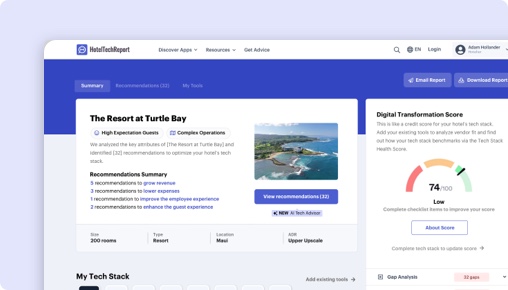
Sorry, this functionality is only available for verified hoteliers
The project dashboard is a free tool that is only available to verified hoteliers to make adopting new technology easier by streamlining their research and simplifying their communication workflow.

Lighthouse Pricing vs. Optimand Rate Shopper:
Which Is Right for You?

TLDR
We analyzed 1,464 verified hotelier reviews, compared feature sets, pricing, and real-world case studies to break down where each platform delivers. The right choice depends on your property type and priorities:
Lighthouse shines in competitor rate shopping and compset comparison — especially for branded chain properties (4.8/5), with exclusive features like Metasearch connectivity and In-app support.
Optimand shines in Customer Support — especially for luxury properties (5.0/5).
How Does Lighthouse Pricing Compare to Optimand Rate Shopper?
Side-by-side ratings based on 1,464 verified hotelier reviews on HTR.
| HTScore |
|
|
| Likelihood to Recommend |
|
|
| Ease of Use |
|
|
| Customer Support |
|
|
| Value for Money |
|
|
| Starting Price | From $100/mo | From $200/mo |
| Verified Reviews | 1,439 | 25 |
What Are the Pros and Cons of Lighthouse Pricing vs Optimand Rate Shopper?
After analyzing 1,464 verified reviews, Lighthouse users most value its competitor rate shopping and compset comparison, reporting, dashboards, and bi analysis, market demand and events intelligence, while Optimand users highlight ease of use and intuitive interface, competitor analysis. Click any theme to see what reviewers say.
|
Lighthouse
|
Optimand
|
|---|---|
| Pros | |
|
+
Competitor rate shopping and compset comparison
▾
|
+
Ease of Use and Intuitive Interface
▾
|
|
+
Reporting, dashboards, and BI analysis
▾
|
+
Competitor Analysis
▾
|
|
+
Market demand and events intelligence
▾
|
|
|
+
Forecasting, budgeting, and forward-looking revenue decisions
▾
|
|
| Cons | |
|
−
Refresh speed and data timeliness
▾
|
−
Market Trend Analysis
▾
|
|
−
Room-type, LOS, occupancy, and rate-mapping accuracy
▾
|
−
Sales Channels Expansion
▾
|
Lighthouse vs Optimand: Rankings by Hotel Segment
How each product ranks among Rate Shopping vendors for different property sizes, types, and regions — based on verified reviews from hoteliers in each segment.
By Hotel Size
| Segment |
Lighthouse
|
Optimand
|
|---|---|---|
| Small (10-24 rooms) ▾ | #2 110 reviews | #6 12 reviews |
| Mid-Size (25-74 rooms) ▾ | #1 636 reviews | #11 6 reviews |
| Large (75-199 rooms) ▾ | #1 374 reviews | #10 5 reviews |
| X-Large (200+ rooms) ▾ | #1 162 reviews | #9 2 reviews |
By Property Type
| Segment |
Lighthouse
|
Optimand
|
|---|---|---|
| Boutique ▾ | #1 518 reviews | #9 9 reviews |
| Luxury ▾ | #1 557 reviews | #9 11 reviews |
| Branded / Chain ▾ | #1 716 reviews | #12 7 reviews |
| Extended Stay ▾ | #1 139 reviews | #9 3 reviews |
By Region
| Segment |
Lighthouse
|
Optimand
|
|---|---|---|
| North America ▾ | #1 345 reviews | #10 2 reviews |
| Europe ▾ | #1 421 reviews | #6 21 reviews |
| Asia Pacific ▾ | #1 283 reviews | — |
| Middle East ▾ | #1 135 reviews | — |
Is Lighthouse Pricing by Lighthouse or Optimand Rate Shopper by Optimand Better for Hotels?
Lighthouse Pricing and Optimand Rate Shopper both serve hotels aiming to optimize their pricing through competitive rate shopping and market intelligence. They diverge primarily in scale, data depth, and ecosystem integration. Lighthouse Pricing is a robust solution with a wide global footprint, supporting 112 countries and featuring 75 verified integrations. It suits hotels and multi-property groups seeking granular competitor insights, detailed event forecasts, and extensive portfolio management tools. Optimand Rate Shopper, with 7 verified partners and presence in 7 countries, is a leaner platform focusing on forward-looking rate intelligence combined with demand insights, suited for smaller hotels or those prioritizing intuitive use and fast support.
Both products address the challenge of tracking competitor pricing, rate parity, and market trends to inform revenue management. They enable hotels to react to market shifts, adjust rates proactively, and protect rate parity across OTAs and direct channels. The problem they solve is reducing manual competitor research and data fragmentation by delivering timely, actionable rate intelligence.
Lighthouse Pricing by Lighthouse vs Optimand Rate Shopper by Optimand: Which Should Your Hotel Choose?
If your hotel operates across multiple properties or across diverse markets globally, Lighthouse Pricing is the stronger choice. Its 1397 reviews with a solid 4.8 overall rating across 112 countries reflect broad adoption and reliability for portfolio-level revenue management. Its 75 verified integrations, including major PMS and channel managers like Oracle Hospitality and Mews, facilitate seamless data flow and consolidated reporting, ideal for branded hotels or city center properties managing complex comp sets.
If you run a smaller boutique or luxury hotel focused on ease of use, personalized support, and combined rate plus demand insights, Optimand Rate Shopper’s higher support (5/5) and onboarding ratings (4.9/5) may suit your needs better, despite lower review volume (25 reviews). Its strength lies in forward-looking competitor pricing analysis paired with local demand data, which benefits properties targeting direct channel growth and flexible tariff strategies. However, Optimand’s smaller regional presence and fewer integrations mean it may not fully support multi-property groups or extensive sales channel benchmarking.
Data for limited service or budget hotels is sparse for Optimand, so recommendations in that segment rely heavily on Lighthouse’s 4.7 rating from 325 reviews. For airport/conference hotels, Lighthouse again leads with 461 reviews rated 4.8/5, while Optimand has minimal presence. Choose Lighthouse if data depth and integration breadth drive your revenue strategy; choose Optimand if personalized support and demand-driven pricing intelligence weigh more heavily.
Is Lighthouse Pricing by Lighthouse or Optimand Rate Shopper by Optimand Easier to Use?
Both products share identical ease of use ratings of 4.8/5, with onboarding scores close at 4.7/5 for Lighthouse and 4.9/5 for Optimand. Lighthouse users praise the intuitive, Google-like design that reduces task time by up to 60%, enabling quick navigation through complex data sets. Multiple reviews highlight how its live shopping and real-time dashboards simplify daily rate comparisons across diverse room types and channels.
Optimand reviewers also emphasize its intuitive interface and fast learning curve, noting that navigation across modules is seamless and reduces data collection time before decision-making. Some users suggest further interface improvements to speed workflows, but overall sentiment points to straightforward usability.
Front desk and revenue teams at properties using either product report efficient adoption, though Lighthouse’s larger user base means more peer support and shared best practices. Both platforms deliver user-friendly onboarding, but Optimand’s slightly higher onboarding rating and personalized support promise faster ramp-up in smaller teams.
Edge: Even.
Which Has Better Features: Lighthouse Pricing by Lighthouse or Optimand Rate Shopper by Optimand?
Lighthouse Pricing offers five hotel-specific features absent in Optimand: metasearch connectivity, in-app support, and an open API for custom integrations, plus a Promotion Impact Report that quantifies discount effects on demand. These features enable revenue managers to monitor rates not only on OTAs but also on metasearch platforms, facilitating broader channel insights and direct intervention through promotions analysis.
Optimand does not list any exclusive features beyond the 24 it shares with Lighthouse. This limits its scope to core rate shopping and competitive pricing intelligence without specialized reporting or open API access. The lack of metasearch connectivity restricts visibility into a critical distribution channel.
Operationally, Lighthouse’s open API allows hotels to integrate rate data into existing revenue management or business intelligence systems, streamlining workflows across departments. The Promotion Impact Report helps marketing and revenue teams measure discount effectiveness, improving pricing tactics. Optimand focuses instead on combining rate intelligence with demand data, but without unique features that extend beyond direct rate analysis.
Edge: Lighthouse Pricing.
Which Has Better Customer Support: Lighthouse Pricing by Lighthouse or Optimand Rate Shopper by Optimand?
Optimand Rate Shopper leads with a perfect 5/5 customer support rating and a 4.9 onboarding score, compared to Lighthouse’s 4.7 support and 4.7 onboarding. Optimand reviews repeatedly praise the speed and quality of support, describing it as personalized and responsive, with a commercial team that quickly addresses doubts and custom requests. This level of support is likely critical for smaller teams needing rapid answers.
Lighthouse users also commend support but occasionally mention a steep initial setup that requires time and training, reflecting its complex, feature-rich platform. Some reviews cite occasional data inaccuracies that must be flagged to support, implying a need for prompt resolution. However, users find the support team generally helpful.
For hotels prioritizing hands-on, rapid assistance during onboarding and daily use, Optimand’s higher ratings and review comments indicate stronger customer care. Larger portfolios benefiting from Lighthouse’s extensive functionality may accept a longer setup phase.
Edge: Optimand Rate Shopper.
Which Has More Integrations: Lighthouse Pricing by Lighthouse or Optimand Rate Shopper by Optimand?
Lighthouse Pricing offers 75 verified integrations, vastly outnumbering Optimand’s 7. Both share 6 key partners, including Stayntouch, Oracle Hospitality, Mews, and IDeaS, covering major PMS and revenue management systems.
Lighthouse’s unique integrations include Visual Matrix PMS, RoomRaccoon, Profitroom, RevControl, and Fairmas, supporting a diverse range of hotel systems worldwide. This extensive connectivity allows hotels to centralize data flows, automate rate refreshes, and incorporate rate intelligence into operational platforms.
Optimand’s limited 7 partners restricts its integration ecosystem, likely reflecting its smaller team and newer market presence. For hotels seeking broad system interoperability, especially multi-property or branded groups requiring complex data pipelines, Lighthouse provides substantial advantages.
Edge: Lighthouse Pricing.
Which Do Hoteliers Rate Higher: Lighthouse Pricing by Lighthouse or Optimand Rate Shopper by Optimand?
Overall ratings are close: Lighthouse at 4.8/5 from 1397 reviews, Optimand at 4.9/5 from 25 reviews. Recent review volume strongly favors Lighthouse with 69 new reviews in the last six months, while Optimand has none, suggesting Lighthouse’s ratings better reflect current product quality.
Segment-specific ratings show both products performing well in luxury hotels: Lighthouse 4.8/5 (576 reviews), Optimand 5/5 (11 reviews). Resorts and boutique hotels also rate both highly, though Lighthouse has more reviews supporting its 4.8 and 4.7 scores respectively, compared to Optimand’s 4.9 and 4.9 with fewer reviews. City center hotels and branded hotels rate Lighthouse at 4.8 with hundreds of reviews, while Optimand’s smaller sample reports 4.8–4.9 ratings.
The volume and recency of Lighthouse reviews provide strong confidence in its consistent performance. Optimand’s small, older review base limits reliability in rating comparisons, especially for limited service or budget hotels where Lighthouse holds 325 reviews averaging 4.7.
Edge: Even.
How Much Do Lighthouse Pricing by Lighthouse and Optimand Rate Shopper by Optimand Cost?
Lighthouse Pricing starts at $100 monthly with no freemium or per-room pricing, and no implementation fees. Optimand Rate Shopper begins at $200 monthly under similar terms—no freemium, no per-room charges, and no implementation fees listed. Neither offers a free trial.
Lighthouse’s lower base price may appeal to budget-conscious hotels or larger portfolios seeking cost-effective scaling. Optimand’s higher starting price reflects its personalized service and smaller client base but lacks case studies or testimonials to justify the premium.
What Type of Hotel Should Use Lighthouse Pricing by Lighthouse?
- Hotels that manage multiple properties or portfolios, benefiting from Lighthouse’s consolidated multi-property analytics and 75 integrations.
- Branded hotels and city center properties, supported by 750 and 581 reviews respectively with 4.8 ratings.
- Hotels requiring metasearch channel rate visibility and detailed promotion impact reports for a comprehensive pricing strategy.
- Revenue teams that need open API access to streamline data integration into existing BI and revenue management systems.
- Properties seeking a mature platform with extensive market intelligence, event forecasting, and customizable reporting.
Not ideal if:
- Your team prefers personalized, rapid support over a larger, more complex platform setup.
- You need a mobile app or more frequent data refreshes as some users report delays.
- Budget constraints limit investment in a platform with advanced features that may exceed smaller hotel needs.
What Type of Hotel Should Use Optimand Rate Shopper by Optimand?
- Smaller luxury and boutique hotels emphasizing user-friendly design and personalized customer support.
- Hotels aiming to combine competitor rate intelligence with website and destination demand data for direct channel growth.
- Properties prioritizing fast, responsive onboarding and tailored commercial strategy assistance.
- Teams looking for straightforward, intuitive navigation without extensive training overhead.
- Hotels in regions where Optimand is active (7 countries) and integrated partners align with local systems.
Not ideal if:
- You operate multi-property portfolios requiring broad integration ecosystem and consolidated reporting.
- You rely on metasearch connectivity and open APIs for advanced data workflows.
- You require frequent new feature releases, broad event forecasting, or detailed promotion impact analysis.
Lighthouse Pricing by Lighthouse vs Optimand Rate Shopper by Optimand: The Bottom Line for Hotels
Lighthouse Pricing delivers a comprehensive, data-rich rate shopping platform with extensive integrations and advanced features that support multi-property revenue management and detailed market intelligence. Its strength lies in deep competitor rate insights, metasearch connectivity, open API access, and event-driven forecasting, making it suitable for branded hotels, city center properties, and groups managing complex portfolios.
Choose Lighthouse Pricing if your hotel requires a mature platform with broad system interoperability and detailed analytics to support strategic pricing decisions across multiple channels and properties. Its 1397 reviews averaging 4.8, plus recent active use, underscore its reliability and scale.
Optimand Rate Shopper offers a more streamlined, user-friendly approach, emphasizing personalized support and combining rate shopping with demand data for direct channel optimization. Its perfect support rating and intuitive interface make it appealing to smaller luxury and boutique hotels seeking quick onboarding and easy navigation without sacrificing essential rate intelligence.
Choose Optimand if your hotel prioritizes high-touch support and forward-looking demand insights within a simpler, less complex platform. However, with only 25 reviews and fewer integrations, it suits smaller properties or those with less complex revenue management needs.
In summary, Lighthouse Pricing fits hotels needing extensive integrations and detailed market data for robust pricing strategies, while Optimand Rate Shopper suits hotels valuing simplicity and personalized service in competitive rate shopping. Both have strong ratings, but Lighthouse’s volume and feature set offer a more scalable solution.
How Much Do Lighthouse Pricing and Optimand Rate Shopper Cost?
Rate Shopping pricing is rarely straightforward. Here is what we know from each vendor's public pricing data. Always request a custom quote for your property size.
|
Lighthouse
|
Optimand
|
|
|---|---|---|
| Starting Price | From $100/mo | From $200/mo |
Feature Comparison: Lighthouse Pricing vs Optimand Rate Shopper
These are the features each vendor has configured, organized by feature group — the same data shown in the vendor dashboard. Expand a group to compare features side by side.
| Feature |
Lighthouse
|
Optimand
|
|---|---|---|
|
▾
Competitor Tracking & Benchmarking
|
|
|
| Competitor Strategy Monitoring | ||
| Discount Monitoring | ||
| Rate Type Comparisons | ||
| OTA Rank Tracking | ||
| Promotion Impact Report | ||
| Rate Intelligence | ||
| Room Rate Comparison | ||
| Vacation Rental Rate Intelligence | ||
| Metasearch connectivity | ||
| Quick rate shopping filters | ||
| Room & rate type filtering | ||
|
▾
Parity Monitoring
|
|
|
| OTA Price Monitoring | ||
| Discrepancy Alerts | ||
| 12-month Parity Monitoring | ||
| Real Time Updates | ||
| Parity Report | ||
|
▾
Data Granularity
|
|
|
| Device Type Tracking | ||
| Discount Monitoring | ||
| Rate Type Comparisons | ||
| Historical Trend Analysis | ||
| Local Event Monitoring & Database | ||
| Room Rate Comparison | ||
| Vacation Rental Rate Intelligence | ||
| Open API | ||
|
▾
Performance Reporting & Analytics
|
|
|
| OTA Rank Tracking | ||
| On the Books (OTB) Comparisons | ||
| Promotion Impact Report | ||
| Performance Reporting | ||
| Rate Intelligence | ||
| Room Rate Comparison | ||
| Multi-property Management | ||
| Analytics dashboard | ||
| Custom dashboards | ||
| Multi-property consolidation | ||
|
▾
Other
|
|
|
| In-app support |
Real-World Results: Lighthouse vs Optimand by Business Goal
We analyzed 8 verified case studies to compare what hotels actually achieve with each platform across four key business objectives.
Furaveri Maldives
Small
"OTA Insight’s tools have transformed the way I work. They’re like a 24/7 buffet where I can get all the live data I need, any time of the day. I start with a look at Market Insight..."
 Optimand
No published case study for this goal yet.
Six Senses Douro Valley
Small
"You can tell that the product development team bases updates and new features on client feedback. This has helped them make the tools even more user-friendly and comprehensive over..."
 Optimand
No published case study for this goal yet.
Lighthouse vs Optimand: The Bottom Line
What hoteliers love
Users most often praise Lighthouse for making competitor rate shopping fast and centralized across compsets, room types, LOS, occupancy, and channels.... Users most often praise Lighthouse for making competitor rate shopping fast and centralized across compsets, room types, LOS, occupancy, and channels. The tool helps hotels see where they sit versus the market, spot pricing gaps quickly, and adjust rates to protect occupancy and revenue.
Users value the dashboards, graphs, drilldowns, and BI reports for turning complex pricing data into actionable insights for revenue teams and stakeho... Users value the dashboards, graphs, drilldowns, and BI reports for turning complex pricing data into actionable insights for revenue teams and stakeholders. Common feedback asks for more customization, cleaner report layouts, easier exports, and stronger consistency across BI views so teams can work faster and reduce manual spreadsheet work.
Many reviews mention market demand, events calendars, and compression signals as a key reason Lighthouse helps hotels price more intelligently. Users... Many reviews mention market demand, events calendars, and compression signals as a key reason Lighthouse helps hotels price more intelligently. Users rely on these insights to anticipate demand spikes, plan around local events, and capture higher rates during high-occupancy periods; some want richer city- and region-specific event coverage.
Where hoteliers push back
A recurring complaint is that rates and reports do not always refresh fast enough, especially during busy periods or when hotels need intraday monitor... A recurring complaint is that rates and reports do not always refresh fast enough, especially during busy periods or when hotels need intraday monitoring. Reviewers want faster automatic updates, more frequent scheduled shops, and fewer manual refresh clicks so they can react sooner to market moves.
Reviewers frequently rely on Lighthouse’s like-for-like comparison logic, but many want better room-type mapping and more control over occupancy, LOS,... Reviewers frequently rely on Lighthouse’s like-for-like comparison logic, but many want better room-type mapping and more control over occupancy, LOS, and rate-type comparisons. Accuracy issues in mapping or display can weaken trust in the data, so users ask for smarter mapping, clearer rate definitions, and more flexible comparison rules.
Ranks higher for
Unique capabilities
What hoteliers love
Users frequently commend Optimand for its user-friendly design and intuitive navigation, making rate comparisons and strategy implementation straightf... Users frequently commend Optimand for its user-friendly design and intuitive navigation, making rate comparisons and strategy implementation straightforward. However, some suggest further interface improvements to enhance user experience.
Optimand's ability to facilitate thorough competitor analysis is highlighted as a key strength, enabling hotels to adjust pricing strategically by com... Optimand's ability to facilitate thorough competitor analysis is highlighted as a key strength, enabling hotels to adjust pricing strategically by comparing rates with rivals. This function is critical in maintaining a competitive edge in the market.
Where hoteliers push back
The tool is lauded for providing insights into market trends, aiding users in forecasting and adapting their strategies to evolving market conditions.... The tool is lauded for providing insights into market trends, aiding users in forecasting and adapting their strategies to evolving market conditions. Users express a desire for additional forecasting tools to enhance this feature further.
Users suggest that incorporating a broader range of sales channels, such as tour operators, would enhance Optimand's benchmarking capabilities, allowi... Users suggest that incorporating a broader range of sales channels, such as tour operators, would enhance Optimand's benchmarking capabilities, allowing for more comprehensive rate comparisons across different distribution sectors.
Where the ratings diverge most
Frequently Asked Questions About Lighthouse Pricing vs Optimand Rate Shopper
Can Lighthouse Pricing replace Optimand Rate Shopper?
It depends on your requirements. Lighthouse Pricing and Optimand Rate Shopper share many core Rate Shopping features, but each has unique capabilities. Lighthouse Pricing offers 75 verified integration partners, while Optimand Rate Shopper offers 7. Review the feature comparison above to see where they differ before switching.
Which is better for small or independent hotels?
Small hotels should prioritize ease of use and fast onboarding. Lighthouse Pricing leads in ease of use at 4.8/5 vs 4.8/5. Look for transparent pricing and a trial or demo option. Filter reviews on each product page by property size to hear from hotels like yours.
Do Lighthouse Pricing or Optimand Rate Shopper offer a free plan?
Lighthouse Pricing: No. Optimand Rate Shopper: No. Neither product currently offers a free tier. Most Rate Shopping vendors offer demos or trials — request one from each to evaluate before committing.
How Does HTR Evaluate and Rank Lighthouse Pricing and Optimand Rate Shopper?
The HT Score is a composite ranking that considers 4 criteria groups and over a dozen variables to help hoteliers objectively compare hotel technology products. Lighthouse has an HT Score of 100 and Optimand has 73. Here is how the score is calculated.
| Criteria Group | Weight | What It Measures |
|---|---|---|
| Customer Ratings & Reviews |
|
How highly do users recommend this product? Ratings Score, Review Volume, Share of Voice, Review Depth, Review Recency, Success Stories ▾ The most heavily weighted factor. Analyzes average satisfaction ratings (likelihood to recommend, ease of use, support, ROI), total review count relative to category peers, review recency (at least 20 reviews in the trailing 6 months), and share of voice across unique hotel clients to detect selection bias. |
| Partner Ecosystem |
|
How highly do tech partners recommend this company? Partner Recommendations, Integration Quantity, Integration Quality ▾ Evaluates partner recommendations as expert votes of confidence, the number of verified integrations, and ecosystem quality — the average HT Scores of integration partners. Products with higher-quality integration ecosystems are more likely to deliver a connected tech stack. |
| Customer Centricity |
|
How customer-centric is this organization? Certified Support, Review Consistency, Profile Completeness ▾ Assesses whether the company has earned HTR Customer Support Certification, maintains consistent review collection over time (an indicator of feedback-driven culture), and keeps product profiles complete with capabilities, screenshots, pricing, and features. |
| Reach, Staying Power & Resources |
|
How extensive is this company's reach and resourcing? Geographic Reach, Staying Power, Company Resources, Trending Score ▾ Measures global presence (countries and regions served), years in business as a stability proxy, team headcount as a resource proxy, and a trending score based on trailing-twelve-month buyer inquiries, reviews, partner recommendations, and press activity. |
Customer ratings and reviews are by far the most important factor in the HT Score algorithm. HTR does not accept payment for higher rankings. All reviews are verified — only hotel industry practitioners with confirmed affiliations can submit ratings. View full HT Score methodology →
What Other Rate Shopping Comparisons Are Hoteliers Reading?
Explore more head-to-head comparisons based on verified hotelier reviews.




Get Your Free AI Analyst Report
Custom recommendations tailored to your property


