

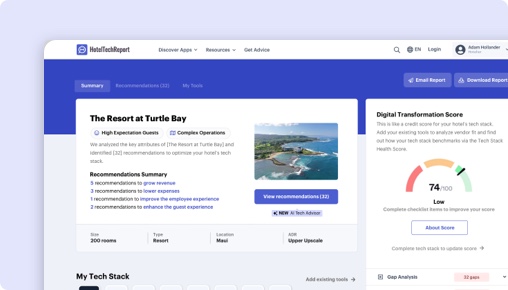
Sorry, this functionality is only available for verified hoteliers
The project dashboard is a free tool that is only available to verified hoteliers to make adopting new technology easier by streamlining their research and simplifying their communication workflow.

Hotelchamp eCommerce vs. Porter - Premium Hotel Websites:
Which Is Right for You?


TLDR
We analyzed 29 verified hotelier reviews, compared feature sets, pricing, and real-world case studies to break down where each platform delivers. The right choice depends on your property type and priorities:
Hotelchamp shines in website design quality — especially for city-center properties (4.9/5), with exclusive features like Drag and Drop Page Builder.
Porter stands out with exclusive features like Whitelabel Capability and Storefront/Voucher Functionality.
How Does Hotelchamp eCommerce Compare to Porter - Premium Hotel Websites?
Side-by-side ratings based on 29 verified hotelier reviews on HTR.
| HTScore |
|
|
| Likelihood to Recommend |
|
|
| Ease of Use |
|
|
| Customer Support |
|
|
| Value for Money |
|
|
| Starting Price | Contact sales | Contact sales |
| Verified Reviews | 19 | 10 |
What Are the Pros and Cons of Hotelchamp eCommerce vs Porter - Premium Hotel Websites?
After analyzing 29 verified reviews, Hotelchamp users most value its website design quality, ease of use, while Porter users highlight . Click any theme to see what reviewers say.
|
Hotelchamp
|
Porter
|
|---|---|
| Pros | |
|
+
Website design quality
▾
|
|
|
+
Ease of use
▾
|
|
| Cons | |
|
−
Conversion tool improvement
▾
|
|
|
−
OpenGDS functionality
▾
|
|
Hotelchamp vs Porter: Rankings by Hotel Segment
How each product ranks among Website Design vendors for different property sizes, types, and regions — based on verified reviews from hoteliers in each segment.
By Hotel Size
| Segment |
Hotelchamp
|
Porter
|
|---|---|---|
| Small (10-24 rooms) | #19 4 reviews | #16 4 reviews |
| Mid-Size (25-74 rooms) ▾ | #15 8 reviews | #20 5 reviews |
| Large (75-199 rooms) | #17 1 reviews | — |
| X-Large (200+ rooms) ▾ | #5 6 reviews | — |
By Property Type
| Segment |
Hotelchamp
|
Porter
|
|---|---|---|
| Boutique ▾ | #14 13 reviews | #21 5 reviews |
| Luxury ▾ | #12 11 reviews | #20 3 reviews |
| Branded / Chain ▾ | #13 6 reviews | #21 2 reviews |
| Extended Stay | #23 0 reviews | #13 1 reviews |
By Region
| Segment |
Hotelchamp
|
Porter
|
|---|---|---|
| North America | — | #24 0 reviews |
| Europe ▾ | #13 8 reviews | #9 9 reviews |
| Asia Pacific ▾ | #3 7 reviews | — |
| Middle East | #9 1 reviews | — |
Is Hotelchamp eCommerce by Hotelchamp or Porter - Premium Hotel Websites by Porter Better for Hotels?
Hotelchamp and Porter both serve hotel website design but diverge in operational focus and client fit. Hotelchamp prioritizes rapid deployment with a drag-and-drop page builder, enabling hotels to launch a future-ready website within four weeks, suitable for properties needing quick turnaround and flexibility. Porter emphasizes premium custom design, SEO tools, and direct booking promotion features that enhance conversion and reduce OTA dependence, fitting hotels aiming for a high-end user experience with advanced marketing support.
Both platforms solve the core problem of increasing direct bookings by creating user-friendly websites integrated with booking engines. Their shared goal is to help hotels control their direct channels, but Hotelchamp targets fast, budget-conscious launches while Porter targets clients focused on conversion optimization and brand differentiation.
Hotelchamp eCommerce by Hotelchamp vs Porter - Premium Hotel Websites by Porter: Which Should Your Hotel Choose?
If you operate a small to mid-sized hotel requiring a website launch within a month and need to manage content internally without extensive technical support, Hotelchamp’s drag-and-drop builder and flexible setup suit you. This is supported by 19 reviews averaging 4.7/5 overall with a 94% likelihood to recommend, showing stable satisfaction even during COVID lockdowns. Its 44 verified integrations provide broad connectivity for operational tools.
If you run a boutique or resort hotel prioritizing a premium, custom-branded website with SEO plugins, blog capabilities, and storefront functions for vouchers, Porter is appropriate. Despite fewer reviews (10 total), Porter scores 4.7/5 overall and 4.9/5 ease of use, reflecting a strong product for users focused on marketing and direct booking growth. Porter’s fewer integrations (7 verified) suggest it fits hotels with selective software environments prioritizing deep marketing features over broad PMS connectivity.
Data for very small properties or vacation rentals is limited for both, but Porter’s boutique hotel users rate it highly (4.7/5 across 5 reviews), while Hotelchamp’s luxury and city center hotels show strong ratings (4.8-4.9/5). Your choice should weigh speed and integration (Hotelchamp) versus advanced marketing tools and premium design (Porter).
Is Hotelchamp eCommerce or Porter Easier to Use?
Hotelchamp and Porter are both rated highly for ease of use and onboarding, with Hotelchamp scoring 4.7/5 ease of use and 4.8/5 onboarding, and Porter slightly higher at 4.9/5 ease of use and 4.7/5 onboarding. Reviewers commend Hotelchamp’s simple backend navigation and flexibility in template changes, while Porter users highlight an easy-to-update content system and a user-friendly CMS supporting fast website edits.
Staff adoption is supported by Hotelchamp’s drag-and-drop builder, which reduces reliance on external developers, and Porter’s CMS that enables marketing teams to manage blog posts and SEO settings internally without technical bottlenecks. Neither product shows a significant gap in usability or learning curve, and both have teams praising support during onboarding phases.
Edge: Even.
Which Has Better Features: Hotelchamp eCommerce or Porter?
Porter offers five unique hotel-specific features not found in Hotelchamp: whitelabel capability for branding control, storefront/voucher functionality enabling direct sales of add-ons, customizable attraction maps that enhance local experience marketing, blog post composer for content marketing, and SEO plugins facilitating search engine optimization. These features empower marketing and revenue teams to engage guests before arrival and improve direct booking visibility.
Hotelchamp’s sole unique feature is its drag-and-drop page builder, which operationally shifts website management from external agencies to internal hotel teams, accelerating content updates and reducing costs. This feature suits hotels that want rapid control over their site without waiting for developer cycles.
Both products share 10 features typical for hotel website platforms, covering essentials such as mobile responsiveness, booking engine integration, and guest engagement tools. For hotels prioritizing marketing content and direct sales of vouchers, Porter’s feature set is more extensive. For hotels valuing quick website creation and flexible content management, Hotelchamp’s builder is the key advantage.
Edge: Porter.
Which Has Better Customer Support: Hotelchamp eCommerce or Porter?
Hotelchamp’s customer support scores 4.8/5 with onboarding at 4.8/5, while Porter leads slightly with 5/5 support and 4.7/5 onboarding. Reviewers of Hotelchamp highlight proactive account management, especially Nadine and Helen, who assist with updates and billing flexibility during COVID lockdowns. Reviewers note the company’s responsiveness to feedback and constant product updates.
Porter users describe support as “flexible, critical when necessary,” and praise the team’s hospitality knowledge and professionalism. They emphasize fast responses, problem resolution, and long-term partnership mentality. Several reviewers call Porter’s team “unrivaled” and “very experienced,” noting the ease of cooperation even remotely.
Both companies earn top marks for support quality and onboarding experience, with no reviewer reporting significant delays or unresolved issues. Given the small sample sizes but strong praise on both sides, neither demonstrates a clear advantage.
Edge: Even.
Which Has More Integrations: Hotelchamp eCommerce or Porter?
Hotelchamp has 44 verified integrations, significantly more than Porter’s 7. Both integrate with key hotel tech partners like SiteMinder, Revinate, Mews, and Becurious, ensuring compatibility with booking engines and marketing tools. Hotelchamp’s broader integration list includes 18 PMS options such as eviivo, WuBook, HiJiffy, and Net Affinity, plus niche marketing and analytics tools like Customer Alliance and Positioner.
Porter’s smaller integration ecosystem features RoomRaccoon, Bookboost, and Userguest, focusing on select booking and guest engagement platforms. This narrower scope may suffice for hotels with streamlined tech stacks but limits flexibility for diverse operational environments.
For hotels with complex technology needs or multiple third-party systems, Hotelchamp’s extensive integrations reduce manual data entry and improve operational efficiency. Hotels focused on simple setups or relying on core booking engines can consider Porter’s integrations adequate.
Edge: Hotelchamp.
Which Do Hoteliers Rate Higher: Hotelchamp eCommerce or Porter?
Both products hold the same overall rating of 4.7/5. Hotelchamp’s 19 reviews with 2 in the last six months show stable satisfaction, though recent ratings are too few to identify trends. Porter’s 10 reviews have no recent additions, so current ratings may not reflect product updates.
Segment ratings reveal Hotelchamp performs best in city center hotels (4.9/5, 7 reviews) and resorts (4.9/5, 5 reviews), with luxury hotels rating it at 4.8/5 across 11 reviews. Porter’s highest segment rating is boutique hotels at 4.7/5 (5 reviews) and city center hotels at 4.8/5 (3 reviews). Porter scores slightly lower in luxury hotels (4.5/5, 3 reviews) and resorts (4.5/5, 3 reviews).
Hotelchamp shows broader adoption across luxury, city center, and boutique properties, while Porter’s reviews skew toward boutique and resort hotels, often valuing design and marketing features. Review counts favor Hotelchamp for statistical confidence.
Edge: Even.
How Much Do Hotelchamp eCommerce and Porter Cost?
Neither Hotelchamp nor Porter publish pricing publicly. Both require custom quotes, likely reflecting the level of customization and service. Neither offers freemium, monthly flat fees, per-room pricing, nor implementation fees. Both lack trial periods.
Hotels must engage sales for detailed pricing, which is common in premium website design services. The absence of transparent pricing limits direct cost comparison but suggests both target mid-market to upscale hotels prepared for investment in direct channel technology.
What Type of Hotel Should Use Hotelchamp eCommerce?
- Hotels that need to launch or relaunch a modern website quickly, as the platform can deliver new sites in about four weeks.
- Teams seeking a flexible drag-and-drop page builder to manage site content internally without heavy developer dependence.
- Properties requiring broad tech connectivity, given Hotelchamp’s 44 verified integrations including multiple PMS and marketing tools.
- City center and luxury hotels, supported by 7 and 11 reviews respectively, rating the platform 4.9/5 and 4.8/5.
- Hotels valuing proactive customer support and regular product updates, highlighted by reviewers praising account managers’ responsiveness.
Not ideal if…
- Your hotel requires advanced marketing features like SEO plugins, blog composition, or voucher storefronts, which Hotelchamp lacks.
- You prioritize a highly customized, premium design over rapid deployment.
- Your property’s tech stack is minimal and you prefer a simpler integration ecosystem.
What Type of Hotel Should Use Porter - Premium Hotel Websites?
- Boutique and resort hotels focused on premium branding, supported by 5 and 3 reviews at 4.7/5 and 4.5/5 respectively.
- Hotels that want built-in marketing tools such as SEO plugins, blog post composer, and customizable attraction maps to enhance guest engagement.
- Properties aiming to reduce OTA dependence with storefront and voucher functionality promoting direct bookings.
- Teams looking for whitelabel capability to maintain strict brand control.
- Hotels with lean tech setups or those aligned with Porter’s 7 key integrations.
Not ideal if…
- You require wide-ranging PMS or marketing tool integrations.
- You need to launch a website rapidly with minimal external support.
- You want internal content management with drag-and-drop ease rather than template-based editing.
Hotelchamp eCommerce by Hotelchamp vs Porter - Premium Hotel Websites by Porter: The Bottom Line for Hotels
Hotelchamp and Porter both provide high-quality hotel website solutions with equal overall satisfaction (4.7/5) and likelihood to recommend (94%). The core difference lies in Hotelchamp’s speed and integration breadth versus Porter’s marketing feature depth and premium design focus.
Choose Hotelchamp if you need to deploy a new website quickly using a drag-and-drop page builder and require extensive integrations with PMS and marketing software. This suits luxury and city center hotels that demand operational flexibility and proactive vendor support.
Choose Porter if your priority is a highly branded, content-rich site with SEO tools, blog capabilities, and direct booking storefronts. Porter fits boutique and resort properties emphasizing marketing sophistication and direct revenue growth through conversion optimization.
Each platform addresses direct booking enhancement but targets different operational priorities and hotel profiles. Select based on your property’s tech environment, timeline, and marketing strategy.
How Much Do Hotelchamp eCommerce and Porter - Premium Hotel Websites Cost?
Website Design pricing is rarely straightforward. Here is what we know from each vendor's public pricing data. Always request a custom quote for your property size.
|
Hotelchamp
|
Porter
|
|---|
Feature Comparison: Hotelchamp eCommerce vs Porter - Premium Hotel Websites
These are the features each vendor has configured, organized by feature group — the same data shown in the vendor dashboard. Expand a group to compare features side by side.
| Feature |
Hotelchamp
|
Porter
|
|---|---|---|
|
▾
Design & Content Management
|
|
|
| Drag and Drop Page Builder | ||
| Hotel Website Templates | ||
| Whitelabel Capability | ||
| Fully Customizable Themes | ||
| Blog Post Composer | ||
| Customizable Attractions Maps | ||
| Website Personalization | ||
|
▾
Conversion
|
|
|
| Google AMP Markup | ||
| Storefront/Voucher Functionality | ||
| Mobile Optimized/Responsive | ||
| Review Widgets | ||
| Booking Engine | ||
| Popups & Alerts | ||
| Customizable Attractions Maps | ||
| Website Personalization | ||
|
▾
Internationalization
|
|
|
| Multi-lingual | ||
|
▾
Analytics
|
|
|
| Google Analytics Connection | ||
|
▾
SEO & Traffic
|
|
|
| Social Media Integrations | ||
| Google AMP Markup | ||
| Mobile Optimized/Responsive | ||
| Multi-lingual | ||
| SEO Plugins | ||
| Customizable Attractions Maps | ||
|
▾
Security & Compliance
|
|
|
| Security Protocals (SSL/HTTPS) | ||
| ADA Compliant | ||
|
▾
Upselling
|
|
|
| Storefront/Voucher Functionality | ||
|
▾
Other
|
|
|
| Conversion Widgets |
Real-World Results: Hotelchamp vs Porter by Business Goal
We analyzed 2 verified case studies to compare what hotels actually achieve with each platform across four key business objectives.
Finca Malvasia
Small
"the speed at which you can build something is much better. (...) There's very little that I've found that I can't do with Hotelchamp and what I haven't been able to do, you guys [H..."
Porter
No published case study for this goal yet.
Crystal Hotels
Small
"The websites are user-friendly on the back end, and for the guests, so everything looks great. And if we want to change the template, we can do so very quickly. We'll be working wi..."
 Porter
No published case study for this goal yet.
Hotelchamp vs Porter: The Bottom Line
What hoteliers love
The review gives positive feedback on Brand’s website design itself, indicating the look and presentation are strong enough to create a good impressio... The review gives positive feedback on Brand’s website design itself, indicating the look and presentation are strong enough to create a good impression for guests. For hotels, this matters because the website acts as a digital storefront that supports brand image and can influence booking decisions.
The reviewer explicitly says Brand is really easy to use, which suggests the platform reduces friction for hotel staff managing the site. A low-comple... The reviewer explicitly says Brand is really easy to use, which suggests the platform reduces friction for hotel staff managing the site. A low-complexity experience can save time and make it easier for teams to keep content updated and aligned with business goals.
Where hoteliers push back
The reviewer says the Convert tool could be improved, indicating that Brand’s booking-conversion or lead-conversion functionality may not yet fully op... The reviewer says the Convert tool could be improved, indicating that Brand’s booking-conversion or lead-conversion functionality may not yet fully optimize direct revenue. For hotels, this is a key area because stronger conversion tools can translate more website visits into direct bookings and reduce reliance on OTAs.
The reviewer also wants the OpenGDS tool improved, showing there may be gaps in how Brand connects with distribution or booking-related workflows. For... The reviewer also wants the OpenGDS tool improved, showing there may be gaps in how Brand connects with distribution or booking-related workflows. For hotel operators, weaknesses here can limit how effectively the website supports reservation flow and rate/channel visibility.
Ranks higher for
Unique capabilities
Ranks higher for
Unique capabilities
Frequently Asked Questions About Hotelchamp eCommerce vs Porter - Premium Hotel Websites
Can Hotelchamp eCommerce replace Porter - Premium Hotel Websites?
It depends on your requirements. Hotelchamp eCommerce and Porter - Premium Hotel Websites share many core Website Design features, but each has unique capabilities. Hotelchamp eCommerce offers 44 verified integration partners, while Porter - Premium Hotel Websites offers 7. Review the feature comparison above to see where they differ before switching.
Which is better for small or independent hotels?
Small hotels should prioritize ease of use and fast onboarding. Porter - Premium Hotel Websites leads in ease of use at 4.9/5 vs 4.7/5. Look for transparent pricing and a trial or demo option. Filter reviews on each product page by property size to hear from hotels like yours.
Do Hotelchamp eCommerce or Porter - Premium Hotel Websites offer a free plan?
Hotelchamp eCommerce: No. Porter - Premium Hotel Websites: No. Neither product currently offers a free tier. Most Website Design vendors offer demos or trials — request one from each to evaluate before committing.
How Does HTR Evaluate and Rank Hotelchamp eCommerce and Porter - Premium Hotel Websites?
The HT Score is a composite ranking that considers 4 criteria groups and over a dozen variables to help hoteliers objectively compare hotel technology products. Hotelchamp has an HT Score of 0 and Porter has 0. Here is how the score is calculated.
| Criteria Group | Weight | What It Measures |
|---|---|---|
| Customer Ratings & Reviews |
|
How highly do users recommend this product? Ratings Score, Review Volume, Share of Voice, Review Depth, Review Recency, Success Stories ▾ The most heavily weighted factor. Analyzes average satisfaction ratings (likelihood to recommend, ease of use, support, ROI), total review count relative to category peers, review recency (at least 20 reviews in the trailing 6 months), and share of voice across unique hotel clients to detect selection bias. |
| Partner Ecosystem |
|
How highly do tech partners recommend this company? Partner Recommendations, Integration Quantity, Integration Quality ▾ Evaluates partner recommendations as expert votes of confidence, the number of verified integrations, and ecosystem quality — the average HT Scores of integration partners. Products with higher-quality integration ecosystems are more likely to deliver a connected tech stack. |
| Customer Centricity |
|
How customer-centric is this organization? Certified Support, Review Consistency, Profile Completeness ▾ Assesses whether the company has earned HTR Customer Support Certification, maintains consistent review collection over time (an indicator of feedback-driven culture), and keeps product profiles complete with capabilities, screenshots, pricing, and features. |
| Reach, Staying Power & Resources |
|
How extensive is this company's reach and resourcing? Geographic Reach, Staying Power, Company Resources, Trending Score ▾ Measures global presence (countries and regions served), years in business as a stability proxy, team headcount as a resource proxy, and a trending score based on trailing-twelve-month buyer inquiries, reviews, partner recommendations, and press activity. |
Customer ratings and reviews are by far the most important factor in the HT Score algorithm. HTR does not accept payment for higher rankings. All reviews are verified — only hotel industry practitioners with confirmed affiliations can submit ratings. View full HT Score methodology →
What Other Website Design Comparisons Are Hoteliers Reading?
Explore more head-to-head comparisons based on verified hotelier reviews.





Contents
Get Your Free AI Analyst Report
Custom recommendations tailored to your property


Let´s lookup your hotel information
Still weighing your website design options?
A few popular systems from our website design guide — or let our AI score each one against your specific property in about two minutes.


