

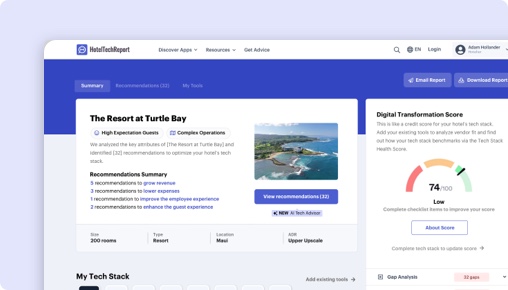
Sorry, this functionality is only available for verified hoteliers
The project dashboard is a free tool that is only available to verified hoteliers to make adopting new technology easier by streamlining their research and simplifying their communication workflow.

Amadeus – RevenueStrategy360™ (Formerly Rate360®) vs. Avalon Analytics:
Which Is Right for You?


TLDR
We analyzed 97 verified hotelier reviews, compared feature sets, pricing, and real-world case studies to break down where each platform delivers. The right choice depends on your property type and priorities:
Amadeus shines in market intelligence tools — especially for bed & breakfast properties (4.6/5), with exclusive features like Workflow Automation and Performance Reporting.
Avalon shines in Customer Support, with exclusive features like Food & Beverage Reporting, Analysis & Forecasting and Other Income Forecasting, Reporting & Analysis.
How Does Amadeus – RevenueStrategy360™ (Formerly Rate360®) Compare to Avalon Analytics?
Side-by-side ratings based on 97 verified hotelier reviews on HTR.
| HTScore |
|
|
| Likelihood to Recommend |
|
|
| Ease of Use |
|
|
| Customer Support |
|
|
| Value for Money |
|
|
| Starting Price | Contact sales | From $300/mo |
| Verified Reviews | 47 | 50 |
What Are the Pros and Cons of Amadeus – RevenueStrategy360™ (Formerly Rate360®) vs Avalon Analytics?
After analyzing 97 verified reviews, Amadeus users most value its market intelligence tools, user interface and usability, analytics and reporting accuracy, while Avalon users highlight visualization and dashboard quality, customizable reports, user-friendly interface. Click any theme to see what reviewers say.
|
Amadeus
|
Avalon
|
|---|---|
| Pros | |
|
+
Market Intelligence Tools
▾
|
+
Visualization and Dashboard Quality
▾
|
|
+
User Interface and Usability
▾
|
+
Customizable Reports
▾
|
|
+
Analytics and Reporting Accuracy
▾
|
+
User-Friendly Interface
▾
|
|
+
Innovation and Feature Updates
▾
|
+
Automated Reporting
▾
|
| Cons | |
|
−
Customer Support and Account Management
▾
|
−
Data Accuracy
▾
|
Amadeus vs Avalon: Rankings by Hotel Segment
How each product ranks among Business Intelligence vendors for different property sizes, types, and regions — based on verified reviews from hoteliers in each segment.
By Hotel Size
| Segment |
Amadeus
|
Avalon
|
|---|---|---|
| Small (10-24 rooms) | #16 3 reviews | — |
| Mid-Size (25-74 rooms) ▾ | #12 18 reviews | #9 20 reviews |
| Large (75-199 rooms) ▾ | #8 20 reviews | #6 22 reviews |
| X-Large (200+ rooms) ▾ | #12 3 reviews | #6 8 reviews |
By Property Type
| Segment |
Amadeus
|
Avalon
|
|---|---|---|
| Boutique ▾ | #11 19 reviews | #9 20 reviews |
| Luxury ▾ | #9 24 reviews | #8 26 reviews |
| Branded / Chain ▾ | #11 22 reviews | #7 26 reviews |
| Extended Stay ▾ | #9 5 reviews | #11 4 reviews |
By Region
| Segment |
Amadeus
|
Avalon
|
|---|---|---|
| North America ▾ | #9 9 reviews | #15 1 reviews |
| Europe ▾ | #14 13 reviews | — |
| Asia Pacific ▾ | #5 11 reviews | #2 45 reviews |
| Middle East | #7 4 reviews | — |
Is Amadeus – RevenueStrategy360™ or Avalon Analytics Better for Hotels?
Amadeus – RevenueStrategy360™ and Avalon Analytics both serve the hotel business intelligence category by providing data-driven insights aimed at optimizing revenue management. They diverge sharply in scale and scope: Amadeus targets medium to large portfolios with its expansive multi-property consolidation, real-time data from over 35,000 hotels, and integration with 600+ data sources, while Avalon focuses on flexible, customizable reporting and quick analysis, primarily geared toward smaller portfolios or properties valuing highly tailored business intelligence. Amadeus delivers forward-looking occupancy and rate data updated daily, enabling strategic rate optimization over a 12-month horizon. Avalon excels at automated and customizable reporting, centralizing disparate data for real-time insights, especially for portfolio managers tracking ROI opportunities.
Both platforms address the core hotel challenge of turning complex, multi-channel data into actionable revenue strategies. Amadeus’s strength lies in comprehensive market intelligence and historical plus forecast data to refine pricing and distribution decisions. Avalon’s advantage lies in rapid report generation and user-friendly visualizations that reduce manual workload and speed decision cycles. The choice rests on property size, portfolio complexity, and the desired balance between broad market data and tailored analytics.
Amadeus – RevenueStrategy360™ vs Avalon Analytics: Which Should Your Hotel Choose?
If your hotel operates multiple properties or belongs to a branded or city center segment, Amadeus’s 107 verified integrations and multi-property consolidation give it a strong edge, supported by 21% of its users from branded hotels and 27% from city center hotels, scoring 4.5 and 4.6 respectively. Amadeus’s 12 months of forward-looking occupancy data and 600+ data sources provide unparalleled market intelligence for strategic pricing, particularly for properties seeking comprehensive rate shopping and distribution partner management.
If you run a boutique hotel, resort, or a smaller branded property that values highly customizable reporting, automated daily and weekly reports, and user-friendly dashboards, Avalon is superior. Avalon’s user base includes 24% resorts and 34% branded hotels, with segment ratings averaging 4.7 or higher across resorts, branded, and boutique hotels. Avalon’s focus on detailed segmentation, flexible portfolio grouping, and real-time ROI alerts benefits owners and revenue managers needing fast insights without the scale complexity of Amadeus’s platform. However, Avalon's smaller integration ecosystem (6 partners) and limited multi-property data consolidation mean it may not suit large portfolios or properties requiring extensive market data.
Data supporting this includes Amadeus’s 47 reviews versus Avalon’s 50, both with no new reviews in the last six months. Amadeus’s broader market reach across 29 countries versus Avalon’s 10 countries reflects Amadeus’s global suitability. For limited-service or budget hotels, Avalon has a higher segment rating (4.6 vs. 3.8), but the sample sizes are small and should be interpreted cautiously. Overall, Amadeus fits larger, data-intensive hotels; Avalon fits smaller, customization-demanding hotels.
Is Amadeus – RevenueStrategy360™ or Avalon Analytics Easier to Use?
Both platforms received nearly identical ease of use scores: Amadeus 4.6/5 and Avalon 4.8/5, with onboarding ratings similarly close (4.4 vs. 4.6). Reviewers of Amadeus describe its interface as intuitive but desire improvements in graphical design and user experience in modules like iHotelier. Avalon users consistently praise the platform’s intuitive dashboards and ease of navigation, noting that non-technical staff can quickly interpret data, speeding adoption.
However, Amadeus’s complexity due to its broad market data and multi-property features can initially challenge smaller teams. Avalon’s simplicity and flexibility in report creation reduce training time for general managers and revenue teams, facilitating faster operational use, especially where PMS integration is critical.
Despite these nuances, neither platform holds a decisive user-friendliness advantage in the data. Both provide solid onboarding and usability, with Avalon slightly favored in user interface clarity but Amadeus praised for reliability in core functions.
Edge: Even.
Which Has Better Features: Amadeus – RevenueStrategy360™ or Avalon Analytics?
Amadeus boasts 22 unique features not found in Avalon, heavily weighted toward large-scale operations: room and rate type filtering, quick rate shopping filters, multi-property management, real-time data collection, metasearch connectivity, distribution partner management, workflow automation, and a comprehensive open API. These features enable centralized rate optimization, distribution channel control, and forward-looking occupancy insights, crucial for revenue managers handling extensive portfolios. For example, Amadeus’s version control and centralized user and role management streamline coordinated pricing strategies across multiple properties, reducing errors and manual workload.
Avalon has 6 unique features focused on detailed business intelligence granularity: sales team productivity tracking, corporate and travel agency account tracking, food and beverage reporting and forecasting, forecast locking and workflows, other income forecasting, and flexible portfolio grouping. These features expand revenue analysis beyond room sales to include F&B and ancillary income, supporting hotels wanting deeper operational insights. For instance, F&B forecasting aids resorts and boutique hotels in budgeting and staffing.
Both share 16 features including analytics dashboards and performance reporting, but Amadeus’s broader feature set supports complex, multi-property revenue strategies while Avalon’s unique features target operational segments often overlooked by traditional revenue systems.
Edge: Amadeus.
Which Has Better Customer Support: Amadeus – RevenueStrategy360™ or Avalon Analytics?
Avalon leads with a combined customer support and onboarding rating of 4.7/5 versus Amadeus’s 4.3/5. Avalon reviewers emphasize daily hands-on support, expert team availability, and quick issue resolution that reduce hotel teams’ workload. A reviewer noted the “daily and weekly review with team expert” and “great support and return on investment,” highlighting a partnership approach. Another mentions frequent interactions with support to resolve data accuracy issues, indicating responsive engagement.
Amadeus reviews are mixed: while some praise professional and efficient support, others criticize delayed responses and limited account manager availability. One review cited “no proper customer support and no support from the Account Manager,” reflecting inconsistency. Despite this, many users found Amadeus’s support adequate for technical issues and appreciated in-app support and training webinars.
Avalon’s focus on personalized, ongoing support better suits hoteliers needing active guidance in complex data interpretation, while Amadeus’s support may suffice for hotels with experienced revenue teams comfortable with self-service tools.
Edge: Avalon.
Which Has More Integrations: Amadeus – RevenueStrategy360™ or Avalon Analytics?
Amadeus offers 107 verified integrations versus Avalon’s 6, a 1683% difference that strongly favors Amadeus. Both share core integrations with HOTELTIME, Oracle Hospitality, Mews, and Infor, but Amadeus extends to niche and regional partners such as Priority Software, Orange Hotel Marketing, Profitroom, and RevControl, crucial for multi-channel rate management and distribution.
Avalon’s limited integration set includes RMS and Access Hospitality, suitable for properties using these PMS providers but restricts flexibility for hotels with diverse or evolving tech stacks. Amadeus’s extensive partner ecosystem supports complex technology environments, enabling seamless data flow, which is vital for centralized rate shopping, metasearch connectivity, and market intelligence aggregation.
Hotels relying on broad PMS, channel management, and metasearch integrations should prioritize Amadeus, while Avalon suits properties with simpler integration needs or specialized PMS.
Edge: Amadeus.
Which Do Hoteliers Rate Higher: Amadeus – RevenueStrategy360™ or Avalon Analytics?
Both products hold strong overall ratings: Amadeus 4.5/5 across 47 reviews, Avalon 4.7/5 across 50 reviews. Neither has reviews in the last six months, so current user sentiment is stable but not recently updated. Likelihood to recommend rates are 90% for Amadeus and 94% for Avalon, showing a moderately higher enthusiasm for Avalon.
Segment breakdown provides clearer insight. Avalon scores 4.7 or higher in boutique (20 reviews), branded (29), resorts (23), and city center hotels (20), whereas Amadeus scores slightly lower in the same segments (boutique 4.3, branded 4.5, resorts 4.1, city center 4.6). Amadeus’s strongest segments are luxury hotels (4.5 across 24 reviews) and bed & breakfasts (4.6 with 17 reviews). Avalon’s luxury hotels rate it at 4.8 across 26 reviews, indicating a marginal preference in this segment as well.
Limited service and budget hotels rate Avalon significantly higher (4.6 vs. 3.8), but sample sizes are small. Both products receive excellent marks from vacation rentals and villas (5/5).
Given the volume and recency parity, Avalon holds a slight edge in ratings across hotel segments that dominate its user base, but the difference is not decisive.
Edge: Even.
How Much Do Amadeus – RevenueStrategy360™ and Avalon Analytics Cost?
Amadeus does not publish pricing publicly, and there is no information about trial availability, monthly fees, or implementation costs. This opacity suggests pricing is likely customized based on portfolio size and feature needs, typical for large enterprise-level solutions.
Avalon publishes a base price of $300 but does not offer freemium, monthly flat, or per-room pricing. No implementation fees or trials are offered, indicating a fixed entry point likely reflecting its boutique or mid-market target.
Hotels seeking transparent, predictable pricing may favor Avalon for its clear base cost. Those with complex, multi-property requirements must contact Amadeus for a tailored quote.
What Type of Hotel Should Use Amadeus – RevenueStrategy360™?
- Hotels that operate multiple properties or large portfolios needing multi-property consolidation and centralized control.
- Teams requiring detailed rate shopping, distribution partner management, and real-time market intelligence from over 600 sources.
- Branded and city center hotels seeking forward-looking occupancy data and version control to optimize complex pricing strategies.
- Properties with established revenue management teams that can leverage advanced analytics dashboards and workflow automation.
- Hotels using diverse PMS and channel management systems requiring broad integrations (107 verified partners).
Not ideal if:
- Your property is small or independent with limited revenue management resources.
- You require transparent, upfront pricing information.
- You prioritize highly customizable operational reporting over broad market data.
What Type of Hotel Should Use Avalon Analytics?
- Hotels that want highly customizable, automated reporting to reduce manual data compilation.
- Properties focused on detailed segmentation including F&B, sales productivity, and other income forecasting.
- Boutique, resort, and branded hotels valuing quick, user-friendly dashboards for rapid decision-making.
- Revenue teams needing real-time visibility across portfolios with flexible grouping but limited multi-property data complexity.
- Hotels with PMS systems like RMS or Access Hospitality that benefit from seamless integration.
Not ideal if:
- You manage large portfolios requiring extensive multi-property consolidation and real-time market pricing data.
- You need extensive integration with a wide range of distribution and channel partners.
- You demand advanced rate shopping features and predictive pricing tools.
Amadeus – RevenueStrategy360™ vs Avalon Analytics: The Bottom Line for Hotels
Amadeus – RevenueStrategy360™ delivers a comprehensive, data-rich platform aimed at medium to large multi-property portfolios requiring forward-looking occupancy data, broad integrations, and complex revenue management workflows. Its 22 unique features geared toward rate shopping, multi-property management, and distribution partner control distinguish it as a strategic pricing tool with deep market intelligence.
Avalon Analytics offers a more focused business intelligence solution for hotels prioritizing customizable, automated reporting, detailed operational segmentation, and user-friendly dashboards. With 6 unique features targeting F&B and sales analysis, Avalon suits boutique, resort, and branded hotels needing flexible analytics without the scale or complexity of Amadeus.
Choose Amadeus if your hotel needs extensive market data from 600+ sources, multi-property consolidation, and integration with over 100 partners to optimize pricing strategies across numerous distribution channels. Choose Avalon if your priority is reducing manual reporting efforts with customizable, real-time analytics and a user-friendly interface, particularly for smaller portfolios or operations focused on ancillary revenue streams. These distinctions are supported by review volumes, feature sets, and integration breadth, providing clear guidance based on property size, segment, and operational needs.
How Much Do Amadeus – RevenueStrategy360™ (Formerly Rate360®) and Avalon Analytics Cost?
Business Intelligence pricing is rarely straightforward. Here is what we know from each vendor's public pricing data. Always request a custom quote for your property size.
|
Amadeus
|
Avalon
|
|
|---|---|---|
| Starting Price | — | From $300/mo |
Feature Comparison: Amadeus – RevenueStrategy360™ (Formerly Rate360®) vs Avalon Analytics
These are the features each vendor has configured, organized by feature group — the same data shown in the vendor dashboard. Expand a group to compare features side by side.
| Feature |
Amadeus
|
Avalon
|
|---|---|---|
|
▾
Analytics
|
|
|
| Custom Reports & Templates | ||
| Net Revenue KPIs | ||
| Other Income Forecasting, Reporting & Analysis | ||
| Food & Beverage Reporting, Analysis & Forecasting | ||
| Corporate & Travel Agency Account Tracking | ||
| Analytics dashboard | ||
| Sales team productivity tracking | ||
| Revenue pacing | ||
| Dashboarding & data visualization | ||
| Distribution Cost Analytics | ||
| Scheduled Reports | ||
| Multi-Property & Portfolio Level Tracking | ||
| Pricing Decision Impact Tracking | ||
| Profitability Contribution by Customer | ||
| Shared Demand Calendar | ||
| Flexible Portfolio Grouping | ||
| Artificial Intelligence | ||
|
▾
Forecasting, Budgeting & Planning
|
|
|
| Revenue pacing | ||
| Forecast Locking & Workflows | ||
| Driver Based Models | ||
| Food & Beverage Reporting, Analysis & Forecasting | ||
| Other Income Forecasting, Reporting & Analysis | ||
| Business & marketing plans | ||
| Version Control | ||
| Web Based | ||
| Pricing Decision Impact Tracking | ||
| Shared Demand Calendar | ||
| Flexible Portfolio Grouping | ||
|
▾
Data Management
|
|
|
| Multi-property management | ||
| Centralized user & role management | ||
| Open API | ||
| Automated data gathering & integration | ||
| Customizable Data Hierarchies | ||
| In-App Data Management | ||
| Flexible Portfolio Grouping | ||
|
▾
Collaboration
|
|
|
| Collaboration & Commenting | ||
| Shareable Templates & Plans | ||
| File Attachments | ||
| Web Based | ||
| Alerts Feed |
Amadeus vs Avalon: The Bottom Line
What hoteliers love
Tools like Agency 360 and Rate 360 are commended for providing valuable insights into market trends, competitor pricing, and corporate strategies. How... Tools like Agency 360 and Rate 360 are commended for providing valuable insights into market trends, competitor pricing, and corporate strategies. However, some users feel that more live data and frequent updates could enhance these tools' usefulness.
TravelClick's interface is described as intuitive and user-friendly, though some users express dissatisfaction with the overall design aesthetics and... TravelClick's interface is described as intuitive and user-friendly, though some users express dissatisfaction with the overall design aesthetics and occasional complexity in some modules. They suggest graphical and user experience enhancements to make the platform more engaging.
TravelClick's analytics and reporting tools are highly valued by users for their comprehensiveness and strategic utility. The detailed reports, especi... TravelClick's analytics and reporting tools are highly valued by users for their comprehensiveness and strategic utility. The detailed reports, especially from Demand 360 and Rate 360, help in monitoring market trends and competition, aiding in informed decision-making.
Where hoteliers push back
While users generally appreciate the dedication of TravelClick's support and account management teams, there are recurrent issues with delayed respons... While users generally appreciate the dedication of TravelClick's support and account management teams, there are recurrent issues with delayed responses and the need for more proactive, localized customer engagement. Consistency in account management staff is suggested to improve service continuity.
Ranks higher for
Unique capabilities
What hoteliers love
The quality of visualizations and dashboards in Avalon is consistently praised. Users find the visual representation of data helps in quickly identify... The quality of visualizations and dashboards in Avalon is consistently praised. Users find the visual representation of data helps in quickly identifying trends, outliers, and strategic insights, making the data easier to understand at a glance.
Avalon's system allows for highly customizable reporting, enabling users to create tailored reports that meet specific needs. This flexibility is part... Avalon's system allows for highly customizable reporting, enabling users to create tailored reports that meet specific needs. This flexibility is particularly beneficial for multi-property management and adapting to unique business requirements, reducing the manual workload.
The majority of reviews highlight Avalon's user-friendly and intuitive interface, which makes navigation easy even for non-revenue team members. The d... The majority of reviews highlight Avalon's user-friendly and intuitive interface, which makes navigation easy even for non-revenue team members. The dashboards are simple yet powerful, aiding in faster and more efficient data interpretation.
Where hoteliers push back
Several reviews have pointed out issues with data accuracy, specifically data discrepancies and errors. These issues sometimes delay meetings and comp... Several reviews have pointed out issues with data accuracy, specifically data discrepancies and errors. These issues sometimes delay meetings and complicate the decision-making process, requiring frequent interactions with Avalon’s support team for corrections.
Ranks higher for
Unique capabilities
Where the ratings diverge most
Frequently Asked Questions About Amadeus – RevenueStrategy360™ (Formerly Rate360®) vs Avalon Analytics
Can Amadeus – RevenueStrategy360™ (Formerly Rate360®) replace Avalon Analytics?
It depends on your requirements. Amadeus – RevenueStrategy360™ (Formerly Rate360®) and Avalon Analytics share many core Business Intelligence features, but each has unique capabilities. Amadeus – RevenueStrategy360™ (Formerly Rate360®) offers 107 verified integration partners, while Avalon Analytics offers 6. Review the feature comparison above to see where they differ before switching.
Which is better for small or independent hotels?
Small hotels should prioritize ease of use and fast onboarding. Avalon Analytics leads in ease of use at 4.8/5 vs 4.6/5. Look for transparent pricing and a trial or demo option. Filter reviews on each product page by property size to hear from hotels like yours.
Do Amadeus – RevenueStrategy360™ (Formerly Rate360®) or Avalon Analytics offer a free plan?
Amadeus – RevenueStrategy360™ (Formerly Rate360®): No. Avalon Analytics: No. Neither product currently offers a free tier. Most Business Intelligence vendors offer demos or trials — request one from each to evaluate before committing.
How Does HTR Evaluate and Rank Amadeus – RevenueStrategy360™ (Formerly Rate360®) and Avalon Analytics?
The HT Score is a composite ranking that considers 4 criteria groups and over a dozen variables to help hoteliers objectively compare hotel technology products. Amadeus has an HT Score of 72 and Avalon has 17. Here is how the score is calculated.
| Criteria Group | Weight | What It Measures |
|---|---|---|
| Customer Ratings & Reviews |
|
How highly do users recommend this product? Ratings Score, Review Volume, Share of Voice, Review Depth, Review Recency, Success Stories ▾ The most heavily weighted factor. Analyzes average satisfaction ratings (likelihood to recommend, ease of use, support, ROI), total review count relative to category peers, review recency (at least 20 reviews in the trailing 6 months), and share of voice across unique hotel clients to detect selection bias. |
| Partner Ecosystem |
|
How highly do tech partners recommend this company? Partner Recommendations, Integration Quantity, Integration Quality ▾ Evaluates partner recommendations as expert votes of confidence, the number of verified integrations, and ecosystem quality — the average HT Scores of integration partners. Products with higher-quality integration ecosystems are more likely to deliver a connected tech stack. |
| Customer Centricity |
|
How customer-centric is this organization? Certified Support, Review Consistency, Profile Completeness ▾ Assesses whether the company has earned HTR Customer Support Certification, maintains consistent review collection over time (an indicator of feedback-driven culture), and keeps product profiles complete with capabilities, screenshots, pricing, and features. |
| Reach, Staying Power & Resources |
|
How extensive is this company's reach and resourcing? Geographic Reach, Staying Power, Company Resources, Trending Score ▾ Measures global presence (countries and regions served), years in business as a stability proxy, team headcount as a resource proxy, and a trending score based on trailing-twelve-month buyer inquiries, reviews, partner recommendations, and press activity. |
Customer ratings and reviews are by far the most important factor in the HT Score algorithm. HTR does not accept payment for higher rankings. All reviews are verified — only hotel industry practitioners with confirmed affiliations can submit ratings. View full HT Score methodology →
What Other Business Intelligence Comparisons Are Hoteliers Reading?
Explore more head-to-head comparisons based on verified hotelier reviews.





Contents
Get Your Free AI Analyst Report
Custom recommendations tailored to your property


